Author: mamali

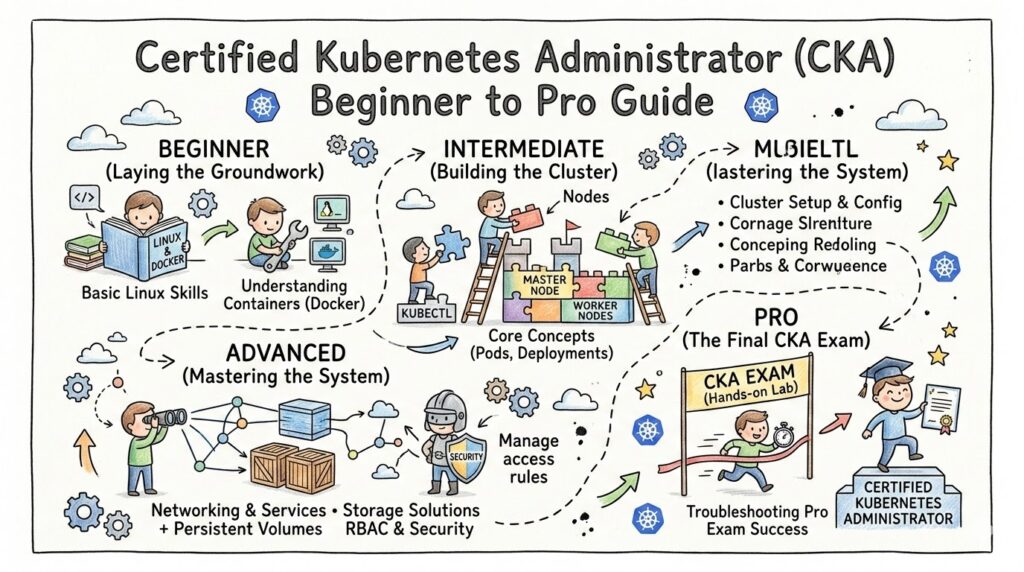
  • Certified Kubernetes Administrator (CKA) Beginner to Pro Guide

    Introduction

    The Certified Kubernetes Administrator (CKA) is a professional certification created by the Cloud Native Computing Foundation (CNCF). it is designed to ensure that administrators have the skills, knowledge, and competency to perform the responsibilities of a Kubernetes administrator. This is an industry-standard, hands-on exam that tests the ability to manage, configure, and troubleshoot Kubernetes clusters.

    Why it Matters in Today’s Ecosystem

    In the current world of software, cloud, and automation, containerization has become the standard. Kubernetes is the engine that runs these containers at scale. Whether a company is working on DevOps, Site Reliability Engineering (SRE), or simple cloud migration, Kubernetes is likely at the center of it. Being a certified administrator means there is a verified proof of ability to keep these complex systems running smoothly.

    Why Certifications are Important

    For engineers and managers alike, certifications serve as a benchmark. For an engineer, it provides a structured learning path and a boost in professional confidence. For a manager, it provides a level of trust that the team member understands the core principles of the technology. In a competitive global market, having a CKA shows a commitment to continuous learning and technical excellence.


    Certification Overview Table

    TrackLevelWho it’s forPrerequisitesSkills CoveredRecommended Order
    AdministrationIntermediateDevOps, SRE, AdminsBasic Linux, DockerCluster setup, Networking, Storage, SecurityAfter CKAD or directly

    Why Choose DevOpsSchool?

    DevOpsSchool is chosen by many because of its practical approach to learning. The training is delivered by experts who have spent years handling real-world production issues. Complex topics are broken down into simple, manageable steps. High-quality lab environments are provided so that students can practice until they are confident. It is not just about passing an exam; it is about gaining the skills needed to excel in a professional career.


    Certification Deep-Dive

    What is this certification?

    This certification is a performance-based exam. It requires solving multiple issues in a command-line interface within a specific time frame. It proves that a person can handle the operational aspects of a Kubernetes cluster.

    Who should take this certification?

    • DevOps Engineers looking to specialize in orchestration.
    • System Administrators moving toward cloud-native roles.
    • SREs who need to ensure high availability of containerized apps.
    • Cloud Engineers managing multi-cloud environments.

    Skills you will gain

    • Installation and configuration of Kubernetes clusters.
    • Management of cluster components and nodes.
    • Configuration of secure networking and persistent storage.
    • Troubleshooting complex application and node failures.
    • Managing resource scheduling and scaling.

    Real-world projects after certification

    • Building a high-availability cluster from scratch.
    • Implementing role-based access control (RBAC) for a large team.
    • Automating cluster backups and recovery processes.
    • Optimizing resource usage to reduce cloud costs.

    Preparation Plan

    7–14 Days Plan (The Intensive Review)

    • Day 1-3: Focus on cluster architecture and installation.
    • Day 4-7: Practice networking (Services, Ingress) and Storage (PV, PVC).
    • Day 8-10: Deep dive into troubleshooting and logging.
    • Day 11-14: Take multiple mock exams to build speed.

    30 Days Plan (The Balanced Approach)

    • Week 1: Core concepts, API, and Pod orchestration.
    • Week 2: Networking, Services, and Cluster maintenance.
    • Week 3: Security, RBAC, and Troubleshooting.
    • Week 4: Intense lab practice and final mock tests.

    60 Days Plan (The Deep Learner)

    • Month 1: Focus on Linux fundamentals, Docker, and basic Kubernetes objects.
    • Month 2: Focus on advanced cluster management, networking, and exam-specific scenarios.

    Common Mistakes to Avoid

    • Spending too much time on a single difficult question.
    • Not practicing enough with the command line (kubectl).
    • Ignoring the official documentation during practice.
    • Neglecting basic Linux administration skills.

    Best Next Certification

    • Same Track: Certified Kubernetes Security Specialist (CKS).
    • Cross-Track: AWS or Azure Solutions Architect.
    • Leadership: Certified Kubernetes Application Developer (CKAD) for broader insight.

    Choose Your Learning Path

    DevOps Path

    This path is best for those who want to bridge the gap between development and operations. Focus is placed on CI/CD integration with Kubernetes and automating deployments.

    DevSecOps Path

    Ideal for security-focused engineers. The focus is shifted toward securing the container supply chain and implementing network policies within the cluster.

    Site Reliability Engineering (SRE) Path

    Best for those focused on uptime and performance. Kubernetes is used to build self-healing systems and monitor service level objectives (SLOs).

    AIOps / MLOps Path

    Designed for data scientists and engineers. Kubernetes is utilized to deploy machine learning models and manage large-scale data processing workloads.

    DataOps Path

    Best for data engineers. The focus is on running stateful applications, databases, and big data tools like Spark on Kubernetes.

    FinOps Path

    Ideal for those managing cloud budgets. The path focuses on monitoring resource consumption and implementing cost-saving measures like autoscaling.


    Role → Recommended Certifications Mapping

    • DevOps Engineer: CKA + CKAD + Jenkins Certification.
    • Site Reliability Engineer (SRE): CKA + Prometheus/Grafana specialized training.
    • Platform Engineer: CKA + Terraform Associate + CKS.
    • Cloud Engineer: CKA + AWS/Azure/GCP Professional Architect.
    • Security Engineer: CKA + CKS + HashiCorp Vault.
    • Data Engineer: CKA + Spark/Kafka specialized courses.
    • FinOps Practitioner: CKA + FinOps Certified Practitioner.
    • Engineering Manager: CKA (for technical literacy) + PMP or Agile Leadership.

    Next Certifications to Take

    For the DevOps Learner

    • Same-track: Certified Kubernetes Security Specialist (CKS).
    • Cross-track: HashiCorp Certified: Terraform Associate.
    • Leadership: Certified DevSecOps Professional.

    For the Cloud Learner

    • Same-track: Google Professional Cloud Architect.
    • Cross-track: CKA.
    • Leadership: Cloud Digital Leader.

    Training & Certification Support Institutions

    DevOpsSchool

    Comprehensive training is provided with a focus on real-world application. Students are guided through hands-on labs and mentored by industry veterans. Support is offered for both the learning phase and the certification process.

    Cotocus

    Specialized training is offered for modern tech stacks. A strong emphasis is placed on practical scenarios and helping professionals transition into high-demand cloud roles.

    ScmGalaxy

    A wide range of resources for configuration management and DevOps is provided. It serves as a community hub where knowledge on the latest tools is shared freely.

    BestDevOps

    Bootcamp-style training is delivered for those who want to master DevOps quickly. The curriculum is designed to be lean and highly effective for working professionals.

    devsecopsschool.com

    A dedicated platform for security integration in DevOps is maintained. Courses are structured to help engineers build secure and resilient systems.

    sreschool.com

    Training is focused on the principles of Site Reliability Engineering. Practical methods for achieving high availability and scalability are taught here.

    aiopsschool.com

    Courses are provided for the intersection of AI and Operations. Professionals are taught how to use machine learning to improve IT operations.

    dataopsschool.com

    Focus is given to the lifecycle of data management. Training is provided on how to apply DevOps principles to data pipelines.

    finopsschool.com

    Education on cloud financial management is provided. Teams are taught how to bring accountability to cloud spending.


    FAQs Section

    General FAQs

    1. What is the difficulty level of CKA?
      It is considered an intermediate to advanced exam because it is 100% hands-on.
    2. How much time is required to prepare?
      For a working professional, 4 to 8 weeks is usually sufficient.
    3. What are the prerequisites?
      A good understanding of Linux command line and Docker is highly recommended.
    4. In what sequence should I take Kubernetes exams?
      Often, CKAD is taken first to understand apps, followed by CKA for administration.
    5. What is the career value of CKA?
      It is one of the most respected certifications in the cloud industry today.
    6. Which job roles require CKA?
      DevOps Engineer, Cloud Architect, and System Administrator roles often list it as a requirement.
    7. Is the exam proctored?
      Yes, it is an online proctored exam taken from your own location.
    8. How long is the certification valid?
      The certification is valid for three years from the date of passing.
    9. Can I use documentation during the exam?
      Yes, access to the official Kubernetes documentation is allowed.
    10. What is the passing score?
      A score of 66% or higher is required to pass the CKA exam.
    11. Are there retakes available?
      One free retake is typically included if the first attempt is not successful.
    12. Does it help in getting a salary hike?
      Yes, certified professionals often report better salary packages and growth opportunities.

    CKA Specific FAQs

    1. What version of Kubernetes is used in the exam?
      The exam is updated regularly to reflect a recent stable version.
    2. How many questions are in the CKA exam?
      There are usually between 15 to 20 performance-based tasks.
    3. Is there a lot of YAML writing involved?
      Yes, being comfortable with YAML is essential for success.
    4. Can I use bookmarks in the exam?
      No, external bookmarks are not allowed; you must navigate the official docs manually.
    5. What is the duration of the exam?
      The total time allowed is 2 hours.
    6. Which Linux distribution is used?
      The environment is typically based on Ubuntu.
    7. Is CKA better than a cloud-specific cert?|
      It is vendor-neutral, making it valuable across AWS, Azure, and GCP.
    8. How do I renew my CKA?
      You must retake and pass the exam again before the expiration date.

    Testimonials

    Aarav

    The CKA training helped in understanding how clusters actually work behind the scenes. The confidence gained during the labs was immediately useful in my daily tasks as a DevOps Engineer.

    Meera

    As an SRE, the ability to troubleshoot quickly is everything. This certification process sharpened my skills and provided a clear path for my career growth in platform engineering.

    Jordan

    Coming from a traditional sysadmin background, the CKA was a challenge. However, the structured approach helped me transition into a Cloud Engineer role with ease.

    Sanjay

    The practical nature of the CKA is what makes it valuable. My team’s ability to manage our production environment improved significantly after we all became certified.

    Elena

    As an Engineering Manager, I took the CKA to better lead my technical team. It gave me the insight needed to make better architectural decisions for our products.


    Conclusion

    The Certified Kubernetes Administrator (CKA) certification is more than just a piece of paper. It is a rigorous validation of the skills needed to navigate the modern cloud landscape. By following a structured learning path and choosing a supportive training institution like DevOpsSchool, any engineer can master these complex systems. Long-term career benefits include higher pay, better job security, and the ability to work on cutting-edge technology. Strategic planning and consistent practice are the keys to success.
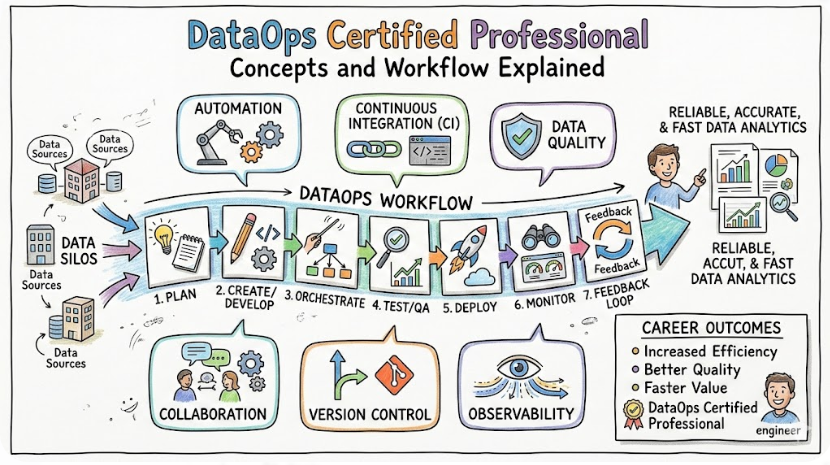
  • DataOps Certified Professional Concepts and Workflow Explained

    Introduction


    Data was handled in storage where teams worked separately. This caused many delays and mistakes. Now, speed and quality are needed at every step of the process. This is where DataOps comes into play. It is a set of practices that brings together data engineers, data scientists, and operations teams. The goal is to provide a seamless flow of data that is reliable and ready for use by the business. When these teams work together, the value of data is realized much faster.

    A Dataops Certified Professional is an individual who has mastered these modern practices. This certification is designed to help professionals understand how to automate data workflows from start to finish. It focuses on reducing the time it takes to turn raw data into useful insights. In today’s software, cloud, and automation ecosystem, this skill is highly valued by top companies. Organizations are no longer looking for just data collectors who store information. They need experts who can manage the entire lifecycle of data while keeping it secure and accurate.

    Certifications are important for both engineers and managers in the current job market. For an engineer, it serves as professional proof of specialized knowledge. It shows that the person is updated with the latest industry standards and can handle complex tools. For a manager, certifications help in building a team that speaks the same technical language. It ensures that every project follows a proven framework. This reduces the risk of project failure and improves the overall efficiency of the department.


    Certification Overview Table

    TrackLevelWho it’s forPrerequisitesSkills CoveredRecommended Order
    DataOpsProfessionalData Engineers, DevOps Engineers, ManagersBasic knowledge of Data & DevOpsData Pipelines, Automation, Quality ControlFoundational to Advanced

    Why Choose DevOpsSchool?

    When looking for a place to learn, DevOpsSchool is often selected by professionals because of its long history of success. This platform is known for providing deep technical insights that are easy to follow even for beginners. The training is structured in a way that complex topics are broken down into simple, manageable steps. This ensures that no student feels overwhelmed by the technical depth of the course.

    It is preferred because the focus is always on real-world application rather than just reading from a book. Instead of just teaching theory, practical scenarios from the industry are discussed in detail. This helps the learner feel confident when they return to their actual jobs and have to solve real problems. The support provided during the certification journey is also a major reason why many engineers trust this institution. They offer a helpful environment where questions are encouraged and answered by experts.


    Certification Deep-Dive: Dataops Certified Professional

    What is this certification?

    This certification is a professional-level program that teaches the core principles of DataOps. It covers the methods used to build automated, reliable, and high-quality data pipelines. These pipelines are built using modern tools that help data move smoothly through an organization.

    Who should take this certification?

    This is ideal for Data Engineers, Software Developers, and DevOps professionals who want to specialize in data. It is also very helpful for Engineering Managers and Cloud Architects. Anyone who is responsible for the flow of data within a company will find this program very useful.

    Skills you will gain

    • Mastery of data pipeline automation: You will learn how to make data move automatically without manual work.
    • Knowledge of data quality frameworks: Skills will be gained to ensure that data is clean and correct before it is used.
    • Understanding of version control for data: You will learn how to track changes in data just like developers track changes in code.
    • Ability to monitor data workflows: Tools will be mastered to watch the health of data systems in real-time.
    • Skills in team collaboration: Methods will be learned to help data and operations teams work together without friction.

    Real-world projects you should be able to do after this certification

    • Setting up an end-to-end data delivery pipeline: A complete system can be built to move data from a source to a final report automatically.
    • Implementing automated testing for big data sets: Tests can be created to check millions of rows of data for errors in seconds.
    • Creating a monitoring dashboard for data health: A visual screen can be built to show if the data systems are running correctly or if they have failed.
    • Orchestrating complex data workflows: Multiple data tasks can be scheduled to run in the correct order using modern orchestration tools.

    Preparation plan

    • 7–14 days plan: The first two weeks should be used to focus on the core concepts of DataOps. The DataOps manifesto should be read and understood. The basic flow of how data moves through a pipeline should be studied.
    • 30 days plan: The next month should be spent working with automation tools. Practice should be done by setting up small pipelines. Learning how to identify and fix common errors is a key part of this stage.
    • 60 days plan: The final month is for a deep dive into advanced topics. This includes data security and how to scale systems for millions of users. Mock tests should be taken, and real-world case studies should be reviewed to finish the preparation.

    Common mistakes to avoid

    • Skipping the foundational concepts: Many people try to learn tools before they understand the basic rules of DevOps.
    • Focusing only on tools: It is a mistake to think that a tool can fix a bad process. The culture of DataOps must be learned first.
    • Ignoring data quality testing: Building a fast pipeline is useless if the data it carries is wrong or broken.

    Best next certification after this

    • Same track: Advanced DataOps Engineer Certification.
    • Cross-track: Site Reliability Engineering (SRE) Foundation.
    • Leadership / management: Certified Engineering Manager Program.

    Choose Your Learning Path

    1. DevOps Path

    This path is best for those who want to integrate data workflows into standard software delivery. It is chosen by people who already know how to ship code and now want to learn how to ship data. It focuses heavily on using CI/CD methods for data tasks.

    2. DevSecOps Path

    This is for professionals who want to ensure that data pipelines are safe from hackers. Security checks are integrated at every stage of the data flow. This path is vital for industries like banking or healthcare where data privacy is a top priority.

    3. Site Reliability Engineering (SRE) Path

    This path is best for those focused on the uptime and reliability of data platforms. It teaches how to manage data systems at scale so they never go down. It is ideal for engineers who like solving complex infrastructure puzzles.

    4. AIOps / MLOps Path

    This path is chosen by those working with Artificial Intelligence and Machine Learning. It focuses on automating the data that feeds into AI models. This ensures that the models are always trained on the most recent and accurate data.

    5. DataOps Path

    This is the core path for data specialists. It is designed for individuals who want to become absolute experts in managing data lifecycles. It covers everything from data collection to final analysis and is perfect for career data engineers.

    6. FinOps Path

    This path is best for professionals who need to manage the cost of data in the cloud. As data grows, it becomes very expensive to store. This path helps in optimizing the financial side so the company saves money while handling big data.


    Role → Recommended Certifications Mapping

    • DevOps Engineer: Dataops Certified Professional and Docker & Kubernetes Certifications are recommended.
    • Site Reliability Engineer (SRE): SRE Foundation along with Dataops Certified Professional should be taken.
    • Platform Engineer: Cloud Platform Architect and Dataops Professional are the best choices.
    • Cloud Engineer: Any major cloud architect certification plus Dataops Certified Professional is suggested.
    • Security Engineer: DevSecOps Professional and DataOps Security Specialist should be the focus.
    • Data Engineer: Dataops Certified Professional and Big Data Specialty are the ideal pair.
    • FinOps Practitioner: FinOps Certified Professional and DataOps for Finance are highly recommended.
    • Engineering Manager: Leadership in Tech and Dataops Certified Professional provide the best balance.

    Next Certifications to Take

    For any learner finishing this program, the following are recommended based on what the industry currently needs:

    • One same-track certification: DataOps Master Level should be the next goal for deeper expertise.
    • One cross-track certification: Site Reliability Engineering (SRE) Practitioner is recommended to learn about system stability.
    • One leadership-focused certification: Technical Product Manager Certification is great for those who want to move into decision-making roles.

    Training & Certification Support Institutions

    DevOpsSchool

    This institution provides extensive training for various DevOps and DataOps tracks. It is well-regarded for its expert-led sessions and hands-on approach. The instructors bring years of practical experience into the classroom.

    Cotocus

    A dedicated platform that offers specialized training in cloud and automation. It is often chosen for its clear curriculum and professional certification support. The lessons are designed to be very direct and easy to understand.

    ScmGalaxy

    This is a popular community and training hub for software configuration management. It offers a wealth of resources, including blogs and videos, for those looking to master delivery pipelines. It is a great place to connect with other professionals.

    BestDevOps

    A reliable source for learning modern engineering practices in a simple way. It focuses on providing practical knowledge that can be used immediately in a professional setting. The training is updated regularly to match industry changes.

    devsecopsschool.com

    This site is focused entirely on the security aspect of the DevOps world. It is a great place for those wanting to specialize in secure data delivery. The courses cover how to protect data throughout its entire journey.

    sreschool.com

    A specialized platform for learning about reliability and stability in IT systems. It offers deep dives into SRE practices for modern engineers. It is perfect for those who want to build systems that are robust and fail-safe.

    aiopsschool.com

    This institution focuses on the intersection of AI and operations. It is the go-to place for learning how to use artificial intelligence to improve daily IT tasks. The content is very forward-looking and innovative.

    dataopsschool.com

    A dedicated site for all things related to DataOps. It provides the most focused training for the Dataops Certified Professional program. Every resource on this site is tailored to help data professionals succeed.

    finopsschool.com

    This platform teaches the financial management of cloud services. It is essential for those who want to control cloud spending effectively. It bridges the gap between the finance department and the engineering team.


    FAQs Section

    General FAQs

    1. What is the difficulty level of this certification?
      The level is moderate. A basic understanding of data is needed, but the course explains the difficult parts clearly.
    2. How much time is required to prepare?
      Most professionals complete the entire study and exam within 30 to 60 days.
    3. Are there any prerequisites?
      There are no strict rules, but basic knowledge of data handling and DevOps is very helpful.
    4. In what sequence should I take these certifications?
      It is usually suggested to start with DataOps and then move to SRE or DevSecOps later.
    5. What is the career value of being certified?
      It significantly increases the chances of getting higher-paying roles and shows that you are a serious professional.
    6. Which job roles can I apply for?
      You can apply for roles like DataOps Engineer, Senior Data Engineer, and Analytics Manager.
    7. Is this certification recognized globally?
      Yes, it is valued by companies in India and all over the world.
    8. Will this help me move into management?
      Yes, it provides the technical oversight that is needed to lead data-driven teams.
    9. How is the exam conducted?
      The exam is usually taken online through a secure proctored system at your convenience.
    10. Does the certification expire?
      Most professional certifications are valid for a few years before a refresh is suggested.
    11. Are there lab sessions included?
      Yes, practical labs are a major part of the training so you can practice what you learn.
    12. Can a beginner take this course?
      Yes, as long as the person is willing to learn the basics of software development alongside the course.

    Dataops Certified Professional FAQs

    13. What is the main focus of this program?
    The main focus is on the automation, speed, and quality of data pipelines.

    14. Is coding required for this certification?
    Some basic scripting knowledge is helpful, but you do not need to be a master programmer.

    15. Does it cover specific tools?

    It teaches the general methodologies and the types of tools used by the industry leaders.

    16. How does DataOps differ from DevOps?
    DevOps is for software applications, while DataOps is specifically built for data and analytics.

    17. Why is data quality emphasized?
    Bad data leads to bad business decisions, so quality is treated as a top priority in this course.

    18. Can I take this if I am a Project Manager?
    Yes, it will help you manage data-centric projects and communicate better with engineers.

    19. What kind of support is provided?
    Many institutions provide study materials, recorded videos, and access to expert mentors.

    20. Is there a community for DataOps professionals?
    Yes, many learners join groups like ScmGalaxy to stay connected and share knowledge.


    Testimonials

    Amit

    The complexity of data pipelines was finally understood through this course. The transition from a developer role to DataOps was made much smoother than expected.

    Suresh

    New skills were gained that were immediately used in my daily work at the office. The confidence to handle large-scale data projects grew significantly after finishing the certification.

    Priya

    Career clarity was achieved by following the structured learning path provided by the mentors. The real-world scenarios discussed during the sessions were very helpful for my interviews.

    Rahul

    A much better understanding of automation was developed during the training. This certification helped me in securing a promotion within my current engineering team.

    Anjali

    The gap between data science and operations was finally bridged for me. It is highly recommended for anyone who is currently working in a modern data environment.


    Conclusion

    The Dataops Certified Professional certification is a vital step for anyone looking to excel in the data industry. it ensures that the principles of automation, quality, and collaboration are well-understood and practiced. By obtaining this certification, a professional is better prepared for the challenges of modern software and cloud environments. Long-term career benefits include better job opportunities, higher salaries, and the ability to lead high-performing data teams. Strategic learning should be planned today to stay ahead in this competitive and fast-moving field.

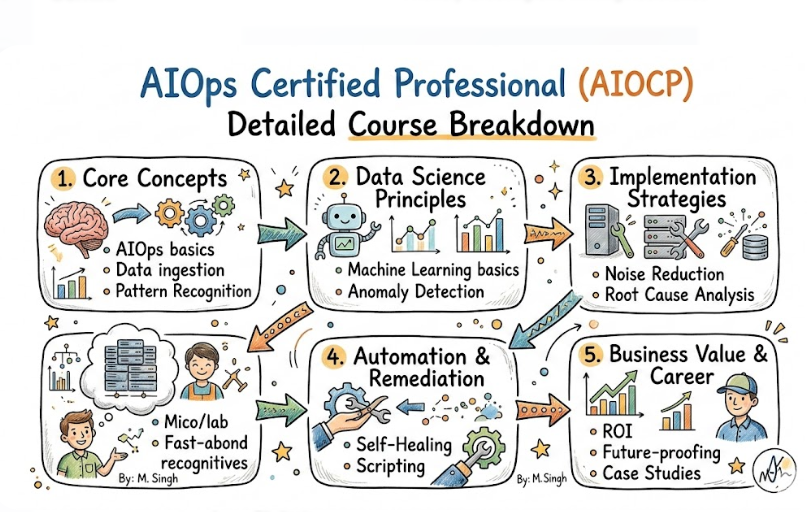
  • AIOps Certified Professional (AIOCP) Detailed Course Breakdown

    Introduction

    The AIOps Certified Professional (AIOCP) is a specialized certification designed to bridge the gap between traditional IT operations and artificial intelligence. A deep focus is placed on teaching professionals how to use AI and machine learning models to automate tasks. These models help in predicting system failures and resolving issues before they impact the end-user. It is not just about using new tools; it is about a new way of thinking about system health. The program ensures that the transition from manual monitoring to intelligent automation is smooth and effective for any organization.

    Why it matters in today’s ecosystem

    In the current software and cloud world, data is being generated in massive amounts. Logs, metrics, and traces are flowing in every second from thousands of different sources. Human teams cannot keep up with this volume of data manually anymore. AIOps allows teams to find the “needle in the haystack” automatically. It helps in reducing noise, identifying root causes faster, and ensuring that systems stay online with minimal human intervention. This leads to higher uptime and a much better experience for the people using the software.

    Why certifications are important

    For engineers and managers, certifications serve as a structured way to gain new skills. They provide a clear roadmap so you do not get lost in the sea of online information. More importantly, they validate your knowledge to the industry in a way that experience alone sometimes cannot. Having a certification like AIOCP shows that you have put in the effort to master the intersection of AI and operations. This makes you a high-value asset in any technical team and helps you stand out during career discussions.


    Certification Overview Table

    TrackLevelWho it’s forPrerequisitesSkills CoveredRecommended Order
    AI & OperationsProfessionalDevOps, SRE, Cloud EngineersBasic Linux & Cloud KnowledgeML in Ops, Data Analysis, AutomationPrimary

    Why Choose DevOpsSchool?

    Choosing the right place to learn is just as important as the subject itself. DevOpsSchool is chosen by many because the focus is kept on real-world application rather than just theory. The trainers have spent years in the trenches of IT, so the lessons are practical and based on actual challenges. The community support is strong, and the curriculum is updated regularly to match what companies are actually looking for in candidates. It is a place where learning is treated as a career-long journey, and students are given the tools they need to succeed in the long run.


    Certification Deep-Dive: AIOps Certified Professional (AIOCP)

    What is this certification?

    This certification is a deep dive into using AI to enhance IT operations. It covers the entire lifecycle of data, how to train models specifically for operational use, and how to integrate these models into existing DevOps pipelines.

    Who should take this certification?

    It is ideal for anyone working in DevOps, Site Reliability Engineering, or Cloud Architecture. If you are tired of chasing alerts all night and want to build smarter systems that fix themselves, this is for you.

    Skills you will gain

    • Understanding of Machine Learning basics: You will learn the core concepts of AI and ML that are specifically useful for system operations and monitoring.
    • Real-time Anomaly Detection: You will gain the ability to identify unusual patterns in system behavior that standard monitoring tools might miss.
    • Automated Root Cause Analysis: You will learn how to build systems that automatically find the source of a problem, saving hours of manual investigation.
    • Predictive Maintenance: You will gain the skills to forecast when hardware or software might fail, allowing for repairs before an actual outage occurs.
    • Event Correlation: You will become proficient in grouping related alerts together, which drastically reduces alert fatigue for your engineering teams.

    Real-world projects you should be able to do

    • Predictive Failure System: You will be able to build a system that monitors hardware health and predicts disk or memory failures before they happen.
    • Incident Response Bot: You will learn to set up an automated bot that can trigger specific fixes when it detects a known issue in the environment.
    • Smart Monitoring Dashboard: You will create a dashboard that uses AI to filter out 90% of useless “noise” and only shows the alerts that actually matter.
    • AI-Driven Auto-scaling: You will be able to implement an auto-scaling policy that uses AI to predict traffic spikes and scale resources up in advance.

    Preparation Plan

    • 7–14 days plan: The first two weeks should be spent on the core concepts of AIOps and reading the official study guide. You should focus on understanding the basic vocabulary of AI and ML so you can speak the language fluently.
    • 30 days plan: During this time, you should go much deeper into data collection methods. You must spend time with various monitoring tools and learn exactly how they feed data into AI models for analysis.
    • 60 days plan: This is the best approach for long-term success. Spend the first 30 days on the theory and the next 30 days on hands-on labs. You should build small models and test them against real system logs to see how they perform.

    Common mistakes to avoid

    • Ignoring Data Quality: You must remember that AI is only as good as the data you give it. If your logs are messy, your AI will not provide good results.
    • Over-Automating Too Fast: It is a mistake to try to automate everything at once. You should understand the manual process perfectly before you try to let an AI handle it.
    • Forgetting the Culture: AIOps is not just a tool; it requires collaboration between data scientists and ops teams. Ignoring this teamwork can lead to failure.

    Best next certification after this

    • Same track: You should consider an Advanced AIOps Implementation course to further your technical depth.
    • Cross-track: The MLOps Certified Professional is a great next step to learn how to manage the models you have built.
    • Leadership / management: For those looking to move up, a Digital Transformation Lead or Engineering Manager certification is highly recommended.

    Choose Your Learning Path

    DevOps Path

    This path is best for those who want to integrate AI into CI/CD pipelines. It focuses on using AI to speed up testing cycles and ensure that only the highest quality code is deployed to production.

    DevSecOps Path

    This is built for security-minded engineers. It focuses on using AI to detect security threats and vulnerabilities in real-time. It helps in spotting patterns of an attack before any data is stolen.

    Site Reliability Engineering (SRE) Path

    This is for those focused strictly on uptime and system health. The path emphasizes using AI for error budget management and creating automated incident resolution workflows.

    AIOps / MLOps Path

    This is best for those who want to specialize in the infrastructure side of AI. It covers how to manage the lifecycle of machine learning models and keep them running efficiently in production.

    DataOps Path

    Designed specifically for data engineers. It focuses on ensuring data quality and speed through the entire pipeline by using automated AI checks to find errors.

    FinOps Path

    This is best for those who are responsible for managing cloud costs. It uses AI to predict spending patterns and identify exactly where money is being wasted in a cloud environment.


    Role → Recommended Certifications Mapping

    For a clearer career direction, these combinations are suggested:

    • DevOps Engineer: You should aim for the AIOCP combined with a Docker or Kubernetes Certification to master both automation and orchestration.
    • Site Reliability Engineer (SRE): The AIOCP paired with an Observability Specialist certification will help you manage complex system health.
    • Platform Engineer: You should focus on the AIOCP and become an Infrastructure as Code (IaC) Expert to build smarter foundations.
    • Cloud Engineer: Combining the AIOCP with a Multi-Cloud Architect certification is the best way to manage modern, diverse environments.
    • Security Engineer: The AIOCP and a DevSecOps Professional certification will make you a leader in automated security.
    • Data Engineer: You should look into the AIOCP and a Big Data Architect program to handle massive data flows with intelligence.
    • FinOps Practitioner: The AIOCP plus a Cloud Financial Management course is perfect for those who want to optimize cloud budgets.
    • Engineering Manager: A combination of the AIOCP and a Leadership in Tech course will help you lead modern engineering teams effectively.

    Next Certifications to Take

    For any learner who has finished the AIOCP, the following steps are suggested to keep the momentum going based on industry trends.

    • One same-track certification: You should pursue the MLOps Professional to learn the operational side of machine learning.
    • One cross-track certification: The Site Reliability Engineering (SRE) Foundation is a great way to broaden your understanding of system uptime.
    • One leadership-focused certification: Technical Project Management is highly suggested for those who want to lead larger teams and projects.

    Training & Certification Support Institutions

    DevOpsSchool

    This institution is known for its wide range of technical courses that cover every aspect of modern IT. Extensive support is provided to students, ranging from deep study materials to active interview preparation. It is a solid choice for those who prefer hands-on learning over just reading books.

    Cotocus

    A strong focus is placed on specialized consulting and high-level training. It is highly regarded for its deep technical expertise in cloud-native technologies and helping professionals transition into niche, high-paying roles.

    ScmGalaxy

    This is a vast community-driven platform that has been around for a long time. A wealth of resources, free tutorials, and certification guides are offered here, making it a go-to spot for self-paced learners who want to explore.

    BestDevOps

    Simplified learning paths are the primary specialty here. Complex topics are broken down into very easy-to-follow modules, ensuring that even beginners can master advanced concepts without feeling overwhelmed.

    devsecopsschool.com

    A dedicated focus on security within the DevOps world is maintained at all times. Everything needed to secure the software supply chain and protect against modern threats is taught here in detail.

    sreschool.com

    The core principles of reliability and system health are the main focus of this institution. It is designed specifically for those who want to master the art of keeping massive systems running smoothly around the clock.

    aiopsschool.com

    Deep specialization in artificial intelligence for operations is provided by this platform. It is considered the primary place for advanced AIOps training for those who want to become true experts.

    dataopsschool.com

    The entire lifecycle of data and its operational efficiency is covered in this school. It is built specifically for engineers who are handling large-scale data pipelines and need them to be fast and reliable.

    finopsschool.com

    The intersection of finance and cloud operations is explored here in depth. It helps engineers and managers understand the direct financial impact of their technical decisions on the company.


    FAQs Section

    General FAQs

    1. Is the AIOCP certification difficult? The difficulty is moderate; a good understanding of operations is needed, but the AI parts are explained in a very clear way.
    2. How much time is required to prepare? Most professionals find that 4 to 8 weeks of regular study is enough to be fully prepared for the exam.
    3. What are the prerequisites? A basic understanding of Linux, cloud computing, and how software is generally deployed will give you a great head start.
    4. In what order should I take certifications? It is usually recommended to start with the basics of DevOps or SRE before you move into the specialized world of AIOps.
    5. What is the career value of AIOCP? It sets you apart as a forward-thinking engineer who is capable of handling the most modern and complex systems.
    6. Will this help me get a promotion? Yes, showing mastery in a growing field like AIOps is a very strong signal to your leadership that you are ready for more responsibility.
    7. Is coding required for AIOCP? You do not need to be a full-time software developer, but having basic scripting skills in Python or Bash is very helpful.
    8. Does this certification expire? Like most technical certifications, it is suggested that you take a refresher every 2-3 years to stay updated with new tools.
    9. Are there labs included? Yes, hands-on practice through labs is a major part of the learning process and is required for completion.
    10. Can a manager take this course? Absolutely; it helps managers understand the future of automation so they can better support their technical teams.
    11. Is the exam online? Yes, the exam is designed to be taken from the comfort of your own home or office at a time that suits you.
    12. What kind of jobs can I get? You will be qualified for roles such as AIOps Engineer, Senior SRE, Automation Architect, or Platform Lead.

    AIOps Certified Professional (AIOCP) Focused FAQs

    1. What specific AI models are covered? The program focuses on regression, clustering, and neural networks that are most effective for analyzing system logs.
    2. How does AIOps differ from standard monitoring? Standard monitoring only tells you when something is wrong, while AIOps tells you why it happened and how it can be fixed.
    3. Is the AIOCP recognized globally? Yes, it is a recognized standard that is respected by many large multinational companies around the world.
    4. Does it cover specific tools like Splunk or ELK? The core concepts are kept tool-agnostic, but popular tools are often used in the practical labs for demonstration.
    5. How much math is involved? A high-level understanding of statistics is used, but you do not need to worry about deep calculus or complex math theories.
    6. Can I transition from a DBA role to AIOps? Yes, having a strong background in data is a fantastic foundation for moving into the world of AIOps.
    7. What is the passing score? Usually, a score of 70% or higher is required on the final exam to be granted the certification.
    8. Is there a community for AIOCP holders? Yes, there are several online groups where professionals share their real-world AIOps challenges and solutions with each other.

    Testimonials

    Aman

    “The way AIOps was explained made the complex topics so easy to grasp. My confidence in handling large-scale system incidents has grown tremendously since I finished.”

    Sarah

    “I finally have total clarity on how to use AI in my daily SRE tasks. The real-world projects were the absolute highlight of the program for me.”

    Rajesh

    “Career growth was my main goal for this year, and this certification helped me land a senior role much faster than I expected. It is a very practical program.”

    Vikram

    “My skill improvement was noticeable within the first few weeks of starting. I can now build automation workflows that I didn’t even think were possible before.”

    Elena

    “As an engineering manager, this course gave me the professional language I needed to lead my team into the future of intelligent automation.”


    Conclusion

    The AIOps Certified Professional (AIOCP) certification is a vital step for any tech professional today. As systems grow more complex, the old ways of managing them by hand will simply no longer work. By learning how to combine AI with operations, your long-term career benefits are secured. Strategic learning and planning your certification path right now will ensure that you remain a leader in the industry for many years to come.

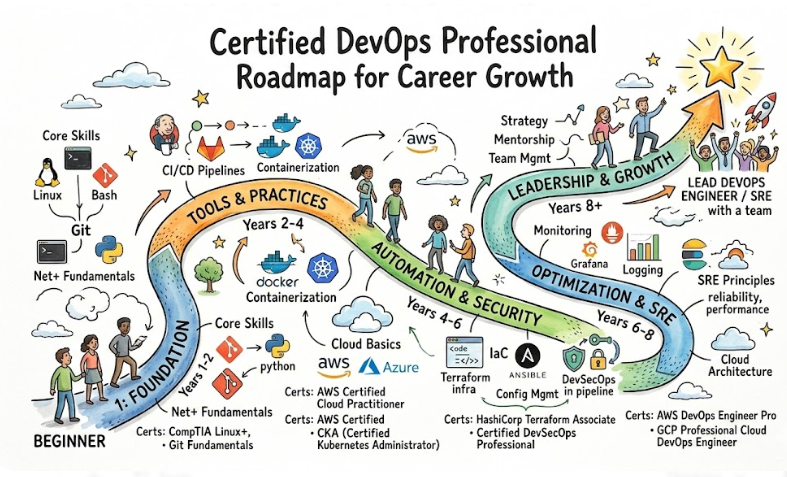
  • Certified DevOps Professional Roadmap for Career Growth

    Introduction

    Machine Learning Operations, which is commonly referred to as MLOps, is being recognized as the most critical bridge between the world of data science and the field of IT operations. As artificial intelligence continues to be integrated into everyday software products, the need for standardized and reliable processes is being felt more than ever before. The MLOps Certified Professional (MLOCP) program is specifically designed to address this industry gap by providing a very structured and logical framework for deploying, managing, and scaling machine learning models in a production environment. It ensures that the gap between a model working on a laptop and a model working for millions of users is closed safely.


    What is MLOps Certified Professional (MLOCP)?

    The MLOps Certified Professional (MLOCP) is a high-level professional credential that focuses on the vital intersection of machine learning, software engineering, and platform operations. It is intended to validate the specific technical skills that are required to automate the entire lifecycle of machine learning models. Through this certification program, the many complexities of moving a model from a simple local development environment to a production-ready, highly secure cloud infrastructure are simplified and standardized. It is not just about the code; it is about the entire system that supports the code in a live environment.

    Why it matters in today’s software, cloud, and automation ecosystem

    In the current technological landscape, many organizations are found to be struggling with the difficult transition of AI projects from experimental research phases to actual real-world applications. MLOps is used as a primary solution to solve what is known as “hidden technical debt” in machine learning systems. By adopting these MLOps practices, the overall reliability of the system is increased, and the time taken to deploy new models is significantly reduced from months to just a few days. For companies operating in India and across the global markets, having certified professionals on the team ensures that expensive AI investments actually result in stable, high-performing products that provide value to customers.

    Why certifications are important for engineers and managers

    Certifications are viewed by the industry as a clear benchmark for professional competency and dedication to a specific field. For engineers, a certification like the MLOCP provides a very structured learning path that might otherwise be missed through unorganized self-study or trial and error on the job. For managers and leadership teams, it serves as a reliable validation that their team members possess the necessary skills to handle production-level AI workloads without causing system failures. In a highly competitive job market, certified professionals are often prioritized during the hiring and promotion process because their foundational knowledge has already been verified by an independent authority.


    Certification Overview Table

    TrackLevelWho it’s forPrerequisitesSkills CoveredRecommended Order
    MLOpsProfessionalDevOps & Software EngineersBasic DevOps & PythonCI/CD for ML, MonitoringAfter DevOps/Cloud basics

    Provider: DevOpsSchool


    Why Choose DevOpsSchool?

    DevOpsSchool is chosen by thousands of working professionals because of its extremely deep focus on practical, industry-aligned training methods. The entire curriculum is developed and updated by senior experts who have spent many decades working in the field, ensuring that the content is not just theoretical but is directly applicable to real-world business scenarios.

    Comprehensive support is provided to every learner, helping them to navigate through complex and difficult technical topics with a lot of ease. By choosing this specific platform, access is gained to a global community of experts and a massive library of resources that are specifically tailored to meet the needs of the modern IT industry. The focus here is always on making sure that the student can perform the tasks in a real office environment immediately after completing the certification.


    Certification Deep-Dive: MLOps Certified Professional (MLOCP)

    What is this certification?

    This certification is a master-level credential that validates the ability of an individual to design, implement, and manage complex MLOps workflows. It covers the entire lifecycle of a machine learning model, starting from initial data preparation and ending with final deployment and continuous automated monitoring. It is considered a mark of excellence for those who want to lead AI infrastructure projects.

    Who should take this certification?

    • Software Engineers: Those who want to understand how their code interacts with machine learning models in a production setting.
    • DevOps Engineers: Professionals who are already experts in automation but want to specialize in the unique requirements of AI systems.
    • Data Engineers: Individuals who manage data pipelines and want to ensure those pipelines feed into a reliable model deployment system.
    • Engineering Managers: Leaders who oversee technical teams and need to understand the architectural requirements of MLOps to make better hiring and planning decisions.

    Skills you will gain

    • Automated CI/CD for ML: The ability to build continuous integration and continuous delivery pipelines that are specifically optimized for machine learning models and data.
    • Containerization Expertise: High proficiency in using tools like Docker and Kubernetes to package models so they can run consistently on any server.
    • Model and Data Versioning: A deep understanding of how to track changes in both the code and the data to ensure that any model can be reproduced or rolled back if a failure occurs.
    • Automated Testing: Expertise in creating automated tests that check for the quality of data, the accuracy of models, and the security of the infrastructure.
    • Production Monitoring: Knowledge of how to monitor model performance in real-time and how to detect “data drift” or “concept drift” before it affects the business negatively.

    Real-world projects you should be able to do after this certification

    • End-to-End ML Pipeline: A fully automated pipeline can be built that retrains a model automatically whenever new data is detected in the system.
    • Scalable Serving Infrastructure: A highly scalable infrastructure can be deployed using Kubernetes that allows thousands of users to get predictions from a model at the same time.
    • Centralized Monitoring Dashboard: A centralized system can be implemented that tracks the health and performance of multiple machine learning models across different cloud environments.

    Preparation plan

    7–14 days plan

    In this very short duration, the primary focus is placed on understanding the core theoretical concepts of MLOps. The official documentation provided by the certification body is reviewed thoroughly. Basic hands-on labs are completed to understand the command-line tools. Familiarization with the exam format and types of questions is achieved through basic practice sets.

    30 days plan

    A more balanced approach is taken where at least two hours are dedicated every day to structured learning. Deep dives into specific CI/CD tools and model monitoring frameworks are conducted. Several small-scale MLOps projects are built from scratch to reinforce the theoretical knowledge gained during the first two weeks.

    60 days plan

    This is the most comprehensive and recommended path for full mastery. A detailed study of various cloud-native machine learning services is performed across different providers. Complex, end-to-end projects are implemented, which include full security integration and automated testing. Multiple full-length mock exams are taken to ensure total readiness for the final certification.

    Common mistakes to avoid

    • Ignoring Operations: A very common mistake is focusing too much on the “Machine Learning” algorithms while completely ignoring the “Operations” and infrastructure side.
    • Neglecting Data Versioning: The importance of versioning the data is often underestimated, leading to models that cannot be explained or reproduced later.
    • Manual Monitoring: Many engineers forget to automate the monitoring process, which leads to models failing in production without anyone noticing until it is too late.

    Best next certification after this

    • Same track: Advanced MLOps Architect for those who want to design large-scale global systems.
    • Cross-track: DevSecOps Certified Professional to learn how to secure the AI pipelines from cyber threats.
    • Leadership / management: IT Strategy and Digital Transformation for those moving into executive roles.

    Choose Your Learning Path

    Choosing the correct path is essential for long-term career growth. Here are six highly structured paths explained:

    1. DevOps Path: This path is best suited for those who want to master the art of general automation, cloud infrastructure, and traditional software delivery. It is the foundation for almost all other tracks.
    2. DevSecOps Path: This is intended for professionals who want to make security a core part of the development process. It is highly recommended for those working in banking, healthcare, or government sectors.
    3. Site Reliability Engineering (SRE) Path: This is best for engineers who are obsessed with system uptime, high availability, and performance tuning. It teaches how to build systems that almost never fail.
    4. AIOps / MLOps Path: This modern path is designed for those who want to apply the best principles of DevOps to the world of Artificial Intelligence. It is the fastest-growing field in the current market.
    5. DataOps Path: This is best for Data Engineers and Architects who want to ensure that data delivery is as automated and reliable as software delivery. It focuses on the “plumbing” of the data world.
    6. FinOps Path: This is intended for those who want to bridge the gap between engineering and finance. It teaches how to manage and optimize cloud costs so that the company saves money while scaling.

    Role → Recommended Certifications Mapping

    To help with your specific career planning, the following certifications are recommended based on your current or target role:

    • DevOps Engineer: DevOps Certified Professional should be taken first, followed immediately by the MLOCP to gain a competitive edge.
    • Site Reliability Engineer (SRE): SRE Certified Professional is the core requirement, with AIOps Professional as a secondary specialization.
    • Platform Engineer: Kubernetes Certified Specialist is essential, along with MLOCP to manage modern AI-driven platforms.
    • Cloud Engineer: Multi-Cloud Architect certifications are recommended to understand how to manage diverse cloud environments.
    • Security Engineer: DevSecOps Certified Professional is the most important credential for this specific role.
    • Data Engineer: DataOps Professional should be the primary focus, supported by MLOCP for model deployment skills.
    • FinOps Practitioner: FinOps Certified Professional is required to master the financial management of the cloud.
    • Engineering Manager: Leadership in Tech and MLOps for Managers are highly recommended to lead technical teams effectively.

    Next Certifications to Take

    Based on your current learning progress, these are the recommended logical next steps:

    • For the MLOps Learner:
      • Same-track: MLOps Architect (for deeper technical mastery).
      • Cross-track: DevSecOps Professional (to add security skills).
      • Leadership-focused: Engineering Management Excellence (for future leaders).
    • For the SRE Learner:
      • Same-track: Advanced SRE (for high-scale systems).
      • Cross-track: AIOps Professional (to use AI for system monitoring).
      • Leadership-focused: Strategic IT Leadership (for moving into Director roles).

    Training & Certification Support Institutions

    Several well-known institutions provide excellent support and training for these programs:

    • DevOpsSchool: A very wide range of technical courses is offered here. A strong emphasis is placed on hands-on labs where students work on real servers. It is famous for its very detailed curriculum and expert mentorship.
    • Cotocus: This institution is highly recognized for providing specialized training in niche and advanced areas like AIOps and MLOps. Support is provided for both individual career changers and large corporate teams.
    • ScmGalaxy: This is a massive community-driven platform where a wealth of resources for software configuration and DevOps is shared for free. It is a great place for deep technical reading and staying updated.
    • BestDevOps: The primary focus here is on providing simplified and easy-to-understand learning paths for beginners. High-quality training materials are provided to ensure that every student succeeds in their certification exam.
    • devsecopsschool.com: This specific site is dedicated entirely to the field of security within the DevOps lifecycle. Specialized training and certifications for DevSecOps are provided here.
    • sreschool.com: The core principles and advanced practices of Site Reliability Engineering are taught here. It is considered a top choice for those aiming for high-paying SRE roles in top tech companies.
    • aiopsschool.com: Training for the application of Artificial Intelligence in IT Operations is provided. It helps engineers understand how AI can be used to predict and prevent system failures.
    • dataopsschool.com: This platform focuses specifically on the automation of data delivery, data quality, and data governance. It is highly recommended for all modern Data Engineers.
    • finopsschool.com: Practical guidance on cloud financial management and cost optimization is provided here. It is the best place for learning how to control cloud spending.

    FAQs Section

    General Career FAQs

    1. What is the overall difficulty level of these certifications?
      The difficulty is considered to be moderate to high because a combination of deep technical theory and actual hands-on experience is required to pass.
    2. How much time is usually required to prepare for the exam?Usually, a period of 30 to 60 days is found to be sufficient if a consistent study routine is maintained every day.
    3. Are there any mandatory prerequisites for these programs?
      A basic understanding of the Linux operating system, command-line usage, and at least one programming language like Python is highly recommended.
    4. In what specific sequence should these certifications be taken?
      It is generally advised to start with foundational DevOps certifications before moving into specialized areas like MLOps or DevSecOps.
    5. What is the actual career value of being a certified professional?
      Much higher salary potential is frequently reported by certified individuals, along with increased respect and credibility within the professional tech community.
    6. Which specific job roles can I apply for after completing the MLOCP?
      Roles such as MLOps Engineer, Machine Learning Operations Lead, and AI Platform Engineer can be successfully pursued.
    7. Is periodic recertification required for these credentials?
      Yes, certifications are typically updated every two to three years to ensure that the professional’s knowledge stays current with changing technology.
    8. Can these certifications be taken by fresh graduates or freshers?
      While it is possible, having at least some basic industry experience is highly recommended to fully understand the practical challenges discussed in the course.
    9. Are online exam options available for international students?Yes, all exams are generally conducted online through secure and proctored platforms that can be accessed from anywhere in the world.
    10. How do these certifications help in gaining jobs in global markets?
      These certifications are recognized globally, which makes it much easier to find high-paying opportunities in regions like the US, Europe, and the Middle East.
    11. Do these certifications help in long-term career growth?
      A very clear and structured path for moving from junior roles to senior, lead, and even architectural roles is provided through these programs.
    12. Is formal training mandatory to sit for the certification exam?While not always strictly mandatory, taking a formal training course is highly recommended to ensure that all exam topics are covered in detail.

    MLOps Certified Professional (MLOCP) Specific FAQs

    1. Is knowledge of the Python language mandatory for the MLOCP?
      Yes, a basic to intermediate understanding of Python is required because almost all modern MLOps tools and scripts are based on it.
    2. Does the MLOCP program cover specific cloud platforms?
      Yes, the core principles that are taught can be applied to all major cloud providers including AWS, Microsoft Azure, and Google Cloud Platform.
    3. Is very deep mathematical knowledge required for this certification?
      No, the primary focus is on the operations, automation, and infrastructure side rather than on building complex mathematical or statistical models.
    4. Will I learn about Kubernetes as part of this program?Yes, Kubernetes is covered in detail because it is the industry-standard tool for deploying and managing machine learning models at scale.
    5. What specific tools are included in the MLOCP curriculum?
      A variety of tools such as Docker, Jenkins, Git, and specialized ML tracking and orchestration tools are explored during the training.
    6. Is this certification recognized by large technology companies?Yes, it is highly valued by tech companies and startups that are currently scaling their AI operations and need reliable engineers.
    7. How is the MLOCP different from a standard Data Science certification?
      Data science focuses on the creation and training of models, while the MLOCP focuses on the deployment, scaling, and maintenance of those models in production.
    8. Can I transition from a traditional DevOps role to an MLOps role easily?
      Yes, the MLOCP certification is designed to be the perfect bridge to help DevOps professionals move into the high-growth field of MLOps.

    Testimonials

    “The MLOCP program provided me with the absolute clarity I needed to handle production-grade AI models. My confidence in managing complex automated pipelines has grown significantly since I completed the course.”

    Arjun

    “A very practical and hands-on approach was taken during the entire training session. The skills I gained are now being applied every day in my role as an SRE to improve the uptime of our machine learning services.”

    Priya

    “The structured nature of the course helped me to identify the major gaps in our team’s current deployment process. Our overall efficiency has improved greatly thanks to the insights I gained from DevOpsSchool.”

    Rahul

    “Security in AI was a major concern for our organization. The knowledge I gained here allowed us to successfully integrate automated security checks into our machine learning workflows for the first time.”

    Sanjay

    “As an engineering manager, I now have a much better understanding of the infrastructure and talent required for our AI projects. It has helped me to plan our team’s resources and hiring more effectively.”

    Amit


    Conclusion

    The MLOps Certified Professional (MLOCP) certification is a truly powerful tool for anyone who is looking to excel and lead in the modern technology era. By bridging the critical gap between machine learning research and daily IT operations, it opens doors to some of the most exciting and highly-paid roles in the global industry today.

    Long-term career benefits include much higher growth potential, increased job stability, and the unique ability to lead cutting-edge AI initiatives from the front. Strategic planning of your learning path and certification goals is highly encouraged for those who wish to stay relevant, competitive, and successful in the ever-evolving world of software, cloud, and automation.

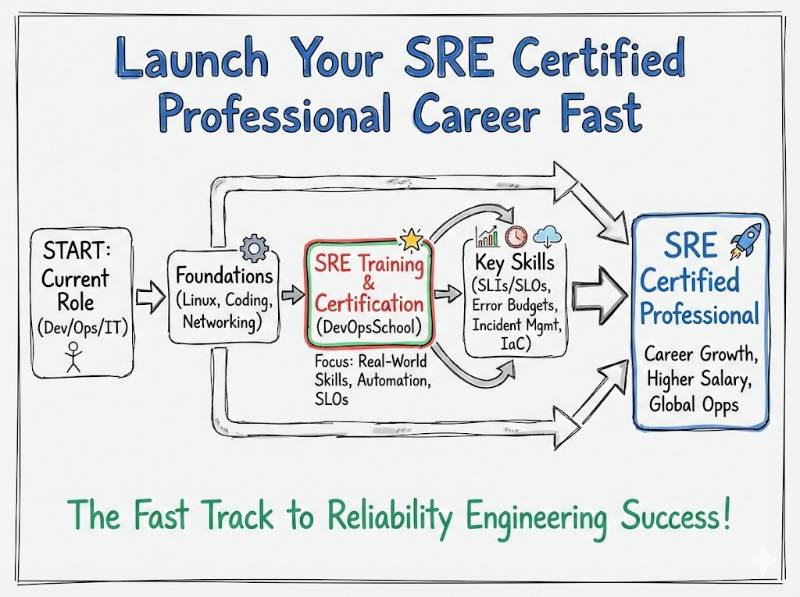
  • Launch Your SRE Certified Professional Career Fast

    1. Introduction

    The SRE Certified Professional (Training & Certification) program is designed to bridge the gap between traditional operations and modern software engineering. It is an approach where software engineering practices are applied to infrastructure and operations problems. Systems are built to be scalable, highly reliable, and efficient.

    In today’s ecosystem, where automation and cloud-native technologies dominate, this certification matters because it provides a standardized framework for managing complex systems. It is observed that companies are moving away from manual interventions and moving toward self-healing systems.

    Certifications are considered important for both engineers and managers. For an engineer, a certification acts as a validation of technical skills and a commitment to best practices. For a manager, it ensures that the team is speaking the same language and following a consistent methodology to reduce downtime and improve performance.


    2. Certification Overview Table

    TrackLevelWho it’s forPrerequisitesSkills CoveredRecommended Order
    SREProfessionalSoftware Engineers, DevOps, SREsBasic Linux & CodingAutomation, SLIs/SLOs, Error Budgets, Incident ManagementCore Certification

    Provider: DevOpsSchool

    Why Choose DevOpsSchool?

    A unique learning environment is offered by DevOpsSchool. The training is delivered by industry experts who focus on practical, real-world scenarios rather than just theoretical knowledge. Extensive support is provided to ensure that every candidate understands the core concepts of SRE. The curriculum is constantly updated to reflect the latest trends in the industry, making it a preferred choice for those looking to advance their careers in DevOps and SRE.


    3. Certification Deep-Dive

    What is this certification?

    The SRE Certified Professional is a comprehensive program that focuses on the principles of Site Reliability Engineering. The focus is placed on creating a balance between releasing new features and ensuring the stability of the system.

    Who should take this certification?

    This program is ideal for software developers who want to move into operations, or operations professionals who want to enhance their coding and automation skills. It is also highly recommended for system administrators and platform engineers.

    Skills you will gain

    • The ability to define and monitor Service Level Indicators (SLIs) and Service Level Objectives (SLOs).
    • Management of Error Budgets to balance risk and reliability.
    • Implementation of automation to eliminate repetitive manual tasks (Toil).
    • Advanced incident management and post-mortem analysis techniques.
    • Design of distributed systems that are resilient to failure.

    Real-world projects you should be able to do

    • A monitoring and alerting dashboard can be built using tools like Prometheus and Grafana.
    • A fully automated CI/CD pipeline with reliability gates can be designed.
    • Chaos engineering experiments can be conducted to test system resilience.
    • Infrastructure as Code (IaC) can be used to manage cloud environments.

    Preparation Plan

    7–14 Days Plan:

    • Focus is placed on understanding the core definitions of SRE.
    • The official curriculum is reviewed daily.
    • Practice exams are taken to identify weak areas.

    30 Days Plan:

    • Deep dives into automation tools are conducted.
    • Hands-on labs are completed at least three times a week.
    • The SRE handbook is studied to understand cultural aspects.

    60 Days Plan:

    • Real-world scenarios are simulated in a lab environment.
    • Advanced topics like capacity planning and networking are mastered.
    • Peer reviews and group discussions are joined to solidify knowledge.

    Common mistakes to avoid

    • Ignoring the cultural shift required for SRE and focusing only on tools.
    • Overcomplicating the SLOs by choosing too many metrics.
    • Neglecting the importance of documentation and post-mortems.

    Best next certification after this

    • Same track: Advanced SRE Practitioner.
    • Cross-track: DevSecOps Certified Professional.
    • Leadership / management: SRE Director or Engineering Manager Certification.

    4. Choose Your Learning Path

    1. DevOps Path: This path is chosen by those who want to integrate development and operations smoothly. The focus is on the entire lifecycle of software.

    2. DevSecOps Path: This is best for security-minded engineers. Security is integrated into the SRE and DevOps workflows from the start.

    3. Site Reliability Engineering (SRE) Path: This path is dedicated to those who want to specialize in high availability and large-scale system performance.

    4. AIOps / MLOps Path: This is intended for data scientists and engineers who want to apply AI to operations or manage machine learning lifecycles.

    5. DataOps Path: This path is suitable for data engineers who want to bring reliability and speed to data pipelines.

    6. FinOps Path: This is best for those focusing on cloud cost optimization and financial accountability in engineering.


    5. Role → Recommended Certifications Mapping

    • DevOps Engineer: SRE Certified Professional, CI/CD Expert.
    • Site Reliability Engineer (SRE): SRE Certified Professional, Chaos Engineering Specialist.
    • Platform Engineer: Kubernetes Certified Professional, Cloud Architect.
    • Cloud Engineer: SRE Certified Professional, AWS/Azure/GCP Professional.
    • Security Engineer: DevSecOps Certified Professional.
    • Data Engineer: DataOps Certified Professional.
    • FinOps Practitioner: Cloud Cost Management Certification.
    • Engineering Manager: SRE Leadership, Project Management.

    6. Next Certifications to Take

    Based on industry trends, the following recommendations are made for learners:

    • Same-track: Advanced Infrastructure Automation.
    • Cross-track: Multi-Cloud Security Expert.
    • Leadership-focused: Strategic IT Management.

    7. Training & Certification Support Institutions

    DevOpsSchool: Comprehensive training is provided for all SRE and DevOps tracks. A focus is maintained on career growth and technical mastery.

    Cotocus: Highly specialized consultancy-driven training is offered here. Practical implementation of SRE tools is a key highlight.

    ScmGalaxy: This platform is known for its vast library of resources and community support. Certification guidance is provided for various technical tracks.

    BestDevOps: Targeted training modules are designed for working professionals. The focus is kept on fast-tracking certification success.

    devsecopsschool.com: A dedicated space for security integration is found here. The intersection of SRE and Security is explored deeply.

    sreschool.com: This institution focuses exclusively on SRE principles. A deep understanding of reliability is fostered through expert-led sessions.

    aiopsschool.com: AI-driven operations are the primary focus. Training is provided on how to automate operations using machine learning.

    dataopsschool.com: This site supports those looking to master data pipeline reliability. Training is aligned with modern data engineering needs.

    finopsschool.com: Financial management in the cloud is taught here. Professionals are trained to manage cloud spend effectively.


    8. FAQs Section

    General FAQs

    1. What is the difficulty level?
      It is considered moderate to high, requiring both coding and operational knowledge.
    2. How much time is required?
      Usually, 4 to 8 weeks are needed depending on prior experience.
    3. Are there prerequisites?
      A basic understanding of Linux and at least one programming language is recommended.
    4. What is the certification sequence?
      SRE Foundation is often taken before the Professional level.
    5. What is the career value?
      High demand is seen for certified professionals, often leading to salary increases.
    6. Which job roles require this?
      SREs, DevOps Engineers, and System Architects.
    7. Is recertification needed?
      Yes, staying updated every few years is suggested.
    8. Can a manager take this?
      Yes, it is beneficial for understanding team workflows.
    9. Is the exam online?
      Usually, an online proctored exam is provided.
    10. What is the pass mark?
      Typically, a score of 70% or higher is expected.
    11. Are lab exercises included?
      Yes, hands-on labs are a core part of the training.
    12. Does it help in global markets?
      Yes, the certification is recognized worldwide.

    SRE Certified Professional Specific FAQs

    1. What makes this different from DevOps?
      SRE is a specific implementation of DevOps focused on reliability.
    2. Is coding mandatory?
      Yes, coding is used for automation in this certification.
    3. Are SLIs/SLOs covered?
      Yes, they are a primary focus of the curriculum.
    4. Is incident management taught?
      A significant portion of the course is dedicated to managing outages.
    5. Does it cover cloud platforms?
      Principles are taught that apply to AWS, Azure, and Google Cloud.
    6. How is Toil managed?
      Strategies for identifying and reducing manual work are covered.
    7. Is post-mortem analysis included?
      Yes, learning from failures is a key skill taught.
    8. Who is the primary provider?
      DevOpsSchool is the lead institution for this certification.

    9. Testimonials

    Aarav: A great improvement in technical clarity was achieved. The concepts of error budgets are now being applied in daily tasks.

    Ishani: Real-world applications were the best part of the training. Confidence in managing large-scale outages has grown significantly.

    Rohan: The career path became much clearer after completing this certification. A more structured approach to automation is now followed.

    Ananya: Complex systems are no longer intimidating. The skills gained have helped in designing more resilient architectures.

    Vikram: Strategic planning for reliability is now possible. The team’s efficiency has improved because of the methodologies learned here.


    Conclusion

    The SRE Certified Professional (Training & Certification) is an essential step for anyone looking to excel in the modern tech industry. Long-term career benefits are seen through increased expertise and the ability to handle complex infrastructure challenges. Strategic learning is encouraged, and planning for this certification should be prioritized by those seeking growth in software engineering and operations.

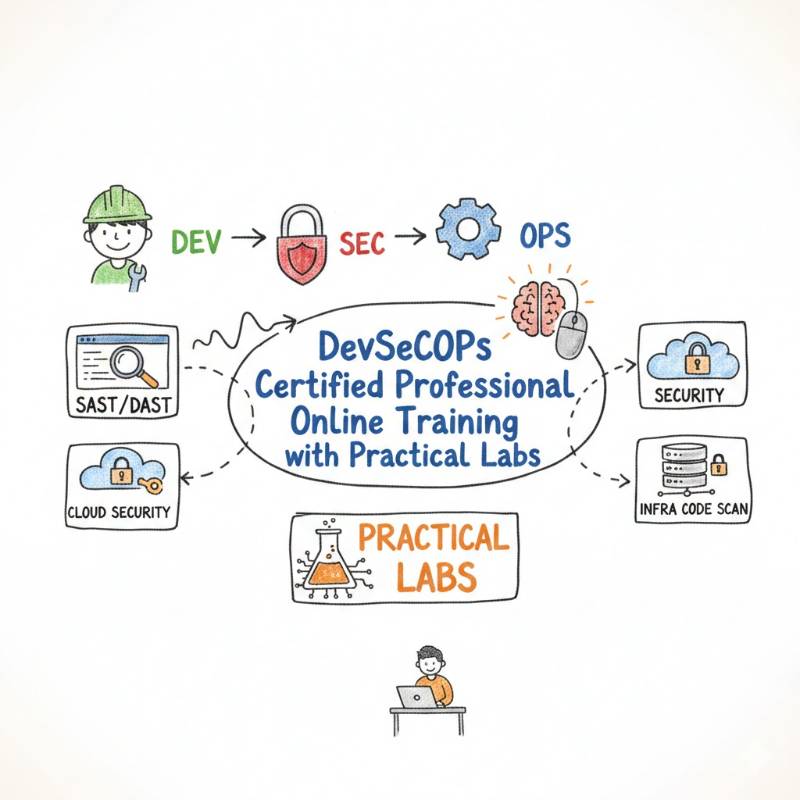
  • DevSecOps Certified Professional Online Training with Practical Labs

    Introduction

    The way software is built has changed quite a bit over the years. In the older days, security was something that happened at the very end of a project. It was like building a whole house and only then checking if the locks worked. This often caused big delays and a lot of frustration. Today, we use a better way called DevSecOps. This means security is baked into every single step, from the first line of code to the final release.


    1. What is DevSecOps Certified Professional Online Training?

    DevSecOps Certified Professional Online training is a special program made for people who work in technology and want to learn how to keep software safe without slowing down their work. It is not just about learning how to use a few new tools. It is about learning a new way of thinking where everyone on the team takes responsibility for security. The training shows you how to use automation to check for mistakes and safety risks every time the code is changed. Instead of waiting for a human to check everything, the system does it for you, which makes the whole process much faster and more reliable.

    Why it Matters in Today’s Ecosystem

    Most companies now use the cloud and complex systems to run their businesses. Because these systems are so large, there are more places where a hacker could try to cause trouble. Old ways of checking for security manualy just cannot keep up with how fast we work now. DevSecOps is important because it catches problems early. When you find a mistake right away, it is much cheaper and easier to fix than if you find it after the software is already being used by customers. It helps teams stay fast while staying safe.

    The Importance of Certification

    Having a certification is a great way to show that you really know what you are doing. For both workers and managers, it acts as a proof of skill that is recognized everywhere. The world of technology is very crowded, and a certificate helps you stand out from the rest. It also gives you a clear path to follow so you don’t miss any important lessons. Instead of trying to learn bits and pieces on your own, this program ensures you understand all the necessary parts of keeping a system secure.


    2. Certification Overview Table

    TrackLevelWho it’s forPrerequisitesSkills CoveredRecommended Order
    SecurityProfessionalEngineers, ManagersBasic DevOps KnowledgeTesting, Scanning, ComplianceAfter DevOps Basics

    Why Choose DevOpsSchool?

    DevOpsSchool is a top choice for many because they focus on real-world skills rather than just theory. The people who teach the classes have spent many years working in the industry, so they know exactly what challenges you will face at work. The lessons are updated all the time so that they include the newest threats and the best ways to stop them. When you study here, you get to practice on real systems, which means you will feel ready to handle your job duties the moment the class is over. It is a very supportive place to learn.


    3. Certification Deep-Dive

    DevSecOps Certified Professional Online Training

    What is this certification?

    This is a high-level program that proves a person can handle security in a modern automation environment. It is focused on “shifting left,” which simply means moving security tasks to the beginning of the work cycle instead of the end.

    Who should take this certification?

    It is built for people who are already working as software developers, system administrators, or security workers. It is also very helpful for managers who need to understand how their teams should be protecting the company’s data and software.

    Skills You Will Gain

    • Checking Code Automatically: You will learn how to look for weaknesses in the code while it is being written.
    • Testing Running Software: You will find out how to test the software for bugs while it is actually running.
    • Checking Third-Party Parts: Most software uses parts made by others; you will learn how to make sure those parts are safe.
    • Infrastructure Safety: You will learn how to make sure the servers and cloud settings are locked down tight.
    • Automated Rules: You will learn how to make the system follow safety rules automatically so nothing is forgotten.
    • Container Security: You will gain the skills to protect modern “containers” which are used to run most apps today.

    Real-World Projects

    • Building a Safe Pipeline: You will create a system that automatically stops any work if a security risk is found.
    • Secret Management: You will set up a way to keep passwords and keys hidden so they are never stolen.
    • Compliance Dashboard: You will build a screen that shows in real-time if the company is following all the safety laws.
    • Automated Scanning: You will set up tools that scan for viruses and bugs every single time a change is made.

    Preparation Plan

    • 7–14 Days Plan: Start by learning the basic ideas. Spend time understanding why security needs to be part of the whole process. Learn the names of the main tools used for scanning code.
    • 30 Days Plan: This is the time for practice. Start using the tools in a small project. Learn how to fix the common errors that the tools find. Study how to keep cloud servers safe.
    • 60 Days Plan: Take on bigger challenges. Practice what to do when a big security problem is found. Review real stories of how other companies stayed safe or failed so you can learn from them.

    Common Mistakes to Avoid

    • Working Alone: Security is not a one-person job; you must talk to the developers and the operations team.
    • Too Much Automation: Do not just turn on every tool at once; you need to understand what each tool is doing first.
    • Ignoring Small Risks: Sometimes small bugs can lead to big problems later, so pay attention to everything the scans find.

    Best Next Certification

    • Same Track: Look for a course that focuses on advanced cloud security.
    • Cross-Track: Learning about Site Reliability Engineering (SRE) is a smart move to understand how to keep systems running.
    • Leadership: Consider a course on how to manage engineering teams and follow government safety rules.

    4. Choose Your Learning Path

    • DevOps Path: This is for people who want to focus on making things fast. It covers how to build and ship software quickly using automation.
    • DevSecOps Path: This is for those who want to be the “guardians” of the code. It is all about making sure that speed does not come at the cost of safety.
    • Site Reliability Engineering (SRE) Path: This is for people who love to solve problems and keep things running. It focuses on making sure the website or app never goes down.
    • AIOps / MLOps Path: This is a newer path for people working with Artificial Intelligence. It shows how to manage the lifecycle of smart computer models.
    • DataOps Path: This is for people who work with large amounts of information. It ensures that data moves quickly and safely through the company.
    • FinOps Path: This is a very popular path for those who want to manage money. It teaches how to use the cloud without spending too much cash.

    5. Role → Recommended Certifications Mapping

    • DevOps Engineer: You should take the DevSecOps Professional and SRE Foundation courses.
    • Site Reliability Engineer (SRE): Focus on the SRE Professional and Chaos Engineering programs.
    • Platform Engineer: You will benefit most from Kubernetes Security and Infrastructure Automation.
    • Cloud Engineer: Look into Cloud Provider Security and the DevSecOps Professional course.
    • Security Engineer: Take Advanced Pen-Testing and the DevSecOps Certified Professional course.
    • Data Engineer: The DataOps Certification and Big Data Security are the best fits for you.
    • FinOps Practitioner: Focus on FinOps Certified Professional and Cloud Cost Management.
    • Engineering Manager: You should study DevSecOps for Managers and Agile Leadership.

    6. Next Certifications to Take

    It is always good to keep learning new things to keep your career moving forward:

    • Stay on Track: Find a course that goes deeper into how to protect containers and modern cloud tools.
    • Broaden Your Skills: Learn about Site Reliability Engineering. It helps you understand the bigger picture of how systems stay healthy.
    • Move into Leadership: If you want to be a boss, look for a course that teaches you how to manage people and follow big company rules.

    7. Training & Certification Support Institutions

    DevOpsSchool

    This is a very well-known place to learn. They offer many different courses that cover everything from the basics to very advanced topics. They are famous for having great teachers and lots of study guides to help you pass your exams.

    Cotocus

    Cotocus is a smaller, more personal school. They offer a lot of one-on-one help and mentorship. If you feel like you need a bit more attention to help you understand difficult topics, this is a great place to go.

    ScmGalaxy

    This is a big community of people who love technology. They have a lot of free information you can read, but they also have professional classes. It is a great place to meet other people who are learning the same things as you.

    BestDevOps

    BestDevOps is focused on helping people who work in big offices. Their training is very practical and is meant to help a whole team of people change the way they work together to be more modern.

    Specialized Schools

    There are also schools that focus on just one thing, such as devsecopsschool.com, sreschool.com, aiopsschool.com, dataopsschool.com, and finopsschool.com. These are perfect if you already know exactly what you want to specialize in.


    8. FAQs Section

    General FAQs

    1. Is this course hard?
      It is in the middle. You need to know a little bit about computers and code before you start.
    2. How long does it take?
      Most people finish in about one or two months if they study a few hours a week.
    3. Do I need a degree?
      No, but knowing the basics of how Linux and automation work is very helpful.
    4. Which course should I do first?
      Usually, it is best to take a basic DevOps course before this one.
    5. Will I get paid more?
      Many people find that they get better job offers and higher pay once they are certified.
    6. Can a manager do this?
      Yes, it is very good for managers so they can lead their teams better.
    7. Is it all on the computer?
      Yes, the training is done online so you can do it from home.
    8. Do I get to practice?
      Yes, you will be given tasks to do on a real system to prove you can do the work.
    9. What jobs can I get?
      You can work as a DevSecOps Engineer, a Security Lead, or a Cloud Architect.
    10. Is this certificate good in other countries?
      Yes, the skills you learn are used by companies all over the world.
    11. What if I fail the test?
      Most schools allow you to try again after studying a bit more.
    12. Do you teach about digital signatures?
      Yes, keeping code authentic is a part of the lessons.

    DevSecOps Specific FAQs

    1. Do you teach about Kubernetes?
      Yes, keeping these systems safe is a big part of the training.
    2. Does it work with AWS or Azure?
      Yes, the lessons work no matter which cloud company you use.
    3. Will I learn about SonarQube?
      Yes, this is a very common tool that is used in the course.
    4. Which is better, SAST or DAST?
      You need both to be truly safe, so the course teaches you both.
    5. How do I stop too many alerts?
      You will learn how to set up the tools so they only tell you about real problems.
    6. Is threat modeling included?
      Yes, you will learn how to guess where a hacker might try to attack.
    7. Do I need to be a pro programmer?
      No, but you should be able to read code and understand what it is doing.
    8. What about safety laws?
      Yes, you will learn how to make sure your code follows the law automatically.

    9. Testimonials

    Aarav

    “I used to just build things, but now I know how to build them safely. The lessons were very clear and helped me get a promotion at my job.”

    Sanya

    “I really liked the hands-on parts of the class. It wasn’t just reading books; I actually got to fix security problems on a real server.”

    Vikram

    “The teachers were very helpful. They explained things in a way that was easy to understand, even the parts that seemed very hard at first.”

    Anjali

    “Before this, I felt like I was always arguing with the developers. Now we have a system that helps us all work together to keep things secure.”

    Rohan

    “As a manager, this gave me the knowledge I needed to make sure my whole team is doing things the right way. Our software is much safer now.”


    10. Conclusion

    Taking the DevSecOps Certified Professional Online Training is a very smart move for your future. It gives you the skills to handle the biggest challenges in technology today. By learning how to keep software safe from the start, you become a very valuable member of any team. This certification is a great investment that will help you get better jobs and more respect in your field. Start planning your training today to make sure your career stays on the right track for years to come.

  • Boost Your Skills with Master in DevOps Engineering (MDE)

    Introduction

    In the current landscape of global technology, the traditional boundaries between software development and IT operations have been completely removed. High-speed delivery, unbreakable security, and 24/7 system reliability are no longer just goals; they are the standard requirements for any business to survive. To meet these high stakes, the Master in DevOps Engineering (MDE) has been developed as the gold standard for professionals who wish to lead this transformation. This program is not just a course; it is a structured, comprehensive journey designed to turn experienced engineers into versatile technical masters who can handle the most complex cloud and automation challenges.


    1. Defining the Master in DevOps Engineering (MDE)

    What Exactly is the Master in DevOps Engineering (MDE) Program?

    The Master in DevOps Engineering (MDE) is an advanced professional certification designed for the modern tech era. It is built to provide a holistic view of the entire software delivery lifecycle, from the first line of code to the final deployment in a production environment. Unlike basic certifications that focus on a single tool or a specific cloud provider, the MDE program is focused on the “how” and “why” of the entire ecosystem. It bridges the gap between manual processes and fully automated, self-healing systems. It is intended to produce engineers who are not just “tool users,” but “system architects.”

    The Critical Role of This Framework in Today’s Ecosystem

    As companies move toward microservices, serverless computing, and multi-cloud strategies, the complexity of managing these environments has grown exponentially. Software is now expected to be updated multiple times a day without any downtime. This is why the MDE framework is so vital. It provides the methodologies and the technical depth required to manage these high-pressure environments. By mastering this program, an engineer ensures that the speed of innovation never comes at the cost of system stability or data security. It is the backbone of modern automation and cloud management.

    The Practical Value of Validation for Engineers and Management

    For a working professional, a master-level certification like the MDE is a powerful validation of their hard-earned skills. It serves as a clear signal to the industry that the individual possesses a deep, standardized understanding of global best practices. For engineering managers, these certifications are essential benchmarks. When a team is certified, it ensures that everyone is speaking the same technical language and following the same high-quality processes. In a competitive market, having this credential often leads to better project assignments, higher leadership roles, and a stronger professional reputation across both Indian and global tech hubs.


    2. Comprehensive Certification Overview

    Track NameSkill LevelTargeted ProfessionalFoundational RequirementsKey Competencies TaughtIdeal Sequence
    DevOpsMasterSoftware & Systems EngineersLinux & Basic ScriptingCI/CD, IaC, Orchestration1
    SREExpertOperations & Site EngineersDevOps Core PrinciplesReliability & Monitoring2
    DevSecOpsExpertSecurity & DevOps PeersDevOps Pipeline KnowledgeAutomated Security Audit3
    AIOpsAdvancedData & Ops ProfessionalsPython & Core DevOpsML-driven Operations4
    DataOpsAdvancedData Architects & LeadsSQL & Pipeline BasicsData Lifecycle Automation5
    FinOpsManagementLead Engineers & ManagersCloud Infrastructure BasicsCost Control & Efficiency6

    Primary Certification Provider: DevOpsSchool

    Why Choose DevOpsSchool for Your Journey?

    When selecting a training partner, DevOpsSchool is frequently the top choice for serious professionals. This preference exists because the institution prioritizes real-world application over theoretical memorization. Every module is taught by industry veterans who have spent decades managing large-scale infrastructures. The learning environment is highly interactive, and students are provided with a vast library of resources and 24/7 lab access. Furthermore, the curriculum is updated every few months to ensure it reflects the latest shifts in technology, making it a reliable partner for anyone looking to stay ahead of the curve.


    3. Deep-Dive into Each Technical Track

    Master in DevOps Engineering (MDE)

    What is this certification?

    This is the flagship certification that covers the end-to-end DevOps journey. It is designed to take an engineer through the complete process of planning, coding, building, testing, releasing, deploying, operating, and monitoring software in a fully automated way. It is a comprehensive curriculum that turns specialized workers into versatile master engineers.

    Who should take this certification?

    This track is highly recommended for software developers, system administrators, and technical leads who wish to advance into senior DevOps or Platform Engineering roles. It is also perfect for those moving from traditional IT roles into modern cloud-native environments.

    Skills you will gain

    • Advanced mastery of Continuous Integration (CI) and Continuous Deployment (CD) pipelines.
    • Deep knowledge of Infrastructure as Code (IaC) using tools like Terraform and CloudFormation.
    • Expert-level management of containerized environments using Kubernetes and Docker.
    • Setup and management of comprehensive observability and alerting stacks.

    Real-world projects you should be able to do

    • Implementation of a Zero-Downtime deployment strategy for a global web application.
    • Construction of a multi-cloud infrastructure that can failover automatically if one provider goes down.
    • Automation of complex security compliance checks within the deployment pipeline.

    Preparation plan

    • First 14 Days: The focus is placed on mastering the command line, understanding networking protocols, and learning the core DevOps philosophy.
    • Days 15–45: A deep dive is conducted into automation tools, CI/CD orchestration, and container management through extensive lab work.
    • Days 46–60: The final weeks are spent on building a capstone project and practicing troubleshooting in live, complex environments.

    Common mistakes to avoid

    • Learning tools in isolation without understanding how they integrate into the full pipeline.
    • Neglecting the cultural aspects of DevOps, such as collaboration and shared responsibility.
    • Skipping the fundamentals of security and networking which are the base of all cloud work.

    Recommended Next Step

    • Within Track: Advanced Kubernetes Operator and Security.
    • Across Track: Site Reliability Engineering (SRE) for better system uptime.
    • For Leadership: Technical Team Leadership and Strategic Planning.

    4. Selecting Your Specialized Learning Path

    Choosing the right path is essential for long-term career satisfaction. Below are the most common routes taken by professionals:

    • The DevOps Path: This is the most popular route, focusing on the speed of delivery. It is best for those who enjoy automation and building tools that help developers move faster.
    • The DevSecOps Path: This is designed for professionals who are passionate about security. It teaches how to “shift security left,” ensuring that safety checks are performed at every step of the development process.
    • The Site Reliability Engineering (SRE) Path: This path is for those who enjoy the challenge of high-scale systems. It focuses on the balance between releasing new features and keeping the system stable and fast.
    • The AIOps / MLOps Path: This is a specialized route for engineers working with artificial intelligence. It focuses on automating the lifecycle of machine learning models and using AI to manage IT operations.
    • The DataOps Path: This is the best choice for data engineers. It applies the principles of DevOps to data pipelines, ensuring that data is delivered accurately and quickly to the business.
    • The FinOps Path: This is a leadership-focused path. It is for those who need to manage the financial side of the cloud, ensuring that every dollar spent on infrastructure is optimized and accounted for.

    5. Role → Recommended Certification Mapping

    To help you plan your career, the following mapping is suggested based on standard industry roles:

    • DevOps Engineer: MDE Certification + Advanced Cloud Architecture.
    • Site Reliability Engineer (SRE): SRE Practitioner + Observability & Monitoring Specialist.
    • Platform Engineer: MDE Certification + Infrastructure as Code (IaC) Master.
    • Cloud Engineer: Multi-Cloud Architect + MDE Certification.
    • Security Engineer: DevSecOps Professional + Automated Compliance Specialist.
    • Data Engineer: DataOps Specialist + Big Data Infrastructure Expert.
    • FinOps Practitioner: Cloud Financial Management + Cost Optimization Expert.
    • Engineering Manager: MDE for Managers + FinOps Practitioner + Leadership Training.

    6. Strategic Growth and Next Certifications

    Growth in technology never stops. For those who have completed the MDE, the following “next steps” are recommended to maintain a competitive edge:

    • Same-Track Growth: If you are a DevOps expert, the next step is to master Cloud-Native Security or Advanced Orchestration patterns to handle massive traffic.
    • Cross-Track Growth: A DevOps professional should consider moving into SRE or DataOps to broaden their impact on the organization’s overall efficiency.
    • Leadership Growth: For those aiming for the C-suite or senior management, certifications in IT Governance and FinOps are highly recommended to understand the business and financial impact of tech decisions.

    7. Trusted Training and Certification Support Institutions

    DevOpsSchool

    This institution is recognized globally for its deep technical focus and extensive hands-on training. It provides a complete support system including career counseling, interview preparation, and 24/7 technical labs.

    Cotocus

    A strong emphasis on cloud consulting and technical excellence is maintained by Cotocus. They are known for their high-end labs where engineers can practice solving real-world infrastructure failures.

    ScmGalaxy

    This is one of the largest communities for SCM and DevOps professionals. It offers a wealth of free resources, tutorials, and specialized training programs for those looking to master source control and automation.

    BestDevOps

    Specialized programs are designed by BestDevOps to help professionals transition from legacy roles into modern automated environments. Their training is highly practical and project-oriented.

    devsecopsschool.com

    This institution is dedicated to the integration of security into the DevOps pipeline. It provides deep-dive training on automated security tools and regulatory compliance.

    sreschool.com

    A focus on reliability and high availability is maintained here. The curriculum is designed to teach engineers how to manage massive systems with minimal downtime.

    aiopsschool.com

    This school is at the forefront of the AIOps movement. It teaches how to use machine learning and artificial intelligence to automate and optimize IT operations.

    dataopsschool.com

    Data management and pipeline automation are the core focus of this institution. It is the ideal place for data engineers to learn how to apply DevOps principles to their work.

    finopsschool.com

    This organization focuses on the financial management of the cloud. It helps professionals bridge the gap between engineering and finance to ensure cost-effective cloud usage.


    8. Frequently Asked Questions (FAQs)

    Career & Growth FAQs

    1. What is the difficulty level of the MDE exam?
      It is a master-level certification, meaning it requires a deep understanding of concepts and practical experience. It is designed to be challenging.
    2. How long does it take to get certified?
      On average, a working professional requires about 2 to 3 months of dedicated study to complete the program.
    3. What are the minimum prerequisites?
      A basic understanding of the Linux command line and some experience with a programming language like Python or Bash is recommended.
    4. In what order should I take the certifications?
      It is usually suggested to start with the core MDE and then move into specialized tracks like SRE or DevSecOps.
    5. How does this certification affect salary?
      Certified MDE professionals often see a significant increase in their salary packages due to their high-demand skill set.
    6. What job roles are available after MDE?
      One can apply for roles like Senior DevOps Engineer, Cloud Architect, Platform Lead, or SRE.
    7. Is coding required for these roles?
      Yes, a basic understanding of scripting is required to automate infrastructure and pipelines.
    8. How long is the certification valid?
      The certification is typically valid for two years, after which a renewal or an advanced exam is suggested.
    9. Are the labs included in the training fee?
      Yes, most providers like DevOpsSchool include full lab access as part of the training package.
    10. Is this certification recognized in international markets?
      Yes, the curriculum is based on global industry standards and is recognized by top tech firms worldwide.
    11. Can a complete beginner join this program?
      Yes, the program is designed to start from the basics and slowly move to the most advanced topics.
    12. Is there any support for job placement?
      Institutions like DevOpsSchool offer extensive career support, including resume building and interview prep.

    MDE Specific FAQs

    1. How is MDE different from a basic DevOps course?
      MDE is a “master” program that covers multiple tracks like MLOps, FinOps, and SRE, providing a much broader career path.
    2. Is Kubernetes a core part of MDE?
      Yes, advanced Kubernetes orchestration is a major pillar of the MDE curriculum.
    3. Does MDE provide real-world project experience?
      Yes, the final part of the program involves a capstone project based on a real industry problem.
    4. Are the trainers experienced?
      All trainers are senior industry practitioners with over a decade of experience in the field.
    5. Can I take the course while working full-time?
      Yes, flexible weekend and evening batches are available for working professionals.
    6. Is this course good for Engineering Managers?
      Yes, it provides managers with the technical depth they need to lead and plan technical projects effectively.
    7. What tools are covered in MDE?
      Tools like Git, Jenkins, Docker, Kubernetes, Terraform, Ansible, and Prometheus are all covered.
    8. Is a certification certificate provided?
      Yes, a globally recognized digital certificate is provided upon successful completion of the exam and project.

    9. Real-World Success Stories

    • Aravind: “The MDE program completely changed how I look at software delivery. I was able to automate our entire testing process, which saved our team hours of manual work every week.”
    • Megha: “The SRE track was exactly what I needed to move into a senior role. The focus on system reliability helped me solve several critical production issues at my current company.”
    • Karthik: “As a cloud engineer, the MDE certification gave me the confidence to manage multi-cloud environments. The practical labs were the highlight of the training for me.”
    • Pooja: “The DevSecOps modules were incredibly eye-opening. I now have the skills to build secure pipelines that meet the highest industry standards for our banking clients.”
    • Nitin: “The MDE for Managers course helped me bridge the gap between our development and operations teams. Our project delivery speed has improved by 40% since I implemented the new strategies.”

    10. Conclusion

    In conclusion, the Master in DevOps Engineering (MDE) is an essential step for anyone who wants to reach the top tier of the technology world. It provides a structured path to mastering the most important skills in today’s cloud-driven market. By earning this certification, a professional ensures long-term career growth, high compensation, and the ability to lead major technological changes. Strategic planning for continuous learning is the key to success in this fast-moving industry, and the MDE is the perfect foundation for that journey.

  • DevOps Certified Professional Journey from Tools to Impact

    Introduction

    Modern software delivery is being reshaped by a move toward constant automation and team unity. In previous years, a deep divide was often seen between those who wrote code and those who managed servers. This gap frequently resulted in slow releases and many technical errors. Today, these challenges are being solved through a set of practices that prioritize speed and system stability. A trusted standard for these skills is found in the DevOps Certified Professional (DCP) program.

    This guide is written from the perspective of an industry veteran with decades of experience. Lessons learned from managing complex systems across various global markets are shared here. The goal is to provide a simple yet deep roadmap for anyone who wishes to master these advanced methods.


    1. What is the DevOps Certified Professional (DCP)?

    The DevOps Certified Professional (DCP) is much more than just a title on a resume. It is a formal validation of an individual’s ability to manage the entire lifecycle of software. This program is designed to teach how various tools and cultural changes work together to create a smooth workflow. When this certification is earned, it is proven that the professional understands how to make different departments function as one efficient unit.

    Why it matters in today’s ecosystem

    In the current world, applications are expected to be updated almost instantly. Systems must remain stable even when changes are being made every day. Automation and cloud-native strategies are no longer seen as optional for successful businesses. The importance of the DCP path is found in how it addresses these high-pressure needs. It provides the necessary framework to manage large-scale systems without the constant risk of failure or downtime.

    The value of certifications for engineers and managers

    Certifications are often used by hiring managers to identify top talent in a very crowded job market. For an engineer, it serves as a major milestone that confirms technical depth and professional dedication. For a leader, it ensures that the entire team is following a unified set of best practices that are respected globally. By holding a DCP, a professional is recognized as someone who can reduce waste and speed up the delivery of work in any organization.


    2. Certification Overview Table

    The key details of the program are organized in the following table for quick reference.

    Track NameSkill LevelTarget AudienceRequired KnowledgeCore SkillsRecommended Order
    DevOps DeliveryProfessionalEngineers & IT LeadsLinux & ScriptingCI/CD, Docker, MonitoringFoundation -> DCP

    Official Provider: devopsschool

    Why choose DevOpsSchool?

    DevOpsSchool is chosen by thousands of learners because of its strong focus on practical, hands-on application. The curriculum is built by veterans who understand the daily challenges faced by engineering teams. It is not just a place for reading theory; it is a platform where real-world skills are practiced and perfected. Detailed support is provided at every step, ensuring that the transition into a senior role is smooth. The labs are designed to mimic actual production environments, which is why it is preferred by serious professionals.


    3. Detailed Breakdown: DevOps Certified Professional (DCP)

    Nature of the Credential

    The DevOps Certified Professional (DCP) is an advanced recognition for those who manage the end-to-end delivery of software products. It is crafted to ensure that the entire pipeline—from the first line of code to the final deployment—is automated, secure, and reliable. It represents a mastery of both the modern tools and the collaborative culture required for engineering success.

    Who should follow this path?

    This path should be followed by software creators, system administrators, and those in charge of quality assurance. It is also highly suitable for team leads and engineering managers who need to oversee the technical health of their projects. Even experienced professionals find value here by updating their knowledge with the latest global standards.

    Skills you will gain

    • Pipeline Creation: The building of robust and error-free Continuous Integration and Continuous Deployment pipelines is mastered through deep practice.
    • Code Management: Version control, branching strategies, and repository management are effectively handled to ensure team harmony.
    • Application Packaging: The use of containers is implemented to ensure that software runs perfectly across all different environments.
    • System Observability: Advanced monitoring, alerting, and log management techniques are fully understood and put into action.
    • Integrated Security: Essential security measures are woven into the automated flow to protect data from the very beginning.
    • Infrastructure as Code: The principles of automated server management are utilized to handle networks and servers with code rather than manual effort.

    Real-world projects you should be able to do

    • End-to-End Automation: A multi-stage deployment pipeline for a cloud-native application is constructed from the ground up.
    • Self-Healing Systems: Scalable and resilient systems are configured to ensure high availability and minimal manual intervention.
    • Automated Quality Checks: Comprehensive testing suites are linked to the build process to catch bugs before they ever reach a user.
    • Cloud Provisioning: Cloud resources are provisioned and managed using automated scripts, which greatly reduces setup time.
    • Performance Monitoring: A centralized dashboard for tracking application health and performance is built for real-time visibility.

    Preparation Roadmap

    Early Phase (7–14 Days):

    • Conceptual Review: The foundational ideas of automation and the DevOps mindset are revisited to build a strong theoretical base.
    • Terminal Practice: Daily practice with Linux commands and version control operations is strictly maintained.
    • Syllabus Study: The core requirements of the DCP exam are reviewed thoroughly to set clear learning goals for the month.

    Middle Phase (30 Days):

    • Hands-on Lab Work: Significant time is spent every day on setting up and managing local and cloud-based lab environments.
    • Tool Specialization: Container management and networking tools are practiced in detail to understand their inner workings.
    • Task Automation: Small-scale automation tasks are completed frequently to build muscle memory and solve common problems.

    Final Phase (60 Days):

    • Complex Integration: Multi-tool projects that require the coordination of several technologies are designed and executed.
    • Exam Simulation: Mock tests are used to find knowledge gaps and fix them before the actual certification attempt.
    • Troubleshooting: Complex and realistic failure scenarios are studied and resolved to prepare for real-world engineering challenges.

    Common mistakes to avoid

    • Ignoring the Process: Learning is often limited to tools while the underlying communication and process changes are ignored.
    • Skipping Labs: Hands-on practice is frequently sacrificed for quick reading, which leads to a lack of confidence during the exam.
    • Forgetting Security: The critical role of security in the early stages of the pipeline is often overlooked, leading to vulnerable systems.
    • Weak Basics: Mastery of the operating system and basic networking is often neglected before moving to advanced tools.

    Best next steps after this

    • Same Track: A Master in DevOps Engineering is recommended for those wanting to reach the highest technical levels.
    • Cross-Track: The Certified DevSecOps Professional path is suggested for those wanting to specialize in security.
    • Management: Roles like Site Reliability Lead or DevOps Manager are advised for those moving into organizational leadership.

    4. Choose Your Learning Path

    Six distinct paths are identified to help professionals find their niche in the tech industry:

    1. General DevOps: This is the most popular choice for those who want a broad and deep understanding of the whole software lifecycle.
    2. DevSecOps: This path is selected by those who wish to make security a core, automated part of the development pipeline.
    3. Site Reliability Engineering (SRE): This is chosen by engineers who focus on system stability, massive scalability, and peak performance.
    4. AIOps & MLOps: This is best for data-focused individuals who want to apply automation to artificial intelligence models.
    5. DataOps: This path is designed for professionals managing data flow and quality within big data environments.
    6. FinOps: This is for professionals who focus on the financial health and cost optimization of modern cloud infrastructure.

    5. Role → Recommended Certifications

    Recommended paths for specific roles are mapped below to ensure professional growth:

    Professional RoleSuggested Certification
    DevOps EngineerDevOps Certified Professional (DCP)
    SRESRE Foundation & Practitioner
    Platform EngineerCloud Infrastructure Specialist
    Security EngineerCertified DevSecOps Professional
    Cloud ArchitectCloud Computing Specialist
    Data EngineerDataOps Professional
    FinOps AnalystCloud Cost Management
    Engineering ManagerDevOps Leader / Lead

    6. Next Certifications to Take

    For every learner, a strategic next step is suggested to maintain momentum:

    • Deep Specialization: A deeper technical certification in the same track is recommended for those wanting to be top-tier experts.
    • Skill Diversification: A cross-track certification in security or data is suggested for those wanting to be versatile.
    • Leadership Transition: A leadership-focused program is advised for those who are ready to move into managerial roles.

    7. Training & Certification Support Institutions

    Comprehensive support for the DCP and related paths is provided by several recognized institutions.

    DevOpsSchool

    A deep and highly practical learning experience is offered by DevOpsSchool. It is globally well-known for its vast library of educational videos and live sessions conducted by industry experts.

    Cotocus

    Enterprise-level consulting and specialized training are delivered by Cotocus. Their focus is on the practical deployment of modern technology in high-stakes environments.

    ScmGalaxy

    A wealth of community resources, technical tutorials, and expert blogs is maintained by ScmGalaxy. It serves as a vital hub for professionals needing updated tool information.

    BestDevOps

    Specialized exam preparation, technical coaching, and mentorship are provided by BestDevOps. Their curriculum is strictly aligned with the latest requirements of major certifications.

    devsecopsschool.com

    A specialized focus on security within the automation pipeline is maintained here. Training is given on how to protect systems from the very start.

    sreschool.com

    The principles of high availability and system resilience are taught at this institution. It is ideal for those managing infrastructure at a massive scale.

    aiopsschool.com

    The bridge between artificial intelligence and IT operations is explored here. Students learn how to use smart data to manage complex systems effectively.

    dataopsschool.com

    Efficient data management and pipeline automation are the core focuses. It is tailored specifically for the needs of data-driven companies.

    finopsschool.com

    Financial transparency and optimization in the cloud are the main subjects here. Professionals are taught how to save costs while maintaining high performance.


    8. FAQs Section

    General FAQs

    1. What is the difficulty level of the DCP?
      It is viewed as a moderate to advanced exam that requires both theory and practice.
    2. How much time is needed for prep?
      Usually, two months of dedicated study and lab work are sufficient.
    3. Is coding knowledge required?
      Yes, a basic understanding of scripting is needed to complete the automation labs.
    4. What is the best course sequence?
      Starting with a foundation course is always advised before the professional level.
    5. Are these certifications valued?
      They are highly valued as proof of practical expertise and a commitment to standards.
    6. What salary growth is expected?
      Significant increases and better offers are often reported by certified professionals.
    7. Is the DCP valid globally?
      Yes, it is a globally recognized standard used by companies in many countries.
    8. Can the exam be taken online?
      Yes, online-proctored exams are made available for working professionals.
    9. Are retakes allowed?
      Yes, retake policies are provided, and students are given guidance on how to improve.
    10. Does it cover multiple clouds?
      Yes, the principles taught apply to AWS, Azure, and Google Cloud.
    11. Is there a community for holders?
      Yes, large alumni networks and forums are often accessible for support.
    12. How often is the syllabus updated?
      It is updated frequently to ensure it matches the latest industry trends.

    DCP Specific FAQs

    1. What is the primary focus of the exam?
      The focus is on implementing end-to-end automation and reliable delivery.
    2. Are real projects required?
      Yes, the training includes several hands-on projects that simulate actual tasks.
    3. Is there an experience limit?
      There is no age limit, but some professional IT experience is recommended.
    4. How much does the exam cost?
      The current pricing details are shared on the official provider’s website.
    5. What happens if the exam is failed?
      A retake can be scheduled after a specific period of further study.
    6. Are study materials provided?
      Yes, extensive guides, videos, and lab manuals are usually included.
    7. Does DCP cover Kubernetes?
      Basic and intermediate container orchestration concepts are included in the syllabus.
    8. Is job placement support provided?
      Many partners offer career guidance and mock interviews to help students.

    9. Testimonials

    Aditi:

    “The depth of the DCP course was truly surprising and very helpful. A clear path for my career was found through the hands-on labs and expert guidance.”

    Rohan:

    “My confidence in managing large-scale systems was greatly boosted. The transition to an automated workflow was made very simple and easy to follow.”

    Karan:

    “The practical nature of the training allowed me to implement positive changes in my office immediately. It is much more than just a certificate.”

    Sanya:

    “A very balanced approach between theory and practice was experienced. The complexity of CI/CD was broken down into easy, manageable steps.”

    Yash:

    “The mentorship provided during the program was exceptional and very motivating. My understanding of software delivery was completely transformed for the better.”


    10. Conclusion

    In conclusion, the DevOps Certified Professional (DCP) is an essential milestone for anyone looking to excel in the tech industry. The long-term benefits of this path include not just better job opportunities, but a much deeper understanding of how modern software truly works. A strategic plan for learning should be followed to ensure that these skills are mastered properly. The focus should always remain on practical application rather than just passing the test.

  • Certified DevOps Manager Program Overview and Benefits

    Introduction

    1. What exactly is a Certified DevOps Manager?

    A Certified DevOps Manager is not just a senior engineer with a new title. This role represents a bridge between the high-level business goals of an organization and the technical reality of the engineering teams. While a DevOps engineer focuses on the “how” of automation—writing scripts, managing pipelines, and configuring cloud resources—the Manager focuses on the “why” and the “result.” They are responsible for the entire delivery ecosystem, ensuring that every piece of software moving through the pipeline adds value to the customer while maintaining the highest standards of safety and efficiency.

    Why this role is critical in today’s ecosystem

    In today’s market, speed is the primary currency. However, speed without a plan leads to “technical debt” and system failures. Organizations now realize they need a central figure who can oversee the entire “Value Stream.” This means looking at the software lifecycle from the moment an idea is born until it is running in production. A DevOps Manager manages the friction between the need for rapid change and the need for absolute stability. Without this role, automation often becomes messy, expensive, and difficult to scale across large departments.

    The growing importance of certification

    For both engineers and managers, certification acts as a universal language. In a global job market—especially in competitive hubs like India, the US, and Europe—having a verified credential proves that your knowledge isn’t just based on one company’s specific way of doing things. It shows you have mastered a standardized set of best practices that can be applied anywhere. For a manager, it provides the “soft skills” of leadership combined with the “hard skills” of technical auditing, making you a dual-threat professional in the eyes of hiring managers.


    2. Comprehensive Certification Overview

    TrackLevelTarget AudiencePrerequisitesCore Skills CoveredRecommended PathOfficial Link
    ManagementExpertLeads & Managers5+ Years in IT/CloudStrategy, ROI, AuditingPost-ProfessionalOfficial Link

    Why choose DevOpsSchool?

    Choosing where to invest your time and money is a big decision. DevOpsSchool has become a preferred choice for thousands of professionals because they understand that DevOps is 80% culture and 20% tools. Their curriculum is designed by industry veterans who have managed massive migrations for Fortune 500 companies.

    • Real-World Focus: They don’t just teach you how a tool works; they teach you how to deploy that tool in a high-pressure production environment where downtime isn’t an option.
    • Mentor Support: You get access to experts who have 15-20 years of experience, providing you with insights that you simply cannot find in a textbook or a pre-recorded video.
    • Hands-on Labs: Their training environments mimic real office setups, ensuring that you gain the muscle memory needed to lead a team through a technical crisis.
    • Career Growth: Beyond the technical skills, they focus on helping you build a portfolio and a resume that stands out to top-tier tech recruiters.

    3. Deep-Dive into the Manager Certification

    Detailed Program Explanation

    This certification is a deep exploration of the “Managerial” side of technology. It moves away from the “hands-on-keyboard” approach and moves toward “architectural-thinking.” You will learn how to design a roadmap that moves a company from slow, manual releases to a fully automated, self-healing infrastructure. It covers the governance of cloud environments, the selection of the right vendors, and the orchestration of multiple teams working on different parts of a product.

    Who is the ideal candidate?

    • Technical Leads: Professionals who currently manage a small team and want to step up to managing a whole department or organization.
    • Project Managers: People who understand timelines but want to gain the technical “teeth” to lead DevOps transformations effectively.
    • Cloud Architects: Experts who design systems but need to understand the human and process side of how those systems are operated.

    Advanced Skills You Will Master

    • DORA Metrics Implementation: You will learn how to track the four key metrics (Deployment Frequency, Lead Time for Changes, Change Failure Rate, and Time to Restore Service) to prove the success of your team to stakeholders.
    • Value Stream Mapping: You will gain the ability to visualize the entire software process and identify exactly where “waste” is happening, allowing you to save the company time and money.
    • Toolchain Orchestration: Instead of just knowing one tool like Jenkins or GitLab, you will learn how to audit an entire stack to ensure every tool is working together without creating security holes.
    • Conflict Resolution: One of the hardest parts of DevOps is getting Dev and Ops to stop blaming each other. You will learn the psychological tools needed to build a blameless culture.

    Career Preparation Strategy

    • The 14-Day “Sprint”: Start by immersing yourself in the DevOps philosophy. Study the “Three Ways” of DevOps (Flow, Feedback, and Continuous Learning). This period is about changing your mindset from a worker to a thinker.
    • The 30-Day “Deep-Dive”: Begin analyzing your current workplace. Apply the concepts you are learning to your daily tasks. Start documenting the inefficiencies you see in your current deployment pipelines.
    • The 60-Day “Mastery”: Engage in heavy scenario-based learning. Practice how you would respond to a major security breach or a total system outage. Complete your capstone project and prepare for the final evaluation.

    Strategic Career Transitions

    • Same Track Advancement: After this, you might look into specialized “GitOps” or “Platform Engineering” leadership.
    • Cross-Track Growth: Many managers move into SRE (Site Reliability Engineering) to focus more on system uptime and performance at scale.
    • Leadership Focus: From here, the natural progression is toward a Director of Engineering, VP of DevOps, or even a CTO (Chief Technology Officer) role.

    4. Custom Learning Paths for Every Goal

    • The DevOps Path: This is the most popular route. It is built for those who want to master the “Continuous” world—Continuous Integration, Continuous Delivery, and Continuous Deployment. It is best for those who want a balanced career in both coding and systems.
    • The DevSecOps Path: As cyber threats grow, this path is becoming essential. It teaches you how to automate security checks so that they happen every time code is saved. This is ideal for those who want to work in banking, healthcare, or government sectors.
    • The SRE Path: This is for the “Engineers of Reliability.” It focuses on using software to manage systems. If you enjoy solving complex puzzles and building systems that can handle millions of users, this is your path.
    • The AIOps/MLOps Path: This is the frontier of the industry. It involves using AI to monitor systems and managing the lifecycle of Machine Learning models. It’s perfect for the data-driven professional who loves the intersection of AI and Infrastructure.
    • The DataOps Path: This path focuses on the “Pipeline of Data.” It ensures that data is clean, secure, and reaches the right people at the right time. It is vital for companies that rely on Big Data and Analytics.
    • The FinOps Path: Cloud costs are spiraling out of control for many companies. FinOps managers help businesses understand their cloud bills and optimize their spending. This is a high-demand role for those with a mix of technical and financial interest.

    5. Mapping Roles to the Right Training

    • Platform Engineers: Should focus on Infrastructure as Code (Terraform) and Kubernetes to build internal developer platforms.
    • Security Analysts: Need the DevSecOps track to understand how to keep up with high-speed automated development.
    • Data Scientists: Benefit from MLOps training to ensure their models actually make it into production and stay accurate.
    • Engineering Directors: Must take the Certified DevOps Manager track to understand how to lead their entire department toward a modern, automated future.

    6. Training Institutions and Support

    DevOpsSchool

    This is a comprehensive training hub that provides a “full-stack” learning experience. They are highly regarded for their ability to take complex technical subjects and make them easy to understand for everyone from beginners to veterans.

    Cotocus

    A boutique firm that focuses on high-end technical training and consulting. They are the go-to choice for companies that need to train their entire staff on cloud-native technologies and container orchestration.

    ScmGalaxy

    More than just a training site, this is a massive knowledge base. It is used by engineers worldwide to troubleshoot issues with Git, Jenkins, and other CI/CD tools. It is an essential bookmark for any DevOps professional.

    BestDevOps

    This portal specializes in career-focused roadmaps. They help you cut through the noise and focus only on the skills that will actually get you hired in today’s job market.


    7. Frequently Asked Questions

    1. Is this program too technical for a non-coder?
      It requires technical understanding, but you don’t need to be a full-time programmer. You just need to know how the pieces fit together.
    2. How does this certification impact my salary?
      Industry data shows that certified managers often earn 20-30% more than their non-certified peers because they can handle higher levels of responsibility.
    3. What if I have no DevOps experience?
      We recommend starting with a Foundation or Professional level course before attempting the Manager certification.
    4. Can I complete the labs on a basic laptop?
      Yes, most training providers like DevOpsSchool provide cloud-based labs, so you only need a web browser and a stable internet connection.
    5. Is there a focus on specific clouds like AWS?
      The principles are “Cloud-Agnostic,” meaning they work on AWS, Azure, Google Cloud, or even on-premise servers.
    6. How are the exams structured?
      Usually, they consist of multiple-choice questions and scenario-based problems that test your decision-making skills.
    7. Is there job placement assistance?
      Most top institutions like DevOpsSchool provide resume building and interview coaching as part of their premium packages.
    8. Will I learn about “Soft Skills”?
      Yes, a major part of the manager track is learning how to lead people, manage stakeholders, and handle office politics.
    9. What is the time commitment per week?
      Expect to spend about 5-10 hours a week if you want to finish within the two-month timeframe.
    10. Is the certification recognized by HR?
      Yes, “Certified DevOps Manager” is a recognized title that helps your resume pass through automated screening tools.
    11. Do I need to renew the certification?
      Technology moves fast, so most certifications suggest a “refresher” every two to three years to stay current.
    12. Are there group discounts?
      Many of these institutions offer special rates for corporate teams looking to train five or more people at once.

    8. Real-World Success Stories

    Kiran

    “The transition from a Senior Admin to a DevOps Manager was the hardest jump in my career. This certification gave me the framework I needed to stop doing the work and start leading the work.”

    Ishaan

    “I used to struggle with explaining our technical needs to the business team. After this course, I learned how to speak the language of ROI and business value. It got our project the budget it needed.”

    Meera

    “The labs on cloud cost optimization were a lifesaver. I was able to reduce our monthly AWS bill by 15% just by applying the tagging and monitoring strategies I learned.”

    Zoya

    “Being a woman in a lead tech role can be challenging. This certification gave me the extra layer of authority and confidence to lead my team through a major migration without any downtime.”

    Aravind

    “I finally feel like I have a 360-degree view of how software is made. I’m no longer just a ‘tool guy’—I’m a strategy guy. My career growth has been exponential since finishing the program.”


    Conclusion

    The path to becoming a Certified DevOps Manager is a journey of professional growth. It requires a commitment to learning not just the tools of today, but the leadership strategies of tomorrow. By choosing a comprehensive training program and following a structured learning path, you position yourself at the very top of the technology industry.

  • How Certified DevOps Architect (CDA) Elevates Your Career

    Introduction

    In the world of technology, your skills are your most valuable assets. Just like an investor looks for a solid stock that will grow over time, a software professional must look for skills that will stay relevant for years. If you have been working in this industry for a long time, you know that tools come and go. However, the ability to design a system that works perfectly is a skill that never loses its value. This is where the transition into architecture begins.

    The Certified DevOps Architect (CDA) is not just another certificate to put on a wall. It is a major upgrade to your professional portfolio. It represents a move from being a person who follows a plan to being the person who creates the plan. In this guide, we will explore why this specific path is the best investment you can make for your career and how it helps you build a future that is both stable and high-paying.


    Understanding the Foundation of Technical Leadership

    What exactly is the Certified DevOps Architect (CDA)?

    The Certified DevOps Architect (CDA) is a master-level training program focused on the art of system design and automation. When we talk about architecture in software, we are talking about the “skeleton” of the entire system. A CDA is the professional who decides how the cloud, the code, and the security measures all fit together. It is a role that requires looking at the big picture and making sure that the platform can handle thousands of users without crashing or costing too much money.

    Being a CDA means you have moved past the basics of just “fixing things.” You are now in a position where you prevent problems before they ever happen. You are responsible for creating a smooth, automated path that allows developers to get their work to the customers as fast as possible. It is a high-level role that combines technical deep-dives with strategic thinking.

    Why Architecture is the Secret to Modern Software Success

    In the current tech market, things move faster than ever. A company cannot wait weeks to release a new feature. They need to do it in days or even hours. But if you move too fast without a good plan, the whole system can break. This is why architecture is so important today. Without a solid design, a company will spend more time fixing errors than building new things.

    A DevOps Architect provides the safety net that allows for this speed. By building automated checks and balances, the architect ensures that the system is resilient. This means even if a server fails or a piece of code has a bug, the entire platform stays online. In a world where every minute of downtime costs thousands of dollars, the person who can design a stable system is the most important person in the room.

    The Real-World Impact of Professional Certification

    For an individual, getting a certification like the Certified DevOps Architect (CDA) is about proving your worth to the global market. It acts as a standard of quality. When an employer sees this on your resume, they know you have been trained by experts and that you understand the highest levels of system design. It removes the guesswork for them and gives you a clear advantage over others.

    For the company, having a certified architect means they are following industry best practices. It means their systems are being built by someone who understands how to save money on cloud costs and how to keep data secure. It is a win-win situation where the professional gets a better career and the company gets a better, more reliable product.


    The Technical Portfolio Breakdown

    Investment TrackLevelBest ForTechnical PrerequisitesKey Skills TaughtProgression
    System Architecture & Platform DesignMaster / ExpertSenior Leads, Tech Managers, SRE Leads, & Solution Architects3–5 Years of IT Experience + Hands-on Cloud/CI-CD knowledgeCloud-Native Design, IaC (Terraform), Advanced Kubernetes, DevSecOps, & FinOpsFoundation → Professional → CDA

    Official Provider: devopsschool

    Why Choose DevOpsSchool?

    Choosing the right place to get your training is the most important decision you will make. DevOpsSchool has spent years building a reputation as the most practical and honest training provider in the market. They do not just teach you how to pass an exam; they teach you how to survive and thrive in a real-world job environment. Their courses are built on the actual experiences of people who have managed some of the biggest software systems in the world.

    What really sets DevOpsSchool apart is their focus on hands-on mastery. You don’t just watch videos; you get into the labs and build things. You learn how to handle real failures, how to manage complex cloud setups, and how to lead a team through a technical crisis. When you finish a course with them, you aren’t just “certified”—you are truly capable. They provide a level of support and community that helps you long after the classes are over.


    A Deep Dive into the CDA Specialization

    What is this certification all about?

    The CDA is a top-tier program that teaches you how to design and govern the automated platforms that modern businesses run on. It is the ultimate training for anyone who wants to stop being a “manual worker” and start being a “system designer,” focusing on high availability and massive scale.

    Who should consider this path?

    This is perfect for Software Engineers, Cloud Professionals, and IT Managers who have a few years of experience and are ready for a leadership role. If you want to be the person who makes the big technical decisions for your company, this is your next step.

    High-Value Skills You Will Gain

    • Total Automation Design: You will learn how to create systems where the code moves from the developer to the customer with almost no human help.
    • Infrastructure as Code (IaC): You will master tools that allow you to build entire data centers using just a few lines of code.
    • Multi-Cloud Mastery: You will learn how to design systems that can run on any cloud, whether it is AWS, Azure, or Google Cloud.
    • Security Architecture: You will learn how to build “security by design,” making sure that the system is safe from the very first day.
    • Observability: You will learn how to build monitoring systems that tell you exactly what is happening inside your platform at all times.

    Real-World Projects for Your Portfolio

    • Building a self-service cloud platform where developers can get their own databases and servers without asking for permission.
    • Designing a global disaster recovery plan that ensures the business never loses data, even if a whole region goes offline.
    • Creating a security pipeline that automatically finds and fixes bugs before they ever reach the production environment.

    Strategic Preparation Blueprints

    The 14-Day “Fast Track”

    • Week 1: Focus on the core philosophy of DevOps and the high-level rules of system architecture.
    • Week 2: Spend every day in the labs. Focus on connecting tools like Kubernetes and Terraform into one working system.

    The 30-Day “Balanced” Path

    • First 15 Days: Master the basics of Linux, cloud networking, and version control. These are the foundations of all great architecture.
    • Last 15 Days: Build a full end-to-end project. Document your design choices and take multiple practice exams to get ready for the real thing.

    The 60-Day “Mastery” Plan

    • Month 1: Focus entirely on hands-on work. Build different types of architectures—some for small startups and some for giant corporations.
    • Month 2: Focus on the “Business” of tech. Learn about cost-saving, security audits, and how to explain technical choices to managers. Spend the final two weeks in deep revision.

    Common Errors to Avoid

    • Focusing only on the buttons: Don’t just learn where to click in a tool. Learn why the tool exists and what problem it solves for the company.
    • Ignoring the Bill: A great architect is also a financial guardian. Never build a system that is so expensive that it hurts the company’s profits.
    • Forgetting the People: Architecture is for people. If your system is too hard for the developers to use, it will eventually fail.

    Your Next Career Move

    • Same Field: Master in Machine Learning Operations (MLOps).
    • New Perspective: Certified DevSecOps Professional.
    • Management Goal: Certified DevOps Manager.

    Designing Your Professional Learning Path

    There is no “one size fits all” in tech. Depending on what you enjoy, you can choose from these six major tracks:

    1. The DevOps Path: Best for those who want to be the general architects of the software delivery world.
    2. The DevSecOps Path: For the person who wants to be a specialist in keeping automated systems safe from hackers.
    3. The Site Reliability (SRE) Path: Perfect for those who love the challenge of building systems that never, ever crash.
    4. The AIOps / MLOps Path: The future of tech. This is for people who want to manage infrastructure for AI models.
    5. The DataOps Path: A specialized track for those who focus on the high-speed delivery of big data.
    6. The FinOps Path: A very high-value role focused on managing the money and efficiency of the cloud.

    Mapping Your Current Role to the CDA Path

    Where you are today determines how you should approach the Certified DevOps Architect (CDA):

    • DevOps Engineer: You are the primary candidate. This certification is your ticket to a “Lead” or “Architect” title and a much higher salary.
    • SRE: Focus on the architectural side to move from “keeping things running” to “designing how things run.”
    • Platform Engineer: The CDA is the standard for your role. It gives you the framework to build better internal developer platforms.
    • Cloud Engineer: Use the CDA to move beyond just “managing the cloud” and start “designing the cloud strategy.”
    • Security Specialist: Combine your security knowledge with the CDA to become a top-tier DevSecOps Architect.
    • Data Professional: Use the CDA principles to bring automation and stability to your big data pipelines.
    • Engineering Manager: This certification gives you the technical respect you need to lead a team of senior engineers effectively.

    The Next Steps for Continued Growth

    Completing the Certified DevOps Architect (CDA) is a huge milestone, but the journey doesn’t end there. To stay at the top of the market, you should consider these next steps:

    • Deep Technical Dive: Master specific tools like Kubernetes or Terraform at an expert level to become the “go-to” person for those technologies.
    • Add a Security Layer: Take the Certified DevSecOps Professional course. Security is the biggest concern for every big company right now.
    • Leadership Transition: If you want to move into a Director or VP role, the Certified DevOps Manager program will teach you the business and people side of tech.

    Professional data shows that architects who also understand security and management are the highest-paid individuals in the entire software industry.


    Leading Support Institutions for Your Journey

    If you want to reach the top, you need to learn from the best. Here are the institutions that lead the way:

    • DevOpsSchool: The top global provider for hands-on training in DevOps, SRE, and Cloud Architecture.
    • Cotocus: A specialized provider known for expert consulting and deep technical training for large teams.
    • ScmGalaxy: A massive community and knowledge base for anyone looking to master the art of build and release engineering.
    • BestDevOps: Focuses on clear, job-oriented training that helps people get hired in the shortest time possible.
    • devsecopsschool.com: The primary place to go if you want to become an expert in building secure automated pipelines.
    • sreschool.com: Dedicated to the skills needed to keep massive systems stable and highly available.
    • aiopsschool.com: Where you learn to use artificial intelligence to make your IT operations smarter and faster.
    • dataopsschool.com: Focused on the unique challenges of managing and automating massive data flows.
    • finopsschool.com: The best place to learn how to manage cloud budgets and save your company money.

    Frequently Asked Questions (FAQs)

    General Career and Value Questions

    1. Will this certification help me get a job in India?
      Yes, the Indian tech market has a massive shortage of skilled architects who can lead large projects.
    2. How much time do I need to study every day?
      About 1.5 to 2 hours a day is plenty to stay on track and learn deeply.
    3. Do I need to be a coding genius?
      No. You need to understand how systems work and be able to read and write simple scripts.
    4. Can I take the exam from my home?
      Yes, most certifications are now done online through a secure proctored system.
    5. How long does the certificate stay valid?
      Usually, it is good for 2 to 3 years, after which you should refresh your knowledge.
    6. I am an IT manager; will this be too hard?
      It is challenging, but it is exactly what a manager needs to lead a technical team with confidence.
    7. Is there a lot of math?
      No. It is about logic, process, and system flow, not complex calculations.
    8. Will this help me get a job in the US or Europe?
      Absolutely. These principles are global and are in high demand everywhere in the world.
    9. What is the format of the exam?
      It is typically multiple-choice, focusing on how you would solve a real problem in a real company.
    10. Do I get a digital badge for my profile?
      Yes, you get a verifiable digital certificate and badge to show off on LinkedIn.
    11. What if I have trouble with the labs?
      DevOpsSchool provides mentor support to help you through any technical roadblocks.
    12. Is there a community of other students?
      Yes, you get access to a large global network of fellow architects and experts.

    Specific CDA Questions

    1. What is the main thing I will learn?
      You will learn how to design a complete, automated software delivery machine for any company.
    2. Does it cover Kubernetes?
      Yes, it is one of the most important parts of the entire program.
    3. Will I learn about Terraform?
      Yes, Infrastructure as Code is a key skill for every modern architect.
    4. How long is the actual test?
      It usually takes about two hours to complete.
    5. Is cloud cost management included?
      Yes, learning how to build efficient systems is a core part of the CDA role.
    6. Do I learn about security?
      Yes, the CDA program focuses heavily on building secure systems from the ground up.
    7. Is this good for people with a lot of experience?
      Yes, it is specifically designed to help experienced people move into leadership.
    8. Does it cover multi-cloud design?
      Yes, you will learn how to make systems that work on AWS, Azure, and other providers at the same time.

    Success Stories

    Voices of the Profession

    “After working for years as a senior engineer, I felt like I was doing the same thing every day. The Certified DevOps Architect (CDA) helped me see the bigger picture. I now lead the cloud strategy for my entire department and my salary has seen a huge jump.” — Rajesh, Technical Lead

    “The labs at DevOpsSchool were the best part. I didn’t just read about Kubernetes; I built a massive system and learned how to fix it when it broke. That gave me the confidence to take on a lead role at a top startup.” — Preeti, Senior SRE

    “I finally have the technical authority I was missing. Now, when I suggest a design change in a meeting, the stakeholders listen because they know I have the certification to back it up.” — Ishaan, Cloud Architect

    “This program helped me bridge the gap between my dev team and our security team. We now build things faster and safer than we ever did before. It has been a total game-changer for my career.” — Kavita, DevSecOps Lead

    “As a manager, I was always a bit behind my engineers on the tech side. The CDA program gave me the depth I needed to plan our roadmap and hire the right people with total clarity.” — Manish, Engineering Manager

    Final Conclusion

    Investing in yourself is the only investment that is guaranteed to pay off. The Certified DevOps Architect (CDA) is the “blue-chip stock” of the technology world. It is a long-term asset that grows in value as you gain more experience. By moving into architecture, you are moving away from the daily fires and moving toward a role of true technical leadership.

    The industry will always need people who can build things. But it will pay much more to the people who can design them. Don’t just be a part of the system—be the one who creates it.