Introduction
Buying software subscriptions, selling digital consulting, paying for cloud storage, running online advertisements, downloading digital content, or receiving services from a foreign platform may look like ordinary internet transactions, but their GST treatment can be surprisingly different. The difficulty is that GST does not depend only on whether a service is delivered online. Classification, supplier location, customer location, GST registration status, place of supply, and whether the transaction qualifies as an import, export, or OIDAR service can all matter. This guide explains these concepts practically so beginners, freelancers, consumers, and businesses can understand what to check before charging, paying, reporting, or claiming GST.
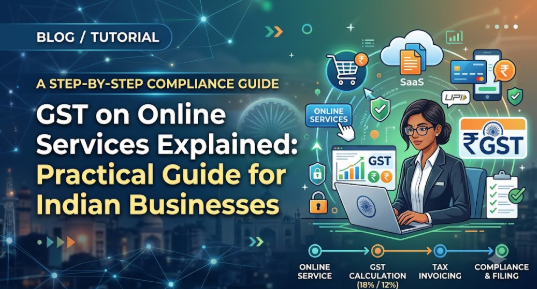
Understanding GST on Online Services Explained in Simple Words
GST on online services means the application of Goods and Services Tax to services supplied, accessed, purchased, or delivered through digital channels.
Examples may include:
- Software subscriptions
- Cloud-hosting services
- Online advertising
- Digital consulting
- Web-development services
- Paid databases
- Streaming subscriptions
- Digital storage
- Electronic publications
- Online professional services
- SaaS products
- Certain digital memberships
The first important lesson is that “online service” is a practical description, not one universal GST category.
A live consulting session conducted through video conferencing, for example, may involve substantial professional work. A cloud-storage subscription may instead fall within information-supply services. A downloaded e-book can have yet another rate treatment.
Therefore, businesses should first identify what service is actually being supplied.
What Is OIDAR?
A particularly important category for cross-border digital services is Online Information and Database Access or Retrieval services, commonly called OIDAR.
Under the current IGST law, OIDAR broadly covers services delivered through information technology over the internet or an electronic network where the supply cannot be provided without information technology. Examples listed in the law include internet advertising, cloud services, digital software and other intangibles, electronic information, digital content, and digital data storage.
This definition has become broader than its earlier form because the older requirement concerning essentially automated delivery and minimal human intervention was removed.
That change makes classification especially important.
A Beginner-Friendly Example
Suppose an Indian business purchases a cloud subscription from an overseas provider.
If the Indian customer is GST-registered, the tax responsibility may arise for the Indian recipient under the reverse-charge mechanism for applicable imported online database or OIDAR services. CBIC guidance specifically states that a registered recipient obtaining online database access from a foreign company has to pay applicable IGST under reverse charge.
If an overseas OIDAR provider supplies qualifying services to an unregistered recipient located in India, the overseas supplier is generally responsible for payment of IGST under the special OIDAR provisions.
Why GST on Online Services Is Important
Online services increasingly form part of everyday personal and business spending. Companies pay for accounting software, cloud storage, advertisements, design applications, cybersecurity tools, productivity platforms, data subscriptions, and remote professional services.
Incorrect GST treatment can affect several financial areas.
Business Costs
Where GST is correctly charged and a registered business satisfies input-tax-credit conditions, eligible tax may potentially be claimed as ITC when the service is used in the course or furtherance of business. Eligibility remains subject to statutory conditions and restrictions.
Incorrect invoices or incorrect GSTIN information can complicate this process.
Cash Flow
Suppose a business buys an overseas subscription on which reverse charge applies. The business may need to account for GST itself rather than assuming that the overseas supplier has handled Indian tax.
Failing to plan for this liability can create an unexpected compliance cost.
Pricing
Online-service providers need to understand whether quoted prices are:
- GST-inclusive
- GST-exclusive
- subject to IGST
- subject to CGST and SGST
- zero-rated as a qualifying export
- subject to reverse charge
Poor understanding can affect margins and customer communication.
Tax Planning
Tax planning does not mean avoiding lawful GST. It means understanding obligations before invoices, contracts, and payments are created.
Record Keeping
Digital businesses often process hundreds of small recurring transactions. Without disciplined records, subscription invoices, GSTINs, customer locations, foreign payments, cancellations, and credit notes can become difficult to reconcile.
Practical Scenario
Consider a small marketing company buying foreign cloud software while also selling online consulting to Indian clients.
Three separate GST questions may arise:
- How should GST be charged on Indian clients?
- Does reverse charge apply to foreign software purchases?
- Can eligible GST paid on business purchases be claimed as input tax credit?
Treating every transaction simply as an “online payment” would miss these important differences.
The Real Problem Readers Face With GST on Online Services
The biggest problem is rarely the absence of information. It is usually too much information without enough context.
Beginners may read one article saying digital services attract GST, another discussing OIDAR, another discussing exports, and another explaining reverse charge. All can be discussing different circumstances.
Lack of Awareness
A freelancer may know GST applies to services but not understand place-of-supply rules.
A business owner may know about GST registration but not realise that certain imported services can create reverse-charge obligations.
Confusing Online Advice
Rules applying to:
- domestic SaaS sales,
- foreign OIDAR suppliers,
- Indian exporters,
- unregistered consumers,
- registered businesses,
are often mixed together online.
Weak Classification
The transaction may be described commercially as “digital marketing,” “subscription,” or “membership,” while GST classification requires deeper examination.
Ignoring Customer Status
Whether the customer has a GST registration can materially affect some cross-border online transactions.
Ignoring Place of Supply
GST is destination-oriented. Place-of-supply rules determine where a service is treated as supplied and help decide whether IGST or CGST plus SGST applies.
For ordinary domestic services, the general rule for services supplied to a registered recipient is the location of that recipient, subject to specific exceptions. For certain cross-border services, different rules under the IGST Act apply.
Depending Only on Software
Accounting software can calculate tax based on configured rules, but it cannot correct a fundamentally wrong legal classification.
The better approach is:
understand first, configure software second, review regularly.
How GST on Online Services Works Step by Step
Step 1: Identify the Exact Service
Begin by describing exactly what the customer receives. Is the service cloud storage, downloadable software, advertising, professional consulting, live teaching, data access, hosting, streaming, or technical support? This matters because different services can have different GST classifications and rates. For example, the CBIC service-rate schedule generally places telecommunications, broadcasting, and information-supply services under an 18% rate, while qualifying e-books under the specified entry receive separate treatment. A common mistake is calling everything “software service.” The better approach is to review the contract, invoice description, service code, and actual deliverable.
Step 2: Identify the Supplier’s Location
Determine whether the supplier is located in India or outside India. This is particularly important for online subscriptions purchased from global providers. A domestic transaction and an imported service can create different tax responsibilities. For example, when a registered Indian recipient obtains applicable online database services from overseas, reverse charge can apply. A common mistake is assuming that GST does not matter merely because payment was made to a foreign company. The better approach is to review every significant foreign-service payment separately.
Step 3: Identify the Recipient
Determine who actually receives the service. Is the customer an individual consumer, GST-registered business, unregistered business, government entity, or overseas customer? Under the current OIDAR definition, a “non-taxable online recipient” broadly means an unregistered person receiving OIDAR services in the taxable territory, including the statutory explanation concerning certain registrations. A common mistake is collecting only a customer name and email. The better approach is to maintain billing address, GSTIN where applicable, business status, and relevant customer-location evidence.
Step 4: Determine the Place of Supply
Place of supply is one of the most important concepts in GST. For many services where both supplier and recipient are in India, a registered recipient’s location is generally relevant, while special rules apply to particular services. Where either supplier or recipient is outside India, Section 13 of the IGST Act applies, with the general rule being the recipient’s location unless another specific provision overrides it. For OIDAR specifically, the place of supply is the recipient’s location. A common mistake is deciding tax type only from the customer’s payment method. Instead, apply the statutory place-of-supply rule.
Step 5: Check Whether OIDAR Rules Apply
If the service is supplied digitally, particularly across borders, determine whether it falls under OIDAR. Current law includes internet advertising, cloud services, electronic software and other intangibles, digital information, digital content, and storage among its examples. The mistake is automatically classifying any Zoom meeting, consulting assignment, or remote service as OIDAR. The better approach is to examine whether the particular service meets the statutory definition rather than relying on marketing terminology.
Step 6: Determine Who Must Pay GST
After classification and place of supply, determine the person responsible for tax. An Indian domestic supplier will commonly collect and pay GST on taxable outward services where applicable. A registered Indian recipient of relevant foreign online database services may face reverse-charge liability. For OIDAR supplied from outside India to an unregistered Indian recipient, the overseas supplier generally bears the IGST payment responsibility under Section 14. The mistake is assuming the invoice issuer always pays GST. Reverse-charge transactions show why that assumption can fail.
Step 7: Check the GST Rate and Invoice Treatment
Do not assume every digital service carries the same rate. Many IT and information-supply services commonly attract 18% GST, but exemptions and special classifications exist. CBIC guidance states that IT services generally attract 18%, while the service-rate schedule also contains specific exceptions. A common mistake is copying the tax rate used by another company. The better approach is to verify the correct service classification and current notification applicable to the transaction.
Step 8: Record, Report, and Reconcile
Finally, preserve invoices, GSTINs, customer addresses, contracts, payment records, foreign-service bills, credit notes, and tax calculations. Eligible businesses should also reconcile ITC against applicable GST records and ensure statutory conditions are satisfied. Section 16 of the CGST Act requires, among other conditions, appropriate tax documentation, receipt of supply, relevant supplier reporting, payment of tax to the government as applicable, and filing of the required return. A common mistake is waiting until return preparation to organise documents. Monthly reconciliation is a stronger approach.
Key Factors That Influence GST on Online Services
1. Service Classification
Classification determines which GST provisions and rate schedule apply.
Do not rely only on:
- product name,
- website category,
- payment description,
- or the word “subscription.”
Read what is actually being supplied.
2. Documentation
A strong digital GST record may contain:
- invoice number
- customer name
- billing address
- GSTIN
- description of service
- taxable value
- GST amount
- place-of-supply information
- payment record
- contract or subscription terms
Incomplete records can create problems during reconciliation or professional review.
3. Filing Accuracy
Incorrect classification may flow into:
- invoices,
- outward-supply reporting,
- tax payment,
- ITC,
- accounting entries,
- financial statements.
Fixing the source error is usually better than repeatedly correcting downstream reports.
4. Registration Status
The supplier’s and recipient’s registration positions matter.
For ordinary Indian service providers, registration depends on statutory thresholds and compulsory-registration rules, subject to relevant exemptions and notifications. Notification 10/2017, for example, provides relief for certain persons making inter-State taxable supplies of services up to the prescribed threshold.
Foreign OIDAR suppliers serving unregistered Indian recipients are covered by special registration and payment provisions.
5. Place of Supply
A correct GST rate is still not enough if the wrong tax type is charged.
Businesses must determine whether a transaction requires:
- CGST plus SGST/UTGST, or
- IGST.
6. Invoice Discipline
Recurring online subscriptions can generate large volumes of invoices. Businesses should download and store invoices promptly instead of relying on permanent account access from vendors.
7. Input Tax Credit
A registered business should not automatically assume every GST amount is claimable.
ITC depends on:
- business use,
- documentation,
- statutory conditions,
- supplier reporting,
- receipt of service,
- applicable restrictions.
8. Professional Review
Complex cross-border services, bundled subscriptions, marketplace structures, exports, intermediary arrangements, and OIDAR classifications deserve professional review where material amounts are involved.
Detailed Breakdown of GST on Online Services Explained
Domestic Online Services
Suppose an Indian web-development agency supplies website maintenance to an Indian business.
The fact that the work is performed remotely does not by itself create a special foreign or OIDAR situation. The supplier must analyse the service under normal GST rules.
Important questions include:
- Is the supplier GST-registered?
- What service classification applies?
- What GST rate applies?
- Where is the customer located?
- Is the customer registered?
- What is the place of supply?
If supplier and place of supply are in the same state, CGST and SGST may generally apply. If the transaction qualifies as an inter-State supply, IGST generally applies.
GST on SaaS Services
Software as a Service allows customers to use software hosted by the provider rather than buying a conventional physical product.
Typical business examples include:
- accounting platforms,
- CRM software,
- project-management systems,
- design tools,
- email platforms,
- HR software,
- cybersecurity services,
- analytics platforms.
Many such services fall within taxable IT or information-service categories, commonly at 18%, though the exact classification should always be checked rather than assumed.
Common SaaS Mistake
Businesses sometimes enter the vendor’s total subscription payment as an expense without separately reviewing GST.
The better process is:
- Check the invoice.
- Identify vendor location.
- Check your GSTIN.
- Review tax charged.
- Determine whether reverse charge applies.
- Determine whether eligible ITC can be claimed.
GST on Online Subscriptions
An “online subscription” may represent very different supplies.
Examples include:
- news access,
- professional databases,
- cloud storage,
- video content,
- business software,
- learning platforms,
- research services,
- membership benefits.
Therefore, the subscription model does not itself establish the tax rate.
The underlying supply determines the treatment.
OIDAR Services
OIDAR deserves special attention because digital businesses can operate in India without a traditional physical office.
The current statutory definition covers services mediated by information technology where supply is impossible without that technology and specifically includes categories such as cloud services, internet advertising, electronic software or other intangibles, electronic information, digital content, and digital storage.
Foreign OIDAR Supplier to an Unregistered Indian Customer
Where a foreign supplier provides OIDAR services to a non-taxable online recipient located in India, the foreign supplier is generally liable to pay IGST.
The law provides for a simplified registration mechanism for such suppliers.
Foreign Supplier to GST-Registered Indian Business
For a registered Indian recipient obtaining applicable online database access services from a foreign supplier, CBIC guidance states that the Indian recipient pays applicable IGST under reverse charge.
This distinction is one reason overseas digital vendors commonly ask Indian customers for a GSTIN.
Place of Supply for OIDAR Services
For OIDAR services, the IGST Act states that the place of supply is the location of the recipient.
The law also contains indicators for determining whether a recipient is located in India, including factors such as billing address, payment-card origin, IP address, bank location, SIM country code, and other prescribed indicators.
Businesses should therefore maintain reliable customer-location information.
GST on Imported Online Services
A service can qualify as an import of services when:
- the supplier is outside India,
- the recipient is in India, and
- the place of supply is in India.
Registered businesses purchasing foreign online services should therefore include overseas subscriptions in their GST review instead of examining only Indian invoices.
GST on Exported Online Services
An Indian business providing services to an overseas customer may potentially qualify as an exporter of services.
Under the IGST Act, export-of-services conditions include:
- supplier located in India,
- recipient located outside India,
- place of supply outside India,
- payment received in convertible foreign exchange or Indian rupees where permitted by the Reserve Bank of India, and
- supplier and recipient not merely establishments of the same distinct person.
Qualifying exports are zero-rated supplies under GST.
Important Distinction
Zero-rated does not mean the transaction should simply be ignored.
A qualifying exporter still needs to follow applicable GST procedures, documentation, return reporting, and refund/LUT rules where relevant.
Input Tax Credit on Online Services
A GST-registered business may purchase:
- business software,
- hosting,
- advertisements,
- consulting,
- cloud services,
- data services.
If GST has been properly paid and statutory conditions are satisfied, ITC may potentially reduce the effective tax burden on eligible business inputs.
Section 16 requires conditions such as possession of prescribed documentation, receipt of the service, relevant invoice reporting, payment of tax, and filing of the return.
Businesses should not claim ITC merely because a transaction shows GST.
GST Rates on Digital Services
A common beginner question is:
“Is GST on every online service 18%?”
No universal answer should be assumed.
Many IT and information-supply services do attract 18%. CBIC’s rate schedule, for example, generally places telecommunications, broadcasting, and information-supply services other than qualifying e-books at 18%. A specified e-book supply under the same heading carries different treatment.
Always verify the underlying service.
Common Mistakes Beginners Make With GST on Online Services
Mistake 1: Assuming Every Online Service Has the Same GST Rate
This happens because 18% is common across many business and digital services.
However, classification matters.
Better approach: Check the exact service entry before invoicing.
Mistake 2: Ignoring Foreign Subscriptions
A foreign invoice without Indian GST does not necessarily mean there is no Indian GST implication.
Better approach: Review imported services and reverse-charge requirements.
Mistake 3: Confusing OIDAR With All Remote Work
A professional working through email or video conferencing does not automatically make every engagement identical to cloud storage or automated digital content.
Better approach: Apply the statutory definition to the actual service.
Mistake 4: Using the Wrong Customer Address
Place-of-supply errors can lead to incorrect IGST or CGST/SGST treatment.
Better approach: Maintain accurate billing and GST registration information.
Mistake 5: Failing to Collect GSTIN
A B2B customer may provide a GSTIN, and this information can materially affect invoicing and cross-border treatment.
Better approach: Validate customer tax information during onboarding.
Mistake 6: Assuming Foreign Clients Automatically Mean Export
A foreign customer alone does not prove that a service satisfies every export condition.
Better approach: Test the complete export-of-services definition.
Mistake 7: Claiming ITC Without Verification
Seeing GST on an invoice is not enough.
Better approach: Check statutory eligibility and reconciliation.
Mistake 8: Poor Subscription Records
Small monthly charges can become significant over a financial period.
Better approach: Maintain a central subscription register.
Mistake 9: Ignoring Credit Notes and Cancellations
Refunds, service cancellations, and pricing adjustments can affect tax reporting.
Better approach: Reconcile original invoices and subsequent adjustments.
Mistake 10: Depending Entirely on Social Media Advice
GST advice based on a short post may not consider your registration status, service type, customer, or location.
Better approach: Use general content for awareness and qualified professional advice for material decisions.
Don’t Do This Checklist
- Do not assume all digital services have identical GST treatment.
- Do not ignore foreign software invoices.
- Do not use an incorrect GSTIN.
- Do not guess the place of supply.
- Do not claim ITC without supporting records.
- Do not call every remote service OIDAR.
- Do not treat every foreign sale automatically as an export.
- Do not copy another company’s GST rate without checking classification.
- Do not delete old subscription invoices.
- Do not ignore reverse-charge entries.
- Do not mix personal subscriptions with business expenses.
- Do not postpone reconciliation until a notice or audit arises.
Practical Real-Life Examples of GST on Online Services
Example 1: Small Business Buying Accounting Software
Situation: A small company purchases accounting software for business operations.
Challenge: The owner records the full payment as a normal expense without checking GST.
Better action: Review the supplier’s GST invoice, business GSTIN, tax rate, and potential ITC eligibility.
Learning: Every recurring digital purchase should be included in GST reconciliation.
Example 2: Freelancer Serving an Overseas Client
Situation: An Indian freelancer performs digital design work for a customer outside India.
Challenge: The freelancer assumes every foreign payment is automatically GST-free.
Better action: Check all export-of-services conditions, including place of supply and payment requirements.
Learning: Foreign customer location alone does not establish zero-rated export status.
Example 3: Indian Company Purchasing Foreign Cloud Storage
Situation: A GST-registered Indian company subscribes to a foreign cloud-storage provider.
Challenge: No Indian GST appears on the invoice, so the accounts team ignores GST.
Better action: Review whether import-of-service and reverse-charge provisions apply.
Learning: Foreign digital purchases should have their own compliance review.
Example 4: Consumer Buying a Foreign Digital Subscription
Situation: An unregistered individual in India buys a qualifying OIDAR subscription from an overseas provider.
Challenge: The consumer wonders why Indian GST appears despite the vendor being foreign.
Better action: Understand that foreign OIDAR suppliers serving unregistered Indian recipients can be responsible for Indian IGST.
Learning: Physical presence in India is not always required for Indian GST obligations.
Example 5: SaaS Company Selling Across Indian States
Situation: An Indian SaaS company serves GST-registered customers in several states.
Challenge: The company initially charges the same tax type to every customer.
Better action: Determine the applicable place of supply for each transaction and charge IGST or CGST/SGST appropriately.
Learning: Customer location can matter as much as the GST rate.
Table 1: Common Online-Service Situations
| Situation | Key GST Question | Better Approach |
|---|---|---|
| Indian supplier to Indian customer | Rate and place of supply | Check classification, registration and customer location |
| Indian supplier to overseas customer | Does it qualify as export? | Test every export-of-services condition |
| Foreign digital supplier to GST-registered Indian business | Does reverse charge apply? | Review import and RCM provisions |
| Foreign OIDAR supplier to unregistered Indian customer | Who pays IGST? | Review special OIDAR rules |
| Indian business buying SaaS | Is ITC available? | Check invoice, business use and statutory ITC conditions |
| Online subscription | What service is actually supplied? | Classify the underlying service, not merely the subscription model |
Table 2: Beginner Mistake vs Better GST Practice
| Beginner Mistake | Possible Problem | Better Practice |
|---|---|---|
| Assuming every online service is 18% | Incorrect tax rate | Verify service classification |
| Ignoring overseas invoices | Missed RCM liability | Review foreign-service payments |
| Using wrong billing location | Wrong place of supply | Maintain verified customer details |
| Treating all foreign revenue as export | Incorrect zero-rating | Check all export conditions |
| Claiming every GST payment as ITC | Ineligible credit | Apply Section 16 conditions |
| Calling every remote service OIDAR | Wrong tax treatment | Test the statutory OIDAR definition |
| Missing credit notes | Reconciliation differences | Match adjustments to original invoices |
Tools, Methods, and Frameworks Readers Can Use
1. GST Transaction Checklist
Create a checklist containing:
- service description,
- supplier country/state,
- recipient country/state,
- GSTIN,
- place of supply,
- GST rate,
- reverse-charge status,
- export status,
- ITC eligibility.
This prevents teams from deciding GST treatment from invoice appearance alone.
2. Subscription Register
Maintain a spreadsheet for every recurring online service.
Include:
- provider,
- purpose,
- billing frequency,
- vendor country,
- GST charged,
- RCM review,
- GSTIN,
- renewal date,
- business owner.
This can expose forgotten subscriptions and missed tax entries.
3. Foreign-Service Review Sheet
Create a separate monthly list of payments made to overseas providers.
Examples include:
- advertising platforms,
- SaaS,
- hosting,
- cloud tools,
- research databases,
- software,
- consulting.
Then review whether any GST liability arises.
4. Customer Onboarding Framework
For B2B digital services, collect:
- legal name,
- billing address,
- GSTIN,
- state,
- country,
- business status,
- contract information.
This helps reduce place-of-supply errors.
5. Invoice Reconciliation System
Match:
Contract → Invoice → Payment → GST Record → Return → ITC
A missing link should be investigated.
6. Export Documentation File
For overseas customers, retain documentation supporting:
- customer identity,
- recipient location,
- contract,
- invoice,
- place of supply,
- receipt of payment,
- applicable export conditions.
This is more reliable than relying only on a foreign bank receipt.
Expert Tips to Make Better GST Decisions
1. Classify Before Calculating
Always determine the service first. GST calculation should come after classification, not before it.
2. Separate Domestic and Foreign Transactions
Maintain separate reports for Indian and overseas vendors and customers. Cross-border supplies often require additional analysis.
3. Verify GSTIN Details
Incorrect GSTIN information can affect invoice reporting and customer ITC.
Build verification into customer onboarding.
4. Review Foreign Software Every Month
Do not wait until the end of the financial period to identify foreign SaaS and cloud subscriptions.
Monthly reviews are easier to correct.
5. Do Not Assume “No GST on Invoice” Means “No GST”
Reverse charge is specifically designed for situations where the recipient may carry tax responsibility.
6. Understand the Place of Supply
The place of supply helps determine the nature of the transaction and the appropriate GST type.
It should be reviewed before issuing the invoice.
7. Treat Export Status as a Legal Test
A foreign customer is only the starting point.
Check every statutory condition for export of services.
8. Protect Your ITC
Keep valid invoices and complete records.
Missing documents or unresolved mismatches can create unnecessary credit risk.
9. Keep Personal and Business Subscriptions Separate
Personal subscriptions should not be mixed casually into business GST records.
Use business accounts for business tools where practical.
10. Record Why a Tax Position Was Chosen
For significant or unusual digital transactions, maintain a short internal note explaining:
- classification,
- rate,
- place of supply,
- RCM position,
- export position.
This creates continuity when employees or accountants change.
11. Review Bundled Services Carefully
A package may combine:
- software,
- implementation,
- training,
- support,
- consulting.
The tax treatment should reflect the legal nature of the supply rather than an arbitrary label.
12. Do Not Blindly Copy Competitors
Another company’s invoice may involve a different service model or customer category.
Use your own facts.
13. Keep Evidence of Customer Location
This is particularly important for digital and cross-border supplies.
Billing records and contractual information should be consistent.
14. Review Compliance When Business Models Change
Adding foreign customers, subscription products, marketplaces, or overseas vendors may create new GST questions.
Do not assume the old setup remains correct.
15. Seek Professional Review for Material Transactions
A qualified GST or tax professional can review complex exports, imported services, OIDAR classifications, marketplace arrangements, and recurring compliance issues before errors become expensive.
Case Studies: How Better Understanding Changes Decisions
Case Study 1: Small Marketing Agency Using Foreign SaaS
Profile
A GST-registered digital marketing agency uses several overseas applications for analytics, design, automation, and cloud storage.
Situation
The company records all foreign subscription payments as software expenses.
Problem
Its accounts team focuses only on invoices from Indian vendors and does not examine overseas services for reverse-charge implications.
Wrong Approach
The team assumes:
“No Indian GST is shown, therefore nothing needs to be reported.”
Better Approach
The agency creates a monthly foreign-vendor register. Each payment is reviewed for:
- service nature,
- supplier location,
- place of supply,
- import-of-service treatment,
- reverse charge,
- ITC eligibility where applicable.
Result or Learning
The business develops a repeatable process instead of relying on memory at return-filing time.
Key Takeaway
Foreign digital expenditure should be reviewed deliberately rather than treated as an ordinary expense automatically.
Case Study 2: Indian Consultant With Foreign Clients
Profile
An independent technology consultant in India works remotely for Indian and overseas companies.
Situation
International clients pay the consultant in foreign currency.
Problem
The consultant believes all international revenue automatically qualifies as zero-rated export revenue.
Wrong Approach
Customer country is used as the only test.
Better Approach
The consultant reviews:
- supplier location,
- recipient location,
- place of supply,
- payment condition,
- relationship between supplier and recipient,
- applicable zero-rating procedures.
These are aligned with the statutory export-of-services test.
Result or Learning
The consultant can document why each qualifying transaction is treated as export instead of relying on a general assumption.
Key Takeaway
Export status must be established through conditions, not merely through a foreign customer’s address.
Case Study 3: SaaS Business Selling Across India
Profile
A software company sells monthly SaaS plans to startups and professionals throughout India.
Situation
The billing system initially applies the same GST configuration to every transaction.
Problem
Customer GSTIN and place-of-supply information are inconsistent.
Wrong Approach
The finance team assumes that because the service is delivered online, customer state does not matter.
Better Approach
The company redesigns customer onboarding to capture:
- legal name,
- GSTIN,
- billing state,
- registration status,
- invoice address.
Its invoicing system then applies the appropriate GST treatment after the place-of-supply rules are reviewed.
Result or Learning
The business improves invoice consistency and reduces manual corrections.
Key Takeaway
Automation works best after the tax logic has been properly designed.
Risk Awareness: What Readers Must Check First
Classification Risk
What it means: The service is placed under the wrong GST category.
Why it matters: This can lead to the wrong rate or incorrect treatment.
Risk reduction: Keep clear contracts and seek classification advice for unusual services.
Place-of-Supply Risk
What it means: The transaction is treated as supplied in the wrong state or country.
Why it matters: The business may charge the wrong GST type or incorrectly treat a transaction as an export.
Risk reduction: Verify customer location and apply the correct statutory rule.
Reverse-Charge Risk
What it means: A recipient fails to pay GST where the law places liability on the recipient.
Why it matters: Foreign-service purchases may go unnoticed.
Risk reduction: Maintain a monthly foreign-vendor review.
ITC Risk
What it means: Input tax credit is claimed without satisfying legal conditions.
Why it matters: Credit may later need reversal or correction.
Risk reduction: Reconcile invoices and comply with Section 16 conditions.
Documentation Risk
What it means: Contracts, invoices, GSTIN records, payment documents, or customer-location details are missing.
Why it matters: Even a correct tax position becomes harder to demonstrate.
Risk reduction: Maintain central digital records.
Export Risk
What it means: Foreign revenue is treated as zero-rated without meeting export conditions.
Why it matters: Tax liability may be understated.
Risk reduction: Use a formal export checklist.
Compliance Risk
What it means: Returns, registrations, adjustments, or tax payments are incorrect or delayed.
Risk reduction: Use a compliance calendar and professional review.
Data-Privacy Risk
Online-service businesses often collect:
- billing information,
- addresses,
- GSTINs,
- payment information,
- account details.
Only necessary information should be collected and stored securely.
Misinformation Risk
Search results, social posts, and old articles may describe previous versions of GST rules.
Risk reduction: Verify important positions against current law, notifications, official guidance, and qualified professional advice.
Checklist Before Taking Action
Before charging, paying, or claiming GST on an online service, check:
- I understand exactly what service is being supplied.
- I know where the supplier is located.
- I know where the recipient is located.
- I have verified the recipient’s GST registration status.
- I have determined the place of supply.
- I have checked the correct GST classification.
- I have verified the GST rate.
- I know whether IGST or CGST plus SGST applies.
- I have checked whether the transaction is an imported service.
- I have reviewed reverse-charge applicability.
- I have checked whether OIDAR provisions apply.
- I have not assumed that every online service is OIDAR.
- I have checked all export conditions for foreign customers.
- I have supporting invoices and contracts.
- I have reviewed ITC eligibility separately.
- I have recorded refunds or credit notes.
- I have retained payment evidence.
- I have reviewed unusual transactions with a qualified professional.
Use this checklist before the transaction is finalised where possible. Fixing the tax configuration before issuing hundreds of invoices is far easier than correcting them afterward.
Strategic Insights for Better Decision-Making
Documentation Discipline
Strong GST compliance begins outside the GST return.
It begins when the business creates:
- customer accounts,
- vendor accounts,
- contracts,
- subscriptions,
- purchase orders,
- invoices.
Accurate source records make tax reporting easier.
Filing Accuracy
Do not treat filing as a data-entry exercise.
Every return is based on prior decisions about:
- classification,
- place of supply,
- rate,
- reverse charge,
- ITC,
- exports.
Correct the decision-making process first.
Record Maintenance
Digital invoices can disappear when:
- subscriptions are cancelled,
- employee accounts close,
- vendors change portals,
- emails are deleted.
Create a central archive independent of individual employees.
Compliance Calendar Planning
Track:
- GST returns,
- tax payments,
- RCM reviews,
- invoice reconciliation,
- credit-note reviews,
- ITC reconciliation,
- export documentation.
Small routine checks reduce the burden of large year-end corrections.
Build GST Into Product Design
Digital companies should involve finance teams when launching:
- new subscriptions,
- international sales,
- marketplaces,
- bundled services,
- new pricing plans.
Tax should not be considered only after the website begins accepting payments.
Segment Customers Correctly
At minimum, distinguish:
- registered Indian businesses,
- unregistered Indian customers,
- overseas businesses,
- overseas consumers.
This helps determine which tax questions need review.
Segment Vendors Correctly
Separate:
- Indian vendors,
- foreign software vendors,
- foreign consultants,
- cloud providers,
- advertising platforms.
Cross-border purchases deserve greater visibility.
Review Exception Transactions
Instead of spending equal time on every invoice, create exception reports for:
- foreign suppliers,
- foreign customers,
- missing GSTINs,
- mismatched states,
- unusual tax rates,
- invoices without GST,
- unusually large subscription payments.
This makes review more efficient.
Key Terms Explained for Beginners
- GST: Goods and Services Tax is India’s indirect tax framework for taxable supplies of goods and services. GST treatment depends on factors such as classification, location, place of supply, and exemptions.
- CGST: Central Goods and Services Tax is the central component commonly charged on qualifying intra-State transactions.
- SGST: State Goods and Services Tax is the state component commonly charged together with CGST on qualifying intra-State transactions.
- IGST: Integrated Goods and Services Tax generally applies to qualifying inter-State and cross-border taxable supplies.
- OIDAR: Online Information and Database Access or Retrieval services are certain digitally supplied services covered by a specific definition under the IGST Act.
- SaaS: Software as a Service allows customers to access software remotely, usually through recurring subscriptions instead of installing or purchasing a traditional physical product.
- Place of Supply: Place of supply determines where GST law treats a service as supplied. It is essential for determining whether a transaction is intra-State, inter-State, imported, or potentially exported.
- Reverse Charge Mechanism: Under RCM, the recipient rather than the supplier becomes responsible for paying GST on specified transactions.
- Input Tax Credit: ITC is eligible GST credit that a registered business may claim on qualifying business inputs and input services, subject to statutory conditions.
- GSTIN: GST Identification Number is the registration identifier assigned to a GST-registered person.
- Export of Services: A service supplied from India to a foreign recipient can qualify as export only when all applicable statutory conditions are satisfied.
- Zero-Rated Supply: Under GST, qualifying exports and specified supplies to SEZ developers or units are treated as zero-rated supplies.
- Tax Invoice: A tax invoice is a prescribed document recording a taxable supply and relevant GST details.
- Taxable Value: Taxable value is the value on which GST is calculated after applying applicable valuation provisions.
- Billing Address: Billing address is important in online transactions because recipient location can influence place-of-supply and OIDAR analysis.
Who Should Read This Blog
Beginners
This guide helps readers understand why GST cannot be determined from the word “online” alone.
Students
Commerce, taxation, finance, and business students can use it to connect GST concepts with real digital transactions.
Salaried Employees
Employees who freelance, sell digital services, or purchase business tools can understand basic GST questions that may arise.
Small Business Owners
Owners can improve vendor reviews, invoicing, subscription management, and GST record keeping.
New Investors
Investors researching SaaS and digital businesses can better understand how indirect-tax compliance affects operations and reporting.
Traders
Traders running commercial businesses or paying for data, charting, analytics, and software platforms can understand the difference between a business expense and its GST treatment.
Loan Seekers
Although online-service GST is not a loan topic, entrepreneurs preparing financial records for borrowing benefit from accurate expense and tax accounting.
Crypto Learners
Crypto users who purchase unrelated software or digital services can understand that online payment technology does not itself determine GST classification.
Casino Content Creators
Content businesses using foreign hosting, SaaS, advertising, analytics, and digital tools may have GST considerations similar to other online publishers, subject to their specific activities and applicable laws.
Finance Bloggers
Finance publishers purchasing hosting, research platforms, software, and foreign digital services can use these principles to organise GST records.
People Improving Financial Awareness
Understanding taxes on recurring subscriptions makes personal and business spending more transparent.
People Trying to Avoid Financial Mistakes
Anyone running a digital business can benefit from checking tax treatment before relying on assumptions or outdated online advice.
Frequently Asked Questions
1. What does GST on Online Services Explained mean?
GST on Online Services Explained refers to understanding how Indian GST applies to digitally supplied or internet-enabled services. The tax treatment depends on service classification, supplier and recipient locations, place of supply, registration status, and other GST provisions rather than merely the fact that the service is online.
2. Is GST charged on every online service?
Not every online transaction is taxed identically. Some services are taxable at commonly used rates such as 18%, while specific classifications can carry different rates or exemptions. The underlying service must therefore be identified before determining GST.
3. What GST rate applies to online services?
Many IT and information-supply services commonly attract 18% GST, and CBIC guidance states that IT services generally attract 18%. However, specific classifications can differ, including separate treatment for qualifying e-books. Always verify the exact service.
4. What are OIDAR services under GST?
OIDAR means Online Information and Database Access or Retrieval services. The definition includes qualifying internet-mediated services such as cloud services, internet advertising, electronic software and intangibles, electronic information, digital content, and digital storage.
5. Are all Zoom or online consulting services OIDAR?
Not automatically. A service should be tested against the statutory OIDAR definition and its actual characteristics. The use of the internet as a communication tool alone should not replace proper classification analysis.
6. Does GST apply when an Indian business buys foreign software?
Potentially, yes. A registered Indian recipient buying applicable online database or similar services from an overseas supplier may have IGST liability under reverse charge. The exact service and facts should be reviewed.
7. Who pays GST when a foreign OIDAR company sells to an Indian consumer?
For qualifying OIDAR supplied from outside India to a non-taxable online recipient in India, Section 14 generally makes the foreign supplier responsible for paying IGST under the special OIDAR mechanism.
8. Can a business claim input tax credit on software subscriptions?
A registered business may potentially claim eligible ITC where the subscription is used in the course or furtherance of business and all statutory conditions are satisfied. Appropriate documentation, receipt of supply, reporting, and other Section 16 requirements must be checked.
9. Is every service supplied to a foreign client GST-free?
No. A supply must satisfy the statutory export-of-services conditions before it qualifies as an export. These include supplier location, recipient location, place of supply, payment requirements, and the relationship between the supplier and recipient.
10. Why is place of supply important in GST on Online Services Explained?
Place of supply helps determine where a service is considered supplied and whether CGST plus SGST or IGST may apply. It is also central to determining imports and exports. For OIDAR, the place of supply is generally the location of the recipient.
11. Should small businesses review foreign subscriptions for GST?
Yes. Foreign SaaS, cloud, advertising, hosting, and database expenses should be included in periodic GST reviews. A foreign invoice without Indian GST does not automatically mean the transaction has no Indian GST consequences.
12. When should professional GST advice be taken?
Professional advice is sensible when dealing with significant cross-border services, exports, imported services, reverse charge, OIDAR classification, bundled services, marketplaces, unusual tax rates, or uncertain place-of-supply positions. Early review can prevent repeated invoicing and reporting mistakes.
Conclusion
Understanding GST on online services is important for freelancers, businesses, professionals, and consumers using digital platforms. GST treatment can vary depending on the type of service, supplier and customer location, registration status, place of supply, and whether OIDAR, reverse charge, import, export, or input tax credit rules apply. Businesses should avoid assuming that every online service follows the same GST rate or tax process. Maintaining accurate invoices, GSTIN details, payment records, and subscription information can make compliance easier and reduce errors. For complex digital or cross-border transactions, verifying current GST rules and consulting a qualified tax professional can help ensure accurate reporting and better financial planning.