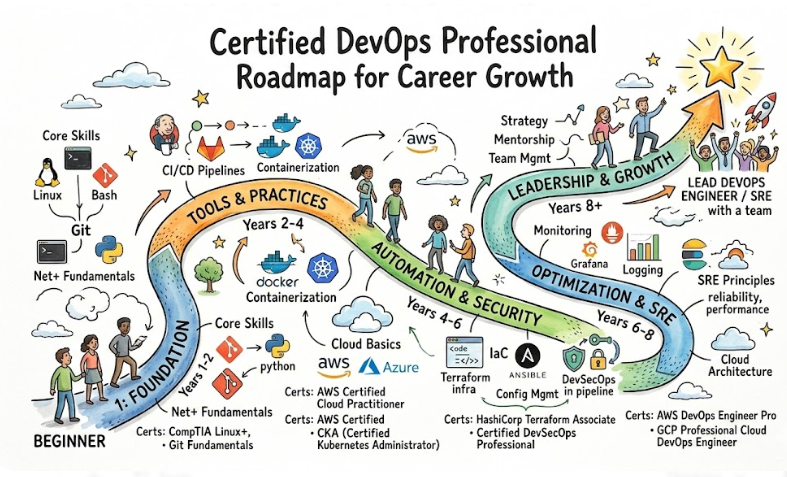
Introduction
Machine Learning Operations, which is commonly referred to as MLOps, is being recognized as the most critical bridge between the world of data science and the field of IT operations. As artificial intelligence continues to be integrated into everyday software products, the need for standardized and reliable processes is being felt more than ever before. The MLOps Certified Professional (MLOCP) program is specifically designed to address this industry gap by providing a very structured and logical framework for deploying, managing, and scaling machine learning models in a production environment. It ensures that the gap between a model working on a laptop and a model working for millions of users is closed safely.
What is MLOps Certified Professional (MLOCP)?
The MLOps Certified Professional (MLOCP) is a high-level professional credential that focuses on the vital intersection of machine learning, software engineering, and platform operations. It is intended to validate the specific technical skills that are required to automate the entire lifecycle of machine learning models. Through this certification program, the many complexities of moving a model from a simple local development environment to a production-ready, highly secure cloud infrastructure are simplified and standardized. It is not just about the code; it is about the entire system that supports the code in a live environment.
Why it matters in today’s software, cloud, and automation ecosystem
In the current technological landscape, many organizations are found to be struggling with the difficult transition of AI projects from experimental research phases to actual real-world applications. MLOps is used as a primary solution to solve what is known as “hidden technical debt” in machine learning systems. By adopting these MLOps practices, the overall reliability of the system is increased, and the time taken to deploy new models is significantly reduced from months to just a few days. For companies operating in India and across the global markets, having certified professionals on the team ensures that expensive AI investments actually result in stable, high-performing products that provide value to customers.
Why certifications are important for engineers and managers
Certifications are viewed by the industry as a clear benchmark for professional competency and dedication to a specific field. For engineers, a certification like the MLOCP provides a very structured learning path that might otherwise be missed through unorganized self-study or trial and error on the job. For managers and leadership teams, it serves as a reliable validation that their team members possess the necessary skills to handle production-level AI workloads without causing system failures. In a highly competitive job market, certified professionals are often prioritized during the hiring and promotion process because their foundational knowledge has already been verified by an independent authority.
Certification Overview Table
| Track | Level | Who it’s for | Prerequisites | Skills Covered | Recommended Order |
| MLOps | Professional | DevOps & Software Engineers | Basic DevOps & Python | CI/CD for ML, Monitoring | After DevOps/Cloud basics |
Provider: DevOpsSchool
Why Choose DevOpsSchool?
DevOpsSchool is chosen by thousands of working professionals because of its extremely deep focus on practical, industry-aligned training methods. The entire curriculum is developed and updated by senior experts who have spent many decades working in the field, ensuring that the content is not just theoretical but is directly applicable to real-world business scenarios.
Comprehensive support is provided to every learner, helping them to navigate through complex and difficult technical topics with a lot of ease. By choosing this specific platform, access is gained to a global community of experts and a massive library of resources that are specifically tailored to meet the needs of the modern IT industry. The focus here is always on making sure that the student can perform the tasks in a real office environment immediately after completing the certification.
Certification Deep-Dive: MLOps Certified Professional (MLOCP)
What is this certification?
This certification is a master-level credential that validates the ability of an individual to design, implement, and manage complex MLOps workflows. It covers the entire lifecycle of a machine learning model, starting from initial data preparation and ending with final deployment and continuous automated monitoring. It is considered a mark of excellence for those who want to lead AI infrastructure projects.
Who should take this certification?
- Software Engineers: Those who want to understand how their code interacts with machine learning models in a production setting.
- DevOps Engineers: Professionals who are already experts in automation but want to specialize in the unique requirements of AI systems.
- Data Engineers: Individuals who manage data pipelines and want to ensure those pipelines feed into a reliable model deployment system.
- Engineering Managers: Leaders who oversee technical teams and need to understand the architectural requirements of MLOps to make better hiring and planning decisions.
Skills you will gain
- Automated CI/CD for ML: The ability to build continuous integration and continuous delivery pipelines that are specifically optimized for machine learning models and data.
- Containerization Expertise: High proficiency in using tools like Docker and Kubernetes to package models so they can run consistently on any server.
- Model and Data Versioning: A deep understanding of how to track changes in both the code and the data to ensure that any model can be reproduced or rolled back if a failure occurs.
- Automated Testing: Expertise in creating automated tests that check for the quality of data, the accuracy of models, and the security of the infrastructure.
- Production Monitoring: Knowledge of how to monitor model performance in real-time and how to detect “data drift” or “concept drift” before it affects the business negatively.
Real-world projects you should be able to do after this certification
- End-to-End ML Pipeline: A fully automated pipeline can be built that retrains a model automatically whenever new data is detected in the system.
- Scalable Serving Infrastructure: A highly scalable infrastructure can be deployed using Kubernetes that allows thousands of users to get predictions from a model at the same time.
- Centralized Monitoring Dashboard: A centralized system can be implemented that tracks the health and performance of multiple machine learning models across different cloud environments.
Preparation plan
7–14 days plan
In this very short duration, the primary focus is placed on understanding the core theoretical concepts of MLOps. The official documentation provided by the certification body is reviewed thoroughly. Basic hands-on labs are completed to understand the command-line tools. Familiarization with the exam format and types of questions is achieved through basic practice sets.
30 days plan
A more balanced approach is taken where at least two hours are dedicated every day to structured learning. Deep dives into specific CI/CD tools and model monitoring frameworks are conducted. Several small-scale MLOps projects are built from scratch to reinforce the theoretical knowledge gained during the first two weeks.
60 days plan
This is the most comprehensive and recommended path for full mastery. A detailed study of various cloud-native machine learning services is performed across different providers. Complex, end-to-end projects are implemented, which include full security integration and automated testing. Multiple full-length mock exams are taken to ensure total readiness for the final certification.
Common mistakes to avoid
- Ignoring Operations: A very common mistake is focusing too much on the “Machine Learning” algorithms while completely ignoring the “Operations” and infrastructure side.
- Neglecting Data Versioning: The importance of versioning the data is often underestimated, leading to models that cannot be explained or reproduced later.
- Manual Monitoring: Many engineers forget to automate the monitoring process, which leads to models failing in production without anyone noticing until it is too late.
Best next certification after this
- Same track: Advanced MLOps Architect for those who want to design large-scale global systems.
- Cross-track: DevSecOps Certified Professional to learn how to secure the AI pipelines from cyber threats.
- Leadership / management: IT Strategy and Digital Transformation for those moving into executive roles.
Choose Your Learning Path
Choosing the correct path is essential for long-term career growth. Here are six highly structured paths explained:
- DevOps Path: This path is best suited for those who want to master the art of general automation, cloud infrastructure, and traditional software delivery. It is the foundation for almost all other tracks.
- DevSecOps Path: This is intended for professionals who want to make security a core part of the development process. It is highly recommended for those working in banking, healthcare, or government sectors.
- Site Reliability Engineering (SRE) Path: This is best for engineers who are obsessed with system uptime, high availability, and performance tuning. It teaches how to build systems that almost never fail.
- AIOps / MLOps Path: This modern path is designed for those who want to apply the best principles of DevOps to the world of Artificial Intelligence. It is the fastest-growing field in the current market.
- DataOps Path: This is best for Data Engineers and Architects who want to ensure that data delivery is as automated and reliable as software delivery. It focuses on the “plumbing” of the data world.
- FinOps Path: This is intended for those who want to bridge the gap between engineering and finance. It teaches how to manage and optimize cloud costs so that the company saves money while scaling.
Role → Recommended Certifications Mapping
To help with your specific career planning, the following certifications are recommended based on your current or target role:
- DevOps Engineer: DevOps Certified Professional should be taken first, followed immediately by the MLOCP to gain a competitive edge.
- Site Reliability Engineer (SRE): SRE Certified Professional is the core requirement, with AIOps Professional as a secondary specialization.
- Platform Engineer: Kubernetes Certified Specialist is essential, along with MLOCP to manage modern AI-driven platforms.
- Cloud Engineer: Multi-Cloud Architect certifications are recommended to understand how to manage diverse cloud environments.
- Security Engineer: DevSecOps Certified Professional is the most important credential for this specific role.
- Data Engineer: DataOps Professional should be the primary focus, supported by MLOCP for model deployment skills.
- FinOps Practitioner: FinOps Certified Professional is required to master the financial management of the cloud.
- Engineering Manager: Leadership in Tech and MLOps for Managers are highly recommended to lead technical teams effectively.
Next Certifications to Take
Based on your current learning progress, these are the recommended logical next steps:
- For the MLOps Learner:
- Same-track: MLOps Architect (for deeper technical mastery).
- Cross-track: DevSecOps Professional (to add security skills).
- Leadership-focused: Engineering Management Excellence (for future leaders).
- For the SRE Learner:
- Same-track: Advanced SRE (for high-scale systems).
- Cross-track: AIOps Professional (to use AI for system monitoring).
- Leadership-focused: Strategic IT Leadership (for moving into Director roles).
Training & Certification Support Institutions
Several well-known institutions provide excellent support and training for these programs:
- DevOpsSchool: A very wide range of technical courses is offered here. A strong emphasis is placed on hands-on labs where students work on real servers. It is famous for its very detailed curriculum and expert mentorship.
- Cotocus: This institution is highly recognized for providing specialized training in niche and advanced areas like AIOps and MLOps. Support is provided for both individual career changers and large corporate teams.
- ScmGalaxy: This is a massive community-driven platform where a wealth of resources for software configuration and DevOps is shared for free. It is a great place for deep technical reading and staying updated.
- BestDevOps: The primary focus here is on providing simplified and easy-to-understand learning paths for beginners. High-quality training materials are provided to ensure that every student succeeds in their certification exam.
- devsecopsschool.com: This specific site is dedicated entirely to the field of security within the DevOps lifecycle. Specialized training and certifications for DevSecOps are provided here.
- sreschool.com: The core principles and advanced practices of Site Reliability Engineering are taught here. It is considered a top choice for those aiming for high-paying SRE roles in top tech companies.
- aiopsschool.com: Training for the application of Artificial Intelligence in IT Operations is provided. It helps engineers understand how AI can be used to predict and prevent system failures.
- dataopsschool.com: This platform focuses specifically on the automation of data delivery, data quality, and data governance. It is highly recommended for all modern Data Engineers.
- finopsschool.com: Practical guidance on cloud financial management and cost optimization is provided here. It is the best place for learning how to control cloud spending.
FAQs Section
General Career FAQs
- What is the overall difficulty level of these certifications?
The difficulty is considered to be moderate to high because a combination of deep technical theory and actual hands-on experience is required to pass. - How much time is usually required to prepare for the exam?Usually, a period of 30 to 60 days is found to be sufficient if a consistent study routine is maintained every day.
- Are there any mandatory prerequisites for these programs?
A basic understanding of the Linux operating system, command-line usage, and at least one programming language like Python is highly recommended. - In what specific sequence should these certifications be taken?
It is generally advised to start with foundational DevOps certifications before moving into specialized areas like MLOps or DevSecOps. - What is the actual career value of being a certified professional?
Much higher salary potential is frequently reported by certified individuals, along with increased respect and credibility within the professional tech community. - Which specific job roles can I apply for after completing the MLOCP?
Roles such as MLOps Engineer, Machine Learning Operations Lead, and AI Platform Engineer can be successfully pursued. - Is periodic recertification required for these credentials?
Yes, certifications are typically updated every two to three years to ensure that the professional’s knowledge stays current with changing technology. - Can these certifications be taken by fresh graduates or freshers?
While it is possible, having at least some basic industry experience is highly recommended to fully understand the practical challenges discussed in the course. - Are online exam options available for international students?Yes, all exams are generally conducted online through secure and proctored platforms that can be accessed from anywhere in the world.
- How do these certifications help in gaining jobs in global markets?
These certifications are recognized globally, which makes it much easier to find high-paying opportunities in regions like the US, Europe, and the Middle East. - Do these certifications help in long-term career growth?
A very clear and structured path for moving from junior roles to senior, lead, and even architectural roles is provided through these programs. - Is formal training mandatory to sit for the certification exam?While not always strictly mandatory, taking a formal training course is highly recommended to ensure that all exam topics are covered in detail.
MLOps Certified Professional (MLOCP) Specific FAQs
- Is knowledge of the Python language mandatory for the MLOCP?
Yes, a basic to intermediate understanding of Python is required because almost all modern MLOps tools and scripts are based on it. - Does the MLOCP program cover specific cloud platforms?
Yes, the core principles that are taught can be applied to all major cloud providers including AWS, Microsoft Azure, and Google Cloud Platform. - Is very deep mathematical knowledge required for this certification?
No, the primary focus is on the operations, automation, and infrastructure side rather than on building complex mathematical or statistical models. - Will I learn about Kubernetes as part of this program?Yes, Kubernetes is covered in detail because it is the industry-standard tool for deploying and managing machine learning models at scale.
- What specific tools are included in the MLOCP curriculum?
A variety of tools such as Docker, Jenkins, Git, and specialized ML tracking and orchestration tools are explored during the training. - Is this certification recognized by large technology companies?Yes, it is highly valued by tech companies and startups that are currently scaling their AI operations and need reliable engineers.
- How is the MLOCP different from a standard Data Science certification?
Data science focuses on the creation and training of models, while the MLOCP focuses on the deployment, scaling, and maintenance of those models in production. - Can I transition from a traditional DevOps role to an MLOps role easily?
Yes, the MLOCP certification is designed to be the perfect bridge to help DevOps professionals move into the high-growth field of MLOps.
Testimonials
“The MLOCP program provided me with the absolute clarity I needed to handle production-grade AI models. My confidence in managing complex automated pipelines has grown significantly since I completed the course.”
— Arjun
“A very practical and hands-on approach was taken during the entire training session. The skills I gained are now being applied every day in my role as an SRE to improve the uptime of our machine learning services.”
— Priya
“The structured nature of the course helped me to identify the major gaps in our team’s current deployment process. Our overall efficiency has improved greatly thanks to the insights I gained from DevOpsSchool.”
— Rahul
“Security in AI was a major concern for our organization. The knowledge I gained here allowed us to successfully integrate automated security checks into our machine learning workflows for the first time.”
— Sanjay
“As an engineering manager, I now have a much better understanding of the infrastructure and talent required for our AI projects. It has helped me to plan our team’s resources and hiring more effectively.”
— Amit
Conclusion
The MLOps Certified Professional (MLOCP) certification is a truly powerful tool for anyone who is looking to excel and lead in the modern technology era. By bridging the critical gap between machine learning research and daily IT operations, it opens doors to some of the most exciting and highly-paid roles in the global industry today.
Long-term career benefits include much higher growth potential, increased job stability, and the unique ability to lead cutting-edge AI initiatives from the front. Strategic planning of your learning path and certification goals is highly encouraged for those who wish to stay relevant, competitive, and successful in the ever-evolving world of software, cloud, and automation.
Leave a Reply