Introduction
Tax season often brings a sense of panic to many working professionals. Staring at government portals, downloading statements, and matching numbers can feel like solving a complex puzzle. Many salaried employees believe filing taxes is difficult because of complicated financial terms and legal jargon.
However, filing your Income Tax Return does not have to be stressful. Once you break the process down into a simple, step-by-step checklist, it becomes as straightforward as online shopping.
Poor tax filing can cause serious problems. If you miss important income details or forget to claim valid deductions, you might end up paying extra tax, facing notices from tax authorities, or delaying your tax refunds.
This guide provides a complete checklist for salaried employees. It walks you through every essential document, the filing process, and common traps to avoid so you can file your taxes with confidence.
What Is an Income Tax Return (ITR)?
An Income Tax Return (ITR) is a official form that individuals use to report their total income earned and taxes paid to the government during a financial year.
Think of it as a financial report card. You submit this report to the tax department to show how much money you made from your job, bank interest, or investments, and how much tax was already deducted from your paycheck.
Why It Matters
Filing your ITR is a legal requirement if your income crosses the basic exemption limit. Beyond compliance, an ITR document serves as proof of income. Banks require your ITR when you apply for home loans, car loans, or credit cards. Foreign embassies also frequently ask for past ITRs when reviewing visa applications.
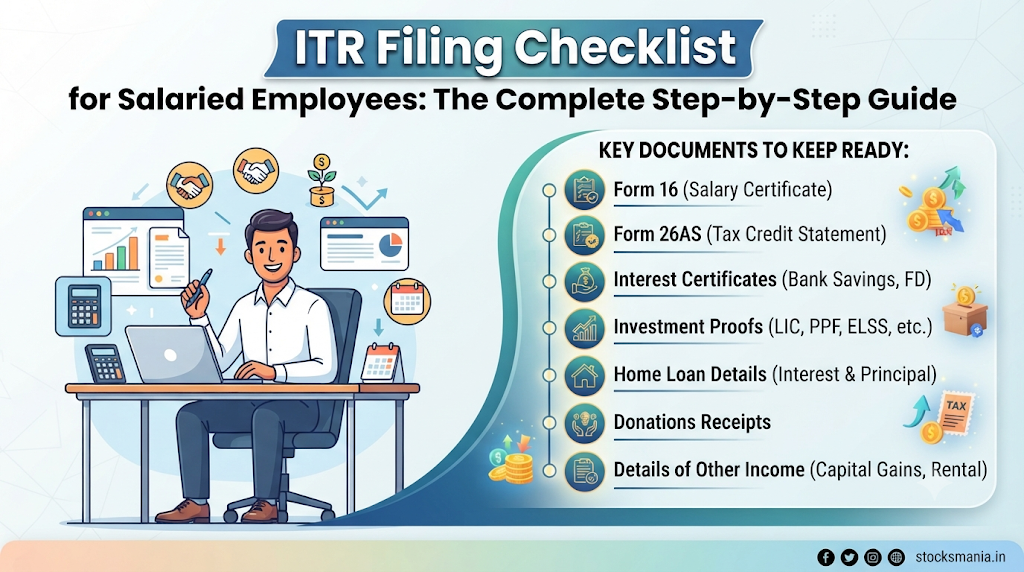
Essential Documents Required for Salaried Employees
Before you log into the tax portal, you must gather all necessary paperwork. Having these documents ready saves time and prevents calculation errors.
1. Form 16
Form 16 is a certificate issued by your employer that details the salary you earned and the tax (TDS) your employer deducted and deposited with the government on your behalf. It contains two parts: Part A (tracks tax deductions and deposits) and Part B (breaks down your salary structure, allowances, and deductions).
2. Form 26AS and AIS (Annual Information Statement)
Form 26AS and AIS are consolidated financial statements available on the tax portal. They record all financial transactions linked to your Permanent Account Number (PAN).
- Why it matters: They show taxes deducted by your employer, banks, or tenants, along with high-value financial transactions like mutual fund purchases or property deals. Your ITR data must match these statements.
3. Investment Proofs and Savings Certificates
These include documents supporting tax-saving investments and expenses, such as life insurance policies, Public Provident Fund (PPF) statements, tuition fee receipts for children, and equity-linked saving scheme (ELSS) proofs.
4. Bank Account Statements
You need statements from all your active savings accounts for the financial year. These help you calculate interest earned on your savings accounts and fixed deposits, which is taxable income.
5. Home Loan Interest Certificate
If you pay a home loan, your bank provides a certificate detailing the split between the principal repayment and the interest paid. The interest portion helps you claim deductions on your taxable income.
Understanding Tax Regimes: Old vs. New
Salaried employees must choose between two tax structures when filing returns. Selecting the right regime can significantly lower your tax liability.
- Old Tax Regime: This system offers numerous deductions and exemptions—such as Section 80C, 80D, House Rent Allowance (HRA), and Leave Travel Concession (LTC)—allowing you to lower your taxable income if you have active investments and expenses.
- New Tax Regime: This system offers lower tax slab rates but removes almost all major deductions and exemptions.
How to Choose
If you have high deductions (such as a large home loan interest, high PPF investments, and high medical insurance), the Old Tax Regime is often better. If you prefer simple finances without locking your money into specific tax-saving instruments, the New Tax Regime usually works out to be more beneficial due to its lower tax rates.
Common Mistakes to Avoid
Even experienced professionals make errors during tax season. Watch out for these common pitfalls:
- Mismatched TDS Data: Failing to match the TDS figures in your Form 16 with Form 26AS and AIS. If numbers do not match, the tax department may send a discrepancy notice.
- Failing to Report Bank Interest: Many people only report their salary and forget to add interest earned from savings accounts and fixed deposits. All interest is taxable income.
- Selecting the Wrong ITR Form: Using ITR-1 when your income sources require ITR-2 (such as capital gains from stocks or owning multiple houses).
- Missing the Deadline: Filing after the due date can attract late fees and interest penalties on unpaid taxes.
- Forgetting to E-Verify: Filing the return is not enough. You must complete electronic verification (e-verification) via Aadhaar OTP or net banking within the designated timeframe to make your return valid.
Key Terms
- TDS (Tax Deducted at Source): Tax collected directly from your income source (like your salary or bank interest) before it is paid to you.
- PAN (Permanent Account Number): A unique 10-character alphanumeric identifier issued by the tax department to track financial transactions.
- Deduction: Specific expenses or investments that the government allows you to subtract from your total income to lower your taxable amount.
- Exemption: Specific types of income or earnings that are completely free from income tax by law.
- E-Verification: The final step of confirming your submitted tax return online using Aadhaar OTP or other approved electronic methods.
Frequently Asked Questions
1. Is it mandatory for salaried employees to file an ITR if tax is already deducted?
Yes. Even if your employer deducts TDS from your salary, filing your ITR is mandatory if your total gross income exceeds the basic exemption limit. It is also required if you want to claim a tax refund.
2. What happens if I file my ITR after the due date?
Filing after the deadline can result in late fees, interest charges on any unpaid tax dues, and the loss of the ability to carry forward certain financial losses.
3. Can I change my tax regime after submitting my choice to my employer?
Yes. Salaried employees generally have the option to choose or switch their tax regime directly on the income tax portal when filing their return, regardless of what they declared to their employer earlier in the year.
4. Do I need to attach physical documents to my online tax return?
No. India’s e-filing system is paperless. You do not need to attach or upload physical bills, investment proofs, or salary slips when filing, but you must keep them safely stored for several years in case the tax department requests them later.
5. What should I do if I discover an error after submitting my ITR?
If you find a mistake after filing, you can file a Revised Return on the tax portal before the specified deadline to correct the errors without penalty.
Conclusion
Filing your Income Tax Return does not need to feel like an intimidating chore. By gathering your documents early, understanding your tax regime options, matching your TDS data, and double-checking your numbers against your AIS statement, you can complete your filing smoothly and accurately. Take your time, follow the checklist, and file early to avoid last-minute stress.
Leave a Reply