Introduction
Filing taxes is often the most stressful part of running a business. Between managing daily operations, paying staff, and keeping customers happy, paperwork gets pushed to the bottom of the pile.
Many business owners find tax laws confusing. Words like “audit,” “depreciation,” and “deductions” sound like a foreign language. Because of this, mistakes happen. Some people pay too much tax, while others miss deadlines and face heavy fines.
This guide breaks down everything you need to know about Income Tax Return (ITR) filing for business owners. You do not need a degree in finance to understand it. We will look at which forms to use, how to avoid costly errors, and how to make the whole process smooth and stress-free.
What Is ITR Filing for Business Owners?
An Income Tax Return (ITR) is a formal document you submit to the government. It shows how much money your business earned, what expenses you paid, and your net profit over the financial year.
For a business owner, filing an ITR is not just about paying tax. It is an official record of your business’s financial health.
Why Does It Matter?
- Legal Compliance: The law requires anyone earning taxable business income to file a return.
- Loan Approvals: Banks and financial institutions ask for your past ITR copies before approving business loans or working capital.
- Visa Applications: Embassies often check your ITR to prove you have a stable income and strong financial backing in your home country.
- Carrying Forward Losses: If your business lost money this year, filing on time lets you use that loss to lower your taxes in future profitable years.
Which ITR Form Should a Business Owner Use?
Choosing the right ITR form is the first and most important step. Using the wrong form can lead to your return being rejected or flagged for a tax notice.
1. ITR-3
- Who is it for? Individuals and Hindu Undivided Families (HUFs) who run a business or practice a profession (like doctors, lawyers, or consultants) and maintain regular books of accounts.
- Simple Meaning: If you have regular business income, track your exact expenses, and keep formal account books, this is usually your form.
2. ITR-4 (Sugam)
- Who is it for? Resident individuals, HUFs, and partnership firms (excluding Limited Liability Partnerships) with total income up to 50 lakh rupees and business income calculated under Presumptive Taxation.
- Simple Meaning: If your business is small and you do not want to maintain complex account books, you can declare a set percentage of your turnover as profit and pay tax on that. ITR-4 makes this very easy.
3. ITR-5 and ITR-6
- Who are they for? Partnership firms, Limited Liability Partnerships (LLPs), and registered companies use these forms. ITR-5 is for firms and LLPs, while ITR-6 is for corporate companies.
Understanding Presumptive Taxation (Sections 44AD and 44ADA)
For many small business owners, calculating exact profits and expenses is exhausting. The government offers a shortcut called Presumptive Taxation.
What Is It?
Instead of tracking every single rupee spent on tea, electricity, and travel, the law assumes your business makes a standard profit based on your total sales or turnover.
How It Works
- For Businesses (Section 44AD): If your digital transactions are high, your profit is assumed to be 6% of your total turnover. For cash transactions, it is assumed to be 8% (or higher if you actually made more).
- For Professionals (Section 44ADA): Doctors, engineers, accountants, and interior designers can assume their net profit is 50% of their total gross receipts, provided their gross receipts do not cross specific limits.
Why It Matters
It saves time, lowers accounting costs, and reduces the chance of a detailed tax audit. However, if your actual profit is much lower than these preset percentages and you want to report the lower amount, you must maintain proper books of accounts and file ITR-3 instead.
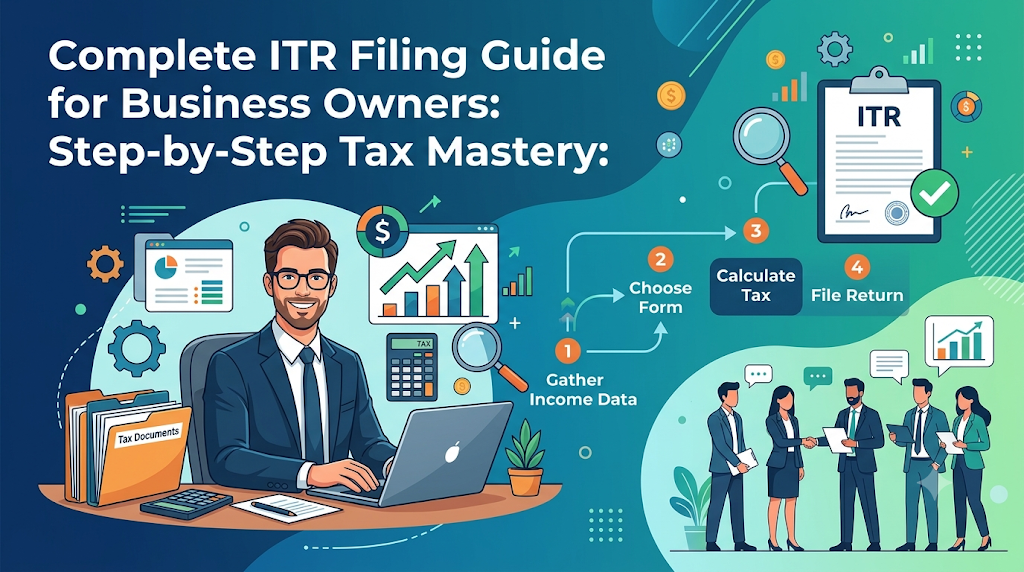
Step-by-Step ITR Filing Process for Business Owners
Filing your business tax return requires preparation. Rushing through it on the last day almost always leads to mistakes.
Step 1: Gather Your Financial Documents
Before logging into the tax portal, keep these documents ready:
- Profit and Loss Statement and Balance Sheet (if applicable).
- Bank statements for all business accounts for the entire financial year.
- GST returns filed during the year (if registered under GST).
- Details of TDS (Tax Deducted at Source) certificates or Form 16A.
- Asset depreciation schedules.
- Aadhaar and PAN linked together.
Step 2: Reconcile Sales with Financials
Make sure your total revenue matches across all records. Your GST filings, bank deposits, and sales ledger should match. Tax departments use automated systems to spot mismatches between GST data and income tax data.
Step 3: Calculate Net Profit and Deductions
Subtract all valid business expenses from your total revenue.
- Valid expenses include: Office rent, employee salaries, utility bills, raw materials, internet charges, and software subscriptions.
- Personal expenses: Do not mix personal shopping or family vacation costs into business expenses.
Step 4: Choose and Fill the Correct ITR Form
Log into the official income tax e-filing portal. Select the correct assessment year and ITR form. Enter your financial data carefully, cross-checking numbers with your balance sheet and P&L statement.
Step 5: Verify and Submit
Once filled, compute your tax liability. If tax is due, pay it online and enter the challan details. Finally, submit the form and complete the verification process (usually via Aadhaar OTP or Electronic Verification Code) within the allowed timeframe.
Common Mistakes Business Owners Make
Even smart entrepreneurs make avoidable errors during tax season. Watch out for these traps:
| Common Mistake | Why It Happens | How to Avoid It |
| Mixing Personal and Business Funds | Using the same bank account for groceries and business purchases. | Open a separate current account strictly for business transactions. |
| Missing GST and ITR Matching | Filing one set of revenue numbers for GST and a different set for Income Tax. | Reconcile GST turnover with your P&L statement before filing. |
| Failing to Claim Depreciation | Forgetting that business assets lose value over time. | Maintain a fixed asset register and calculate depreciation yearly. |
| Waiting Until the Last Day | Procrastinating due to fear of paperwork. | Start gathering documents at least one month before the deadline. |
Key Terms Explained
- Turnover: The total amount of money your business brings in through sales of goods or services before subtracting any expenses.
- Audit: An official examination of your financial records by a certified Chartered Accountant to verify their accuracy.
- TDS (Tax Deducted at Source): A system where the person paying you cuts a small percentage of tax and deposits it with the government on your behalf before handing you the rest.
- Depreciation: The reduction in the value of business assets (like computers, machinery, or delivery vans) over time due to use and age.
Frequently Asked Questions
1. What is the due date for business owners to file ITR?
For businesses that do not require a tax audit, the due date is usually July 31st of the assessment year. If your business requires a tax audit, the deadline is typically extended to October 31st.
2. Can I file my business ITR on my own?
Yes, if your business is small, uses presumptive taxation, and you understand basic accounting. However, if you have complex accounts, multiple partners, or require a tax audit, it is wise to hire a qualified Chartered Accountant.
3. What happens if I miss the ITR filing deadline?
If you miss the deadline, you can file a Belated Return, but you will have to pay late fees and potential interest on unpaid taxes. You also lose the right to carry forward current-year business losses.
4. Are business loans considered taxable income?
No. Loans are borrowed money that you have to pay back, so they are not counted as revenue or profit. Do not include loan amounts when calculating your business income.
5. Can I deduct personal medical bills as a business expense?
Generally, no. Personal medical bills belong to you as an individual, not your commercial operations. However, you can claim tax deductions for medical insurance under specific sections of personal tax laws (like Section 80D).
6. What should I do if I made a mistake in my filed ITR?
If you spot an error after submitting your return, the law allows you to file a Revised Return correcting the mistake before the end of the relevant assessment year.
Conclusion
Filing your business ITR does not have to be a nightmare. By understanding your correct form, keeping your bank statements organized, and separating business expenses from personal ones, you can complete the process smoothly.
Stay organized throughout the year rather than scrambling at the last minute. Clean financial records protect you from legal trouble, build trust with lenders, and give you a clear picture of how much money your business is truly making.
Leave a Reply