Introduction
For thousands of skilled professionals worldwide, relocating to Austria is the ultimate career and lifestyle goal, offering a world-class social structure, pristine natural beauty, and a remarkably high standard of living. However, turning this dream into a reality requires navigating a transparent, criteria-based immigration framework known as the Red-White-Red (Rot-Weiß-Rot) Card. Because Austria manages its skilled migration through a strict, points-based statutory grid rather than random lotteries, utilizing interactive tools like the immigration points calculator on DesiNRI allows you to benchmark your qualifications against real-world government criteria before you ever book an embassy appointment. By looking past the confusing legal jargon, you can break down exactly how this scoring system operates, identify your specific immigration stream, and take practical, proactive steps to maximize your final score.
What is the Austria PR Points Calculator?
The Austria PR points calculator is an analytical tool built to mimic the official assessment metrics used by the Austrian Federal Government (specifically the Public Employment Service, known locally as the AMS). Because Austria does not use a random lottery or a purely subjective review process, it relies on an objective, points-based grid to evaluate whether an applicant will bring meaningful value to the local economy and society.
Why It Matters
Think of the points calculator as your strategic roadmap. Before you spend money on document legalizations, translation services, or official visa application fees, you need to know if you meet the baseline requirements. It saves you time, prevents unexpected rejections, and highlights the exact areas—such as language skills or professional certifications—where you might need to invest a little more effort to secure your approval.
How It Works
- Category Selection: You choose your specific immigration stream (such as a Skilled Worker in a Shortage Occupation or a Very Highly Qualified Worker).
- Data Input: You input your precise age, highest level of completed education, total years of relevant work experience, and official language test scores.
- Score Tallying: The tool automatically weighs your inputs against the statutory maximums allocated for each category.
- Eligibility Output: The calculator provides an instant estimate of your total score, indicating whether you hit or exceed the mandatory minimum target.
Understanding the Eligibility Streams
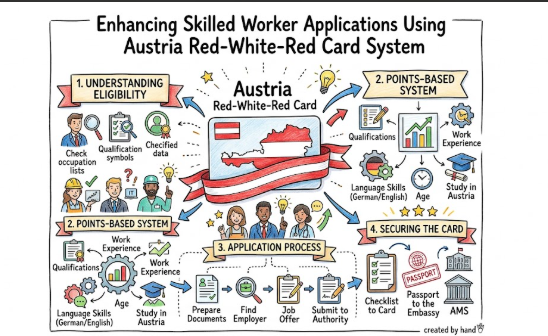
To calculate your points accurately, you first need to identify which immigration stream fits your profile. Austria categorizes skilled applicants into specific groups, each with its own points allocation and minimum requirements.
1. Minimum Points Required
- Very Highly Qualified Workers: You need a minimum of 70 out of 100 points. If you hit this mark, you can actually apply for a 6-month Job Seeker Visa to look for work directly inside Austria, even without a pre-existing job offer.
- Skilled Workers in Shortage Occupations: You need a minimum of 55 out of 90 points. This route requires a concrete job offer from an Austrian employer in a field officially recognized as a shortage trade (such as software engineering, mechanical trades, or specific healthcare roles).
- Other Key Workers: You need a minimum of 55 out of 90 points, along with a job offer that meets a legally mandated minimum monthly salary threshold.
2. The Core Evaluation Factors
The points framework balances several key pillars of your professional and personal life:
- Education Benefits: Higher qualifications yield higher points. A completed vocational training program or a university degree relevant to your field forms your profile’s foundation. If you graduated with a degree in a STEM field (Science, Technology, Engineering, or Mathematics), or if you completed your university studies directly at an Austrian institution, you are awarded significant bonus points.
- Work Experience: Experience points are awarded based on documented employment that directly matches your formal qualifications. The system rewards long-term career stability, calculating points for every six months of verifiable work. Crucially, if you have historical work experience gained directly inside Austria, those months are worth double the points of international experience.
- Language Skills: Communication is the bedrock of integration. You can claim points for both German and English skills. While English proficiency is highly valuable—especially in multinational corporate environments—even basic, verifiable German language skills (A1 or A2 level) can dramatically uplift a borderline score.
- Age Factor: The system is structured to favor individuals who can contribute to the national social security and tax systems over a multi-decade horizon. Because of this, younger applicants receive the maximum point allocations, with point values stepping down incrementally once you pass the ages of 30, 35, or 40 depending on your chosen visa stream.
How to Increase Your Austria PR Points
If you run your initial calculation and find yourself sitting just below the required passing mark, do not be discouraged. The points criteria are dynamic, and there are proactive, practical steps you can take to elevate your score:
- Advance Your Language Levels: This is the fastest, most controllable way to gain points. If you currently have basic conversational English, sit for an official IELTS or TOEFL exam to secure maximum points. Simultaneously, enrolling in a certified German language course (validated by ÖSD, Goethe-Institut, or TELC) to move from an A1 to an A2 or B1 level can instantly inject an extra 5 to 10 points into your application.
- Document Mid-Year Work Milestones: Because the Austrian AMS calculates professional experience in precise six-month increments, waiting an extra few months to hit a clean half-year or full-year anniversary at your current job before submitting your final application can give you the extra points needed to cross the eligibility threshold.
- Target Shortage Trades: If your background crosses multiple disciplines, tailor your job hunt and application toward Austria’s official “Shortage Occupations” list. The baseline entry barrier for shortage occupations is significantly lower (55 points) compared to the generalized highly qualified worker path (70 points).
- Secure a Higher-Tier Job Offer: For those applying under the “Other Key Workers” stream, negotiating a stronger gross monthly salary with your prospective Austrian employer not only secures your economic stability but can directly validate your eligibility during the local labor market testing process.
Step-by-Step Guide to Calculate Your Austria PR Points
Follow this straightforward sequence to manually map out your profile standing before initiating your formal documentation:
- Identify Your Professional Pathway: Review your current status. If you have an engineering or IT background and an active job offer, look at the Shortage Occupations grid. If you hold a PhD or senior executive background and want to search for a job on the ground, look at the Very Highly Qualified Workers grid.
- Gather Your True Age Metrics: Note your exact age at the projected time of your application submission, and match it against the corresponding tier to write down your age points.
- Analyze Your Academic Qualifications: Review your degree or diploma transcripts. Ensure your study program lasted a minimum of three to four years for full university points, and check if your major falls within a MINT/STEM classification.
- Tally Your Verifiable Experience: Count your post-qualification years of employment. Exclude casual student internships or unrelated roles. Break down the total into six-month blocks, separating any time worked inside Austria from your international tenures.
- Convert Your Language Capabilities: Look at your valid language certificates (ensure they are less than five years old). Match your CEFR levels (A1, A2, B1, B2) or IELTS bands to the designated point yields.
- Sum Your Scores: Add the points from steps 2 through 5. Compare your grand total against the mandatory minimum required for your chosen stream to determine your immigration readiness..
Common Mistakes to Avoid
- Counting Unverifiable Work Experience: You cannot claim points for employment that you cannot prove with formal tax documents, official reference letters, or matching bank statements. Casual freelance work or cash-in-hand roles will be discounted by the AMS reviewers.
- Using Expired Language Certificates: Language test results do not remain valid indefinitely for immigration purposes. Austria strictly mandates that your English or German language certificates must be less than 5 years old at the exact moment your application is processed.
- Mismatched Job Descriptions: If your formal degree is in an entirely different, unrelated field than your prospective Austrian job offer (for instance, a humanities degree paired with a software development job offer), the AMS may rule that your education does not match the qualification criteria for that shortage trade.
- Miscalculating the Age Tiers: Points are locked in on the exact day your application is officially registered with the authorities, not when you begin filling out your paperwork. If you are approaching a milestone birthday that drops your point bracket, ensure your submission is made well ahead of time.
Important Documents Needed
- A valid, unexpired international travel passport.
- Legalized or apostilled university degrees, diplomas, or vocational training certificates, alongside complete academic transcripts.
- Comprehensive reference letters from past employers detailing your exact job titles, daily core responsibilities, clear start and end dates, and historical salary structures.
- Official language passing certificates from accredited bodies (such as IELTS, TOEFL, Goethe-Institut, or ÖSD).
- A formal, legally binding employment contract or a highly detailed job offer confirmation (Arbeitsplatzsicherung) from a registered company based in Austria (if applying under a job-tied stream).
- Clear evidence of local accommodation arrangements in Austria, accompanied by valid comprehensive health insurance coverage.
Table 1: Austria PR / Residence Routes Comparison
| Immigration Pathway | Target Audience | Job Offer Required? | Minimum Points Needed | Key Feature / Benefit |
| Very Highly Qualified Workers | Scientists, researchers, high-level corporate executives, and PhD holders. | No (Can enter via a Job Seeker Visa) | 70 out of 100 | Provides a 6-month window to live in Austria while actively seeking long-term employment. |
| Skilled Workers in Shortage Occupations | Trained professionals in fields with national talent deficits (IT, engineering, specific trades). | Yes | 55 out of 90 | Lower points threshold focused heavily on matching vocational training to market needs. |
| Other Key Workers | Experienced professionals across general industries. | Yes | 55 out of 90 | Tied closely to meeting legally mandated minimum monthly salary baselines. |
Table 2: General Points Distribution Framework (Skilled Workers & Key Streams)
| Evaluation Category | Assessment Parameter / Tier | Points Awarded | Category Maximum Cap |
| Qualifications / Education | Completed vocational training in a shortage trade | 30 Points | 30 Points |
| General university admission eligibility | 25 Points | ||
| Completed 3+ year university degree | 30 Points | ||
| Work Experience | Every 6 months of international experience | 1 Point | 20 Points |
| Every 6 months of domestic Austrian experience | 2 Points | ||
| Language Proficiency | German Skills (A1 Level) | 5 Points | 25 Points |
| German Skills (A2 Level) | 10 Points | ||
| German Skills (B1 Level) | 15 Points | ||
| English Skills (A2 Level) | 5 Points | ||
| English Skills (B1 Level) | 10 Points | ||
| Age Group | Up to 30 years of age | 15 Points | 15 Points |
| Up to 40 years of age | 10 Points | ||
| Up to 50 years of age (Shortage stream only) | 5 Points |
Real Stories: Human Journeys to Austria
Testimonial 1: Ananya’s Leap from Bangalore to Vienna
When I first looked at the Austrian Red-White-Red system, I was sitting at 52 points as a systems engineer—just three points short of the mandatory 55-point bar for shortage occupations. Honestly, I panicked and almost gave up on my dream of moving to Europe. I felt completely stuck because I couldn’t change my age or my university degree. After speaking with an advisor, I realized I was overlooking my language options. I spent four intensive months studying basic German and cleared my A2 exam. Those extra 10 points changed everything. Today, walking through the streets of Vienna after a rewarding day at my tech firm, I look back and realize that the points system isn’t a brick wall—it’s just a puzzle that requires strategy and patience.
Testimonial 2: Marcus’s Transition from Cape Town to Linz
As a senior mechanical project manager in my late 30s, the age factor was working heavily against me on paper. I knew I was losing points that younger applicants got automatically, so my application had to be absolutely flawless elsewhere. My biggest hurdle wasn’t my qualifications; it was tracking down highly detailed reference letters from companies I had worked for a decade ago. It took weeks of endless emails and awkward phone calls across time zones to get letters that explicitly matched Austria’s rigid format requirements. When my Red-White-Red Card was finally approved for a position in Linz, the relief was indescribable. My family and I have an incredible quality of life here. My advice? Treat document gathering like a full-time job, because the immigration authorities check every single line item.
Benefits of Austria Immigration
- Unparalleled Quality of Life: Cities like Vienna consistently rank at the absolute pinnacle of global liveability indexes due to exceptional public safety, clean green spaces, and world-class infrastructure.
- Robust Social Systems: Residents enjoy access to highly subsidized, universal healthcare networks and deeply supportive public education frameworks for their families.
- A Gateway to Europe: Holding an Austrian residence permit allows you to travel freely throughout the entire Schengen Zone, making weekend getaways across Europe effortless.
- Long-Term Stability: The Red-White-Red Card serves as a secure, clear stepping stone toward obtaining a permanent Red-White-Red Card Plus (offering unrestricted labor market access), long-term EU residency, and eventually full Austrian citizenship.
Why Understanding the Points System is Critical
- Complete Financial Control: Knowing your exact points standing prevents you from spending hard-earned money on application processing fees when your profile isn’t quite ready.
- Strategic Career Alignment: It helps you understand exactly how European employers and government bodies view your international credentials, giving you the clarity needed to adjust your professional presentation.
- Peace of Mind: Stepping into an immigration embassy with a verified, mathematically sound points surplus shifts your mindset from anxiety to confidence.
Frequently Asked Questions (FAQs)
1. Can I combine my English and German language points to get a higher score?
Yes, depending on the immigration stream. In categories like Skilled Workers in Shortage Occupations, you can accumulate points for both languages up to the maximum category cap of 25 points. For example, holding a B1 certificate in German and a B1 certificate in English lets you stack those point values together.
2. What happens if I am just one or two points short of the minimum score?
The points thresholds set by the Austrian government are statutory and absolute. If the minimum required is 55 or 70 points, entering the system with a 54 or 69 will result in an automated refusal by the AMS. If you find yourself just shy of the target, you must actively work to build up your points—most easily by taking an official language test or accumulating a few more months of documented work experience.
3. Do my university degrees need to be officially evaluated before I calculate points?
To claim your points during the formal visa submission, your academic degrees must be properly recognized. This usually involves getting an apostille or a formal legalization stamp from your home country’s ministry of foreign affairs, followed by a certified translation into German or English.
4. Can I apply for the Red-White-Red Card if I don’t have a job offer yet?
You can only do this if you qualify under the Very Highly Qualified Workers stream by hitting at least 70 out of 100 points. If you meet this high threshold, Austria will grant you a 6-month Job Seeker Visa, allowing you to move to the country temporarily to look for a job. For the other streams, a formal, binding job offer from a local employer is mandatory.
5. Does freelance or self-employed work experience count toward my total points?
Yes, but it is subjected to intense verification. You must show clear business registration documents, matching tax returns, and comprehensive corporate contracts or invoices that prove your self-employment directly mirrors your formal area of qualification.
6. Is there a specific minimum salary required for the Austria PR points system?
For the “Other Key Workers” stream, your job offer must meet a strict, legally mandated monthly gross salary baseline that is updated by the government annually. For the “Shortage Occupations” stream, your salary must match the standard collective bargaining agreements (Kollektivvertrag) established for that specific trade in Austria.
7. How long is the language certificate valid for my points calculation?
Your German or English language passing certificates must be less than 5 years old at the exact time you lodge your visa application with the Austrian authorities. If your test was taken longer ago, you will need to re-sit the exam.
8. Are internships completed during my university studies counted as work experience?
Generally, mandatory student internships required to finish a degree program are not counted as independent professional work experience by the AMS. The system looks for post-qualification, full-time employment.
9. What is the difference between the Red-White-Red Card and the Red-White-Red Card Plus?
The standard Red-White-Red Card is valid for 24 months and ties your residency directly to one specific employer. After working continuously for 21 months under these terms, you can upgrade to the Red-White-Red Card Plus, which grants you complete, unrestricted access to the entire Austrian labor market, allowing you to change employers freely.
10. How long does the Austrian government take to process the points evaluation?
Once your complete physical application file is received by the local authorities and passed along to the Public Employment Service (AMS), the official assessment process generally takes between 4 to 8 weeks to reach a final determination.
Conclusion
The journey toward building a life in Austria is structured, logical, and entirely achievable if you approach it with the right strategy. The points system is not an arbitrary barrier; it is an objective framework that rewards your hard work, academic achievements, and language skills. By treating the points calculator as your personal roadmap, you take the guesswork out of immigration. You can clearly identify your strengths, address any minor gaps in your profile, and build a flawless application folder that matches exactly what the Austrian authorities are looking for.
With careful preparation, attention to detail, and a step-by-step approach to gathering your paperwork, you can transform your European aspirations into a practical reality.
Leave a Reply