Introduction
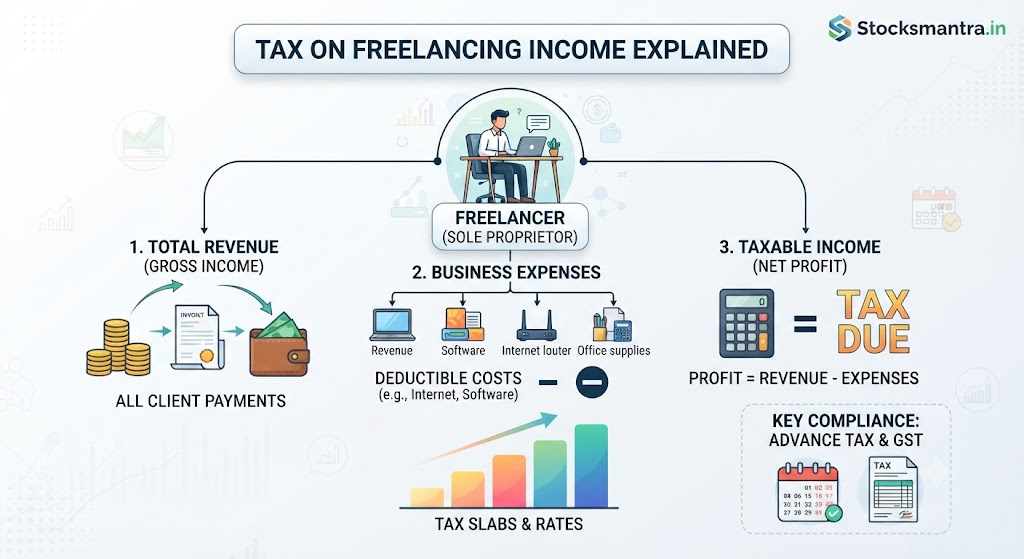
Working for yourself gives you total freedom. You choose your hours, your clients, and your projects. But when tax season arrives, that freedom can suddenly feel stressful.
Unlike a traditional 9-to-5 job where taxes are automatically deducted from your paycheck each month, freelancing puts full responsibility on your shoulders. Nobody calculates your tax for you. Nobody sets aside money for the government on your behalf.
Many beginners make the mistake of treating every dollar entering their bank account as pure profit. They spend it all, only to panic when tax deadlines approach. Understanding how tax on freelancing income works helps you avoid penalties, keep more of your hard-earned money, and run your freelance work like a true professional.
What Is Freelancing Income?
Freelancing income refers to any money you earn by providing services directly to clients without being on their permanent payroll.
Examples include freelance writing, graphic design, software development, consulting, photography, translation, and digital marketing.
Tax departments view freelancers as sole proprietors or independent contractors. Instead of earning a salary, you earn business revenue. This means the rules for taxing your money are quite different from standard salaried employment.
How Freelancing Income is Taxed
When you have a regular job, your employer deducts tax before you even see your salary. As a freelancer, you receive gross payments from your clients. You must calculate, report, and pay your taxes yourself.
Gross Income vs. Net Income
- Gross Income: The total amount of money your clients pay you over the financial year.
- Business Expenses: The legitimate costs you incur to run your freelance work, such as internet bills, software subscriptions, and computer hardware.
- Net Income: Your gross income minus your business expenses.
You pay income tax on your net income, not your gross income. This is why tracking every business expense is so important.
Tax Slabs and Rates
Tax authorities usually tax your net freelance income according to standard income tax slabs. If your total net earnings stay below the basic tax exemption limit, you may owe zero tax. If your earnings cross that threshold, your income falls into progressive tax brackets where higher amounts face higher tax rates.
Why Understanding Freelance Tax Matters
Ignoring tax obligations or guessing your numbers leads to severe financial risks.
- Legal Penalties: Tax authorities charge heavy fines and interest for late filing or missed payments.
- Cash Flow Surprises: If you do not set aside money throughout the year, paying a massive lump sum at tax time can drain your bank account.
- Missed Savings: Failing to claim legitimate business expenses means you end up paying far more tax than necessary.
Mastering the basics of self-employed taxation gives you financial peace of mind and protects your business from legal trouble.
Important Factors to Understand
Navigating freelance taxes requires knowing a few core concepts that govern how self-employed income is reported.
1. The Presumptive Taxation Scheme
Many tax systems offer a simplified option for small business owners and freelancers. Under a presumptive scheme, the government assumes that a fixed percentage of your total gross receipts is your net profit (for example, 50%). You pay tax only on that assumed profit without needing to maintain complex accounting books or track every tiny receipt. However, this option usually has upper revenue limits.
2. Advance Tax Payments
If your total tax liability for the year crosses a certain threshold, tax laws usually require you to pay your taxes in installments throughout the year rather than in one lump sum at the end. These are known as advance tax payments. Missing these deadlines attracts interest penalties.
3. Goods and Services Tax (GST) or Sales Tax
Income tax is separate from consumption taxes like GST. If your annual freelance revenue crosses the mandatory registration threshold set by your government, you must register for GST, collect it from your clients, and deposit it with the government.
Practical Examples
Let us look at how freelance taxation works using a simple scenario.
- The Scenario: Rohan works as a freelance graphic designer. Over the financial year, clients pay him a total of $40,000.
- The Expenses: To earn that money, Rohan spends $5,000 on design software subscriptions, a new laptop, website hosting, and high-speed internet.
- The Calculation:
- Gross Income = $40,000
- Business Expenses = $5,000
- Net Taxable Income = $35,000 ($40,000 – $5,000)
Rohan calculates his income tax based on the $35,000 net profit, rather than the initial $40,000 gross revenue. By keeping track of his software and hardware receipts, he successfully lowers his tax burden.
Real-World Considerations
Running a freelance business involves daily habits that make tax season smooth rather than chaotic.
Separate Your Bank Accounts
Never mix your personal spending money with your freelance earnings. Open a dedicated bank account specifically for your freelance business. All client payments go into this account, and all business expenses come out of it. This makes tracking your numbers effortless when filing taxes.
Save Money Consistently
As soon as a client pays you an invoice, immediately transfer a percentage (such as 20% to 30%) into a separate tax savings account. Doing this consistently ensures the money is ready when tax deadlines arrive.
Common Mistakes
| What People Do | Why They Do It | Why It Causes Problems | What They Should Do Instead |
| Mixing personal and business expenses | It feels easier to use one card for everything | Makes tracking legitimate write-offs nearly impossible and invites audits | Maintain a dedicated business bank account and credit card |
| Waiting until the last week to organize receipts | Procrastination and dread | Leads to missing valid expense deductions and costly filing errors | Update your income and expense records weekly |
| Ignoring advance tax rules | Thinking taxes are only paid once a year | Attracts statutory interest penalties and financial stress | Calculate and pay quarterly advance tax installments if required |
| Forgetting to factor in local sales tax or GST | Confusion between income tax and consumption tax | Results in unpaid compliance dues and government penalties | Check local revenue thresholds for mandatory sales tax registration |
Risks and Limitations
- Audit Risk: Claiming excessive or personal expenses as business deductions can trigger an audit by tax authorities.
- Cash Flow Drains: Failing to plan for quarterly tax installments can paralyze your daily freelance operations.
- Changing Regulations: Tax laws update frequently. Relying on outdated advice can lead to non-compliance.
To reduce these risks, consult a certified tax professional who understands freelance and self-employed income structures.
Comparison: Salaried Work vs. Freelancing Tax
| Feature | Salaried Employee | Freelancer / Independent Contractor |
| Tax Deduction Method | Tax deducted at source (TDS) by employer each month | Self-calculated and paid via advance tax or annual filing |
| Expense Deductions | Very limited standard deductions allowed | Broad range of business expenses can be deducted |
| GST / Sales Tax Compliance | Not applicable | Mandatory if annual revenue crosses government thresholds |
| Record Keeping | Minimal effort required from the worker | Strict bookkeeping and receipt tracking required |
Checklist for Freelance Tax Filing
- Separate all business transactions from personal bank accounts.
- Gather all invoices, client payment proofs, and bank statements for the financial year.
- Compile all legitimate business expense receipts (software, hardware, internet, workspace).
- Calculate total gross revenue and net taxable income.
- Review whether you need to file under regular taxation or presumptive taxation.
- Verify if you made all required advance tax payments throughout the year.
- Check if your revenue crosses the threshold requiring sales tax or GST registration.
- File your income tax return before the official government deadline.
Key Terms
- Gross Receipts: The total cash or digital payments received from clients before subtracting any expenses.
- Deduction: An eligible business cost that you subtract from your gross income to lower your taxable profit.
- Advance Tax: Partial tax payments made in installments to the government before the end of the financial year.
- Sole Proprietorship: A business structure where an individual owns and runs the enterprise independently without a separate corporate entity.
- Audit: An official official inspection and verification of your financial accounts and tax returns by tax authorities.
- Presumptive Tax: A simplified tax system where profit is calculated as a fixed percentage of gross revenue.
- Net Income: The final profit remaining after subtracting all valid business expenses from your total earnings.
- Fiscal Year: The 12-month period chosen by governments or businesses for accounting and tax-reporting purposes.
FAQs
Do I need to pay tax if my freelance earnings are very low?
If your total net taxable income stays below the basic exemption limit set by your government’s tax laws, you do not owe income tax. However, you may still need to file a tax return depending on local regulations.
Can I deduct my home internet bill as a freelance expense?
Yes, if you work from home, you can claim a fair percentage of your internet and electricity bills as business expenses, provided you use them for professional work.
What happens if I miss the freelance tax filing deadline?
Missing the deadline usually results in late fees, financial penalties, and daily interest charges on any unpaid tax amounts.
Do I need to register a formal company to pay freelance taxes?
No. Most freelancers operate as sole proprietors. You can report your freelance earnings directly on your personal tax return using your individual tax identification number.
Are client gifts or meals deductible business expenses?
In many jurisdictions, client entertainment or meal expenses are either partially deductible or non-deductible. Check local tax guidelines for specific rules regarding business entertainment.
How long should I keep my freelance tax records and receipts?
Tax authorities generally recommend keeping your financial records, invoices, and expense receipts for at least 5 to 7 years in case of an audit.
Can I deduct software subscriptions like Adobe or hosting fees?
Yes. Any software, tools, hosting platforms, or domain names purchased strictly for your freelance work qualify as deductible business expenses.
Do I charge GST or sales tax to international clients?
Exporting services to international clients often falls under zero-rated GST rules in many countries, meaning you may not need to charge local sales tax, but strict documentation is required to prove the export.
Conclusion
Paying tax on freelancing income does not have to be an intimidating ordeal. By keeping your business accounts separate, tracking your operational expenses diligently, and setting aside money for tax obligations throughout the year, you transform tax season from a stressful emergency into a simple administrative routine. Treat your freelance work like a real business, stay organized, and keep your financial records accurate.