Introduction
Buying and selling digital coins like Bitcoin or Ethereum has become very popular across India. For many beginners, watching crypto prices move up and down is exciting. However, the excitement often turns into confusion when tax season arrives.
Many people assume crypto exists outside the regular financial system, meaning the government cannot track it. That is a risky mistake. Indian tax authorities track digital asset transactions closely through exchanges and reporting rules.
If you do not understand how crypto taxes work, you might face heavy penalties, surprise tax bills, or notices from the tax department. This guide explains Indian crypto tax rules in clear, simple language, helping you stay compliant while protecting your hard-earned money.
What Is Crypto Tax in India?
In simple terms, crypto tax is the money you must pay to the government on the earnings you make from virtual digital assets.
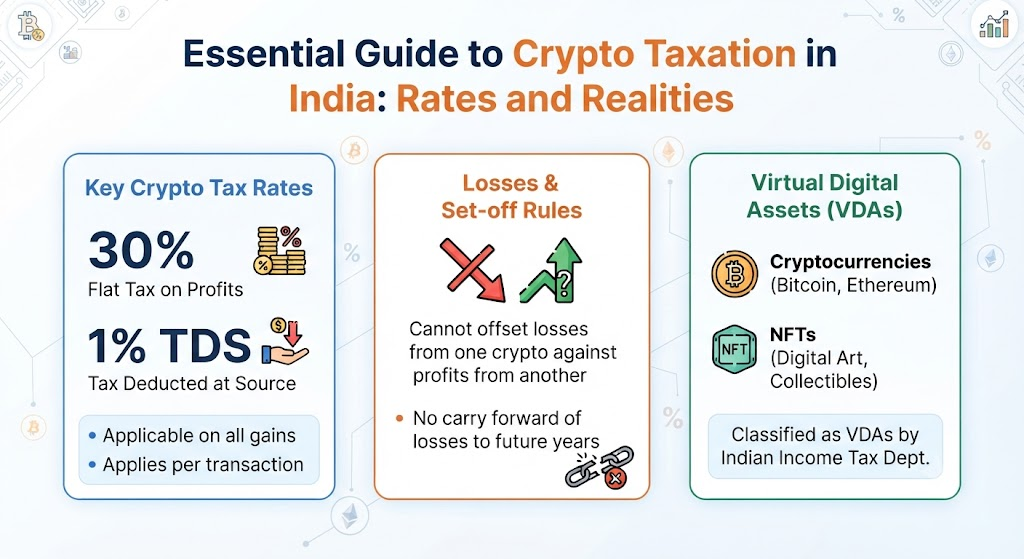
The Indian government officially classifies cryptocurrencies, tokens, and Non-Fungible Tokens (NFTs) as Virtual Digital Assets (VDAs). The Income Tax Department treats these assets similarly to speculative investments. Instead of taxing crypto under regular income tax slabs, the law applies a specific set of rules for digital asset transactions.
Why It Matters
Ignoring crypto taxes can lead to legal trouble. Tax offices use automated data tools to match crypto exchange records with your bank statements. Understanding these rules ensures you keep accurate records and avoid costly penalties.
How Crypto Income Works Under Indian Tax Law
The tax structure for cryptocurrencies in India relies on two main pillars: profit taxation and source deduction.
1. The 30% Flat Tax Rate
Whenever you transfer a virtual digital asset and make a gain, that profit is taxed at a flat rate of 30%.
- The Catch: You are not allowed to deduct most expenses incurred while earning that income. For example, if you buy a computer to mine crypto or pay internet bills, you cannot subtract those costs from your crypto profits. The only allowable deduction is the actual cost of buying the crypto asset itself.
2. The 1% TDS Rule
To track transactions and prevent tax evasion, the government introduced a 1% Tax Deducted at Source (TDS).
- When you sell crypto on an exchange, the platform deducts 1% of the transaction value and deposits it with the government on your behalf.
- You can claim credit for this TDS when filing your annual income tax return.
Why Can’t You Offset Crypto Losses?
In traditional stock trading, if you lose money on one stock, you can use that loss to lower the tax on your profits from another stock. This rule does not apply to crypto in India.
- If you make a profit of ₹50,000 on Bitcoin, you must pay a 30% tax on that ₹50,000.
- If you lose ₹30,000 on Ethereum in the same financial year, you cannot subtract that loss from your Bitcoin profit. You still pay tax on the full ₹50,000.
- Furthermore, crypto losses cannot be carried forward to future financial years.
Practical Examples: How the Math Works
Example 1: Making a Profit
- Action: You buy Bitcoin for ₹1,00,000 and sell it later for ₹1,50,000.
- Profit: ₹50,000.
- Tax Owed: 30% of ₹50,000 = ₹15,000 (plus applicable surcharge and 4% health and education cess).
Example 2: Gifting Crypto
- Action: You transfer crypto worth ₹50,000 as a gift to a friend.
- Tax Rule: The receiver of the gift must treat it as income and pay tax on its value, depending on the rules for gifts and VDAs.
Real-World Considerations for Crypto Investors
Managing crypto taxes requires more than just looking at your bank account balance at the end of the year.
- Multiple Exchanges: If you trade across different Indian and global platforms, tracking your cost basis (the original purchase price) becomes complicated.
- Crypto-to-Crypto Trades: Trading one cryptocurrency directly for another (such as swapping Bitcoin for a stablecoin) is also treated as a “transfer” under the law. You must calculate profit or loss on that trade at the time of the swap.
- Record Keeping: Always download your complete transaction history, ledger reports, and contract notes from every platform you use.
Common Mistakes Beginners Make
| What People Do | Why They Do It | Why It Causes Problems | What They Should Do Instead |
| Hiding crypto trades | Believing decentralized wallets are untraceable. | Exchanges share user data with tax authorities, leading to scrutiny and penalties. | Declare all transactions honestly in your tax return. |
| Ignoring crypto-to-crypto swaps | Assuming tax only applies when converting to Indian Rupees (INR). | Swapping tokens is legally considered a sale and a purchase, triggering tax liability. | Calculate profits in INR value at the exact time of every swap. |
| Deduction mining costs | Thinking electricity and hardware bills reduce taxable profit. | The law only permits deducting the purchase cost of the asset. | Keep clean records of acquisition costs and separate personal expenses. |
Risks and Limitations
- Regulatory Changes: Crypto regulations evolve quickly. Rules regarding compliance, reporting, and taxation can change in upcoming government budgets.
- Platform Security: Using unregulated or overseas platforms can make retrieving transaction history difficult when tax season arrives.
- Cash Flow Crunch: Because the tax rate is a flat 30% without loss adjustments, heavy trading without strict risk management can result in a tax bill that exceeds your remaining capital.
Decision-Making Framework for Crypto Tax Compliance
Use this simple framework to stay organized throughout the financial year:
- Step 1: Choose Compliant Platforms: Use reputable Indian exchanges that automatically deduct TDS and provide clear annual tax summary reports.
- Step 2: Maintain a Ledger: Keep a spreadsheet or use specialized crypto tax software to record every buy, sell, swap, and transfer.
- Step 3: Calculate Gains per Trade: Determine the buy price and sell price in INR for every individual transaction.
- Step 4: Set Aside Tax Reserves: Reserve a portion of your profits immediately so you are never caught short when tax payments are due.
- Step 5: Consult a Professional: If your trading volume is high or complex, work with a Chartered Accountant (CA) who understands digital asset taxation.
Checklist Before Filing Your Taxes
- Collected transaction statements from all crypto exchanges and wallets used during the year.
- Verified all 1% TDS deductions against your Form 26AS or Annual Information Statement (AIS).
- Calculated capital gains separately for each transfer.
- Ensured crypto profits are reported under the correct Income Tax Return (ITR) schedule for Virtual Digital Assets.
- Checked that no crypto losses were incorrectly offset against other income sources.
Key Terms
- Virtual Digital Asset (VDA): The legal classification for cryptocurrencies, tokens, and NFTs in India.
- Flat Tax Rate: A fixed percentage tax (30% for crypto) applied regardless of your total income tax slab.
- TDS (Tax Deducted at Source): A small percentage (1% for crypto) deducted directly by the platform when a transaction occurs.
- Cost of Acquisition: The original purchase price of a crypto asset, which is the only expense you can subtract from your sale price.
- Transfer: Any sale, exchange, or disposal of a digital asset that triggers tax obligations.
FAQs
1. Is crypto legal in India?
Yes, buying, selling, and holding cryptocurrencies is legal in India. However, they are not recognized as legal tender (official currency), and they are subject to strict tax and reporting rules.
2. Do I have to pay tax if I only buy crypto with INR and hold it?
No. Simply buying and holding crypto in your wallet does not trigger a tax liability. Tax applies only when you transfer (sell, trade, or spend) the asset and realize a gain.
3. What if I make a net loss overall in crypto for the year?
You still owe tax on any individual profitable trades you made. Because losses cannot be offset against profits, you cannot use your losing trades to lower the tax owed on your winning trades.
4. Do I need to pay tax on crypto received as an airdrop or mining reward?
Yes. Airdrops, mining rewards, and staking earnings are generally treated as income and are subject to taxation when received and when subsequently sold.
5. How is the 1% TDS refunded or adjusted?
The 1% TDS deducted by exchanges is deposited with the government and appears in your tax documents (like Form 26AS). You can claim credit for this amount when filing your final income tax return to offset your total tax liability.
6. Can I trade on international exchanges to avoid Indian taxes?
No. Using foreign exchanges does not exempt you from Indian tax laws if you are a tax resident of India. Hiding income from foreign platforms can lead to severe penalties under black money and tax evasion laws.
Conclusion
Navigating crypto taxes in India requires discipline, accurate record-keeping, and an understanding of strict rules like the 30% flat tax and the ban on loss set-offs. By treating your crypto activity with the same financial care as traditional investments, you can participate in the digital asset space without running into trouble with tax authorities. Keep your records clean, set aside your tax dues on time, and consult a professional when in doubt.