Introduction
Imagine you own shares of a large, profitable company. At the end of the year, the company decides to share a portion of its profits directly with its shareholders. This payout is called a dividend.
For a long time, receiving dividends felt like getting a pure bonus. Companies paid a special tax before sending you the money, so the cash hitting your bank account was completely tax-free for you.
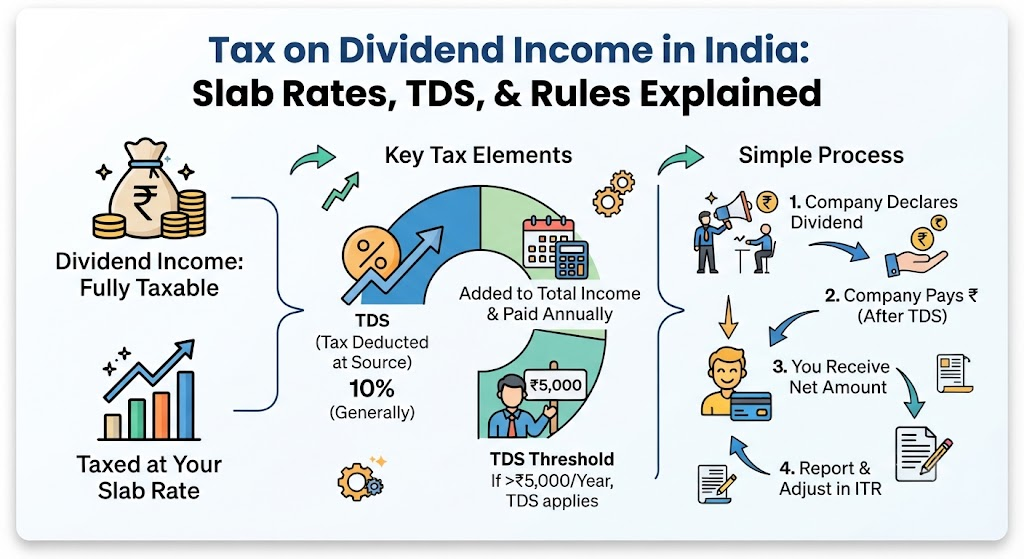
However, the rules changed a few years ago. Today, the government treats dividend money just like your regular salary or bank interest. It gets added to your total income and is taxed according to your income tax slab.
If you invest in stocks or mutual funds for regular income, understanding these rules helps you avoid surprise tax bills and plan your finances better. This guide explains how dividend taxation works in India, how much tax you will pay, and how the deduction process works.
What Is a Dividend and How Does It Work?
A dividend is a reward that a company gives to its shareholders out of its accumulated profits.
When a business runs successfully, it earns profits. The management can choose to reinvest this money back into the business to grow faster, or they can distribute a part of it to the people who own shares in the company.
Why Companies Pay Dividends
- Shareholder Trust: Regular payouts show that the company is financially healthy and genuinely makes real cash, not just paper profits.
- Stable Income: Many investors, especially retirees, rely on these regular cash flows for their daily expenses.
The Payment Lifecycle
- Declaration: The company board announces a dividend amount per share (e.g., ₹5 per share).
- Record Date: The company checks its registry to see who owns the shares on this specific day.
- Payout: The money is transferred directly to the eligible shareholder’s bank account.
Why the Tax Rules Changed
In the past, companies paid a rule called Dividend Distribution Tax (DDT). Under that system, the company paid the tax directly to the government before giving you the money. Because of this, small investors and high earners both received tax-free dividends.
The government felt this system was unfair. Under DDT, a person earning a very high income paid the same flat tax rate as a small investor.
To make the tax system fairer, the government abolished DDT. Now, the classical system is back. The company does not pay DDT anymore. Instead, the person who actually receives the money—you—must pay the tax based on your income bracket.
How Dividend Income Is Taxed in India
Under current Indian tax laws, dividend income falls under the head “Income from Other Sources.”
Here is how the taxation works in practice:
- Added to Your Total Income: Whatever dividend you receive in a financial year is clubbed with your other earnings, such as salary, rental income, or bank interest.
- Slab Rate Applicability: Your total income determines your tax bracket (slab rate). For example, if you fall in the 20% tax bracket, your dividend income is also taxed at 20%.
- No Special Lower Rate: Unlike long-term capital gains from stocks, which enjoy concessional tax rates, dividends carry no special tax discount. They are taxed at your highest applicable slab rate.
Understanding TDS (Tax Deducted at Source) on Dividends
You do not wait until the end of the financial year to pay tax on every single dividend. The government uses TDS (Tax Deducted at Source) to collect tax right at the payment stage.
The Basic Rules of Dividend TDS
- The Threshold: If the total dividend paid to you by a company or mutual fund exceeds ₹5,000 in a single financial year, the payer must deduct TDS.
- The Standard Rate: The standard TDS rate for resident individuals is 10%.
- Missing PAN: If you have not linked your Permanent Account Number (PAN) with the company or your broker/registrar, the TDS rate jumps to a steep 20%.
Practical Example
Suppose you hold shares in a large IT company. Over the financial year, they pay you a total dividend of ₹12,000.
- Because ₹12,000 is greater than the ₹5,000 threshold, the company deducts 10% TDS (which is ₹1,200).
- You receive ₹10,800 in your bank account.
- When filing your tax return, you report the full ₹12,000 as income, but you get credit for the ₹1,200 TDS already paid. If your actual tax slab is lower, or if you have deductions, you can claim a refund for any excess tax deducted.
Deductions Allowed Against Dividend Income
Many investors do not know that the tax law allows you to claim a small deduction against your dividend income. You do not have to pay tax on the gross amount if you incurred expenses to earn it.
The Interest Expense Rule
Under Section 57(iii) of the Income Tax Act, you can deduct any interest expense you paid on a loan taken specifically to buy those shares or mutual fund units.
- Example: Suppose you took a loan to invest in dividend-yielding shares, and you paid ₹5,000 in interest during the year. If you earned ₹15,000 in dividends, you can deduct that ₹5,000 interest expense. You will only pay tax on the net amount of ₹10,000.
- What is NOT allowed: You cannot claim standard deductions like office expenses, brokerage fees, or folio charges against dividend income. Only interest expenses related to the loan taken for the investment are permitted.
Common Mistakes Investors Make
Managing dividend income sounds simple, but small oversights can lead to tax notices or penalties. Watch out for these common errors:
- Forgetting to Report Small Dividends: Many investors assume that if TDS was not deducted (because the dividend from a single company was under ₹5,000), they do not need to report it. This is incorrect. All income must be reported, regardless of whether TDS was cut.
- Ignoring Dividends in Advance Tax Calculations: If you receive large dividends, your tax liability for the year increases. If you do not pay advance tax installments on time, you may attract interest penalties under Sections 234B and 234C.
- Not Checking Form 26AS or AIS: Always verify your Annual Information Statement (AIS) and Form 26AS before filing your Income Tax Return (ITR). Ensure all dividend payouts and TDS entries match your bank statements.
Risks and Limitations of Dividend Investing
While dividends provide steady cash flow, relying solely on them for financial planning carries certain trade-offs:
- Dividend Trap: A high dividend yield can sometimes be a warning sign. If a company’s stock price has crashed, its dividend yield might look artificially high, even though the underlying business is struggling.
- Lack of Control: Unlike selling shares when you need cash, you cannot control when a company declares a dividend. This makes budgeting unpredictable.
- Tax Inefficiency for High Earners: If you fall in the highest tax bracket (30% plus surcharges), paying tax on dividends every year creates a heavy tax drag compared to growth-oriented investments where taxation is delayed until you sell.
Decision-Making Framework: Should You Focus on Dividends?
Use this simple framework to decide if dividend stocks fit your financial strategy:
- Define Your Goal: Are you looking for regular cash flow for living expenses, or are you trying to grow your wealth over the long term?
- Check Your Tax Bracket: If you are in the 30% tax slab, heavy dividend reliance will eat into your returns every single year through taxation.
- Look Beyond the Payout: Evaluate the company’s fundamental strength, debt levels, and future growth potential rather than just looking at its dividend history.
- Compare Alternatives: Weigh dividend yields against other income sources like fixed deposits, debt mutual funds, or growth stocks.
Checklist for Filing Taxes on Dividend Income
Before you submit your Income Tax Return (ITR), run through this quick verification checklist:
- Gather dividend statements from all brokers, demat accounts, and mutual fund houses.
- Cross-check total dividend amounts with your Form 26AS and AIS.
- Verify that all TDS deductions match the certificates provided by companies or registrars.
- Report the aggregate dividend under “Income from Other Sources” in the correct ITR form (ITR-2 or ITR-3 typically).
- Check if you incurred any eligible loan interest expenses to offset against the dividend income.
- Ensure advance tax obligations are met if your total tax liability exceeds the statutory limits.
Key Terms
- Dividend: A portion of a company’s profits distributed to its shareholders.
- TDS (Tax Deducted at Source): Tax collected by the payer at the time of making a payment, credited to the taxpayer’s PAN.
- Record Date: The cut-off date set by a company to determine which shareholders are eligible to receive a declared dividend.
- Dividend Distribution Tax (DDT): An older tax system where companies paid tax on dividends before distribution; currently abolished in India.
- AIS (Annual Information Statement): A comprehensive statement available on the tax portal showing your financial transactions, including dividends and interest.
- Income from Other Sources: The residual head of income under the Income Tax Act where dividends, interest, and winning prizes are taxed.
FAQs
1. Are dividends from mutual funds tax-free?
No. Mutual fund dividends (technically called Income Distribution cum Capital Withdrawal or IDCW) are fully taxable at your individual income tax slab rate. Mutual funds also deduct 10% TDS if the dividend exceeds ₹5,000 in a financial year.
2. Is there any exemption limit for dividend income?
Unlike bank interest (which has deductions under Section 80TTA/80TTB for senior citizens), there is no general exemption limit for dividend income. Every rupee of dividend earned is taxable.
3. Do I need to pay advance tax on dividends?
Yes. If your total tax liability after adjusting for TDS exceeds ₹10,000 in a financial year, you are required to pay advance tax in quarterly installments. Failing to do so can attract interest penalties.
4. Which ITR form should I use to report dividend income?
If you only have salary, capital gains, and dividend income, you generally need to file ITR-2. If you have business or professional income alongside dividends, you will use ITR-3.
5. Can I claim brokerage charges incurred while buying shares against dividend income?
No. The Income Tax Act only allows deductions for interest expenses incurred on a loan taken specifically to acquire those shares. Brokerage, advisory, and Demat maintenance charges cannot be deducted.
6. What happens if I forget to report dividends in my ITR?
Failing to report dividend income can lead to tax mismatches when the tax department cross-references your ITR with the Annual Information Statement (AIS). This can trigger an income tax notice, demand for unpaid tax, and potential penalties.
7. Are dividends received from foreign companies taxable in India?
Yes. If you are a resident and ordinarily resident in India, your global income—including dividends from foreign stocks—is taxable in India. You may be able to claim relief under Double Taxation Avoidance Agreements (DTAA) if tax was already withheld abroad.
Conclusion
Dividend income is a great way to earn passive cash flow from your investments, but it comes with clear tax responsibilities. Because dividends are taxed at your regular income slab rates and subject to TDS, you must track your payouts carefully throughout the year.
By keeping accurate records, checking your AIS before filing, and factoring taxes into your investment strategy, you can enjoy your dividend payouts without worrying about unexpected tax trouble.