Filing your Goods and Services Tax (GST) returns can feel like navigating a maze, especially if you are a small business owner, freelancer, or startup founder. One of the most common points of confusion for beginners is understanding the difference between GSTR-1 and GSTR-3B. It is quite common to wonder why the government requires two separate returns that seem to cover the same sales information.
Understanding these differences is absolutely vital for proper tax compliance. Mixing up these returns or filling them out incorrectly can lead to mismatched data, blocked input tax credit for your clients, and automated compliance notices from the GST portal. This comprehensive guide will break down everything you need to know about GSTR-1 vs GSTR-3B, their distinct purposes, and how to file them accurately.
What Is GSTR-1?
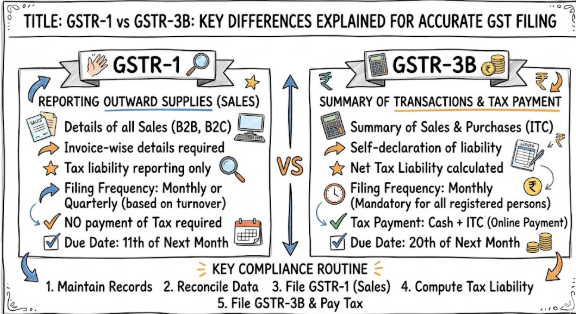
GSTR-1 is a mandatory statement of outward supplies that must be filed by regular registered taxpayers. It is not a tax payment return; rather, it is a detailed report of all sales transactions made by your business during a specific tax period. In GSTR-1, you must upload invoice-level details for Business-to-Business (B2B) sales, large inter-state Business-to-Consumer (B2C) invoices, exports, and summaries of debit or credit notes issued.
Moreover, GSTR-1 requires you to submit an HSN (Harmonized System of Nomenclature) summary of goods or services sold. The primary objective of GSTR-1 return filing is to report your revenue to the government and pass on the Input Tax Credit (ITC) to your buyers. When you upload sales invoices in GSTR-1, the data automatically populates into your buyers’ GSTR-2B, allowing them to view and claim their legitimate tax credits. The filing process is carried out online through the GST portal, and depending on your business turnover, it can be done on either a monthly or quarterly basis.
What Is GSTR-3B?
GSTR-3B is a simplified, self-declared summary return that regular taxpayers must file every month. Unlike GSTR-1, which focuses entirely on itemized sales, GSTR-3B is where the actual financial settlement takes place. It provides a high-level summary of your total outward supplies, your total eligible Input Tax Credit (ITC) on purchases, and the final net tax liability you owe to the government.
GSTR-3B return filing is the mechanism through which you actually pay your GST dues. You can offset your tax liability using the eligible ITC available in your electronic credit ledger, and any remaining balance must be paid in cash through a generated challan. Even if a business has zero transactions during a specific month, submitting a “Nil” GSTR-3B return is still legally mandatory. The data in GSTR-3B is partially auto-populated from your filed GSTR-1 and your system-generated GSTR-2B, making it essential that your underlying records are clean and synchronized.
Summary of sales and purchases, tax payable, ITC claimed
Input Tax Credit
Not reported
Claimed in this return
Amendments
Can be corrected in next GSTR-1
Can revise via next GSTR-3B or GSTR-1
Compliance
Mandatory for registered taxpayers
Mandatory for all regular taxpayers
Portal Section
GSTR-1 tab
GSTR-3B tab
Penalty for Late Filing
Applicable
Applicable
Data Source
Invoices issued during period
Accounting books summary
Reconciliation
Required with GSTR-3B
Should match GSTR-1
Importance of Understanding the Differences
Failing to grasp the distinct mechanisms of GSTR-1 vs GSTR-3B filing can lead to operational bottlenecks for any business. Maintaining a clear line between the two forms may help in understanding GST compliance deeply and safeguards your cash flow.
Ensures Proper Compliance: Knowing which details go into which form prevents filing errors and keeps your GST profile clean in the government database.
Avoids Penalties and Interest: Under GST rules, delays or data mismatches can attract automatic late fees and an interest charge of 18% per annum on unpaid net tax liabilities.
Facilitates Accurate ITC Claims: Proper reporting ensures that you claim the correct amount of Input Tax Credit in GSTR-3B without facing reversals or legal scrutiny.
Maintains Correct Filing Sequence: The GST portal enforces a strict sequential filing lock. You cannot file your current GSTR-1 if your previous GSTR-3B has not been submitted.
Improves Vendor and Client Relations: Because your GSTR-1 feeds directly into your clients’ GSTR-2B forms, timely and accurate filing ensures your business partners never face blocked or delayed tax credits.
Filing Process Overview on the GST Portal
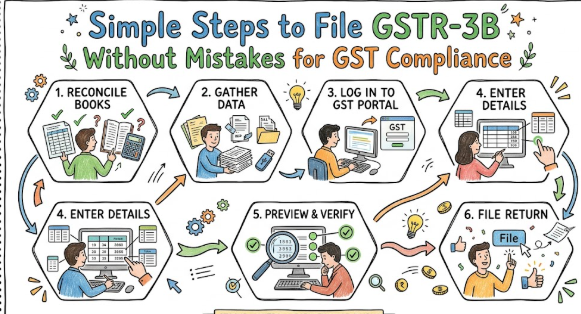
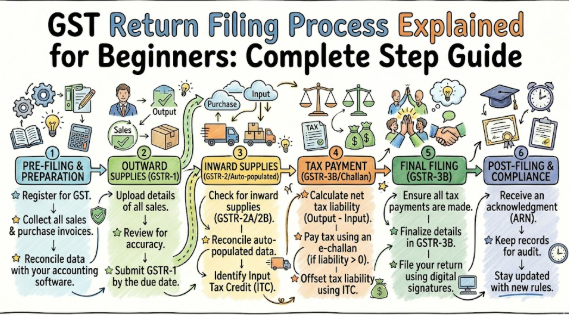
Filing your returns on the online GST portal requires a systematic approach. Following a structured order can guide proper filing and minimize the risk of technical rejections.
Collect and Sort Invoices: Gather all sales and purchase invoices for the tax period. Ensure that GSTINs, taxable values, and tax rates are completely accurate.
Reconcile Purchases and Sales: Match your internal sales register with the invoices you intend to upload, and check your purchase register against the auto-generated GSTR-2B statement.
Check Eligible ITC: Determine your final eligible Input Tax Credit after filtering out blocked or ineligible credits under the law.
Log In to the GST Portal: Use your secure credentials to log into the official Indian GST portal dashboard.
Navigate to the Returns Dashboard: Select the appropriate Financial Year and Return Filing Period from the drop-down menus.
Select the Return Type: Choose the GSTR-1 tile if you are reporting sales, or the GSTR-3B tile if you are performing the monthly summary settlement.
Fill In the Required Details: Enter invoice-wise details for GSTR-1 or review the auto-populated summary aggregates in GSTR-3B.
Preview Draft Return: Always download the draft summary PDF to verify your data before hitting the final submit option.
Submit and Pay Dues: If filing GSTR-3B, offset your liability with your ITC ledger and pay any residual amount via net banking or UPI.
File with DSC or EVC: Complete the verification using a Digital Signature Certificate (DSC) or an Electronic Verification Code (EVC) sent to your registered mobile number.
Download Acknowledgment: Once filed, download and archive the generated Application Reference Number (ARN) receipt for your internal audit records.
Common Mistakes in Filing GSTR-1 vs GSTR-3B
Even seasoned accountants occasionally slip up when handling monthly GST compliance. Being aware of frequent pitfalls is the best way to safeguard your business from compliance notices.
Missing or Omitted Invoices: Forgetting to upload specific B2B invoices in GSTR-1 prevents your clients from claiming credit, which often leads to disputes and withheld payments.
Input Tax Credit Mismatches: Claiming provisional or excess ITC in GSTR-3B without matching it against the actual invoices uploaded by your suppliers in GSTR-2B is illegal and triggers automatic system alerts.
Incorrect HSN or SAC Codes: Entering vague or incorrect HSN summaries can result in data validation errors on the portal during submission.
Delayed Submissions: Waiting until the last hour often leads to portal lag, resulting in missed deadlines, daily late fees, and accumulated interest charges.
Ignoring Reverse Charge Mechanism (RCM): Failing to declare and pay tax on inward supplies that fall under RCM can attract penalties during departmental tax audits.
Summary and Aggregation Errors: Manually overriding auto-populated fields in GSTR-3B without proper reconciliation creates a direct data mismatch with your previously filed GSTR-1.
Complete GST Filing Checklist
Checklist Point
Status
Sales invoices reconciled
Yes/No
Purchase invoices verified
Yes/No
ITC properly calculated
Yes/No
HSN summary filled
Yes/No
Reverse charge verified
Yes/No
Return preview reviewed
Yes/No
Payment calculated
Yes/No
DSC/EVC ready
Yes/No
Submission done
Yes/No
Acknowledgment saved
Yes/No
Practical Tips for Accurate Filing
Achieving seamless GST compliance depends heavily on your daily accounting habits and reporting systems. Implement these strategic tips to optimize your tax workflow.
Reconcile Before Submission: Never file your GSTR-3B without comparing its sales summary against the data submitted in your GSTR-1 for that specific month.
Double-Check Input Tax Credit: Make it a strict policy to only claim the ITC that is fully visible and confirmed in your GSTR-2B statement.
Utilize the Return Preview Feature: Always download the summary draft to cross-check totals under CGST, SGST, and IGST before executing the final submission block.
Review HSN Summaries Carefully: Ensure that the total taxable values declared in your HSN tables exactly match the gross taxable values provided in your sales tables.
Track Deadlines Proactively: Mark your calendar for the 11th of every month for monthly GSTR-1 filing, and the 20th of every month for GSTR-3B filing to maintain a zero-late-fee record.
Real-Life Example of Accurate Compliance
Let us look at a practical scenario involving a hypothetical small enterprise to see how these returns interact in the real world.
Consider Mantra Digital Solutions, a web development startup based in Ranchi, Jharkhand. During the month of May, the company issued B2B invoices worth a total taxable value of ₹5,000,000, collecting ₹900,000 in Integrated GST (IGST). During the same month, they purchased high-end servers and office equipment, and their suppliers uploaded those invoices promptly, reflecting an eligible Input Tax Credit of ₹400,000 in Mantra Digital’s GSTR-2B.
By June 11, the company filed its GSTR-1, entering every client’s GSTIN and invoice detail carefully. This allowed their corporate clients to view their credit on the portal immediately. Around June 18, the accountant logged in to file GSTR-3B. The system automatically pulled the ₹900,000 output tax liability from GSTR-1 and the ₹400,000 ITC from GSTR-2B. The accountant verified these details against their accounting books, used the ₹400,000 credit to offset a portion of the tax, paid the remaining net liability of ₹500,000 online, and successfully filed the return via EVC before the June 20 deadline.
Frequently Asked Questions (FAQs)
1. Can I file GSTR-3B without filing GSTR-1 first?
No, the GST portal enforces a strict sequential filing system. You must complete and submit your GSTR-1 statement for the given tax period before the portal unlocks the GSTR-3B summary tile for filing.
2. What happens if there is a mismatch between GSTR-1 and GSTR-3B data?
Significant data mismatches can result in the tax department issuing automated system warnings or show-cause notices. It can also lead to the provisional restriction of your outward supply reporting capabilities.
3. Is it possible to revise a GSTR-1 return after it has been submitted?
You cannot directly delete or modify a filed GSTR-1 return. However, you can easily file amendments, fix invoice details, or adjust tax rates in the amendment tables of the subsequent month’s GSTR-1 return.
4. Can I claim Input Tax Credit using my GSTR-1 form?
No, GSTR-1 is strictly meant for reporting your outward sales transactions. Input Tax Credit can only be claimed and adjusted against your liabilities inside your monthly GSTR-3B summary return.
5. What are the late fees for delaying my GSTR-1 or GSTR-3B filing?
The standard late fee is ₹50 per day for returns with tax liabilities, split equally as ₹25 under CGST and ₹25 under SGST. For a completely Nil return, the reduced late fee is ₹20 per day.
6. Who is exempted from filing these regular monthly returns?
Taxpayers who have registered under the GST Composition Scheme, Non-Resident Taxable Persons, Input Service Distributors (ISD), and persons liable to deduct TDS under Section 51 are exempted from regular GSTR-1 and GSTR-3B filings.
7. What is the QRMP scheme and how does it affect my filing dates?
The Quarterly Return Monthly Payment (QRMP) scheme allows eligible small taxpayers with an aggregate turnover up to ₹5 crore to file GSTR-1 and GSTR-3B quarterly, while making simplified tax payments every month.
8. What is the role of GSTR-2B in relation to my GSTR-3B return?
GSTR-2B is a static, auto-generated monthly statement that acts as your primary source of truth for ITC. The eligible credit figures from GSTR-2B flow directly into Table 4 of your GSTR-3B return.
9. Can I pay my pending GST liability using my accumulated ITC balance entirely?
Yes, you can use your eligible ITC balance to offset your output tax liabilities. However, certain liabilities, like taxes due under the Reverse Charge Mechanism (RCM), late fees, and interest, must be paid purely in cash.
10. Should I consult a tax professional if my business transactions are complex?
Yes, while online portal tools are automated, business dynamics vary based on taxpayer category and filing frequency. If you handle complex multi-state trade, it is highly recommended to consult a qualified tax professional.
Conclusion
Mastering the distinct structures of GSTR-1 and GSTR-3B is a fundamental requirement for building a sustainable business in India. GSTR-1 serves as your itemized digital ledger to report sales and pass on credits, while GSTR-3B functions as your final financial settlement statement to declare net liabilities and pay taxes.
Maintaining harmony between these two returns protects your business from unnecessary penalties and builds a highly trustworthy credit profile. Always make it a practice to verify all details before final submission on the portal.
Discover DevOps salary trends, pay ranges by experience and region, top skills that increase income, and data-backed negotiation tips to maximize earnings.
The modern technology ecosystem relies entirely on rapid deployment, reliable infrastructure, and scalable operations. Because businesses must launch software faster than ever without disrupting existing workflows, engineering teams have shifted away from traditional, siloed software development and operations. This architectural shift has positioned system reliability and continuous delivery at the center of corporate strategy. As organizations continue to scale their cloud presence, professionals who bridge the gap between development and engineering operations remain in exceptionally high demand.
Understanding your earning potential is crucial whether you are a university graduate entering the job market, a software engineer looking to switch fields, or a senior engineer evaluating competitive offers. A comprehensive breakdown of compensation structures allows you to assess the value of your existing technical competencies and avoid the common pitfall of accepting under-market compensation. Knowing your market value equips you with the leverage necessary to navigate recruitment cycles confidently and align your skill acquisition with high-paying engineering domains.
The financial landscape of technical operations spans multiple interconnected disciplines, including Cloud Infrastructure, Site Reliability Engineering (SRE), Platform Engineering, and DevSecOps. Earning potential within this space is highly dynamic, fluctuating based on localized demand, technological complexity, and structural industry variations. For example, a professional skilled in automated compliance pipelines often commands a fundamentally different market premium than an engineer managing single-cloud environments.
This analytical guide delivers a granular breakdown of global compensation trends, analyzing regional benchmarks, experience tiers, and tool-specific premium skills. By examining real-world progression trajectories, system design expectations, and practical negotiation frameworks, this guide serves as a strategic roadmap for engineering professionals aiming to maximize their financial and professional growth.
What Does “DevOps Salary” Mean?
When evaluating a technical role, focusing exclusively on the monthly or annual base pay provides an incomplete view of your actual financial compensation. In engineering and infrastructure operations, “total compensation” represents the cumulative economic value an employer provides. This structure is designed to reward system uptime, support long-term engineering stability, and align individual performance with broader company growth.
Total compensation consists of multiple distinct variables that combine to form your overall package. These layers insulate your earnings against inflation and reward deep operational ownership. The fundamental components of a standard enterprise package include:
Base Salary: The guaranteed, predictable cash distribution paid out on a regular bi-weekly or monthly schedule. It reflects your core technical responsibilities, experience tier, and baseline market value.
Sign-on and Performance Bonuses: Single-payment cash awards. Sign-on bonuses offset unvested equity abandoned when leaving a previous employer, while performance bonuses tie directly to team uptime metrics, system stability, and company revenue targets.
Equity and Stock Incentives: Long-term wealth generation mechanisms delivered through Restricted Stock Units (RSUs) or stock options. These typically vest over a multi-year period, aligning an engineer’s financial rewards with the company’s valuation growth.
On-Call Stipends: Structured, extra payments designed to compensate engineers for maintaining production system reliability during nights, weekends, and holidays.
Health and Lifestyle Perks: Comprehensive medical coverage, dedicated learning budgets, home-office stipends for remote engineers, and retirement matching schemes that reduce your out-of-pocket expenses.
DevOps Salary Overview
Global market data indicates that infrastructure automation, cloud operations, and platform reliability roles remain among the highest-compensated segments within the broader technology sector. The global median salary reflects a strong corporate willingness to pay a premium for professionals who can actively lower infrastructure costs, prevent costly production downtime, and accelerate software deployment cycles.
Compensation fluctuates across a wide spectrum, driven primarily by localized economic maturity, cost-of-living index variables, and the structural scale of deployment pipelines. For instance, teams handling hyperscale architectures with millions of concurrent users naturally allocate larger compensation budgets to prevent systemic outages. Key structural trends shaping the global market include:
High infrastructure complexity and rapid multi-cloud migration strategies keep consumer demand outstripping the qualified talent supply, driving upward pressure on total compensation packages.
Specialized practitioners who possess a deep blend of software development and automated operations consistently command higher premiums than infrastructure administrators focused solely on maintenance.
Total compensation packages are increasingly weighted toward equity, performance incentives, and on-call premiums within mature tech ecosystems.
Remote work options have created a unified global talent pool, forcing local companies to increase their domestic pay structures to compete with international organizations.
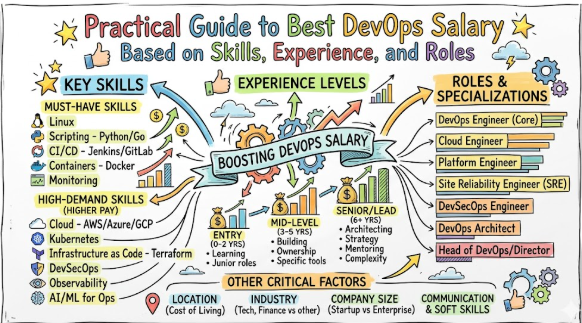
Table 1 – DevOps Salary by Experience Level
Experience Level
Average Base Salary
Range
Typical Responsibilities
Entry-Level / Junior
$75,000
$55,000 – $95,000
Maintaining CI/CD script workflows, basic log monitoring, assisting with cloud resource provisioning under guidance.
Mid-Level Engineer
$115,000
$95,000 – $140,000
Building infrastructure as code pipelines, managing container deployments, building dashboard configurations, and sharing on-call rotations.
Defining enterprise cloud strategy, engineering structural internal developer platforms, and aligning multi-team operations with security.
SRE / Platform Lead
$230,000
$190,000 – $300,000+
Governing enterprise-wide reliability metrics, defining SLO/SLA criteria, reducing operational toil, and leading root-cause postmortems.
Factors That Influence DevOps Salary
Geographic Region and Cost of Living
The physical location of an engineering team or the remote residency of an employee remains a primary factor in determining base compensation. Regions characterized by high cost-of-living indexes and concentrated tech clusters feature elevated baseline compensation packages designed to offset local housing and tax obligations. Conversely, emerging offshore delivery hubs offer lower nominal compensation figures that often provide high local purchasing power.
Company Size and Industry
Tier-one technology enterprises, high-frequency financial trading firms, and heavily backed hyperscale startups allocate much larger compensation budgets than legacy non-tech corporations or early-stage boot-strapped businesses. A company’s operational scale dictates the financial impact of system downtime, which directly influences how much they are willing to invest in top-tier engineering talent.
Cloud and Platform Expertise (AWS, Azure, GCP)
Earning potential varies depending on your mastery of public and hybrid cloud ecosystems. Engineers capable of designing multi-cloud architectures, orchestrating complex cloud migrations, and managing enterprise networking across Amazon Web Services, Microsoft Azure, or Google Cloud Platform command a distinct premium over engineers limited to simple single-provider setups.
Container Orchestration (Kubernetes, Docker)
As applications shift toward distributed microservices, the ability to manage complex container environments is a core differentiator. True market value lies beyond basic container creation; it requires the expertise to scale, secure, and troubleshoot enterprise-grade Kubernetes clusters running under heavy production workloads.
Infrastructure Automation (Terraform, Ansible)
Modern engineering organizations completely reject manual server configuration. High-value engineers treat infrastructure exactly like application software—versioned, tested, and automated. Demonstrating deep proficiency in declarative configuration languages allows you to eliminate human error and secure top-tier compensation packages.
Integrating automated compliance and security protocols directly into software delivery pipelines is a highly sought-after specialization. Security-first practitioners who embed vulnerability scanning, static code analysis, and secret-management workflows into production lifecycles naturally protect companies from catastrophic breaches, commanding premium pay scales for their expertise.
Monitoring and Observability
Collecting basic system metrics is no longer sufficient for complex modern environments. Top-earning engineers understand how to establish holistic observability strategies. They piece together distributed tracing, log aggregation, and metric visualization systems to diagnose subtle performance bottlenecks before they impact end-users.
Team Leadership and Project Scope
As your career advances, your financial growth decouples from pure coding output and shifts toward your systemic blast radius. Engineers who steer cross-functional initiatives, define technical standards across multiple business units, and elevate their peers through structured mentorship unlock senior compensation bands.
Certifications and Practical Experience
While foundational industry certifications validate your conceptual baseline, verified practical experience remains the ultimate currency during salary evaluations. A portfolio demonstrating real-world problem-solving, architectural design trade-offs, and successful production incident resolutions will always carry more weight than certificates alone.
Regional Salary Comparisons
United States
The US tech ecosystem continues to lead global compensation trends, driven by heavy venture capital deployment, intense competition for talent, and a high concentration of primary cloud providers. Major metropolitan hubs like San Francisco, Seattle, New York, and Austin feature elevated compensation packages. These packages are frequently weighted heavily toward equity and variable bonuses, alongside base salaries ranging from $110,000 for mid-level professionals to well over $220,000 for advanced principal leads.
Canada
Canada’s major technology hubs, including Toronto, Vancouver, and Montreal, function as highly mature engineering ecosystems. Compensation scales effectively across these tech centers, with mid-level engineers commanding baseline averages around $115,000 CAD. The market benefits from a blend of strong domestic enterprises and a high concentration of US technology satellites offering highly competitive, talent-retaining compensation packages.
United Kingdom and Europe
The European market presents a diversified compensation landscape shaped by distinct national regulations and economic landscapes. Technical hubs like London, Berlin, Amsterdam, and Zurich lead the region in total compensation. While baseline figures in continental Europe might appear lower than US equivalents, they are supported by comprehensive social benefit models, statutory retirement contributions, and structured health provisions that reduce out-of-pocket costs.
India
India has rapidly transitioned from a traditional back-office outsourcing model into a major global hub for core platform engineering and cloud architecture. Highly competitive tech centers like Bengaluru, Hyderabad, and Pune feature steep salary escalation curves. Engineers who display deep proficiency in advanced system design, distributed systems, and container infrastructure easily outpace traditional developer wage scales.
Australia
The Australian tech sector, concentrated across Sydney and Melbourne, features consistent demand for cloud transformation specialists. Mid-level base packages average roughly $130,000 AUD, with senior leadership positions frequently climbing past $190,000 AUD. This market is heavily focused on public cloud expertise, enterprise security, and migration strategies across finance and enterprise software sectors.
Middle East
Tech hubs like Dubai and Riyadh represent rapidly growing tech ecosystems backed by large-scale sovereign development initiatives and corporate digital transformations. The market offers highly attractive tax-free baseline compensation structures alongside comprehensive relocation, housing, and education stipends. These premiums are designed to attract senior international architects capable of building foundational digital infrastructure from the ground up.
Systems Automation, Scripting, Docker/Kubernetes Administration
Australia
$130,000 AUD
High
Cloud Migrations, Enterprise Security, Service Mesh Networking
Middle East (UAE)
$95,000 USD (Tax-Free)
High
Large-Scale Architecture, Site Reliability Engineering, Governance
Step-by-Step Guide to Increase Your DevOps Salary
1. Master Core Infrastructure Tools
Begin by building a rock-solid operational foundation. True engineering capability requires a deep, fundamental understanding of Linux systems internals, file management, and networking configurations. Combine this with master-level command of Git version control workflows and the ability to build, maintain, and optimize automated CI/CD deployment pipelines using tools like GitHub Actions, GitLab CI, or Jenkins.
2. Deepen Your Public Cloud Platform Domain Knowledge
Move past superficial dashboard interactions and study the underlying mechanics of at least one primary public cloud provider—AWS, Azure, or Google Cloud Platform. You need to confidently navigate core programmatic concepts, including complex Identity and Access Management (IAM) permission models, virtual private networking architectures, serverless computing blocks, and managed database solutions.
3. Specialize in Microservices Containers and Declarative Infrastructure
Transition away from manual setup scripts by adopting declarative Infrastructure as Code (IaC) principles. Master Terraform or OpenTofu to safely provision, version, and manage infrastructure state across different providers. Once comfortable with basic systems automation, focus on microservices architectures by learning to build Docker configurations and orchestrate production-grade workloads inside managed Kubernetes platforms.
4. Implement Comprehensive Observability and Security Pipelines
Elevate your value from a standard tools administrator to a strategic operations engineer by mastering real-time monitoring and telemetry systems. Learn to configure Prometheus metrics collection, design actionable Grafana dashboards, and parse logs to quickly isolate failures. Integrate automated vulnerability scanning, dependency checks, and compliance auditing tools directly into your active deployment pipelines.
Certificates look good on paper, but a functional, production-ready GitHub repository is what lands high-paying offers. Build public projects that demonstrate clean, modular Terraform configurations, automated multi-stage application builds, and self-healing container setups. Document your architecture choices with thorough README files that explain the design trade-offs you made.
6. Prepare Thoroughly for System Design and Behavioral Evaluations
Senior engineering interviews evaluate your systemic problem-solving skills, not just your tool knowledge. Practice designing highly available, fault-tolerant architectures that can handle sudden traffic spikes and isolate service dependencies. Pair this technical preparation with behavioral examples that show how you use data to resolve production outages and coordinate with development teams during critical incidents.
7. Negotiate Compensation Packages Using Market Data
Never enter an offer conversation without objective market data. Research verified, crowdsourced compensation platforms like levels.fyi to understand the exact equity, bonus, and base salary structures for your target tier and location. Frame your salary expectations around the measurable business outcomes you deliver—such as reducing monthly cloud spend or speeding up deployment cycles—rather than your personal financial needs.
Skills That Maximize DevOps Salary
Multi-Cloud Architecture Strategy: The ability to architect resilient infrastructures that span multiple cloud vendors. This approach eliminates vendor lock-in, optimizes multi-region traffic routing, and protects the business from single-provider outages.
Production-Grade Kubernetes Management: Moving beyond basic setups to handle live production workloads. High-value skills include tuning cluster autoscalers, configuring secure ingress controllers, managing persistent storage volumes, and implementing advanced service mesh networking.
Declarative Infrastructure as Code (IaC): Writing clean, reusable, and modular Terraform configurations. This requires a deep understanding of state file locking, remote backends, and building automated drift detection pipelines to prevent environment inconsistencies.
Automated DevSecOps Compliance: Shifting security to the very beginning of the development lifecycle. This involves embedding static application security testing (SAST), dynamic testing (DAST), and automated secrets detection directly into continuous integration workflows.
Site Reliability Engineering (SRE) Principles: Approaching operational problems through a software engineering lens. Engineers maximize value by defining clear Service Level Objectives (SLOs), managing error budgets, and writing automated software to permanently eliminate repetitive manual tasks (toil).
Advanced Monitoring and Observability: Setting up end-to-end telemetry systems. This means designing distributed tracing across microservices, building proactive alerting rules, and configuring metric collectors to expose hidden system bottlenecks.
Programmatic Scripting and Automation: Writing clean, maintainable code in languages like Python or Go. High-earning practitioners use these languages to extend open-source tools, build custom internal integrations, and automate complex infrastructure workflows.
Cross-Functional Communication and Soft Skills: The ability to simplify complex technical concepts for non-technical stakeholders. High-level engineers excel at leading post-incident reviews without placing blame, mentoring junior team members, and aligning engineering goals with broader business priorities.
Real-World Salary Growth Scenarios
Case Study 1: The Accelerated Graduate Trajectory
An entry-level computer science graduate accepted a junior infrastructure operations role at a regional logistics enterprise with a starting base salary of $72,000. Their primary tasks involved maintaining existing bash scripts and reviewing system logs.
By dedicating nights to learning Git workflows, public cloud foundations, and modern CI/CD patterns, they took ownership of upgrading the company’s legacy build pipelines. Within twenty-four months, their demonstrated technical independence and successful pipeline modernizations earned them an internal promotion to Mid-Level Engineer, adjusting their base salary upward to $102,000.
Case Study 2: The Infrastructure Specialist Pivot
A mid-level systems administrator earning a flat $90,000 felt limited by manual server configuration workflows and slow enterprise progression cycles. They decided to pivot their career by focusing deeply on declarative infrastructure management and container ecosystems.
Over a year, they built a public portfolio showcasing modular Terraform code and automated microservices deployments. Using this portfolio to prove their hands-on skills, they transitioned to a dedicated cloud technology company. This strategic move shifted them into a senior engineering band with a base salary of $145,000, supplemented by a 10% performance bonus.
Case Study 3: The Enterprise Platform Architect Transformation
An experienced senior engineer with a $155,000 base salary realized that their single-cloud skill set was capping their market value. They proactively expanded their domain expertise into complex cloud-agnostic architectures, service mesh networking, and internal developer platform design.
When a multi-national financial institution initiated a major migration to hybrid-cloud architecture, they stepped into the Principal Platform Lead role. Their ability to design scalable, compliant deployment foundations across different business units secured them a total compensation package featuring a $215,000 base salary, significant corporate equity options, and a sign-on bonus.
Common Mistakes to Avoid
Expecting Premium Compensation Without Verifiable Practical Skills: Relying purely on conceptual definitions during interview rounds will not land top-tier offers. Teams evaluate your hands-on ability to troubleshoot live infrastructure failures and design resilient, real-world systems.
Relying Solely on Certifications While Ignoring Real Projects: Collecting a long list of certifications without building an accompanying portfolio of working code signals a lack of practical engineering depth to technical recruiters.
Ignoring the Critical Software Development Aspect of the Discipline: Treating the role as merely an updated title for traditional systems administration is a major career bottleneck. You must understand software engineering principles, version control, and API integrations to command premium salaries.
Failing to Learn Modern Observability and Automated Security Platforms: Stopping your education journey once you master basic container creation leaves you exposed to market changes. High-paying roles require expertise in system visibility and automated compliance.
Neglecting Targeted Negotiation Preparation: Accepting the initial baseline numbers presented during an interview loop without conducting data-backed market research can leave significant money and equity on the table.
Frequently Asked Questions (FAQs)
1. What is the average DevOps salary worldwide?
The global average for a mid-level professional hovers between $95,000 and $135,000 annually. However, total compensation varies drastically based on your geographical region, corporate scale, and specific multi-cloud competencies.
2. How much do entry-level DevOps engineers earn?
Entry-level and junior engineers typically secure base salaries ranging from $55,000 to $95,000. Your exact starting offer depends on your familiarity with Linux systems internals, basic source control, and automated scripting frameworks.
3. Does DevOps salary vary by country?
Yes, compensation ranges are highly dependent on regional economic conditions and local tech market maturity. The United States features the highest nominal salaries and equity packages, while regions like Europe offer extensive statutory social benefits alongside lower nominal base numbers.
4. Which skills increase DevOps pay the most?
Mastering production-grade Kubernetes orchestration, declarative multi-cloud architecture design using Terraform, and building automated compliance checks (DevSecOps) yield the highest market premiums.
5. Do certifications improve salary?
Certifications validate your foundational knowledge and help get your resume past initial HR screening filters. However, actual salary scaling is driven by your practical experience, system design competence, and portfolio execution.
6. What is the difference in salary between DevOps and SRE?
Site Reliability Engineers (SREs) typically command a 10% to 20% premium over standard operations engineers. This variance exists because SRE roles demand deeper software engineering capabilities to programmatically solve complex reliability and infrastructure problems.
7. Is cloud expertise necessary to earn more?
Yes, public or hybrid cloud fluency is a fundamental requirement for high compensation bands. Modern enterprises expect engineers to confidently design, secure, and optimize resources across providers like AWS, Azure, or Google Cloud.
8. Can I earn more as a DevOps engineer without a degree?
Absolutely. The infrastructure engineering market values verifiable technical competence, system design skills, and a proven track record of solving production issues far above formal academic credentials.
9. What is the salary trend for DevOps in 2026?
Compensation trends show steady upward growth, particularly for engineers specializing in automated security compliance and platform engineering. Companies are consistently willing to pay a premium for talent that reduces infrastructure sprawl and optimizes cloud spending.
10. Do DevSecOps skills increase pay?
Yes, embedding automated security controls, vulnerability scanning, and secret management directly into active delivery pipelines is a highly valued skill set that protects companies from costly data breaches.
Conclusion
The financial and professional rewards within the technical operations domain remain highly attractive, reflecting how critical infrastructure reliability is to modern business stability. As organizations continue to migrate to complex multi-cloud architectures and microservices, the demand for engineers who can confidently automate and secure these systems will continue to scale. Earning potential is not tied to a specific job title, but rather scales alongside your technical autonomy, system design capabilities, and the overall business impact of your work.
To maximize your market value and secure top-tier total compensation packages, you must move beyond basic tool configuration. Focus your career development on mastering core cloud architecture principles, implementing deep observability strategies, and contributing to open-source or production-grade automation projects. By continuously aligning your technical skill set with emerging enterprise needs—and backing those skills up with a verifiable public portfolio—you position yourself to successfully navigate recruitment cycles and command premium compensation anywhere in the global market.
Navigating the modern infrastructure landscape can feel like trying to map a shifting coastline. Software engineering boundaries have expanded completely, pulling operations professionals into highly specialized territories like Site Reliability Engineering (SRE), GitOps, MLOps, and DevSecOps. Aspiring professionals and seasoned engineers face deep confusion over which technical skills to prioritize, how to build an actionable learning roadmap, and how to avoid getting stuck in a loop of endless tutorial consumption. Choosing the right validation path serves as a structural filter, clearing away the noise and outlining a clear, hands-on path to master complex cloud systems.
What is a DevOps Certification
A Best DevOps certification is an objective, industry-recognized credential that verifies your practical competence across automated delivery pipelines, public cloud platforms, and declarative systems architectures. Rather than relying on simple theoretical definitions, modern certification tracks focus heavily on structured learning and hands-on practice within live, isolated terminal environments. Preparing for these evaluations requires you to write operational code, orchestrate distributed microservices, secure production boundaries, and maintain system availability under real-world infrastructure constraints.
Why DevOps Certifications Matter
Having raw technical curiosity is highly valuable, but structured credentials serve as a verified benchmark of your capability to architectural engineering solutions under enterprise constraints. They transform fragmented knowledge into systematic execution, proving to engineering teams that you can handle high-stakes deployments reliably.
The journey toward earning a professional credential typically follows a clear, step-by-step process:
Step 1: Conceptual Alignment: You study the core architectural blueprints, internal networking models, and operational theories behind a specific tool or platform ecosystem.
Step 2: Sandbox Testing: You actively configure, break, and rebuild virtual systems within lab environments to internalize how configuration changes impact system states.
Step 3: Scenario-Driven Troubleshooting: You solve complex, time-sensitive system failures, security misconfigurations, and deployment bottlenecks that mirror live enterprise outages.
Step 4: Formal Technical Validation: You complete a strict, proctored exam to formally certify your operational readiness for enterprise-level infrastructure engineering.
Who Should Take DevOps Certifications
The modern automation space welcomes professionals from various technical backgrounds, each using structured learning paths to scale systems and accelerate delivery.
Students and Freshers: Entry-level individuals who need to establish day-one engineering credibility, overcome a lack of enterprise experience, and land initial operations roles.
Software Developers and QA Engineers: Engineers looking to demystify production runtime environments, optimize application performance for the cloud, and build frictionless delivery pipelines.
System Administrators and Infrastructure Engineers: IT professionals moving away from manual server provisioning, interactive shell commands, and brittle, undocumented configurations.
DevOps, Platform, and SRE Practitioners: Experienced engineers aiming to formalize their production expertise, master complex distributed clustering, and step into senior technical leadership positions.
DevSecOps and Cybersecurity Specialists: Security engineers focused on embedding automated compliance checks, scanning dependencies, and managing secrets directly within deployment workflows.
Data Scientists and Machine Learning Engineers: Professionals building MLOps foundations to automate model retraining, track experimental data configurations, and host AI workloads at scale.
Engineering Managers and Technical Directors: Decision-makers who need a deep understanding of modern cloud architectures to plan infrastructure investments and guide organizational transformations.
Core Skills Covered
Modern engineering certifications cover a broad spectrum of technical disciplines, ensuring you can manage applications seamlessly from local development code to highly available production systems.
Continuous Delivery Automation: Orchestrating pipelines that automatically validate, package, test, and ship application code while eliminating manual errors and deployment delays.
Declarative Infrastructure Management: Writing clean, modular code templates to provision, version-control, and scale global networks, databases, and compute nodes.
Container Orchestration Ecosystems: Packaging microservices into isolated runtime environments and configuring automated scheduling, health checking, and traffic routing.
Defensive Cloud Security and Access: Implementing zero-trust networking, enforcing fine-grained user permissions, encrypting data at rest, and securing cluster perimeters.
Telemetry and Proactive Observability: Instrumenting distributed services with log aggregations, live performance metrics, and end-to-end request tracing to catch system errors early.
Production MLOps Automation: Designing infrastructure specifically for machine learning lifecycles, ensuring reliable feature tracking, model validation, and scalable inference hosting.
MLOps Infrastructure Engineer, Production ML Specialist
Certification Deep Dive
Real-World Use Case
Consider an online banking platform experiencing frequent deployment failures during feature updates, or an e-commerce backend crashing under sudden traffic surges because it relies on manually configured servers. Engineering teams use these certification frameworks to rebuild fragile environments into automated, containerized platforms. By implementing declarative code blueprints, self-healing orchestrators, and clear metric alerts, organizations can safely ship software updates dozens of times a day while maintaining high availability.
Automated Application Lifecycle Control: Designing end-to-end workflows that automatically build software artifacts, execute unit tests, scan for vulnerabilities, and deploy to production.
Production Cluster Maintenance: Handling container storage volumes, configuring internal cluster networking, managing secrets safely, and diagnosing runtime node errors.
Full-Stack Telemetry Instrumentation: Setting up distributed tracing to pinpoint application latency, aggregating application logs, and building alerts to catch errors before they affect users.
Career Scope
The market demand for engineering professionals with verified automation, cloud architecture, and systems stability skills continues to grow. Organizations across financial services, healthcare, e-commerce, and enterprise SaaS actively seek qualified specialists to secure data pipelines, minimize operational downtime, and lower infrastructure costs. Earning highly respected credentials positions you for high-impact platform roles, accelerates your career path toward senior architectural leadership, and enhances your overall value in the market.
Difficulty Level
Ranges from Beginner (foundational multiple-choice exams covering essential concepts) to Highly Advanced (hands-on, performance-based lab tests that require you to troubleshoot live, broken production systems through a command terminal within a strict time limit).
Best Career Fit / Who Should Take It
Perfect for developers tired of tracking down deployment bugs across inconsistent environments, system administrators wanting to move past repetitive manual scripting tasks, and platform teams tasked with building resilient systems that can scale easily under heavy enterprise workloads.
Hands-On Projects
Multi-Cloud Declarative Infrastructure: Writing modular code templates to spin up a fully isolated public cloud topology complete with secure network subnets, routing rules, and auto-scaling load balancers.
Hardened Production Container Fleet: Building a secured Kubernetes cluster from scratch, setting up internal network isolation policies, managing ingress routing, and configuring encrypted secrets storage.
End-to-End GitOps Release Workflow: Constructing an automated delivery pipeline that monitors a git repository, triggers code quality checks, runs dependency scans, updates container configurations, and synchronizes production states automatically using GitOps tools.
DevOps Certification Roadmap
Building an automation career requires a structured approach to learning. You should focus on mastering core operating system patterns and declarative infrastructure before moving on to complex multi-node container networks.
The following table matches common career goals with targeted learning paths to help you plan your professional development.
Table 2: Targeted Learning Paths
Career Goal
Recommended Certification Path
Why It Fits
Cloud Automation Architect
Terraform Associate ➔ AWS DevOps Professional
Combines flexible, vendor-neutral infrastructure automation with deep, specialized optimization for major enterprise cloud providers.
Platform Container Specialist
Docker Associate ➔ CKA ➔ CKS
Builds a solid understanding of basic application containers before moving into production cluster management and advanced security hardening.
Site Reliability Engineer (SRE)
LFCS ➔ GCP DevOps Engineer ➔ Prometheus Associate
Links foundational open-source operating system management with structured site stability models and cloud-native monitoring systems.
DevSecOps Security Engineer
GitHub Actions ➔ CKS ➔ Certified DevSecOps Professional
Integrates secure development workflows directly with active runtime container defenses and automated compliance checks within the pipeline.
MLOps Infrastructure Lead
CKA ➔ Certified MLOps Engineer ➔ Google Cloud ML Engineer
Pairs robust container orchestration infrastructure with specialized data pipelines and automated model deployment management.
Types of DevOps Certifications
Certification Path by Role
Choosing the right certification path depends heavily on your day-to-day work focus and your long-term career aspirations. Aligning your learning with specific operational roles ensures your training supports your daily responsibilities.
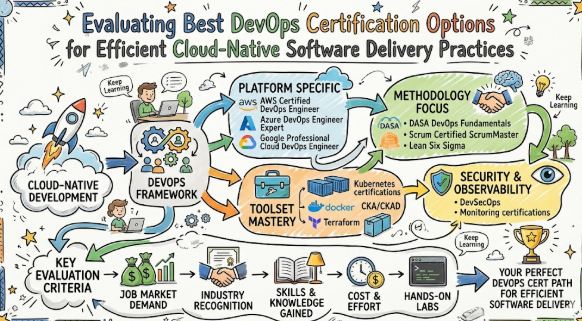
Cloud Provider Ecosystem Frameworks: These tracks focus on mastering the proprietary tools, networking models, identity and access services, and native delivery pipelines of a specific cloud vendor (like AWS, Azure, or GCP).
Cloud-Native and Orchestration Tracks: These vendor-agnostic certifications focus entirely on container lifecycles, cluster networking, service discovery, and declarative application states pulled directly from version-controlled repositories.
Systems Configuration and Infrastructure as Code: These foundational paths emphasize mastering open-source Linux systems, writing declarative templates, and managing multi-cloud infrastructure through code.
Observability and Reliability Engineering: These specialized curriculums center around instrumenting application code, configuring distributed telemetry agents, monitoring metric data, and maintaining production system uptime.
Data Lifecycle Operations and MLOps: These advanced programs focus on scaling data processing environments, managing feature data stores, versioning models, and automating deployment loops for machine learning workloads.
Common Mistakes to Avoid
Focusing on Exam Dumps Over Real Practice: Rote memorizing test questions simply to pass a multiple-choice exam without spending time working inside a live command terminal.
Neglecting System Operations Foundations: Attempting to configure advanced container clusters or service meshes before understanding basic networking, file systems, and bash scripting.
Tying Yourself to a Single Tool’s Syntax: Learning the specific commands of just one tool rather than mastering the underlying concepts and patterns that apply across different platforms.
Treating System Security as an Afterthought: Postponing security checks until after deployment instead of building access controls and compliance scans directly into your initial automation code.
Ignoring Live System Observability: Concentrating entirely on automated code delivery while ignoring the telemetry, log aggregation, and alerting metrics needed to keep systems stable post-release.
Real-Life Examples
Scaling a Global Retail Platform: A major digital marketplace used declarative infrastructure templates and container orchestration to handle massive traffic spikes during holiday shopping events, preventing checkout downtime.
Securing an Automated Healthcare Pipeline: An enterprise health-tech provider integrated automated vulnerability scanning and compliance checks into their delivery pipeline, ensuring all software updates comply with patient data privacy laws before deployment.
Accelerating Financial Environment Setup: A retail banking firm replaced manual environment configurations with modular infrastructure code, cutting the time needed to spin up secure, compliant testing environments from weeks down to a few minutes.
Proactive Microservices Telemetry Monitoring: A media streaming service set up distributed request tracing across its microservices, allowing engineers to identify and resolve playback delays before they impacted end users.
Automating Insurance Machine Learning Models: A national insurance provider built an automated MLOps framework that tracks incoming data trends and automatically triggers model retraining and deployment, keeping risk assessments accurate without manual engineering efforts.
Frequently Asked Questions (FAQs)
Which certification path is best for absolute infrastructure beginners?
The HashiCorp Certified: Terraform Associate or the Docker Certified Associate (DCA) are ideal entry points for beginners. They focus on foundational, vendor-neutral skills—Infrastructure as Code and basic containerization—that are used across almost every modern engineering team, making them practical starting points before diving into complex cloud environments.
Do I need to be a senior software programmer to succeed in these roles?
No, you do not need to be a full-stack software developer, but you must be comfortable with programming fundamentals. You should be able to write functional scripts in languages like Bash or Python, and confidently navigate structured data formats like YAML, JSON, and HCL to build automation workflows.
Why are lab-based, performance-driven exams considered highly valuable?
Performance-based exams (like the CKA or CKS) require you to solve real infrastructure issues within a live terminal rather than choosing from multiple-choice options. This format proves to employers that you possess true problem-solving skills and can confidently manage actual production environments.
How do I decide between a cloud-specific certification and a vendor-neutral one?
Cloud-specific pathways (such as AWS or Azure) are highly effective if you are working within an enterprise that standardizes on one specific cloud vendor. Vendor-neutral options (like Kubernetes or Terraform) teach portable operational skills that apply across multi-cloud environments, giving you more career flexibility.
What is the primary difference between DevOps and Site Reliability Engineering (SRE)?
DevOps focuses on breaking down communication silos, automating release processes, and increasing software deployment speed. SRE treats operational challenges as software engineering problems, focusing heavily on system reliability, monitoring performance metrics, and managing production incidents.
How often do modern engineering certifications require renewal?
Most technical certifications expire every 2 to 3 years. Because cloud tools, security policies, and container features change rapidly, periodic renewal ensures your skills stay sharp and aligned with current industry standards.
Can holding multiple certifications guarantee a senior infrastructure role?
Certifications are highly effective for passing resume filters and proving theoretical knowledge, but they must be paired with real-world application. To land senior roles, you should back your credentials with a public portfolio of projects, open-source contributions, and clear documentation of complex systems you have built.
How does DevSecOps change the traditional software development lifecycle?
Traditional development often left security audits for the very end of a release cycle, creating major project bottlenecks. DevSecOps builds automated security scanning, dependency checking, and compliance tracking directly into the initial stages of the pipeline, keeping releases both fast and secure.
What core issue does an MLOps certification address for AI infrastructure teams?
MLOps addresses the challenges of moving machine learning models from a data scientist’s notebook into a dependable production environment. It automates data pipeline versioning, model testing, and high-scale inference hosting to ensure AI solutions remain reliable over time.
What is the most effective way to prepare for a complex, timed laboratory exam?
The best approach is consistent, hands-on practice inside a terminal environment. Set up local testing sandboxes, use open-source documentation to build infrastructure from scratch, and practice diagnosing common networking and configuration errors under time limits to build up your troubleshooting speed.
Conclusion
Mastering modern cloud infrastructure requires a steady shift away from manual, repetitive engineering workflows toward fluid, programmable automation models. Choosing to earn a respected industry credential is more than just a way to upgrade your resume—it serves as a structured blueprint for hands-on learning that helps you build reliable, production-ready systems. Whether you focus on securing application delivery lines, managing complex multi-cloud deployments, or scaling advanced machine learning environments, matching your technical training with clear, role-based pathways ensures your skills remain highly relevant. True technical expertise is built by actively designing platforms, configuring networks, and troubleshooting actual system failures, making continuous laboratory practice the absolute foundation of long-term career growth. To map out your next professional milestone and discover the perfect learning path for your goals, head over to the comprehensive BestDevOps certification guide.
Navigating the Indian taxation ecosystem can feel like walking through a complex maze, especially for new startup founders, small business owners, and freelance professionals. Among the multiple compliances required under the Goods and Services Tax (GST) framework, filing your sales return is often the very first hurdle. If you find yourself confused by terms like B2B invoices, HSN summaries, or amendment tables, you are not alone. Beginner confusion around GSTR-1 is incredibly common because a single clerical mismatch can disrupt your entire supply chain.
Filing your sales data accurately is a foundational business requirement. When you upload your sales invoices correctly, the data flows seamlessly into your customers’ tax dashboards, allowing them to claim their rightful tax credits. However, an incorrect entry can lead to blocked credits, strained buyer relationships, and potential compliance notices from the tax department.
In this comprehensive, high-quality guide, we will break down the entire online filing mechanism into simple, everyday language. You will learn exactly what data to collect, how the online portal functions, and how to execute the filing sequence securely. This practical walkthrough will help you master the process, protect your venture from penalties, and build long-term business credibility.
What Is GSTR-1?
GSTR-1 is a monthly or quarterly statutory return that contains the comprehensive details of all outward supplies of goods and services made by a registered taxpayer. In simple terms, it is your formal sales report to the Government of India. Every transaction where you sell products or render services to a client must be categorized and recorded here.
It is crucial to understand that GSTR-1 is strictly an information-reporting statement. You do not pay any tax liability directly while filing this specific form. Instead, the total sales figures and tax amounts you declare here establish your official tax liability for the tax period.
Many beginners confuse GSTR-1 with GSTR-3B, but they serve entirely distinct purposes. While GSTR-1 acts as a detailed invoice-by-invoice statement of your outgoing sales, GSTR-3B is a simplified monthly summary return where you actually offset your liabilities using Input Tax Credit (ITC) and pay the remaining balance via cash.
The Supply Chain Connection: The information you submit in your GSTR-1 is dynamically captured by the GST network and auto-populated into your buyers’ GSTR-2B statement. This is the mechanism that allows your business clients to view and claim their ITC. Therefore, timely and accurate reporting is vital for maintaining healthy, professional B2B client relationships.
Who Needs to File GSTR-1?
Every business entity or professional holding an active regular GST registration is usually required to file GSTR-1. This requirement applies regardless of whether you had any active sales transactions during the specific tax period. If your business recorded zero sales during a month, you are still legally obligated to file a Nil GSTR-1 return to stay compliant.
The compliance requirements vary depending on your specific business category, industry type, and aggregate annual financial turnover:
Business-to-Business (B2B) Sellers: Manufacturers, wholesale distributors, and service firms selling to other registered entities must report every single invoice line-by-line.
Business-to-Consumer (B2C) Traders: Retailers, local shop owners, and service providers selling to unregistered end-consumers must report their consolidated sales data.
Freelancers and Independent Consultants: Registered software developers, creative designers, and consultants providing cross-border or domestic professional services must disclose their earnings and applicable integrated or central taxes.
E-commerce Sellers: Digital merchants selling products through online marketplaces must document their platform-mediated transactions, accounting for state-specific consumer locations.
The specific filing frequency depends entirely on the taxpayer’s choice and annual revenue thresholds. Regular taxpayers with an aggregate annual turnover exceeding ₹5 crore are strictly mandated to file on a monthly basis. Meanwhile, small businesses with an annual turnover up to ₹5 crore can choose between filing monthly or selecting the Quarterly Return Monthly Payment (QRMP) scheme based on their operational preferences.
GSTR-1 Sections and Details
The online GST portal organizes your outward supplies into multiple numbered blocks called tables. Each table is designated to hold a specific category of sales data. To navigate the online form efficiently, you must understand what each block represents.
The following table provides a breakdown of the core sections you will interact with inside the GSTR-1 dashboard:
Table 1: GSTR-1 Sections and Details Table
GSTR-1 Section
What It Usually Includes
Beginner-Friendly Meaning
B2B Invoices
Sales to registered businesses
Invoice-wise GST details for buyers
B2C Large
Large unregistered sales
High-value consumer sales reporting
B2C Others
Small unregistered sales summary
Consolidated small consumer sales
Credit/Debit Notes
Invoice adjustments
Returns, discounts, corrections
HSN/SAC Summary
Product/service codes
Classifies goods/services for GST
Nil/Exempt Supplies
Non-taxable or exempt
Reporting zero-rated or exempt sales
Documents and Data Required Before Filing GSTR-1
Before you log into the official government portal, you should gather and organize your business documentation. Scrambling for data mid-way through a live session can cause your web browser to timeout, leading to potential data loss or duplicate entries.
Make sure you have a structured summary containing the following critical components:
Active GSTIN Profiles: A list of your B2B buyers’ valid 15-digit Goods and Services Tax Identification Numbers to ensure accurate systemic mapping.
Core Sales Invoices: A comprehensive set of all tax invoices issued during the reporting period, showing sequential serial numbers and generation dates.
Official Credit and Debit Notes: Documentation for any structural price modifications, product returns, or supplementary charges issued to customers.
HSN and SAC Code Directories: The specific Harmonized System of Nomenclature codes for physical commodities or Service Accounting Codes for professional services, along with total quantities sold.
Place of Supply (POS) Identifiers: Accurate state names indicating where the goods were delivered or where services were consumed, which determines whether you apply CGST/SGST or IGST.
Taxable Value Records: The net base value of your goods or services after deducting commercial discounts but before calculating any tax.
Tax Component Split: The exact break-up of Integrated GST (IGST), Central GST (CGST), and State GST (SGST) or Union Territory GST (UTGST) calculated at standard tariff percentages.
E-commerce Platform Summaries: Merchant sales reports from digital marketplaces detailing transactions where tax collection at source is applicable.
How to File GSTR-1 Step by Step
Filing your sales return involves a series of sequential checkpoints that must be followed in order. Skipping a step or validating fields out of order can result in validation failures on the server. Follow this step-by-step sequence to complete your filing smoothly:
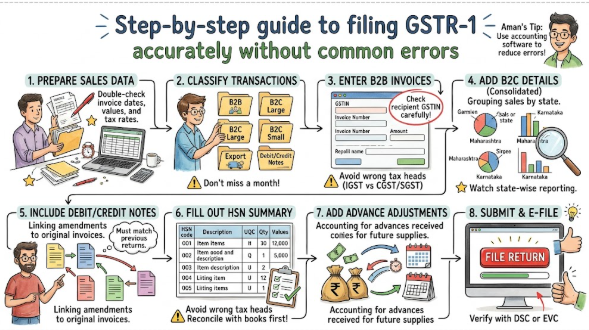
1.Data Collection and Internal Reconciliation:Step 1: Preparation.
Gather your sales registers and reconcile your billing software data against your generated invoice copies. Verify that your total taxable value matches your internal books of accounts perfectly before attempting to enter data on the portal.
2.Establish Portal Access and Navigate:Step 2: Dashboard Navigation.
Access the official government portal and log in securely using your authorized credentials. Click through Services, navigate to Returns, select the Returns Dashboard, and choose the specific financial year and tax filing period.
3.Select Return and Choose Entry Mode:Step 3: Mode Selection.
Locate the Details of outward supplies of goods or services (GSTR-1) card. Click Prepare Online for direct data entry, or use the offline utility tool if you are uploading large batches of invoice data via a generated JSON file.
4.Populate B2B and B2C Supply Data:Step 4: Invoice Upload.
Open the designated invoice tables sequentially. Type in individual B2B sales invoices, making sure the client’s trade name updates correctly upon entering their GSTIN, and log your aggregated B2C sales totals sorted by state-wise tax rates.
5.Log Commercial Adjustments and Notes:Step 5: Credit/Debit Notes Entry.
Navigate to the Credit/Debit Notes section to log any formal value revisions or customer returns. Link these adjustments directly to their original invoice reference numbers where applicable under current systemic fields.
6.Furnish HSN/SAC and Document Summaries:Step 6: Statistical Reporting.
Input your mandated HSN summary details, providing the code, net volume, total valuation, and rate breaks. Scroll down to enter the total count of invoices issued, cancelled, and net active documents utilized during the period.
7.Trigger Document Generation and Preview:Step 7: Data Validation.
Scroll to the bottom of the form and click Generate Summary. Wait a couple of minutes for the portal to compute the values, then refresh the page and click Preview Draft to download a PDF review sheet.
8.Execute Digital Authentication and Submit:Step 8: Final Verification.
Check the legal declaration checkbox and select your authorized signatory’s name. Finalize your submission using a Digital Signature Certificate (DSC) for corporate entities, or an Electronic Verification Code (EVC) OTP sent to the registered mobile number for sole proprietorships.
Entering B2B Invoice Details
Reporting Business-to-Business (B2B) invoices requires meticulous precision because your client’s business relies on this data to claim input tax credits. This data entry should be handled systematically through the online dashboard.
Click on Table 4A, 4B, 4C, 6B, 6C – B2B Invoices to open the reporting grid.
Click the Add Record button to launch a fresh entry screen.
Input the buyer’s 15-digit GSTIN. The system will automatically search the database and display their registered legal name in the adjacent field. If the name does not match your records, double-check the identification number for errors.
Enter the unique, sequential invoice number, the precise invoice date, and the total gross invoice value including taxes.
Select the correct Place of Supply (POS) from the dropdown menu. This selection tells the portal whether to unlock the IGST field for interstate transactions or the CGST/SGST fields for intrastate deals.
Scroll down to the tax assessment grid and locate the specific tax rate row that applies to your product or service (e.g., 5%, 12%, 18%, or 28%).
Type your net base value into the Taxable Value column. The portal will automatically calculate the central, state, or integrated tax amounts based on the selected rate. Verify these calculations against your invoice copy before saving.
Entering B2C Details
When selling directly to unregistered individuals or end-consumers, you do not need to log every transaction one-by-one. Instead, the portal allows you to report these sales in a simplified, consolidated format based on value thresholds and geographic locations.
Table 5 – B2C (Large) Invoices: This table is specifically reserved for interstate sales made to unregistered buyers where the individual invoice value exceeds ₹2.5 lakh. To report these, you must enter the specific invoice number, transaction date, delivery destination state, taxable value, and tax rate.
Table 7 – B2C (Others): This section handles the vast majority of regular consumer transactions, including all local intrastate sales of any amount, and small interstate consumer invoices under ₹2.5 lakh.
To populate Table 7, you simply add rows that group your sales by location and tax percentage. For instance, if you made fifty small sales to retail customers within your home state at an 18% tax rate, you add a single row for that state, choose 18%, and enter the combined taxable value of all fifty receipts.
Ensure you deduct the value of any retail consumer returns from these totals to present a clean, net taxable turnover figure.
Reporting Credit/Debit Notes and Amendments
Business operations frequently require corrections after an invoice has been issued. Whether a customer returns defective stock, a pricing error occurs, or a clerical typo slips through, you must record these changes using formal accounting notes or systemic amendments.
Table 9B – Credit/Debit Notes (Registered): Use this block to log adjustments issued to regular B2B business clients. Enter the buyer’s GSTIN, the note number, note date, note type (Debit or Credit), taxable value, and tax breakdown.
Table 9B – Credit/Debit Notes (Unregistered): Use this section for commercial notes issued to retail consumers, specifically relating to high-value B2C Large transactions or export adjustments.
Table 9A – Amended B2B Invoices: If you discover that you entered an incorrect invoice number, wrong date, or mismatched tax value in a previously filed return, you can correct it here. Select the relevant past financial year and month, enter the original document number to locate the file, and input the corrected parameters.
Table 10 – Amended B2C Others: This section allows you to correct any state-wise or rate-wise summary mix-ups made in your past retail reporting blocks.
Real-Life Example: A Small Trader’s Filing Journey
To understand how these rules apply in day-to-day business, let us follow a practical example. Imagine a small enterprise called Alpha Tech Solutions, a trader of electronic goods based in Maharashtra.
During a standard monthly filing period, Alpha Tech Solutions records three distinct transaction types:
Transaction 1: They sell computer hardware worth ₹1,00,000 (taxed at 18% GST) to a corporate client in Mumbai who holds an active GSTIN.
Transaction 2: They sell a high-end graphics workstation worth ₹3,00,000 (taxed at 18% GST) to an unregistered individual animator living in Bangalore.
Transaction 3: They sell twenty small smartphone accessories totaling ₹40,000 (taxed at 12% GST) to local retail walk-in customers at their storefront.
When the business owner logs into the official portal to file GSTR-1, they distribute this sales data across the appropriate sections. Transaction 1 is entered in the B2B section (Table 4), where they input the client’s GSTIN to ensure the ₹18,000 tax credit transfers to the client’s dashboard. Transaction 2 is a high-value interstate sale to an unregistered person, so it is recorded in the B2C Large section (Table 5). Finally, the twenty small storefront sales are combined into a single entry under the B2C Others section (Table 7) for Maharashtra at the 12% tax rate row.
By categorizing their sales this way, the trader presents a clear, organized return that aligns perfectly with their invoice records.
GSTR-1 Filing Frequency and Due Date
Filing timelines are strictly governed by statutory deadlines. Missing these dates leads to automated systemic blocks on successive returns and carries financial penalties. Taxpayers must track these deadlines based on their filing frequency:
Monthly Filing Mode: This is the standard requirement for taxpayers with an annual turnover exceeding ₹5 crore, or smaller entities who prefer a monthly cycle. The deadline is firmly set for the 11th day of the succeeding month (for example, sales made in May must be filed by June 11th).
Quarterly Filing Mode (QRMP Scheme): Designed for small businesses with an aggregate turnover up to ₹5 crore who opt out of monthly filings. The return must be submitted by the 13th day of the month following the end of the quarter (for example, the April–June quarter must be filed by July 13th).
Important Caution on Late Fees: If you delay filing your GSTR-1, the portal automatically calculates a late fee. This fee accumulates daily from the morning after the due date until you officially file the return. The standard late fee is ₹50 per day for active business returns, and ₹20 per day for Nil returns. This fee must be paid in cash through a generated payment challan when filing your upcoming GSTR-3B summary return.
Common Errors While Filing GSTR-1
Even experienced accountants can make simple mistakes when handling large volumes of financial data. Reviewing your return for these common entry errors before final submission can save your business from future compliance issues:
Mismatched Invoice Numbers: Typing sequential invoice numbers incorrectly (e.g., writing INV-104 instead of INV-0104) makes it difficult to track modifications and reconcile documents later.
Confusing CGST/SGST with IGST: Selecting the wrong Place of Supply can cause you to apply local taxes instead of integrated taxes on interstate sales. This error requires tedious structural corrections in later returns.
Typographical Tax Rate Errors: Accidentally placing a base valuation amount into the 5% column instead of the 18% column distorts your tax calculations and creates tax shortfalls.
Incorrect Customer GSTIN Entry: Failing to verify a client’s trade profile can link an invoice to the wrong business account. This prevents your customer from receiving their input tax credit.
Omiting Credit and Debit Notes: Forgetting to record customer returns or discounts skews your total net turnover, causing you to overpay taxes in your summary return.
Omitting the HSN/SAC Summary Table: Skipping the mandatory product-code reporting table triggers a validation error on the portal, preventing you from completing your final submission.
GSTR-1 Filing Checklist
To ensure your return is complete and error-free, run through this comprehensive checklist before executing the final digital authentication step.
Table 2: GSTR-1 Filing Checklist Table
Checklist Point
Status
Sales invoices collected
Yes/No
B2B invoices verified
Yes/No
B2C summary checked
Yes/No
Credit/debit notes reviewed
Yes/No
HSN/SAC summary checked
Yes/No
Taxable value and GST rate verified
Yes/No
Return preview reviewed
Yes/No
GSTR-1 filed and acknowledgment saved
Yes/No
Practical Tips to File GSTR-1 Correctly
Implement Dedicated Billing Software: Avoid tracking sales manually in basic spreadsheets. Transition to modern, GST-compliant accounting software that formats your data automatically and exports clean, error-free files.
Verify Buyer Profiles Instantly: Make it a standard practice to verify every new B2B client’s GSTIN using the portal’s search tool before finalizing contracts or processing orders.
Run Regular Internal Audits: Cross-check your monthly sales ledger against your generated e-way bills and e-invoices to catch and resolve discrepancies early.
Break Down Large Datasets Dynamically: If your business handles hundreds of transactions monthly, use the government’s official offline utility tool to build, validate, and upload your data batches smoothly.
Maintain Sequential Invoice Numbering: Use a clean, uninterrupted numbering system for your invoices. This makes data entry straightforward and keeps your document summary table organized.
File Early to Beat Portal Traffic: Avoid waiting until the due date to file. High web traffic on deadline day can cause slow page loads and processing delays.
What Happens if GSTR-1 Is Filed Incorrectly
Filing an incorrect GSTR-1 return can trigger a chain reaction of operational and financial complications for both your business and your clients.
Blocked Client Tax Credits: If you enter a client’s GSTIN incorrectly or omit their invoice entirely, the transaction will not appear in their GSTR-2B dashboard. As a result, their internal accounting team will block your outstanding payments until the data is corrected.
Automated System Reconciliation Flags: The portal’s automated systems constantly cross-verify your detailed GSTR-1 sales figures against the summary numbers you report in GSTR-3B. Any noticeable differences can trigger systemic warning flags.
Official Compliance Notices: Significant or persistent differences between your sales reports and your tax payments may prompt the tax department to issue automated clarification notices, requiring formal explanations from your team.
Red Flags on Your GST Profile: Repeated filing errors or frequent, heavy adjustments can lower your compliance rating on the portal, making your business appear less reliable to potential corporate clients.
When Should You Take Professional Help
While the online portal is designed to be accessible, certain business situations require specialized tax expertise to handle correctly. Consider consulting a certified Chartered Accountant or a qualified GST professional in the following scenarios:
Handling Large Volumes of Data: If your business expands and begins processing thousands of multi-state invoices each month, a professional can help secure your data pipeline.
Managing Complex E-commerce Transactions: Selling through multiple online marketplaces involves intricate calculations for returns, platform commissions, and localized tax rules that require expert handling.
Reconciling Large Data Gaps: If you discover significant differences between your billing software, e-way bill portals, and past tax returns, an expert can guide you through the process of making systematic amendments.
Responding to Department Notices: If you receive a formal notice or clarification request from tax authorities, a professional can help draft an accurate, legally sound response.
Restructuring Your Business Setup: When changing your business structure—such as transitioning from a sole proprietorship to a private limited company—a tax expert ensures your active tax assets and liabilities transfer smoothly.
Frequently Asked Questions (FAQs)
Can I modify or edit an invoice after filing my GSTR-1 return?You cannot directly modify an entry within a return that has already been submitted. However, you can make corrections by using the amendment tables (like Table 9A) in your upcoming return period.
Is it mandatory to provide HSN codes for small businesses? Yes, providing HSN details is mandatory for all regular taxpayers. The required number of digits depends on your previous year’s turnover, so check current guidelines to ensure you use the correct code length.
What should I do if my customer’s trade name does not load automatically? Double-check the 15-digit character string for typos. If the field still does not update, the buyer’s registration may be inactive, and you should ask them to verify their account status.
What is the maximum period allowed for amending old sales invoices? Amendments are subject to strict statutory deadlines. Generally, you can amend invoices up to the filing deadline for the October return following the end of the relevant financial year, or the filing date of the annual return, whichever comes first.
Can I use my available Input Tax Credit to settle accumulated late fees? No, statutory late fees cannot be offset using your credit ledger balances. All accumulated penalties must be paid entirely in cash through a generated net-banking challan.
What happens if I forget to report a zero-rated export transaction? Omitting an export invoice delays your eligible integrated tax shipping refunds. You must report the missing invoice in the next return’s amendment section to reactivate the processing queue.
How do I report a transaction that includes products with different tax rates? You do not need to issue separate invoices. On the portal, enter the invoice once and split the total base value across the corresponding tax rate rows in the assessment grid.
Does the portal allow me to file GSTR-1 if I haven’t filed the previous month’s return? No, the portal uses a sequential blocking mechanism. You must file your past due GSTR-1 and GSTR-3B returns before the system will allow you to generate and submit a new return.
Can a regular taxpayer switch from monthly filing to quarterly filing at any time? No, profile modifications are restricted. Taxpayers who qualify for the QRMP scheme can change their filing frequency preference only during specific profile selection windows at the start of a quarter.
Is an external professional audit certificate required for standard monthly filings? No, standard monthly returns are filled out based on self-assessment. An authorized business signatory can verify and sign the return directly using an EVC or DSC authentication code.
Conclusion
Filing your GSTR-1 return step by step does not have to be an overwhelming chore. By understanding how the portal is organized, setting up a clear billing routine, and running regular checks on your numbers, you can easily maintain an accurate, reliable compliance record. Accurate filing protects your business from unnecessary penalties and builds strong relationships with your corporate clients by ensuring they receive their tax credits on time.
Filing taxes can often feel like navigating a complex maze, especially for small business owners, freelancers, and startups trying to keep up with India’s Goods and Services Tax (GST) framework. Among the various compliance requirements, GSTR-1 is one of the most critical returns you need to understand. If you are feeling overwhelmed by the technical jargon or worried about making a costly mistake on the official portal, you are not alone.
Managing your outward supplies efficiently is a core pillar of maintaining a healthy business. In this comprehensive guide, we will break down the entire GSTR-1 filing process into simple, manageable steps. You will learn exactly how to file GSTR-1 step by step, understand what details are required, and discover how to avoid common pitfalls that attract unwanted compliance notices.
What Is GSTR-1?
In simple words, GSTR-1 is a monthly or quarterly return that details all the outward supplies of goods and services made by a registered taxpayer. Think of it as a comprehensive report of your sales invoices, debit notes, credit notes, and advances received during a specific tax period. It is important to note that GSTR-1 is not a return where you actually pay tax; rather, it is a statement of your sales turnover that establishes your tax liability.
When you report your sales in GSTR-1, the data automatically flows into your buyers’ GSTR-2B or GSTR-2A statements. This enables your business buyers to claim their Input Tax Credit (ITC). If you make a mistake or delay your filing, your buyers cannot claim their credit, which can severely damage your business relationships.
GSTR-1 vs. GSTR-3B
Many beginners confuse GSTR-1 with GSTR-3B. However, they serve entirely different purposes:
GSTR-1: A detailed declaration of your outward supplies (sales). No tax payment happens here.
GSTR-3B: A monthly self-assessment summary return where you offset your tax liability using Input Tax Credit and pay the remaining balance online.
Therefore, GSTR-1 acts as the base data provider, while GSTR-3B is the final execution point for tax payments.
Who Needs to File GSTR-1?
Every regular registered GST taxpayer in India usually required to file GSTR-1, regardless of whether there were any sales transactions during the tax period. If your business had zero sales in a month, you must still file a “Nil” GSTR-1 to remain compliant.
The requirement generally applies to:
Regular traders, manufacturers, and shopkeepers.
Service providers and freelancers holding a regular GSTIN.
E-commerce operators and sellers selling through online marketplaces.
Startups and companies making business-to-business (B2B) and business-to-consumer (B2C) sales.
Exceptions to the Rule
Not everyone falls under the regular GSTR-1 compliance track. Filing frequency and requirements may vary depending on the taxpayer category. For instance, Composition Scheme taxpayers do not file GSTR-1; they file a simplified statement called CMP-08 quarterly and GSTR-4 annually. Similarly, Non-Resident Taxable Persons, Input Service Distributors (ISD), and OIDAR service providers have their own distinct return forms.
GSTR-1 Sections and Details Breakdown
When you log in to the government’s online GST portal, the GSTR-1 dashboard presents several tiles or tables. Each section is designed to capture a specific type of sales record. To help beginners navigate this layout easily, here is a breakdown of the primary sections usually found in the form.
GSTR-1 Section
What It Usually Includes
Beginner-Friendly Meaning
B2B Invoices
Sales made to registered businesses
Invoice-wise details for GST-registered buyers so they can claim ITC.
B2C Large Invoices
Large sales to unregistered customers where applicable
Consolidated state-wise and tax-rate-wise sales to local consumers.
Credit/Debit Notes
Changes in earlier invoices
Adjustments for sales returns, post-sale discounts, or invoice value corrections.
HSN/SAC Summary
Product or service code summary
Mandatory reporting of goods or services categorized by code and total quantity/value.
Nil/Exempt Supplies
Supplies with no GST or exempt category
Reporting sales of items that attract 0% GST or are explicitly exempt from tax.
Documents and Details Required Before Filing
Before you sit down to begin the GST portal GSTR-1 filing process, gathering your records beforehand saves immense time and prevents session timeouts on the portal. Make sure you have the following data readily accessible:
Active GSTIN & Login Credentials: Your username and password for the official GST portal.
Sales Invoices File: A structured list or spreadsheet containing all physical and digital invoices raised during the return period.
Buyer Details: The exact GSTIN of your B2B buyers to prevent credit mismatches.
Core Invoice Elements:
Unique invoice numbers and exact invoice dates.
Total invoice value and the corresponding taxable value.
Specific GST rate applied (e.g., 5%, 12%, 18%, or 28%).
Explicit split of tax components: Central GST (CGST), State GST (SGST), or Integrated GST (IGST).
Clear Place of Supply (POS) designation based on the buyer’s state.
Adjustments Records: All Credit Notes and Debit Notes issued to customers during the month.
HSN/SAC Codes: The correct Harmonized System of Nomenclature (HSN) for goods or Services Accounting Code (SAC) for services.
Special Transaction Data: Export invoice details, shipping bills, and e-commerce operator GSTINs if applicable.
How to File GSTR-1 Step by Step
Filing your return accurately requires following a logical sequence. Below is the practical, beginner-friendly filing process for submitting your GSTR-1 statement online.
Step 1: Collect All Outward Supply Invoices
Gather every single invoice, cash memo, and bill of supply issued to customers for the specific tax period. Ensure no invoice number is missing from your sequential series.
Step 2: Separate Your Supply Details
Group your sales documents into distinct piles or folders: B2B invoices, B2C local sales, B2C interstate sales, exports, and any credit or debit notes.
Step 3: Reconcile Sales Data With Books of Accounts
Cross-check your invoice spreadsheet against your accounting software ledger and your bank statements. Confirm that the mathematical totals match perfectly before putting data online.
Step 4: Log In to the GST Portal
Open your web browser, navigate to the official government GST portal, and securely enter your username, password, and the required captcha code.
Step 5: Navigate to the Returns Dashboard
Once logged into your account dashboard, go to Services > Returns > Returns Dashboard.
Step 6: Select the Financial Year and Return Period
Choose the appropriate financial year and the specific tax filing period (month or quarter) from the drop-down menu, then click the ‘Search’ button.
Step 7: Choose GSTR-1
Locate the tile titled “Details of outward supplies of goods or services (GSTR-1)” and click on the ‘Prepare Online’ button (or ‘Prepare Offline’ if using a JSON utility tool).
Step 8: Enter or Upload Invoice Details
Click into the respective section tiles (such as Table 4A for B2B or Table 7 for B2C) and enter your invoice details carefully, saving your progress after completing each section.
Step 9: Add Credit Notes, Debit Notes, and Amendments
If you need to adjust previous periods’ mistakes or log recent sales returns, navigate to the relevant amendment or credit/debit note tables to upload those specific adjustments.
Step 10: Review and Enter HSN/SAC Summary
Open the HSN summary section and enter the total taxable values and tax splits grouped by their specific HSN or SAC codes. Ensure the net totals match your aggregate invoice totals.
Step 11: Generate Summary and Preview Your Return
Scroll to the bottom of the page and click ‘Generate Summary’. Wait a couple of minutes for the portal to refresh, then click the ‘Preview’ button to download a PDF draft of your return. Review every line item closely.
Step 12: Reset or Submit GSTR-1
If you spot errors in the preview draft, edit the incorrect records. Once you are absolutely confident that the data is flawless, click the ‘Submit’ button. Note: After submission, data cannot be modified for that period.
Step 13: File Using DSC or EVC
Click on ‘File Return’, select your authorized signatory declaration checkbox, and choose your preferred verification mode. You can use a Digital Signature Certificate (DSC) or an Electronic Verification Code (EVC) via an OTP sent to your registered mobile and email.
Step 14: Download and Save the Acknowledgement
Once successful, the system will change your status to “Filed” and generate an Application Reference Number (ARN). Download and save the final filed PDF summary for your business records.
How to Enter B2B Invoice Details in GSTR-1
Reporting business-to-business transactions requires maximum precision because your buyers’ financial credits depend directly on this section.
To add a B2B invoice, click on the Table 4A, 4B, 4C, 6B, 6C – B2B Invoices tile. Inside, click ‘Add Record’. You will first need to input the buyer’s active GSTIN. As soon as you enter it, the portal will automatically populate the buyer’s legal trade name. If the name looks unfamiliar, double-check the GSTIN digits immediately.
Next, carefully type in the unique invoice number, the exact invoice date, and select the Place of Supply (POS) from the drop-down list. The portal will automatically determine if the transaction is intra-state (CGST + SGST) or inter-state (IGST) based on your business location and the POS. Enter the total gross invoice value, then scroll down to input the taxable value against the matching GST rate row. The system will calculate the tax amounts automatically. Verify these numbers against your actual physical invoice, check the reverse charge box if applicable, and click ‘Save’.
How to Enter B2C Details in GSTR-1
When you sell directly to end-consumers who do not hold a GST registration, reporting is simpler but still requires careful grouping.
B2C Large Invoices
If you make an interstate sale (outside your home state) where the total invoice value exceeds ₹2.5 Lakhs, it must be reported individually in the B2C Large tile. You must provide the invoice number, date, target place of supply, taxable value, and the tax rate.
B2C Others Summary
For regular local sales to consumers or smaller interstate transactions under ₹2.5 Lakhs, you do not need to upload details invoice by invoice. Instead, go to the Table 7 – B2C (Others) tile. Here, you report a consolidated summary. You simply group your total taxable sales by two parameters:
The Place of Supply (State)
The applicable GST rate
For example, if you made fifty small sales to local unregistered buyers in your home state at an 18% tax rate, you will add a single row selecting your home state, typing the cumulative taxable value of all fifty sales combined, and selecting 18%.
How to Report Credit Notes, Debit Notes, and Amendments
Business operations are dynamic, and modifications are frequently required after a transaction concludes. GST returns provide structured tables to record these adjustments.
Credit Notes and Debit Notes
When a buyer returns goods, or if you accidentally overcharge a client, you issue a Credit Note to reduce your tax liability. Conversely, if you undercharge a client, a Debit Note is issued to increase the transaction value. These are uploaded in separate tiles for registered and unregistered buyers. You must enter the original voucher number, date, and tax components matching your updated accounting books.
Amendments Sections
If you realize that you made a clerical mistake in an invoice that was fully filed and processed in a previous tax period, you cannot delete it. Instead, you must use the specific Amendments tiles (e.g., Table 9A for B2B amendments). These sections allow you to look up the previously filed invoice number and update it with the corrected values.
Real-Life Example: Filing GSTR-1 for a Small Business
Let us look at a practical scenario to see how this works in real life. Imagine Rohit, a small GST-registered trader who runs an electronics distribution business.
During the current return period, Rohit’s sales records look like this:
Transaction 1: Sold laptops worth ₹1,00,000 (plus 18% GST) to a registered corporate retail store in his own state.
Transaction 2: Cash sales of small electronic accessories totaling ₹45,000 (inclusive of 18% GST) to local walk-in retail consumers.
Transaction 3: A registered buyer returned a defective monitor from the previous month, for which Rohit issued a formal Credit Note of ₹10,000.
How Rohit Processes His Return:
First, Rohit opens his accounting spreadsheet to separate his data. For Transaction 1, he extracts the buyer’s exact GSTIN and invoice details. He logs into the online GST portal, navigates to the GSTR-1 dashboard, and opens the B2B Invoices tile to manually type in the buyer’s GSTIN, invoice number, and the ₹1,00,000 taxable value under the 18% rate grid.
Next, for Transaction 2, since these are small consumer sales, he does not enter them one by one. He calculates the reverse taxable value from the total consumer sales, goes to the B2C Others section, creates a single line item for his home state, selects the 18% rate, and saves the consolidated value.
For Transaction 3, Rohit clicks on the Credit/Debit Notes (Registered) tile, inputs the buyer’s details, and enters the ₹10,000 credit note value to adjust his overall outward liability. Finally, he generates his return summary, reviews the PDF draft to confirm that the numbers match his shop logbook, and files using an EVC OTP sent to his phone.
GSTR-1 Filing Frequency and Due Dates
The frequency with which you must file your GSTR-1 return is not uniform for everyone. The rules depend entirely on your business category, annual aggregate turnover, and whether you have opted into specific government initiatives like the Quarterly Return Monthly Payment (QRMP) scheme.
Monthly Filing Category: Generally, businesses with higher turnovers or those who choose not to opt into quarterly schemes file their GSTR-1 monthly. The due date for monthly filers is usually the 11th day of the succeeding month following the tax period.
Quarterly Filing Category: Small businesses eligible for and enrolled in the QRMP scheme file their return once every quarter. For quarterly filers, the due date is usually the 13th day of the month following the end of that quarter.
Filing frequencies, specific windows, and deadline extensions may vary based on revised government updates and notifications. Waiting until the absolute last hour to upload data often leads to portal lag, payment gateway timeouts, or sudden filing disruptions. It is highly recommended to complete your data entries a few days before the deadline.
Common Errors While Filing GSTR-1
Even seasoned accountants can make minor oversight mistakes that lead to compliance issues. Being aware of these common slip-ups can help you review your entries more effectively.
Entering the Wrong Buyer GSTIN: Typing a single incorrect letter can transfer tax credit to a complete stranger, leaving your actual client unable to claim their ITC.
Confusing Invoice Value With Taxable Value: Entering the total invoice value (which includes tax) into the taxable value field causes your tax liabilities to be calculated inaccurately high.
Mismatched Tax Rate Selections: Selecting a 12% grid instead of an 18% grid for a product creates an underpayment discrepancy.
Incorrect Place of Supply (POS) Choice: Labeling an interstate trade as a local trade routes tax money to the wrong state government pool, requiring complex future adjustments.
Omitting Valid Credit or Debit Notes: Forgetting to upload sales returns leaves your legal tax liability inflated on paper.
Inaccurate HSN/SAC Summaries: Failing to align your HSN totals with your main invoice table totals can cause validation errors during submission.
Skipping Zero-Rated or Exempt Declarations: Neglecting to report your tax-free or zero-rated sales leaves your total turnover figure incorrect.
Filing Without Checking the PDF Preview: Skipping the final draft preview step increases the risk of overlooking simple typos.
Duplicate Invoice Numbers: Trying to use an identical invoice number string from earlier in the fiscal year triggers portal entry blocks.
Procrastinating Until the Last Due Date: Running into unexpected network failures or portal maintenance drops on the deadline evening can lead to immediate late fees.
GSTR-1 Filing Checklist
To ensure your return remains accurate and complete before you hit the final submit button, walk through this quick status verification guide.
Checklist Point
Status
All sales invoices for the period collected and numbered sequentially
Yes / No
Active B2B buyer GSTINs verified against trade names
Yes / No
B2C sales aggregated correctly by state and tax rate
Yes / No
All issued credit and debit notes accounted for and entered
Yes / No
HSN/SAC summary quantities and taxable values calculated
Yes / No
Taxable value splits (CGST, SGST, IGST) cross-checked with invoices
Yes / No
Draft return preview reviewed and matched against books
Yes / No
GSTR-1 filed successfully and ARN acknowledgement saved safely
Yes / No
Practical Tips to File GSTR-1 Correctly
Maintain Real-Time Records: Do not wait until the month ends to compile your invoices. Update your billing sheets weekly to distribute the compliance workload evenly.
Verify Client GSTINs Early: Check new business clients’ onboarding documents using the portal’s ‘Search Taxpayer’ tool before printing invoices.
Run Regular Financial Reconciliations: Perform regular checks between your sales registers, GSTR-1 drafts, and eventual GSTR-3B filings to keep your data aligned.
Back Up Digital Tax Invoices: Keep secure cloud backups or localized copies of your complete invoice registries for long-term audit readiness.
Seek Professional Support for Complex Scenarios: If your business involves complex transactions like special economic zone (SEZ) supplies, export bonds, or multi-state operations, working with a qualified tax professional can prevent costly compliance errors.
What Happens If GSTR-1 Is Filed Incorrectly?
Filing an incorrect GSTR-1 return can trigger a chain reaction of financial and operational complications for your business.
Impact on Buyer Credits: If you enter an incorrect GSTIN or omit a B2B invoice entirely, the transaction will not appear in your customer’s GSTR-2B statement. They will be unable to claim their rightful Input Tax Credit, which can strain your business relationships and disrupt cash flows.
System Discrepancies and Notices: The GST portal automatically runs comparative algorithms between your GSTR-1 filings and your GSTR-3B tax payment records. If notable discrepancies emerge between the sales reported and the taxes paid, you may receive automated system alerts or formal clarification notices from tax officials.
Future Corrections and Administrative Hassles: Once a return is fully submitted, you cannot edit it within that specific period’s form. You have to wait until the following month or quarter to apply formal amendments, adding to your administrative workload.
When Should You Take Professional Help?
While filing a basic, straightforward return online can be managed by individuals, certain business expansions make external tax expertise highly advisable. Consider consulting a professional if your operations involve:
High monthly invoice volumes that make manual data entry error-prone.
Complex export shipments requiring custom shipping bills and Letter of Undertaking (LUT) compliance.
E-commerce sales across multiple platforms with complex state-wise tax reporting.
Frequent amendments or complex reconciliations between your accounting software and portal reports.
Receiving any official clarification notices or system-generated alerts from the tax department.
Frequently Asked Questions
1. What is GSTR-1 in simple words?
Answer. GSTR-1 is an online statement of all outward supplies (sales) made by a registered taxpayer. It acts as a detailed report of your sales invoices, debit notes, and credit notes for a specific tax period.
2. How to file GSTR-1 step by step online?
Answer. Log into the official GST portal, go to your Returns Dashboard, select the tax period, and click into GSTR-1. Enter your B2B invoices and B2C summaries, generate the document summary, preview the draft, click submit, and verify using a DSC or EVC OTP.
3. Is it mandatory to file GSTR-1 if there are zero sales?
Answer. Yes, filing is mandatory even if you have zero sales during the tax period. You must log in and submit a formal “Nil” GSTR-1 return to keep your registration status active and avoid late fees.
4. Can I edit my GSTR-1 details after submitting the return?
Answer. No, you cannot edit or delete information once you click the final submit and file buttons for that period. Any corrections or typos must be addressed through the amendment tiles in the subsequent reporting period.
5. What is the main difference between B2B and B2C invoice fields?
Answer. B2B fields require you to input the buyer’s unique GSTIN so they can claim Input Tax Credit. B2C fields do not require a buyer identification number and instead collect sales aggregated by state and tax rate.
6. What happens if I fail to file GSTR-1 by the designated due date?
Answer. Delaying your filing can result in daily late fees that accumulate until the return is submitted. Additionally, your buyers will not see the credit in their GSTR-2B statements, which may freeze their business payments to you.
7. Why is my buyer unable to see my invoice in their GSTR-2B statement?
Answer. This usually happens if you entered their GSTIN incorrectly, left the invoice out of your return, or filed your GSTR-1 after the monthly cutoff date. Double-check your filed records and apply an amendment if needed.
8. Is an HSN summary mandatory for small businesses in GSTR-1?
Answer. Yes, providing an HSN/SAC summary is a standard requirement on the portal. Taxpayers must report their sales grouped by appropriate code classifications, subject to current turnover thresholds and rules.
9. How do I report a sales return from an unregistered consumer?
Answer. For small consumer sales returns, you can adjust the taxable value directly in the consolidated B2C Others summary section. If it involves a B2C Large invoice transaction, use the dedicated Credit/Debit Note Unregistered tile.
10. When should I choose the quarterly filing option over the monthly track?
Answer. Small businesses with an aggregate annual turnover below the specified threshold can opt for the quarterly track under the QRMP scheme. This can simplify your compliance routine by reducing the number of returns you file each year.
Conclusion
Mastering the GSTR-1 return filing process is an essential step toward achieving complete financial compliance for your business. Ensuring your outward invoice records are structured, verifying your buyers’ GSTINs, and tracking your filings regularly helps protect your professional reputation and keeps your operations running smoothly. Timely tax compliance is just as important as managing your investments wisely to ensure long-term financial health.
We encourage you to explore more clear, beginner-friendly taxation, compliance, stock market, and personal finance guides available across Stocksmantra.in to stay informed and confident.
Stepping into the world of business compliance in India can feel like entering a maze, especially when it comes to taxation. For many small business owners, freelancers, and startups, the Goods and Services Tax (GST) system seems like a mountain of paperwork and confusing technical terms. If you have recently registered for GST, you might be wondering what comes next. How do you keep your business compliant without getting overwhelmed?
The truth is that understanding the GST return filing process is completely manageable once you break it down into simple, logical steps. Filing your returns is not just about avoiding penalties from the tax department; it is a vital practice that helps you track your business growth, maintain transparent accounting records, and build trust with your clients and vendors. This comprehensive guide is designed specifically to simplify the GST Return Filing Process Explained for Beginners, helping you confidently navigate your tax obligations.
we believe that financial literacy and tax compliance should be accessible to everyone. Whether you are running a small local shop, managing freelance clients online, or scaling a new startup, this guide will walk you through everything you need to know about GST return filing in India without the confusing jargon.
What is GST Return Filing?
In simple words, a GST return is a official document that a taxpayer must file with the tax administrative authorities. This document contains details of all your sales, purchases, tax collected on sales (output tax), and tax paid on purchases (input tax).
When you complete the GST return filing process, you are essentially declaring your business activity to the government for a specific period, which could be monthly or quarterly depending on your registration category.
It is important to distinguish between GST registration and GST return filing:
GST Registration is the initial, one-time process where your business obtains a unique 15-digit Goods and Services Tax Identification Number (GSTIN) from the government.
GST Return Filing is an ongoing, periodic obligation that begins immediately after you receive your GSTIN. Even if your business had zero transactions during a specific month or quarter, you are usually required to file what is known as a “Nil Return” to maintain active compliance.
Every standard GST return includes specific categories of financial data. It tracks your outward supplies (the goods or services you sold to customers), inward supplies (the goods or services you bought from suppliers), and the exact amount of tax liability calculated after adjusting the taxes you have already paid.
Why GST Return Filing Matters for Beginners
When you are focused on building a new business or finding freelance clients, tax compliance might feel like a distraction. However, setting up a smooth GST filing routine early on offers massive advantages for your long-term success.
Legal Compliance and Peace of Mind: Staying regular with your tax filings keeps your business out of legal trouble. It ensures you do not receive unexpected notices or warning letters from the tax department, allowing you to focus completely on growing your operations.
Claiming Input Tax Credit (ITC): This is perhaps the biggest financial benefit of the GST ecosystem. When you buy raw materials, office equipment, or professional services for your business, you pay GST on them. By filing your returns properly, you can deduct this tax from the GST you collect on your sales, saving your business significant amounts of money.
Avoiding Accumulating Penalties: The GST portal applies automated late fees for every single day a return is delayed. For a beginner, these daily fees can quickly add up to a substantial amount, draining your business capital unnecessarily.
Creating Better Business Records: Regular filing forces you to organize your invoices, track your expenses, and reconcile your bank accounts every month. This disciplined approach leaves you with clean, professional accounting records that are highly useful for business analysis.
Smooth Tax and Loan Management: If your business ever needs a commercial loan or a business credit card in the future, banks and financial institutions will invariably ask for your past GST returns to verify your actual business turnover and financial stability.
Building Trust with Customers and Vendors: Large corporate clients and reputable vendors prefer working with GST-compliant businesses. If you fail to file your returns on time, your buyers cannot claim their Input Tax Credit, which can permanently damage your professional reputation and business relationships.
Who Needs to File GST Returns?
The requirement to file GST returns applies widely across the Indian business ecosystem. It depends entirely on whether your business is registered under the GST Act, regardless of whether you have crossed the official turnover thresholds voluntarily or mandatory.
GST-Registered Businesses: Any individual or company that has been granted a 15-digit GSTIN must file regular returns. Your sales volume for a particular month does not exempt you from this requirement.
Small Businesses and Traders: Local retail shops, wholesalers, and distribution businesses that fall under regular registration must declare their trading activities periodically.
Freelancers and Service Providers: Graphic designers, software developers, consultants, and writers who hold a GST registration are usually required to report their income and file returns.
E-commerce Sellers: Individuals selling products through online marketplaces like Amazon, Flipkart, or their own Shopify stores must comply with specific GST filing rules, as e-commerce transactions face distinct tax collection guidelines.
Composition Scheme Taxpayers: Small businesses with an annual turnover up to a specific limit can opt for the Composition Scheme to reduce paperwork. However, they are still required to file simplified, quarterly statements and an annual return.
Exporters of Goods and Services: Businesses providing services or shipping goods outside India must file their returns carefully to claim tax exemptions or refunds on their inputs.
Please keep in mind that filing requirements, specific forms, and deadlines may vary significantly based on your specific registration type, your business category, and your annual turnover.
Types of GST Returns
The GST framework includes multiple types of return forms, each designed for a specific purpose and category of taxpayer. As a beginner, you do not need to learn all of them, but you must become familiar with the primary forms that apply to regular businesses.
The following table provides an overview of the most common GST return types used in India:
GST Return Type
Purpose
Who Usually Files It
Filing Frequency
GSTR-1
Outward supplies/sales details
Regular taxpayers
Monthly/Quarterly
GSTR-3B
Summary return and tax payment
Regular taxpayers
Monthly/Quarterly
GSTR-4
Composition taxpayer return
Composition taxpayers
Usually annually
GSTR-9
Annual return
Eligible registered taxpayers
Annually
Documents Required for GST Return Filing
Before you sit down to start the online filing process, it is highly recommended to gather all your financial documents for the reporting period. Having these organized beforehand prevents errors and speeds up the entire workflow.
Your GSTIN Details: Your business username, password, and active registration details to log into the government portal.
Sales Invoices (Outward Supplies): All invoices issued to your customers during the month or quarter. These must show the customer’s GSTIN (if it is a B2B sale), the value of the transaction, and the split between CGST, SGST, and IGST.
Purchase Invoices (Inward Supplies): All bills and invoices received from your suppliers for goods or services purchased for your business operations.
Debit and Credit Notes: Documents issued to record adjustments in transaction values, product returns, or corrections in original invoices.
E-way Bills: If your business moves goods worth more than specific regulatory limits across state lines or within a state, corresponding e-way bill numbers must be kept handy.
HSN/SAC Details: Harmonized System of Nomenclature (HSN) codes for physical goods and Services Accounting Codes (SAC) for services must be mentioned accurately based on your business turnover tier.
Input Tax Credit (ITC) Verification Data: Access to your GSTR-2B or GSTR-2A statements on the portal to check which of your suppliers have uploaded their invoices.
Tax Payment Challans: If you have paid any tax liability during the month using online banking or NEFT, save the payment challans and transaction receipts.
Bank Statements and Accounting Records: Your business bank statements and ledger entries to cross-verify that the invoice amounts match the actual money received or paid out.
GST Return Filing Process Explained for Beginners
To make the GST return filing process explained for beginners as practical as possible, let us break the entire exercise down into 13 logical, sequential steps. This is the structural workflow that every tax professional and business owner follows during each tax cycle.
1. Collect Sales and Purchase Invoices
Gather every single bill, invoice, debit note, and credit note generated during the tax period. Ensure they are organized by date and categorized clearly into sales (outward) and purchases (inward).
2. Verify GSTIN and Invoice Details
Double-check that your clients’ GSTIN numbers are correct on your B2B sales invoices. A single wrong digit can cause your client’s tax credit to get blocked, leading to complaints and payment disputes.
3. Calculate Output GST
Sum up the total GST you collected from your customers. You will need to know the total amount divided into Central GST (CGST) and State GST (SGST) for sales within your home state, or Integrated GST (IGST) for sales made outside your state.
4. Check Eligible Input Tax Credit
Review your purchase bills to determine how much GST you paid to your vendors. Only count expenses that are directly related to running your business. Personal expenses cannot be used to claim tax credits.
5. Reconcile Data with Books
Compare your physical invoices and accounting ledger with the data reflecting on the GST portal (specifically GSTR-2B). If a supplier forgot to upload your invoice, you may need to follow up with them to secure your tax credit.
6. Log In to the GST Portal
Visit the official government tax portal and enter your secure username, password, and the displayed captcha code to access your customized business dashboard.
7. Select the Correct Return Form
Navigate to the returns filing section, pick the appropriate financial year, and select the specific tax return form (such as GSTR-1 or GSTR-3B) required for your current filing cycle.
8. Enter or Verify Return Details
Carefully enter your transaction details into the designated tiles on the screen. If you use compliant accounting software, you might be able to generate an offline JSON file to auto-populate these sections instantly.
9. Review Tax Liability
The portal will automatically compute your final tax liability based on the data you provided. It will deduct your eligible Input Tax Credit from your Output Tax to show whether you owe any money to the government.
10. Pay GST if Applicable
If your output liability exceeds your input credit, you must pay the remaining balance. You can generate an online electronic challan directly on the portal and pay using internet banking, debit cards, or NEFT/RTGS.
11. Submit the Return
Once the data is entered and any tax dues are cleared, click the preview button to double-check every figure. If everything looks correct, proceed to click the official submit button.
12. File Using DSC or EVC
To finalize the filing, you must authenticate the return digitally. Proprietary companies, individuals, and freelancers can use an Electronic Verification Code (EVC), which sends an OTP to their registered mobile number. Private limited companies usually require a Digital Signature Certificate (DSC).
13. Download Acknowledgement
Once the authentication is successful, the system will generate an Application Reference Number (ARN). Download and save the official filing acknowledgement recipe for your permanent business records.
How to File GST Return Online
The physical execution of filing happens entirely through the official government portal. While it might look confusing initially, navigating the user interface becomes straightforward once you understand where to click.
First, log into your profile on the secure GST portal. Once your main dashboard loads, click on the Services tab, select Returns, and then click on Returns Dashboard. The portal will prompt you to choose the exact Financial Year and the specific Return Filing Period (the month or quarter) you want to work on.
After selecting the period, the screen will display the available return forms. For instance, if you are uploading your sales details, select GSTR-1 and choose whether to prepare it online directly in your browser or upload an offline file generated by your accounting system. Inside the form, you will see separate boxes or tiles for different categories:
Table 4A, 4B, 4C: Used for entering business-to-business (B2B) invoices where your client has a GSTIN.
Table 7: Used for entering business-to-consumer (B2C) sales where you sold to everyday end-users.
After entering your data in the relevant boxes, click Save, scroll down, and select Generate Summary. This updates the system calculation tables. Review the preview document thoroughly to ensure no typos occurred. If you are filing a GSTR-3B return to settle taxes, click Proceed to Payment, check your cash and credit ledger balances, offset your liabilities, and authorize the submission with your registered mobile OTP or digital signature.
GST Return Filing Example for Beginners
Let us look at a simple, real-world example to see how these numbers actually work out in daily practice.
Imagine a small business owner named Rahul who runs an office stationery supplies startup in Mumbai. During a specific month, Rahul’s business operations look like this:
Outward Supplies (Sales): Rahul sells bulk office files to a corporate company and collects a total GST of ₹18,000 from them. This ₹18,000 is his Output Tax Liability—money he has collected on behalf of the government.
Inward Supplies (Purchases): To make those files, Rahul bought raw paper and plastic sheets from a local manufacturer. When buying these materials, he paid a GST of ₹10,000 to his supplier. This ₹10,000 is his Input Tax Credit (ITC).
When Rahul undergoes the online GST return filing process, the calculation engine applies a simple formula:
Therefore, instead of paying the full ₹18,000, Rahul safely utilizes his Input Tax Credit and pays only ₹8,000 to the government via an online challan. He completes his filings by uploading these details, ensuring his corporate client can easily claim their corresponding credit of ₹18,000.
GST Return Filing Due Dates
Missing deadlines is one of the most common issues beginners encounter. GST return timelines follow a strict calendar structure, and remembering them is critical to avoiding automated system fines.
Due dates are entirely dependent on the specific type of return form your business uses and your annual turnover category. For example, regular taxpayers filing monthly data are usually required to submit their GSTR-1 sales details by the 11th day of the succeeding month. On the other hand, the summary return and actual tax payment form, GSTR-3B, is typically due between the 20th and 24th day of the following month, varying slightly across different Indian states.
Small businesses registered under the QRMP (Quarterly Return Monthly Payment) scheme or the Composition Scheme enjoy longer, quarterly reporting windows. However, the government frequently issues updates, and due dates can be extended during public holidays, technical portal upgrades, or emergency administrative announcements. It is a vital business habit to verify the exact calendar dates on the official GST portal home screen at the start of every month.
GST Late Fees, Penalties, and Interest
The tax portal enforces compliance automatically through pre-programmed financial penalties. Understanding how these accumulate can help you appreciate why timely submission is so critical.
Daily Late Fees: If you file a return after its official due date, a fixed late fee is charged for every single day of delay until the return is submitted. This late fee applies even to “Nil Returns”, though the daily rate for a zero-transaction return is lower than that for an active business return.
Interest on Delayed Tax Payments: If you owe tax money to the government and pay it late, you will have to pay an additional interest charge on the net tax liability amount. This interest rate is calculated annually but applied on a daily basis for the exact number of days the payment was delayed.
Blocked Input Tax Credit: If you repeatedly fail to file your GSTR-1 returns, your buyers and clients will notice that your invoices are not showing up on their dashboards. Consequently, their ITC gets blocked, which can lead them to stop doing business with you or hold back your pending payments.
Suspension of GSTIN Registration: Continuous non-filing over consecutive tax periods gives the authorities the legal right to cancel or suspend your GST registration completely, making it illegal for your business to make further taxable sales.
Benefits of Filing GST Returns on Time
Maintaining a clean track record with the tax department offers massive direct benefits that make the operational effort completely worthwhile.
Elimination of Ghost Expenses: Filing on time ensures your business capital is spent on growth, marketing, or inventory rather than being wasted on preventable government late fees and interest penalties.
Seamless Business Cash Flow: When your filings are accurate and timely, your corporate clients receive their Input Tax Credits seamlessly. This speeds up your invoice processing times and improves your overall working capital.
High Trust Rankings on the Portal: The GST portal internally monitors compliance histories. A clean record ensures your business profile remains highly rated, reducing the chances of facing detailed tax audits or physical premises verifications.
Stress-Free Financial Year-Ends: When you file your data correctly every single month, compiling your comprehensive annual return (GSTR-9) becomes an easy task instead of a stressful bookkeeping nightmare at the end of the fiscal year.
Common GST Return Filing Mistakes Beginners Make
When you are learning how to file GST return options on your own, it is easy to slip up on technical data fields. Being aware of these 10 classic beginner mistakes can help you avoid them completely:
Typing Wrong Customer GSTINs: Inputting a typo in a customer’s registration number shifts the tax credit to a complete stranger’s account, leaving your actual buyer empty-handed.
Treating Sales and Purchase Data Separately Without Reconciliation: Uploading information without cross-checking it against your actual bank statements or internal ledger accounts leads to significant accounting mismatches.
Claiming Blocked or Ineligible ITC: Attempting to claim tax credits on personal lifestyle expenses, luxury items, or food and beverages that are legally restricted under the GST rules.
Completely Forgetting to File Nil Returns: Assuming that if you made zero sales in a particular month, you can simply ignore the portal. This results in accumulated late fees when you log back in next time.
Filing Under the Wrong Return Form Category: Accidentally entering regular transaction figures into forms meant exclusively for specialized composition or non-resident taxpayers.
Ignoring Invoices Left Out by Suppliers: Failing to check your GSTR-2B dashboard and losing out on valuable input tax credits because your vendor forgot to file their reports.
Procrastinating Until the Absolute Last Evening: Waiting until the final hours of the due date when the government servers often face heavy traffic, leading to upload failures and forced late fees.
Mixing Up Tax Rate Components: Accidentally entering an $18\%$ tax item under the $12\%$ or $28\%$ column, resulting in wrong collection declarations.
Failing to Respond to System Notices: Ignoring small automated mismatch alerts sent by the portal, which can escalate into formal tax disputes over time.
Submitting Without Running a Final Manual Review: Clicking the definitive submit button before downloading the draft preview to cross-verify the entered numbers.
Expert Tips for Beginners
To maintain excellent business compliance without losing your mind, try implementing these practical compliance strategies into your weekly work routine:
Adopt Regular Weekly Bookkeeping: Do not leave invoice collection for the end of the month. Spend 30 minutes every Friday evening sorting your sales bills and purchase vouchers into separate folders.
Utilize Reliable Accounting Software: Transition away from simple spreadsheet templates. Use modern cloud accounting applications that generate automated, error-free GST compliance reports and JSON files instantly.
Implement a Vendor Verification Protocol: Before signing a contract with a new material supplier, run their GSTIN through the public “Search Taxpayer” link on the portal to verify that their registration status is active and compliant.
Keep Separate Reserves for Tax Liabilities: The GST you collect from customers is not your business revenue; it belongs to the government. Keep this tax money in a separate bank sub-account so you never face cash crunches on payment day.
Do Not Hesitate to Ask for Expert Help: If your business transactions begin to involve complex scenarios like import-export rules, high transaction volumes, or legal tax notices, hiring a professional accountant can save you money and protect your peace of mind.
GST Return Filing Checklist
Before you officially authorize and click the final button to submit your periodic tax returns, use this quick operational checklist to ensure your data is accurate.
The following table summarizes the vital check-points you should verify during every filing session:
Checklist Point
Status
Sales invoices checked
Yes/No
Purchase invoices checked
Yes/No
ITC matched
Yes/No
Tax liability reviewed
Yes/No
Payment completed
Yes/No
Return filed and acknowledgement saved
Yes/No
Who Should Take Professional Help?
While filing a basic, straightforward return can be handled independently by tech-savvy individuals, certain business growth milestones require expert supervision. You should seriously consider onboarding a chartered accountant or a certified GST practitioner if your business expands to include multiple warehouse locations across different states.
Furthermore, handling international import-export compliance, managing high volumes of daily e-commerce consumer sales, or sorting through complex internal ledger mismatches requires specialized knowledge. Investing in professional support can safeguard your business from costly errors and keep your financial foundation strong.
Frequently Asked Questions
1. What is GST return filing for beginners?
Answer. It is the structured process where a registered business uploads its periodic sales, purchases, and collected tax details to the government portal. This process helps calculate net tax payments and ensures legal business compliance.
2. How can I file GST return online?
Answer. You can file by securely logging into the official government GST portal dashboard using your business credentials. From there, enter your transaction numbers into the appropriate form fields, verify the summaries, and authorize using an OTP or digital signature.
3. Is it mandatory to file a GST return if there are zero sales?
Answer. Yes, filing remains mandatory even during zero-activity periods. You must submit what is known as a “Nil Return” to keep your account active and avoid automated daily late fees.
4. What is the difference between GSTR-1 and GSTR-3B?
Answer. GSTR-1 is used strictly to report the detailed breakdown of your outward sales transactions. GSTR-3B is a separate, self-declaration summary form used to calculate final tax liabilities, claim input credit, and pay taxes.
5. What happens if I make a mistake in my GST filing?
Answer. If an error occurs, you generally cannot edit that specific return once it is submitted. Instead, you must enter rectifications or adjustments in the relevant amendment tables during the subsequent month’s filing cycle.
6. How is Input Tax Credit helpful for small business owners?
Answer. Input Tax Credit prevents double taxation by allowing you to subtract the GST you already paid on business purchases from the GST you collect from customers. This significantly lowers your final out-of-pocket tax bills.
7. Can I file my GST returns without a tax accountant?
Answer. Yes, if your startup has simple, straightforward transactions, you can easily file your returns independently using online tutorials. However, consulting an expert is highly recommended for complex or high-volume business operations.
8. What are the common penalties for late GST filing?
Answer. Late filings attract a fixed daily late fee for every day the return is delayed past the deadline. Additionally, an interest penalty is applied to any unpaid tax amounts due to the government.
9. How can I check if my supplier has uploaded my invoice?
Answer. You can check this by logging into your portal profile and opening your automated GSTR-2B or GSTR-2A statements. These view-only dashboards show all invoices uploaded by registered vendors during that month.
10. What is the QRMP scheme in GST return filing?
Answer. The Quarterly Return Monthly Payment (QRMP) scheme allows eligible small business taxpayers with a turnover below specified limits to submit their detailed returns quarterly while paying taxes monthly through simplified challans.
Conclusion
Mastering the GST return filing process explained for beginners is a powerful milestone for any new business owner, freelancer, or startup founder in India. While the initial setup and terms might seem challenging, breaking the system down into consistent routines turns tax compliance into a straightforward, predictable business habit. Staying regular with your filings protects your capital from late fees, secures your Input Tax Credits, and builds invaluable market credibility with your corporate clients and financial partners.
Always remember that accurate bookkeeping is the secret ingredient behind smooth tax management. Keep your sales and purchase invoices well-sorted, monitor your portal dashboard regularly, and adapt quickly as the government updates its compliance frameworks.
Starting a new business venture in India is an exciting journey. However, navigating the legalities of business compliance can feel overwhelming for beginners. One of the most critical regulatory milestones for any startup, e-commerce seller, or shop owner is getting a Goods and Services Tax (GST) registration.
Many new entrepreneurs delay this step because they assume the process is highly complex, expensive, or requires massive corporate knowledge. In reality, the entire system is digitized, direct, and straightforward if you follow the right steps.
This comprehensive GST Registration Guide for New Businesses in India breaks down the exact online process, threshold limits, documentation checklists, and practical compliance steps. Let’s simplify GST so you can secure your registration without friction.
What is GST Registration in India?
GST registration is the official process by which a commercial entity registers under the Goods and Services Tax law to obtain a unique 15-digit identification number known as the GSTIN (Goods and Services Tax Identification Number).
Once registered, your business becomes legally recognized by the government as a supplier of goods or services. This status authorizes you to collect GST from your customers and pass it on to the government, while also allowing you to claim tax credits on your business purchases.
Why GST Registration is Important for New Businesses
Operating without a valid tax registration when your business legally requires one can lead to heavy financial penalties. Beyond avoiding legal issues, securing a GSTIN early sets up a solid operational framework for your brand.
It unlocks the ability to build trust with enterprise clients, allows you to sell products across state borders, and seamlessly connects your business to national e-commerce marketplaces.
Who Needs GST Registration in India?
Not every small shop or weekend freelancer needs to register immediately. The Indian government provides specific relief parameters based on your business size and geographical location.
GST Registration Eligibility Criteria
The primary deciding factor for a normal taxpayer is Aggregate Annual Turnover. The threshold limits determine exactly when a business must step into mandatory compliance.
Business Type
Location Category
Mandatory Registration Threshold
Supply of Goods Only
Normal States (e.g., Delhi, Maharashtra, Karnataka)
₹40 Lakhs annual turnover
Supply of Goods Only
Special Category States (e.g., Mizoram, Tripura, Uttarakhand)
₹20 Lakhs annual turnover
Service Providers
Normal States (e.g., Bengaluru, Mumbai, Hyderabad)
₹20 Lakhs annual turnover
Service Providers
Special Category States
₹10 Lakhs annual turnover
Cases Where GST Registration is Mandatory (Regardless of Turnover)
Certain business models require a GSTIN from day one, even if your first-year revenue is zero:
Inter-State Suppliers: If you sell products or services from one Indian state to another.
E-commerce Sellers: Anyone selling goods through digital shopping platforms.
Casual Taxable Persons: Individuals managing temporary stalls at trade fairs or exhibitions in a state where they lack a permanent office.
Businesses liable under RCM: Entities that buy from unregistered dealers and must pay tax via the Reverse Charge Mechanism.
Documents Required for GST Registration
To ensure your online application travels smoothly through the system without rejection notices, prepare your documents in advance. Every uploaded file must be clear and legible.
1. For Sole Proprietorships / Individuals
PAN Card: Permanent Account Number of the owner.
Aadhaar Card: Must be linked to an active mobile number for digital signature verification.
Passport Photo: Recent clear picture (JPEG format, under 100 KB).
Bank Proof: A cancelled cheque, the first page of your bank passbook, or a recent bank statement showcasing the business name and transactions.
Business Address Proof: A recent electricity bill, municipal khata copy, or property tax receipt. If the property is rented, provide the formal Rent Agreement alongside a No Objection Certificate (NOC) from the property owner.
2. For Partnership Firms / LLPs
Partnership Deed or LLP Incorporation Document.
PAN Card of the Partnership Firm.
PAN and Aadhaar Cards of all active partners and the designated authorized signatory.
Authorization Letter: A signed declaration nominating one partner to manage the GST process.
3. For Private Limited Companies / OPCs
Certificate of Incorporation issued by the Ministry of Corporate Affairs (MCA).
PAN Card of the Company.
MOA (Memorandum of Association) and AOA (Articles of Association).
Board Resolution: A formal resolution passed by directors authorizing the application.
Class 3 Digital Signature Certificate (DSC): Mandatory for corporate submissions.
Step-by-Step GST Registration Process Online
The modern registration framework operates via a unified layout split into two core steps: Part A (Generating your initial reference tracker) and Part B (Submitting your business specifications).
1.Access the Official GST Portal:Step 1.
Open your web browser and navigate directly to the official government tax portal at www.gst.gov.in. Under the main navigation menu, click on Services > Registration > New Registration.
2.Complete Part A of Form GST REG-01:Step 2.
Select the New Registration radio button. In the “I am a” dropdown menu, select Taxpayer. Enter your legal business name exactly as it appears on your PAN card, fill in your PAN number, enter your primary email address, and provide an active Indian mobile number. Enter the captcha code and click Proceed.
3.Verify Twin OTPs and Generate TRN:Step 3.
The portal will immediately dispatch two distinct One-Time Passwords: one to your mobile number and another to your email ID. Enter both validation codes in their respective fields. Once verified, the system will instantly display a Temporary Reference Number (TRN) on your screen and email it to you. This TRN remains valid for 15 days.
4.Log in Using Your TRN:Step 4.
Return to the registration page, select the Temporary Reference Number (TRN) option, type in your TRN, and enter the captcha. Verify your login with the new single OTP sent to your contact endpoints, and access your live application dashboard. Click the blue edit icon to begin filling out Part B.
5.Fill Business Details and Upload Documents:Step 5.
Navigate through the tabbed interface to fill out your specific business details:
Business Info: Trade name, type of business constitution (e.g., Proprietorship), and commencement date.
Promoters/Partners: Input personal data and upload passport-sized photos.
Principal Place of Business: Fill out your exact address and upload your chosen proof of address files (PDF or JPEG).
Goods/Services: Enter the specific HSN codes (for physical products) or SAC codes (for services) matching your core offerings.
6.Complete Aadhaar Authentication:Step 6.
Under the Aadhaar Authentication tab, opt for the online e-KYC route. The primary authorized signatory will receive a direct verification link on their Aadhaar-linked mobile number to complete biometric validation remotely. This automated check speeds up final processing.
7.Submit via DSC or EVC to Receive Your ARN:Step 7.
Review your data structure. If you are a sole proprietor or partnership, you can submit using an EVC (Electronic Verification Code), which triggers a concluding verification OTP to your phone. If you manage a Private Limited Company or LLP, sign the data structure using your Class 3 DSC. Once submitted, an Application Reference Number (ARN) is sent to your email to track the live review status.
Common Mistakes During GST Registration
Minor data entry slip-ups can halt your setup process and trigger structural delays. Keep an eye out for these frequent mistakes:
Mismatched Legal Names: Typing a commercial brand or trade name into fields reserved specifically for the legal name listed on your PAN card.
Low-Quality Document Scans: Uploading blurry, low-resolution phone photos of address proofs or bank books. If a tax officer cannot read the text clearly, they will issue a clarification notice.
Incorrect Rent Agreements: Uploading expired rent agreements or skipping the owner’s NOC when operating out of a shared home workspace.
Wrong Jurisdiction Selection: Picking the incorrect Ward, Circle, or Commissionerate during setup. Check your local pin code zones carefully before saving.
How Long GST Registration Takes in India
Once you successfully submit your application and complete the Aadhaar authentication process, the automated framework screens your data points for systemic risks.
Fast-Track Window: If your documentation matches perfectly and your Aadhaar e-KYC finishes instantly, your application can be approved within 3 working days.
Clarification Window: If a GST officer finds discrepancies, they will issue an online notice (Form GST REG-03) within 7 working days. You then have 7 working days to submit a clarification response (Form GST REG-04).
Overall Timeline: Most new business owners receive their digital registration certificate within 3 to 7 working days.
Real-World Example: A Small Business Journey
Meet Aarav: Aarav lives in Jaipur, Rajasthan, and runs an online handicraft brand. He creates custom home decor items and wants to list his products on national e-commerce websites.
The Challenge: Aarav’s initial annual sales estimate is just ₹5 Lakhs, which sits well below the standard ₹40 Lakh turnover limit for goods. However, because he plans to sell through an e-commerce platform and ship products to customers across India, GST registration is mandatory for his business from day one.
The Action Step: Aarav gathered his personal PAN card, Aadhaar card, a passport photo, and a recent electricity bill for his home studio alongside an NOC from his father (who owns the house). He logged onto the official portal, filled out Parts A and B entirely for free, and successfully completed his Aadhaar OTP authentication.
The Result: Within 4 business days, Aarav’s application was approved. He received his 15-digit GSTIN and downloaded his official Form GST REG-06 Certificate directly from the portal, allowing him to launch his online store without legal hurdles.
Benefits of GST Registration for Startups
While handling monthly tax filings takes some regular effort, holding a valid registration offers significant advantages to an expanding business:
Input Tax Credit (ITC) Savings: When you buy inventory, office computers, or business equipment, you pay GST. With a valid GSTIN, you can subtract that tax amount from the taxes you collect on sales, reducing your overall costs.
Unrestricted Inter-State Logistics: You can ship goods across state borders freely, unlocking a truly national customer base.
Enterprise Level Credibility: Large corporate clients prefer working with registered vendors. It shows your business operates transparently and professionally.
Smooth Banking Solutions: Banks require a formal tax certificate or business registration to open a commercial current account. A GST certificate fulfills this requirement instantly.
What to Do After GST Registration
Once your tax identification number is active, your compliance cycle officially begins. Make sure to implement these three practices right away:
Link Your Bank Account (Rule 10A): You must add your active commercial bank account details to the online GST portal within 30 days of receiving your registration certificate, or before filing your very first tax return—whichever comes first.
Display Your Details: It is a legal requirement to prominently display your GSTIN and business name on your primary shop or office signage, as well as on all official invoices.
File Regular Returns: Even if your business records zero sales in a given month, you must still log into the portal and file timely Nil Returns (such as GSTR-1 and GSTR-3B) to avoid late fee penalties.
Frequently Asked Questions (FAQs)
Is GST registration mandatory for all businesses in India?
No. Registration is only mandatory if your annual revenue crosses the designated threshold limits (₹40 Lakhs for goods / ₹20 Lakhs for services in most states) or if you engage in specific business activities like inter-state sales or e-commerce.
How much does it cost to get a GST number?
The government portal charges ₹0 (Completely FREE) for application processing. If you handle the registration yourself, the process costs nothing. If you choose to hire an expert tax consultant to review your documents, you will only pay their nominal professional service fee.
Can I register for GST online by myself?
Yes. The entire application system is built to be self-serve and accessible for entrepreneurs. If you have your core identity cards, business location address papers, and an Aadhaar-linked mobile phone ready, you can complete the process yourself via the portal.
What happens if I fail to register for GST when required?
Operating a business without registering when legally required can result in severe financial penalties. The standard penalty for non-registration or tax evasion is 10% of the total tax due, subject to a strict minimum penalty of ₹10,000.
Can I cancel my GST registration later if my business closes?
Yes. If you decide to close down your business operations or your annual turnover drops significantly below the required limits, you can easily file an online application for the cancellation of your registration through the user services section of the portal.
Conclusion
Securing your official tax status is a foundational step in your entrepreneurship journey. It helps protect your business from compliance penalties, simplifies your corporate banking, and opens up access to a nationwide customer base. By keeping your business papers organized and following the structured application portal steps, you can set up your regulatory framework quickly and smoothly.
Take control of your business compliance early. Gather your business papers, log into the official tax portal, and start your GST registration today for smooth business operations!
For thousands of skilled professionals worldwide, relocating to Austria is the ultimate career and lifestyle goal, offering a world-class social structure, pristine natural beauty, and a remarkably high standard of living. However, turning this dream into a reality requires navigating a transparent, criteria-based immigration framework known as the Red-White-Red (Rot-Weiß-Rot) Card. Because Austria manages its skilled migration through a strict, points-based statutory grid rather than random lotteries, utilizing interactive tools like the immigration points calculator on DesiNRI allows you to benchmark your qualifications against real-world government criteria before you ever book an embassy appointment. By looking past the confusing legal jargon, you can break down exactly how this scoring system operates, identify your specific immigration stream, and take practical, proactive steps to maximize your final score.
What is the Austria PR Points Calculator?
The Austria PR points calculator is an analytical tool built to mimic the official assessment metrics used by the Austrian Federal Government (specifically the Public Employment Service, known locally as the AMS). Because Austria does not use a random lottery or a purely subjective review process, it relies on an objective, points-based grid to evaluate whether an applicant will bring meaningful value to the local economy and society.
Why It Matters
Think of the points calculator as your strategic roadmap. Before you spend money on document legalizations, translation services, or official visa application fees, you need to know if you meet the baseline requirements. It saves you time, prevents unexpected rejections, and highlights the exact areas—such as language skills or professional certifications—where you might need to invest a little more effort to secure your approval.
How It Works
Category Selection: You choose your specific immigration stream (such as a Skilled Worker in a Shortage Occupation or a Very Highly Qualified Worker).
Data Input: You input your precise age, highest level of completed education, total years of relevant work experience, and official language test scores.
Score Tallying: The tool automatically weighs your inputs against the statutory maximums allocated for each category.
Eligibility Output: The calculator provides an instant estimate of your total score, indicating whether you hit or exceed the mandatory minimum target.
Understanding the Eligibility Streams
To calculate your points accurately, you first need to identify which immigration stream fits your profile. Austria categorizes skilled applicants into specific groups, each with its own points allocation and minimum requirements.
1. Minimum Points Required
Very Highly Qualified Workers: You need a minimum of 70 out of 100 points. If you hit this mark, you can actually apply for a 6-month Job Seeker Visa to look for work directly inside Austria, even without a pre-existing job offer.
Skilled Workers in Shortage Occupations: You need a minimum of 55 out of 90 points. This route requires a concrete job offer from an Austrian employer in a field officially recognized as a shortage trade (such as software engineering, mechanical trades, or specific healthcare roles).
Other Key Workers: You need a minimum of 55 out of 90 points, along with a job offer that meets a legally mandated minimum monthly salary threshold.
2. The Core Evaluation Factors
The points framework balances several key pillars of your professional and personal life:
Education Benefits: Higher qualifications yield higher points. A completed vocational training program or a university degree relevant to your field forms your profile’s foundation. If you graduated with a degree in a STEM field (Science, Technology, Engineering, or Mathematics), or if you completed your university studies directly at an Austrian institution, you are awarded significant bonus points.
Work Experience: Experience points are awarded based on documented employment that directly matches your formal qualifications. The system rewards long-term career stability, calculating points for every six months of verifiable work. Crucially, if you have historical work experience gained directly inside Austria, those months are worth double the points of international experience.
Language Skills: Communication is the bedrock of integration. You can claim points for both German and English skills. While English proficiency is highly valuable—especially in multinational corporate environments—even basic, verifiable German language skills (A1 or A2 level) can dramatically uplift a borderline score.
Age Factor: The system is structured to favor individuals who can contribute to the national social security and tax systems over a multi-decade horizon. Because of this, younger applicants receive the maximum point allocations, with point values stepping down incrementally once you pass the ages of 30, 35, or 40 depending on your chosen visa stream.
How to Increase Your Austria PR Points
If you run your initial calculation and find yourself sitting just below the required passing mark, do not be discouraged. The points criteria are dynamic, and there are proactive, practical steps you can take to elevate your score:
Advance Your Language Levels: This is the fastest, most controllable way to gain points. If you currently have basic conversational English, sit for an official IELTS or TOEFL exam to secure maximum points. Simultaneously, enrolling in a certified German language course (validated by ÖSD, Goethe-Institut, or TELC) to move from an A1 to an A2 or B1 level can instantly inject an extra 5 to 10 points into your application.
Document Mid-Year Work Milestones: Because the Austrian AMS calculates professional experience in precise six-month increments, waiting an extra few months to hit a clean half-year or full-year anniversary at your current job before submitting your final application can give you the extra points needed to cross the eligibility threshold.
Target Shortage Trades: If your background crosses multiple disciplines, tailor your job hunt and application toward Austria’s official “Shortage Occupations” list. The baseline entry barrier for shortage occupations is significantly lower (55 points) compared to the generalized highly qualified worker path (70 points).
Secure a Higher-Tier Job Offer: For those applying under the “Other Key Workers” stream, negotiating a stronger gross monthly salary with your prospective Austrian employer not only secures your economic stability but can directly validate your eligibility during the local labor market testing process.
Step-by-Step Guide to Calculate Your Austria PR Points
Follow this straightforward sequence to manually map out your profile standing before initiating your formal documentation:
Identify Your Professional Pathway: Review your current status. If you have an engineering or IT background and an active job offer, look at the Shortage Occupations grid. If you hold a PhD or senior executive background and want to search for a job on the ground, look at the Very Highly Qualified Workers grid.
Gather Your True Age Metrics: Note your exact age at the projected time of your application submission, and match it against the corresponding tier to write down your age points.
Analyze Your Academic Qualifications: Review your degree or diploma transcripts. Ensure your study program lasted a minimum of three to four years for full university points, and check if your major falls within a MINT/STEM classification.
Tally Your Verifiable Experience: Count your post-qualification years of employment. Exclude casual student internships or unrelated roles. Break down the total into six-month blocks, separating any time worked inside Austria from your international tenures.
Convert Your Language Capabilities: Look at your valid language certificates (ensure they are less than five years old). Match your CEFR levels (A1, A2, B1, B2) or IELTS bands to the designated point yields.
Sum Your Scores: Add the points from steps 2 through 5. Compare your grand total against the mandatory minimum required for your chosen stream to determine your immigration readiness..
Common Mistakes to Avoid
Counting Unverifiable Work Experience: You cannot claim points for employment that you cannot prove with formal tax documents, official reference letters, or matching bank statements. Casual freelance work or cash-in-hand roles will be discounted by the AMS reviewers.
Using Expired Language Certificates: Language test results do not remain valid indefinitely for immigration purposes. Austria strictly mandates that your English or German language certificates must be less than 5 years old at the exact moment your application is processed.
Mismatched Job Descriptions: If your formal degree is in an entirely different, unrelated field than your prospective Austrian job offer (for instance, a humanities degree paired with a software development job offer), the AMS may rule that your education does not match the qualification criteria for that shortage trade.
Miscalculating the Age Tiers: Points are locked in on the exact day your application is officially registered with the authorities, not when you begin filling out your paperwork. If you are approaching a milestone birthday that drops your point bracket, ensure your submission is made well ahead of time.
Important Documents Needed
A valid, unexpired international travel passport.
Legalized or apostilled university degrees, diplomas, or vocational training certificates, alongside complete academic transcripts.
Comprehensive reference letters from past employers detailing your exact job titles, daily core responsibilities, clear start and end dates, and historical salary structures.
Official language passing certificates from accredited bodies (such as IELTS, TOEFL, Goethe-Institut, or ÖSD).
A formal, legally binding employment contract or a highly detailed job offer confirmation (Arbeitsplatzsicherung) from a registered company based in Austria (if applying under a job-tied stream).
Clear evidence of local accommodation arrangements in Austria, accompanied by valid comprehensive health insurance coverage.
Table 1: Austria PR / Residence Routes Comparison
Immigration Pathway
Target Audience
Job Offer Required?
Minimum Points Needed
Key Feature / Benefit
Very Highly Qualified Workers
Scientists, researchers, high-level corporate executives, and PhD holders.
No (Can enter via a Job Seeker Visa)
70 out of 100
Provides a 6-month window to live in Austria while actively seeking long-term employment.
Skilled Workers in Shortage Occupations
Trained professionals in fields with national talent deficits (IT, engineering, specific trades).
Yes
55 out of 90
Lower points threshold focused heavily on matching vocational training to market needs.
Other Key Workers
Experienced professionals across general industries.
Yes
55 out of 90
Tied closely to meeting legally mandated minimum monthly salary baselines.
Table 2: General Points Distribution Framework (Skilled Workers & Key Streams)
Evaluation Category
Assessment Parameter / Tier
Points Awarded
Category Maximum Cap
Qualifications / Education
Completed vocational training in a shortage trade
30 Points
30 Points
General university admission eligibility
25 Points
Completed 3+ year university degree
30 Points
Work Experience
Every 6 months of international experience
1 Point
20 Points
Every 6 months of domestic Austrian experience
2 Points
Language Proficiency
German Skills (A1 Level)
5 Points
25 Points
German Skills (A2 Level)
10 Points
German Skills (B1 Level)
15 Points
English Skills (A2 Level)
5 Points
English Skills (B1 Level)
10 Points
Age Group
Up to 30 years of age
15 Points
15 Points
Up to 40 years of age
10 Points
Up to 50 years of age (Shortage stream only)
5 Points
Real Stories: Human Journeys to Austria
Testimonial 1: Ananya’s Leap from Bangalore to Vienna
When I first looked at the Austrian Red-White-Red system, I was sitting at 52 points as a systems engineer—just three points short of the mandatory 55-point bar for shortage occupations. Honestly, I panicked and almost gave up on my dream of moving to Europe. I felt completely stuck because I couldn’t change my age or my university degree. After speaking with an advisor, I realized I was overlooking my language options. I spent four intensive months studying basic German and cleared my A2 exam. Those extra 10 points changed everything. Today, walking through the streets of Vienna after a rewarding day at my tech firm, I look back and realize that the points system isn’t a brick wall—it’s just a puzzle that requires strategy and patience.
Testimonial 2: Marcus’s Transition from Cape Town to Linz
As a senior mechanical project manager in my late 30s, the age factor was working heavily against me on paper. I knew I was losing points that younger applicants got automatically, so my application had to be absolutely flawless elsewhere. My biggest hurdle wasn’t my qualifications; it was tracking down highly detailed reference letters from companies I had worked for a decade ago. It took weeks of endless emails and awkward phone calls across time zones to get letters that explicitly matched Austria’s rigid format requirements. When my Red-White-Red Card was finally approved for a position in Linz, the relief was indescribable. My family and I have an incredible quality of life here. My advice? Treat document gathering like a full-time job, because the immigration authorities check every single line item.
Benefits of Austria Immigration
Unparalleled Quality of Life: Cities like Vienna consistently rank at the absolute pinnacle of global liveability indexes due to exceptional public safety, clean green spaces, and world-class infrastructure.
Robust Social Systems: Residents enjoy access to highly subsidized, universal healthcare networks and deeply supportive public education frameworks for their families.
A Gateway to Europe: Holding an Austrian residence permit allows you to travel freely throughout the entire Schengen Zone, making weekend getaways across Europe effortless.
Long-Term Stability: The Red-White-Red Card serves as a secure, clear stepping stone toward obtaining a permanent Red-White-Red Card Plus (offering unrestricted labor market access), long-term EU residency, and eventually full Austrian citizenship.
Why Understanding the Points System is Critical
Complete Financial Control: Knowing your exact points standing prevents you from spending hard-earned money on application processing fees when your profile isn’t quite ready.
Strategic Career Alignment: It helps you understand exactly how European employers and government bodies view your international credentials, giving you the clarity needed to adjust your professional presentation.
Peace of Mind: Stepping into an immigration embassy with a verified, mathematically sound points surplus shifts your mindset from anxiety to confidence.
Frequently Asked Questions (FAQs)
1. Can I combine my English and German language points to get a higher score?
Yes, depending on the immigration stream. In categories like Skilled Workers in Shortage Occupations, you can accumulate points for both languages up to the maximum category cap of 25 points. For example, holding a B1 certificate in German and a B1 certificate in English lets you stack those point values together.
2. What happens if I am just one or two points short of the minimum score?
The points thresholds set by the Austrian government are statutory and absolute. If the minimum required is 55 or 70 points, entering the system with a 54 or 69 will result in an automated refusal by the AMS. If you find yourself just shy of the target, you must actively work to build up your points—most easily by taking an official language test or accumulating a few more months of documented work experience.
3. Do my university degrees need to be officially evaluated before I calculate points?
To claim your points during the formal visa submission, your academic degrees must be properly recognized. This usually involves getting an apostille or a formal legalization stamp from your home country’s ministry of foreign affairs, followed by a certified translation into German or English.
4. Can I apply for the Red-White-Red Card if I don’t have a job offer yet?
You can only do this if you qualify under the Very Highly Qualified Workers stream by hitting at least 70 out of 100 points. If you meet this high threshold, Austria will grant you a 6-month Job Seeker Visa, allowing you to move to the country temporarily to look for a job. For the other streams, a formal, binding job offer from a local employer is mandatory.
5. Does freelance or self-employed work experience count toward my total points?
Yes, but it is subjected to intense verification. You must show clear business registration documents, matching tax returns, and comprehensive corporate contracts or invoices that prove your self-employment directly mirrors your formal area of qualification.
6. Is there a specific minimum salary required for the Austria PR points system?
For the “Other Key Workers” stream, your job offer must meet a strict, legally mandated monthly gross salary baseline that is updated by the government annually. For the “Shortage Occupations” stream, your salary must match the standard collective bargaining agreements (Kollektivvertrag) established for that specific trade in Austria.
7. How long is the language certificate valid for my points calculation?
Your German or English language passing certificates must be less than 5 years old at the exact time you lodge your visa application with the Austrian authorities. If your test was taken longer ago, you will need to re-sit the exam.
8. Are internships completed during my university studies counted as work experience?
Generally, mandatory student internships required to finish a degree program are not counted as independent professional work experience by the AMS. The system looks for post-qualification, full-time employment.
9. What is the difference between the Red-White-Red Card and the Red-White-Red Card Plus?
The standard Red-White-Red Card is valid for 24 months and ties your residency directly to one specific employer. After working continuously for 21 months under these terms, you can upgrade to the Red-White-Red Card Plus, which grants you complete, unrestricted access to the entire Austrian labor market, allowing you to change employers freely.
10. How long does the Austrian government take to process the points evaluation?
Once your complete physical application file is received by the local authorities and passed along to the Public Employment Service (AMS), the official assessment process generally takes between 4 to 8 weeks to reach a final determination.
Conclusion
The journey toward building a life in Austria is structured, logical, and entirely achievable if you approach it with the right strategy. The points system is not an arbitrary barrier; it is an objective framework that rewards your hard work, academic achievements, and language skills. By treating the points calculator as your personal roadmap, you take the guesswork out of immigration. You can clearly identify your strengths, address any minor gaps in your profile, and build a flawless application folder that matches exactly what the Austrian authorities are looking for.
With careful preparation, attention to detail, and a step-by-step approach to gathering your paperwork, you can transform your European aspirations into a practical reality.
In the past, engineering teams focused only on speed and performance. Cloud bills were handled entirely by finance departments at the end of the month. Today, this disconnected approach leads to massive budget overruns and wasted resources.
A modern discipline known as Cloud Financial Operations, or FinOps, has emerged to fix this exact issue. It brings technology, finance, and business teams together to ensure maximum value is extracted from every dollar spent on the cloud. This comprehensive guide is designed to explain the Certified FinOps Professional program. Whether you are a software developer, cloud engineer, or an engineering leader in India or global tech markets, this pathway provides the structural knowledge needed to master cloud cost optimization.
What is Certified FinOps Professional
The Certified FinOps Professional status is an advanced industry qualification designed for individuals who manage cloud financial management practices within an organization. It is not just about reducing costs or cutting down on cloud infrastructure usage. Instead, it focuses on building a culture of financial accountability across engineering and business teams.
Through this program, deep principles of cloud financial optimization are mastered. The ability to track cloud spend, analyze usage metrics, and make data-driven decisions is thoroughly developed. It validates that an individual understands how to balance cloud speed, quality, and cost effectively.
Why it matters today?
In today’s highly competitive tech market, cloud computing costs represent one of the largest operational expenses for any enterprise. When cloud architectures are scaled rapidly without financial guardrails, organizations suffer from severe budget leakages. Companies can no longer afford to treat financial management as an afterthought.
Furthermore, traditional finance models do not fit the dynamic, variable nature of the cloud. Decisions made by an engineer by clicking a button can instantly increase operational costs by thousands of dollars. The possession of specialized skills to align real-time engineering actions with corporate financial goals is highly valued by modern enterprises globally.
Why Certified FinOps Professional certifications are important
Obtaining professional validation in this domain provides a distinct edge in the global job market. Standard cloud certifications teach you how to build systems, but they rarely teach you how to optimize the financial footprint of those systems.
Global Recognition: A structured standard is established for evaluating an engineer’s capability to control cloud financial waste across multiple cloud vendors.
Career Advancement: Technical professionals are elevated into strategic roles where business decisions and engineering processes intersect.
Cultural Transformation: Certified individuals gain the framework needed to establish collaborative practices between isolated engineering teams and corporate finance departments.
Why choose Finopsschool?
When preparing for an advanced domain like cloud financial management, the choice of training foundation determines your success. Finopsschool is chosen because its curriculum is built entirely on real-world practical application rather than pure theoretical concepts. The courses are crafted to simplify complex multi-cloud financial architectures into clear, digestible learning modules. Instead of navigating confusing corporate jargon, students are guided through structured exercises that reflect actual enterprise infrastructure challenges. The platform focuses heavily on closing the communication gap between engineering actions and financial reporting, making it an ideal learning hub for modern tech professionals globally.
Certification Deep-Dive
What is this certification?
The Certified FinOps Professional is a master-level program that validates an individual’s deep expertise in cloud financial management. It confirms a professional’s ability to design, implement, and lead cloud cost optimization strategies across large enterprise environments.
Who should take this certification?
This program is highly recommended for Cloud Engineers, DevOps Professionals, Site Reliability Engineers, Platform Architects, Engineering Managers, and Finance Analysts who oversee cloud budgets and infrastructure optimization.
Unit Economics, Multi-Cloud Allocations, KPI Design
2nd
FinOps Architecture Specialist
Specialist
Enterprise Architects, Lead DevOps
Deep Infrastructure Experience
Tagging Automation, Advanced Rightsizing, Tooling
3rd
FinOps Leadership & Strategy
Expert
Engineering Directors, CFOs, Managers
Professional Certification
Cultural Shift, Budget Governance, Forecasting
4th
Skills you will gain
Advanced Data Allocation: The ability to trace unallocated shared costs and container expenses accurately across complex cloud environments.
Unit Economics Implementation: Mastery over calculating the exact cloud cost per business metric, such as cost per customer onboarding or cost per daily active user.
Forecasting and Budgeting: Developing highly accurate predictive spending models based on historical telemetry data and business growth trends.
Automation of Cost Controls: Creating automated scripts and infrastructure-as-code guardrails to prevent sudden cost anomalies in production environments.
Real-world projects you should be able to do after this certification
Multi-Tenant Container Cost Mapping: Designing an automated system to break down and allocate shared Kubernetes cluster costs to individual microservices and engineering teams.
Enterprise-Wide Tagging Compliance Engine: Deploying policy-as-code tools that automatically flag, report, or terminate cloud resources that lack proper cost-center tags.
Anomalous Spend Detection System: Building an AI-driven monitoring dashboard that analyzes daily cloud billing data to identify and alert teams about unusual spending spikes within hours.
Preparation plan
7–14 days plan
Focus is placed entirely on mastering the core pillars of the FinOps framework. The official study guide is read thoroughly, and basic cloud billing concepts are reviewed. Short practice quizzes are utilized daily to identify gaps in understanding foundational terms.
30 days plan
Detailed case studies involving unit economics and shared cost allocation are analyzed. Hands-on exercises are performed to understand how billing files are structured by major cloud providers. Mock exams are taken weekly to build speed and accuracy for the final assessment.
60 days plan
A comprehensive study deep-dive is executed. Advanced topics like forecasting algorithms, organizational change management, and automated governance are mastered. Real-world architectural scenarios are practiced, and peer study groups are joined to clarify complex multi-cloud billing questions.
Common mistakes to avoid
Ignoring Technical Architecture: Assuming this domain is purely financial. A deep understanding of cloud resource configurations is mandatory to make viable optimization decisions.
Focusing Only on Cost Cutting: Treating the discipline as a tool to just reduce spending. The true goal is maximizing business value, which sometimes requires spending more on high-revenue services.
Neglecting Cultural Elements: Forgetting that successful implementation requires breaking down walls between finance and engineering teams through clear communication.
Best next certification after this
Same track: FinOps Architecture Specialist to deepen technical automation and tagging mechanics.
Cross-track: Site Reliability Engineering (SRE) certifications to learn how cost optimization aligns with system performance and reliability metrics.
Leadership / management: FinOps Leadership & Strategy to master long-term corporate governance, policy creation, and organizational change management.
Choose Your Learning Path
DevOps Path
This path is customized for engineers who build and maintain continuous deployment pipelines. Focus is shifted from pure deployment speed to building cost guardrails directly into the infrastructure-as-code scripts. It is best for DevOps professionals who want to automate financial checks before code reaches production.
DevSecOps Path
Security and compliance rules are blended with financial optimization in this learning track. Automated policies are created to ensure that cloud security tools and data storage methods are both highly secure and financially optimized. It is ideal for security engineers responsible for keeping multi-cloud setups safe without blowing past budgets.
Site Reliability Engineering (SRE) Path
System performance, uptime, and cloud financial efficiency are balanced under this path. Engineers are trained to ensure that application reliability goals (SLAs/SLOs) are met at the lowest possible infrastructure cost. It is best suited for SREs who manage large-scale live systems.
AIOps / MLOps Path
This track targets professionals who manage heavy artificial intelligence and machine learning pipelines. Training is focused on controlling the high costs associated with GPU utilization, data training sets, and model deployment. It is ideal for data scientists and ML engineers looking to rein in AI infrastructure waste.
DataOps Path
Optimizing data warehouses, big data pipelines, and distributed storage systems is the main focus here. Methods to minimize query costs, clean up cold data, and structure data lakes efficiently are mastered. It is best for data engineers who handle massive analytical datasets on cloud platforms.
FinOps Path
The pure, dedicated track focused entirely on enterprise financial management in cloud environments. Deep strategies for vendor negotiations, commitment purchases, and building organizational frameworks are covered. It is best for dedicated cost optimization practitioners and cloud financial analysts.
Role → Recommended Certifications Mapping
Job Role
Core Recommended Certification
Secondary Certification
Strategic Next Step
DevOps Engineer
Certified FinOps Professional
FinOps Architecture Specialist
SRE Professional
Site Reliability Engineer
Certified FinOps Professional
SRE Architecture Expert
Performance Management
Platform Engineer
FinOps Architecture Specialist
Certified FinOps Professional
Enterprise Architecture
Cloud Engineer
FinOps Certified Associate
Certified FinOps Professional
Advanced Multi-Cloud
Security Engineer
DevSecOps Compliance Expert
Certified FinOps Professional
Cloud Governance Lead
Data Engineer
DataOps Optimization Specialist
Certified FinOps Professional
Big Data Architecture
FinOps Practitioner
Certified FinOps Professional
FinOps Leadership & Strategy
Director of Cloud Value
Engineering Manager
FinOps Leadership & Strategy
Certified FinOps Professional
IT Executive Management
Next Certifications to Take
One same-track certification: The FinOps Architecture Specialist program is highly recommended to build advanced technical automation frameworks and deep tooling architectures directly following the professional level.
One cross-track certification: The Site Reliability Engineering Master certification should be pursued to master the intricate balance between system high-availability and cloud cost efficiency across complex production environments.
One leadership-focused certification: The FinOps Leadership & Strategy certification is an excellent choice to acquire the corporate governance, change management, and executive communication skills necessary to lead company-wide financial transformations.
Training & Certification Support Institutions
DevOpsSchool
Comprehensive training programs are delivered by this institution, focusing heavily on hands-on labs and real-world infrastructure tools. Students are guided by industry veterans to master continuous integration, deployment pipelines, and modern automated operations frameworks successfully.
Cotocus
Specialized corporate training and cloud transformation consultancies are provided by this firm. Deep engineering concepts are simplified through custom bootcamps designed to align development teams with modern cloud architectural standards and optimization goals.
ScmGalaxy
An elite platform dedicated to software configuration management and DevOps learning is offered here. Rich educational repositories, community forums, and expert-led webinars are regularly updated to help technical professionals stay ahead in global job markets.
BestDevOps
Practical learning methodologies are prioritized by this educational provider, covering advanced cloud tools and operational workflows. Solid foundational knowledge and step-by-step guidance are supplied to help students crack difficult global certification exams easily.
devsecopsschool.com
This online academy focuses exclusively on integrating strict security practices into the modern development lifecycle. Engineers are taught how to build automated security pipelines, handle vulnerability scans, and maintain continuous compliance without reducing delivery speed.
sreschool.com
Advanced courses centered around site reliability engineering practices, system uptime, and monitoring architectures are delivered by this school. The curriculum teaches professionals how to build resilient, fault-tolerant infrastructure capable of handling massive internet-scale traffic safely.
aiopsschool.com
Cutting-edge instruction on applying artificial intelligence and machine learning to IT operations is provided by this platform. Tech professionals are trained to use automated data analytics to predict system failures, automate incident responses, and streamline infrastructure management.
dataopsschool.com
This technical school focuses entirely on the management, optimization, and continuous delivery of enterprise data pipelines. Data engineers are trained to improve data quality, reduce analytical query costs, and coordinate complex distributed database systems.
finopsschool.com
An elite specialized institution dedicated fully to cloud financial operations and cost optimization methodologies. Structured pathways, certified training setups, and expert guidance are provided to help professionals master the intersection of cloud engineering and corporate finance.
FAQs Section
What is the general difficulty level of cloud financial management exams?
The exams are considered moderately difficult because they test a unique mix of technical infrastructure knowledge and business finance principles, requiring a balanced understanding of both areas.
How much preparation time is required for a professional-level certification?
A minimum of thirty to sixty days of structured study is generally required, depending heavily on an individual’s prior exposure to live cloud billing environments and architecture frameworks.
Are there any hard technical prerequisites before attempting these courses?
No strict coding prerequisites exist, but a solid foundational understanding of cloud service models, storage systems, and basic deployment concepts is highly beneficial for candidates.
What is the recommended certification sequence for a beginner?
It is highly recommended to start with an Associate level program to grasp basic terminology, followed by the Professional certification, and finally specializing in Architecture or Leadership paths.
What career value does a financial operations credential bring to an engineer?
Significant career leverage is unlocked, as certified professionals are seen as business-savvy engineers capable of directly impacting a company’s profit margins by reducing infrastructure waste.
Which job roles see the fastest growth after gaining these skills?
Cloud Architects, FinOps Practitioners, DevOps Leads, and Engineering Managers who possess these qualifications experience rapid advancement into executive and strategic corporate roles.
How often do these cloud financial frameworks get updated?
The core frameworks are reviewed and updated continuously to stay aligned with new cloud pricing structures, container technologies, and global data privacy regulations.
Can a pure finance professional clear this technical certification path?
Yes, provided they invest dedicated time into learning basic cloud infrastructure concepts, microservice architectures, and how cloud vendors meter their resource consumption.
Do these programs cover multi-cloud environments or just single vendors?
Comprehensive multi-cloud strategies are covered, teaching students how to manage and optimize costs across Amazon Web Services, Microsoft Azure, and Google Cloud Platform simultaneously.
How do these qualifications help in passing corporate financial audits?
Clear methods for data tracking, tag compliance, and cost attribution are taught, which directly help organizations provide transparent and accurate financial records during audits.
What is the passing score required for the professional-level exam?
A minimum score of seventy-five percent is typically required to pass the official examination, which consists of scenario-based multiple-choice questions.
Is recertification required after a certain period of time?
Yes, to ensure that practitioners remain updated with rapidly evolving cloud technologies, recertification is usually required every two years following the initial passing date.
Certified FinOps Professional FAQs
1. What is the exact purpose of the Certified FinOps Professional program?
The program validates deep expertise in cloud financial management, confirming that an individual can lead cost optimization cultures and design advanced allocation systems across large enterprise environments.
2. How does this specific course help an engineer improve daily work?
Engineers learn to write code and design systems with financial awareness, building automated guardrails that prevent unexpected production spend spikes before they occur.
3. What is the total exam duration for the Certified FinOps Professional?
The official exam is a timed online assessment, usually lasting ninety minutes, consisting of scenario-based questions that evaluate real-world problem-solving abilities.
4. Are practice tests provided during the official preparation phase?
Yes, comprehensive mock tests and case-study reviews are supplied to ensure candidates understand the structure of the exam thoroughly before attempting it.
5. Can this certification help in reducing an enterprise cloud bill immediately?
The strategies taught, such as rightsizing and commitment management, can be applied immediately to eliminate obvious cloud waste within weeks of implementation.
6. Is the Certified FinOps Professional exam proctored online?
Yes, the examination is conducted via a secure web portal and is fully proctored online, allowing candidates to take the test from any global location safely.
7. What makes this qualification distinct from standard cloud vendor certificates?
Standard certificates focus heavily on how to deploy services, whereas this qualification teaches the business and economic impact of those deployments across multiple cloud platforms.
8. Does the curriculum include deep dives into Kubernetes and container spending?
Yes, extensive modules are dedicated to container cost allocation, teaching students how to accurately divide shared cluster resources among different engineering teams.
Testimonials
A clear framework for managing our massive cloud spend was gained through this training. The structural approach to unit economics was applied directly to our infrastructure, leading to a twenty percent reduction in waste within two months.
— Rohan
The communication gap between my development team and the corporate finance department was completely closed. The confidence to design cost-efficient architectures on multi-cloud platforms was thoroughly built.
— Ananya
Career clarity was achieved after completing this professional program. I transitioned from a traditional infrastructure role into a strategic cloud value position, opening up completely new global job opportunities.
— Devendra
Automated tagging policies were successfully deployed across our entire cloud network using the governance principles learned here. Absolute control over unallocated shared costs was finally established.
— Kritika
Managing multi-million dollar cloud budgets became stress-free after mastering these frameworks. The ability to forecast upcoming capacity demands accurately has brought massive financial stability to our engineering group.
— Suresh
Conclusion
Mastering cloud financial management has evolved from a niche skill into a core business requirement for tech organizations worldwide. The Certified FinOps Professional qualification serves as a powerful validation of an engineer’s capability to bridge tech development with fiscal responsibility. Long-term career benefits are unlocked as certified professionals drive massive cost savings while maintaining high system performance. Strategic learning and structured certification planning should be prioritized by modern tech professionals to secure a leading position in the future of cloud engineering operations.
Cloud infrastructure is being adopted by businesses at an incredible speed. With this growth, cloud costs have often spiraled out of control, creating a significant challenge for technical teams. Many engineering groups find themselves struggling to balance high-performance requirements with strict budget constraints. This is where the Certified FinOps Manager certification becomes a vital asset for professionals looking to master financial operations in the cloud. By bridging the gap between technical execution and financial strategy, this certification ensures that cloud resources are utilized efficiently, preventing the common issue of wasted expenditure that plagues modern enterprise environments.
What is Certified FinOps Manager
The Certified FinOps Manager is a specialized program designed to teach engineers and managers how to align cloud spending with business value. It is focused on building a culture of accountability where technical decisions are connected to financial outcomes.
Why it matters today?
In the current market, cloud waste is a common problem for most organizations. Without proper management, resources are often over-provisioned or left idle. The Certified FinOps Manager certification provides the necessary framework to track, analyze, and optimize these costs effectively without sacrificing system performance.
Why Certified FinOps Manager certifications are important
These certifications are important because they bridge the gap between engineering and finance. Technical teams are often not trained in cost management, while finance teams do not understand the technical requirements of infrastructure. By obtaining this credential, professionals are equipped to lead cost-optimization efforts, ensuring that every dollar spent in the cloud provides maximum return.
Why choose FinOpsSchool?
FinOpsSchool is chosen by professionals because the training is built on practical, hands-on experience rather than just theory. Complex financial concepts are simplified into actionable engineering steps. You are provided with real-world scenarios that are common in enterprise environments. By choosing this institution, you are supported by mentors who understand the intricacies of cloud operations, ensuring that you gain skills that are immediately applicable at your workplace.
Certification Deep-Dive: Certified FinOps Manager
What is this certification?
This certification is a comprehensive program that validates your ability to manage and optimize cloud financial operations. It covers cost allocation, budget forecasting, and the implementation of automated cost-control policies within cloud environments.
Who should take this certification?
This path should be taken by Cloud Engineers, DevOps specialists, Engineering Managers, and Finance professionals who work closely with cloud infrastructure and want to improve cost-efficiency.
Certification Overview Table
Track
Level
Who it’s for
Prerequisites
Skills Covered
Recommended Order
Cloud Finance
Associate
Cloud Engineers
Basic Cloud Knowledge
Cost Monitoring
1
FinOps Operations
Advanced
DevOps Engineers
Cloud Experience
Budget Planning
2
Strategic FinOps
Expert
Managers
FinOps Basics
Policy Automation
3
Cloud Governance
Master
Architects
FinOps Expertise
Compliance Audit
4
FinOps Leadership
Executive
Directors
Strategy Expertise
Financial Forecasting
5
Skills you will gain
Advanced techniques for cloud cost attribution and showback.
Methods for identifying and eliminating wasted cloud resources.
Strategic alignment of cloud budgets with engineering roadmaps.
Implementation of automated cost-alerting systems.
Real-world projects you should be able to do
Develop a comprehensive cost-optimization plan for a multi-cloud environment.
Build automated scripts to identify underutilized virtual machines.
Create a forecasting model to predict monthly cloud expenditure.
Preparation plan
7–14 days plan: Focus on understanding core cloud billing models and basic cost-tracking metrics.
30 days plan: Dedicate time to hands-on labs, focusing on tagging strategies and cost-optimization tools.
60 days plan: Review advanced architectural patterns and financial reporting standards, followed by a practice exam.
Common mistakes to avoid
Ignoring the importance of proper resource tagging at the beginning.
Focusing solely on cost reduction while sacrificing system performance.
Failing to involve stakeholder teams in the budgeting process.
DevOps: Best for engineers looking to integrate cost-efficiency into CI/CD pipelines.
DevSecOps: Best for security-focused professionals who need to manage security costs alongside infrastructure costs.
Site Reliability Engineering (SRE): Best for engineers tasked with balancing uptime with cost constraints.
AIOps / MLOps: Best for teams managing expensive data processing and model training costs.
DataOps: Best for professionals managing large-scale data storage and analytics expenses.
FinOps: Best for those dedicated entirely to the lifecycle of cloud financial management.
Role → Recommended Certifications Mapping
Role
Recommended Certification
DevOps Engineer
Certified FinOps Manager
Site Reliability Engineer
Certified FinOps Manager
Platform Engineer
Certified FinOps Manager
Cloud Engineer
Certified FinOps Manager
Security Engineer
Certified FinOps Manager
Data Engineer
Certified FinOps Manager
FinOps Practitioner
Certified FinOps Manager
Engineering Manager
Certified FinOps Manager
Next Certifications to Take
Same-track certification: The Certified FinOps Architect certification is recommended as the natural progression, as it focuses on designing cost-efficient cloud architectures rather than just managing operational costs.
Cross-track certification: The Certified DevOps Engineer certification is an excellent choice to diversify your skill set, as it deepens your understanding of infrastructure automation which is crucial for scalable cost management.
Leadership-focused certification: The Certified Engineering Manager certification is suggested for professionals transitioning into high-level roles, as it emphasizes team leadership, resource allocation, and strategic decision-making.
Training & Certification Support Institutions
DevOpsSchool: A specialized platform focusing on end-to-end DevOps training and certification for global engineering teams.
Cotocus: Provides advanced consulting and training services tailored for enterprise-scale software development and delivery.
ScmGalaxy: Known for providing deep insights and training into software configuration management and automation workflows.
BestDevOps: Focuses on delivering practical, industry-standard training for modern cloud-native engineering practices.
devsecopsschool.com: Offers comprehensive certification paths dedicated specifically to secure software development and operations.
sreschool.com: Focuses on teaching reliability engineering principles and operational excellence to site reliability teams.
aiopsschool.com: Provides advanced learning modules for implementing artificial intelligence in IT operations.
dataopsschool.com: Specializes in certification programs for managing data workflows and operationalizing data pipelines.
finopsschool.com: The primary source for all financial operations and cloud cost management certification programs.
FAQs Section
General FAQs
What is the difficulty level of these certifications? The programs are challenging yet accessible, requiring a balance of theoretical study and practical application.
How much time is required for study? Most professionals dedicate 4 to 8 weeks, depending on prior experience and daily study commitment.
Are there specific prerequisites? Basic knowledge of cloud platforms is recommended to ensure a smooth learning experience.
What is the recommended certification sequence? It is advised to start with foundational tracks before advancing to expert-level credentials.
What is the career value of this certification? The programs enhance marketability by proving the ability to optimize costs while maintaining high-quality systems.
Which job roles benefit the most? Roles such as DevOps engineers, cloud engineers, and engineering managers gain the most immediate value.
Is this certification recognized globally? Yes, the programs are aligned with international IT and cloud professional standards.
Can I take these exams online? Yes, all exams are available in a flexible online format.
What if I do not have a background in finance? The curriculum is engineering-first, making it easy for technical professionals to grasp financial principles.
How often are the certifications updated? Content is reviewed regularly to reflect the latest advancements in cloud technology.
Do these programs cover multiple cloud providers? Yes, core principles are provider-agnostic, although specific tools may be discussed.
Are there any project requirements? Practical labs are included to ensure learners can apply what they have studied in real-world scenarios.
Certified FinOps Manager FAQs
Is this certification focused on theory or practice? It is heavily practice-oriented, emphasizing real-world cloud cost optimization strategies.
How will this help my daily job? It equips you to identify cost leaks and implement automation to resolve them immediately.
Can I apply these skills to any company size? Yes, the principles scale effectively from small startups to large multinational enterprises.
Does it include information on budget forecasting? Yes, forecasting is a core component of the program.
Is cloud tagging covered in detail? Yes, you will learn how to design, implement, and enforce a robust tagging strategy.
Will I learn to use cost-optimization tools? Yes, the program exposes you to a variety of industry methodologies and tools.
How does it impact career growth? It positions you as a strategic contributor who directly affects organizational cost efficiency and profitability.
What is the focus of the final assessment? The assessment evaluates your ability to solve complex cost-related challenges in a simulated, real-world environment.
Testimonials
This program changed how I approach infrastructure. My cloud spending has become much more transparent. — Rohan
The hands-on labs were extremely useful. I applied the cost-saving tactics to our production environment the next day. — Sarah
I gained immense confidence in managing large-scale budgets. This certification gave me the clarity I needed for my career. — Amit
Understanding how engineering decisions affect finance has been a game changer for my role as a lead. — Priya
The learning path is very well structured. I now understand how to optimize resources without impacting our system speed. — Vikram
Conclusion
The Certified FinOps Manager certification is an essential investment for any professional managing cloud infrastructure. By mastering the balance between technical excellence and financial responsibility, you secure your position as a valuable asset to your team. In an industry where efficiency is becoming a primary metric for success, the ability to manage cloud finances is no longer optional—it is a requirement for career advancement. Start your planning today, focus on building practical, hands-on skills, and take the next step in your professional journey. With the right training, you will not only reduce operational expenses but also drive meaningful innovation within your organization.