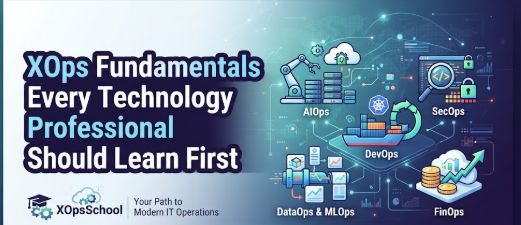
Technology teams today navigate an intricate digital web where software applications, cloud infrastructure, massive data lakes, and machine learning models must function as a single cohesive unit. Historically, engineering departments operated inside rigid silos—developers pushed code, database administrators managed queries, and IT operators monitored servers independently.
As digital systems scale, these isolated workflows inevitably introduce friction, slow down delivery, and complicate incident management. Modern organizations require a unified operational strategy that connects every technical domain. This evolution has brought XOps to the forefront of enterprise technology.
As an umbrella framework connecting diverse operational practices, XOps bridges the gap between disparate technical teams. Educational and knowledge platforms like XOpsSchool provide essential guidance for professionals striving to master these interconnected disciplines, understand underlying toolsets, and build robust operational strategies.
What Is XOps?
To understand What is XOps, it helps to look at the letter “X.” In technology, “X” acts as a variable representing multiple operational disciplines. XOps is not a single tool, a proprietary software product, or a rigid methodology. Instead, it is a conceptual framework that brings together various operational practices under a shared philosophy of automation, continuous delivery, observability, and collaboration.
At its core, XOps acknowledges that modern applications rely on more than just code running on a server. An application today depends on reliable data pipelines, machine learning models, automated infrastructure, proactive monitoring, and robust security controls. When these elements operate under disconnected workflows, teams face friction, miscommunication, and delayed incident resolution.
XOps bridges these gaps by establishing common principles across disciplines. It emphasizes automation as a primary driver of efficiency, treats infrastructure as code, encourages feedback loops across departments, and applies rigorous governance without slowing down innovation. Rather than treating DevOps, DataOps, MLOps, and AIOps as completely separate domains, XOps views them as interconnected gears within a larger organizational engine.
Why XOps Matters in Modern IT
Organizations face mounting pressure to deliver software faster while maintaining absolute reliability, strict security, and cost control. Disconnected operational processes hinder these goals. For example, a development team might push code updates rapidly through a CI/CD pipeline, but if the data engineering team operates on a separate schedule, application features relying on real-time data analytics may fail. Similarly, if machine learning models are deployed without automated monitoring, model drift can cause silent failures in production.
XOps thinking addresses these challenges by encouraging:
- Unified Automation: Extending automation principles beyond software delivery to cover data workflows, infrastructure provisioning, and security checks.
- Shared Observability: Implementing comprehensive monitoring that tracks application performance, infrastructure health, data quality, and model behavior within a unified view.
- Continuous Improvement: Establishing feedback loops where insights from operations flow back into development, data engineering, and machine learning pipelines.
- Standardized Collaboration: Breaking down silos so that developers, data scientists, IT operators, and security engineers share common workflows and operational goals.
By treating operations holistically, organizations can reduce manual toil, minimize downtime, and scale their technology infrastructure sustainably.
Major XOps Disciplines
XOps encompasses several specialized operational fields. Understanding each discipline helps clarify how they contribute to the broader operational ecosystem.
DevOps
DevOps focuses on the cultural and technical practices that unify software development and IT operations. It emphasizes continuous integration and continuous delivery (CI/CD), infrastructure automation, containerization, and rapid feedback loops. DevOps forms the foundational bedrock of modern software delivery.
DataOps
DataOps applies agile and DevOps principles to data engineering and analytics. It focuses on building reliable data pipelines, ensuring data quality, automating data orchestration, and maintaining continuous data delivery. DataOps ensures that organizations can trust their data as much as their application code.
MLOps
MLOps manages the lifecycle of machine learning models in production. It combines machine learning, software engineering, and operational practices to automate model training, testing, versioning, deployment, and monitoring. MLOps ensures that AI models remain accurate and reliable over time.
AIOps
AIOps leverages artificial intelligence and machine learning to improve IT operations. By analyzing large volumes of operational data, logs, and metrics, AIOps tools support proactive anomaly detection, event correlation, intelligent alerting, and automated incident response.
SecOps
SecOps integrates security practices into every phase of the operational lifecycle. Rather than treating security as a final gatekeeper, SecOps embeds security checks, vulnerability scanning, and compliance monitoring directly into automated workflows.
FinOps
FinOps brings financial accountability to cloud and technology operations. It helps cross-functional teams understand, monitor, and optimize cloud spend, ensuring that operational efficiency aligns with business value.
Platform Engineering
Platform engineering focuses on building internal developer platforms that provide self-service capabilities, reusable infrastructure components, and standardized engineering workflows, empowering developers to ship code securely and independently.
XOps Training
Effective XOps Training goes beyond teaching isolated tools; it focuses on building a holistic understanding of how different operational workflows interact. A well-structured learning path helps professionals connect the dots between software delivery, data pipelines, machine learning models, cloud infrastructure, and security.
Comprehensive training programs typically cover foundational DevOps concepts, cloud infrastructure management, container orchestration, observability frameworks, and automation techniques. As learners advance, training expands into specialized domains such as data operations, machine learning workflows, and AI-driven monitoring. By studying these areas together, learners develop the architectural mindset required to design resilient, scalable, and automated operational environments.
XOps Certification
Technical certification plays a valuable role in professional development by helping learners structure their study, establish clear learning milestones, and validate their understanding of core concepts. Pursuing an XOps Certification encourages individuals to review comprehensive syllabi, test their knowledge through practical labs, and identify gaps in their technical understanding.
However, certification preparation should be viewed as a tool for knowledge validation rather than an end in itself. Passing an exam demonstrates familiarity with theoretical concepts and standard frameworks, but real-world expertise requires hands-on practice, troubleshooting experience, and exposure to complex operational challenges. Combining structured study with practical project work provides the best foundation for long-term professional growth.
XOps Course
Choosing the right XOps Course depends on an individual’s current technical background and career objectives. A comprehensive course should follow a logical learning progression, starting with fundamental operational principles and gradually moving into advanced technical domains.
An ideal course structure typically covers:
- XOps fundamentals and the philosophy of connected operations.
- Core DevOps principles, source control, and CI/CD pipelines.
- Cloud infrastructure, networking, and infrastructure as code.
- Containerization and orchestration technologies.
- Observability, monitoring, and reliability engineering.
- Data operations and pipeline management.
- Machine-learning operations and model lifecycle management.
- AI-assisted operations and automated incident response.
- Security, governance, and cost management principles.
- Integration strategies for multi-discipline operational workflows.
Learners should select course depth that matches their existing experience, ensuring they build strong foundations before tackling advanced automation or AI operations.
XOps Tutorial
An effective XOps Tutorial bridges the gap between abstract theory and practical implementation. Tutorials allow learners to experiment with configuration files, automation scripts, CI/CD pipelines, container deployments, and monitoring setups in a controlled environment.
Working through hands-on tutorials helps clarify how different tools communicate with each other. For instance, a tutorial might demonstrate how an infrastructure provisioning tool sets up a Kubernetes cluster, how a CI/CD pipeline deploys an application to that cluster, and how an observability tool monitors performance metrics in real time. While reading tutorials is essential for learning syntax and configuration patterns, true understanding comes from modifying examples, troubleshooting errors, and observing how systems behave under different conditions.
XOps Tools
Because XOps is an umbrella framework rather than a single piece of software, it relies on a diverse ecosystem of tools. Organizations select tools based on their specific technical architecture, scalability requirements, team expertise, and security policies.
- Source Control and Collaboration: Platforms like Git enable teams to track code changes, collaborate on infrastructure definitions, and manage version control.
- CI/CD Automation: Technologies like Jenkins, GitHub Actions, and GitLab CI/CD automate the build, test, and deployment lifecycle.
- Containers and Orchestration: Docker provides containerization, while Kubernetes manages container deployment, scaling, and networking at scale.
- Infrastructure Automation: Tools like Terraform and Ansible automate infrastructure provisioning and configuration management.
- Observability: Prometheus, Grafana, and OpenTelemetry collect and visualize metrics, logs, and traces to monitor system health.
- GitOps: Argo CD and Flux enable declarative, Git-driven infrastructure and application deployments.
- Data Operations: Specialized orchestration tools manage data pipelines, data quality checks, and scheduled data workflows.
- MLOps and AIOps: Experiment-tracking, model registry, and intelligent monitoring platforms support machine learning and AI-driven operations.
Tool selection should always be driven by architectural requirements and team capabilities rather than popularity alone.
DevOps Training
DevOps Training serves as the primary stepping stone into the broader world of XOps. Because DevOps establishes the core practices of automation, version control, CI/CD, containerization, and infrastructure as code, mastering these fundamentals is essential before exploring advanced operational domains.
DevOps training programs teach engineers how to eliminate manual tasks, build reliable delivery pipelines, and manage cloud infrastructure programmatically. These foundational skills form the operational backbone required to support data pipelines, machine learning models, and secure cloud environments.
AIOps Training
AIOps Training focuses on applying artificial intelligence and machine learning to IT operations and incident management. Modern IT environments generate vast amounts of log data, performance metrics, and alert notifications. Manual monitoring often leads to alert fatigue and delayed incident resolution.
Through specialized training, professionals learn how AIOps tools ingest operational data, detect anomalies, correlate related alerts, and automate root-cause analysis. This training helps operations teams shift from reactive firefighting to proactive, intelligent system management.
MLOps Training
MLOps Training addresses the unique challenges of taking machine learning models out of experimental notebooks and running them reliably in production environments. Building an accurate model is only part of the challenge; deploying, versioning, monitoring, and retraining models requires specialized operational engineering.
MLOps training covers automated testing for data and code, model deployment pipelines, performance monitoring, and detection of model drift. This ensures that machine learning applications continue to deliver accurate predictions as real-world data changes.
DataOps Training
DataOps Training focuses on applying agile and automated engineering practices to data management. In modern organizations, data pipelines feed business intelligence tools, analytics platforms, and machine learning models.
DataOps training teaches engineers how to build resilient data pipelines, implement automated data quality tests, orchestrate complex data workflows, and maintain continuous data observability. This ensures that downstream consumers receive timely, accurate, and trustworthy data.
How XOps Connects DevOps, DataOps, MLOps, and AIOps
The true power of XOps lies in how its various disciplines interconnect. While each operational area focuses on a specific domain, they share common underlying principles and technical foundations.
| XOps Discipline | Main Focus | Common Learning Areas |
| DevOps | Software delivery and infrastructure automation | CI/CD, Git, Docker, Kubernetes, Terraform |
| DataOps | Reliable data pipelines and data quality | Data orchestration, testing, observability, pipelines |
| MLOps | Machine learning model lifecycle management | Model versioning, deployment, monitoring, experiment tracking |
| AIOps | Intelligent IT operations and anomaly detection | Log analysis, event correlation, automated alerting |
| SecOps | Security integration across operational workflows | Vulnerability scanning, compliance, IAM, security automation |
| FinOps | Cloud cost management and financial accountability | Cost monitoring, resource optimization, budgeting |
| Platform Engineering | Internal developer platforms and self-service workflows | Developer portals, reusable templates, infrastructure standards |
These disciplines reinforce one another. DevOps provides the delivery pipelines and infrastructure automation that DataOps and MLOps rely on to deploy data workflows and machine learning models. AIOps utilizes telemetry data collected through observability tools—often set up via DevOps practices—to provide intelligent incident insights. Security and FinOps principles wrap around every discipline, ensuring that operations remain secure and cost-effective.
Who Can Benefit from XOpsSchool?
1. DevOps and Cloud Engineers
Cloud and DevOps professionals can broaden their technical scope beyond application deployment and infrastructure management by understanding how data pipelines, machine learning models, and AI operations integrate into cloud environments.
2. Data Engineers
Data engineers can leverage DataOps principles to improve data pipeline reliability, implement automated testing, and enhance monitoring across complex data architectures.
3. Machine Learning Professionals
Machine learning practitioners can utilize MLOps concepts to bridge the gap between experimental model development and reliable production deployment, ensuring sustained model performance.
4. IT Operations and SRE Professionals
Site reliability engineers and operations professionals can adopt AIOps, observability, automation, and platform engineering concepts to improve incident response and system reliability.
5. Developers and Technical Learners
Developers can gain a comprehensive understanding of the operational lifecycle, helping them write more resilient code and collaborate effectively with operations and platform teams.
6. Technology Teams and Organizations
Engineering leaders and organizations can use structured XOps knowledge to break down departmental silos, establish unified automation standards, and improve cross-functional collaboration.
Common Mistakes When Learning XOps
- Treating XOps as a Single Tool: Assuming that purchasing or installing one specific software product achieves XOps adoption.
- Learning Tools Without Concepts: Focusing entirely on tool syntax without understanding the underlying operational principles and architectural patterns.
- Trying to Learn Everything Simultaneously: Attempting to master DevOps, DataOps, MLOps, and AIOps all at once without building a solid foundation first.
- Ignoring Foundational DevOps: Skipping core practices like version control, CI/CD, and basic automation before moving into specialized domains.
- Focusing Solely on Certification: Memorizing exam answers without engaging in practical labs or real-world problem-solving.
- Neglecting Observability: Building complex automated pipelines without implementing adequate monitoring, logging, and tracing.
- Ignoring Security and Cost: Treating security and FinOps as afterthoughts rather than core operational responsibilities.
- Chasing Hype: Adopting trendy tools or frameworks that do not align with actual technical requirements or team capabilities.
Best Practices for Learning XOps
- Start with Fundamentals: Build a strong grasp of basic operational concepts, Linux, networking, and version control before advancing.
- Master Core DevOps: Understand CI/CD pipelines, containerization, and infrastructure as code before exploring data or machine learning operations.
- Learn Cloud Basics: Gain familiarity with core cloud computing services, resource management, and IAM policies.
- Embrace Automation: Practice automating repetitive tasks through scripts, pipelines, and infrastructure definitions.
- Study Observability: Learn how to collect and interpret metrics, logs, and traces to understand system behavior.
- Explore Specialized Domains Gradually: Once fundamentals are secure, branch out into DataOps, MLOps, or AIOps based on professional interests.
- Build Integrated Projects: Combine multiple operational disciplines in small, hands-on projects rather than studying each area in total isolation.
- Document Your Learning: Maintain notes, architecture diagrams, and configuration repositories to reinforce technical concepts.
| Learning Goal | Recommended XOps Area | Skills to Develop |
| Automating software delivery and infrastructure | DevOps | CI/CD, Git, Docker, Kubernetes, Terraform |
| Ensuring reliable data delivery and quality | DataOps | Data pipelines, orchestration, automated testing |
| Managing machine learning models in production | MLOps | Model versioning, deployment pipelines, monitoring |
| Automating incident detection and log analysis | AIOps | Log analytics, anomaly detection, event correlation |
| Embedding security into operational workflows | SecOps | Vulnerability management, automated compliance |
| Optimizing cloud expenditure and resource allocation | FinOps | Cost monitoring, resource rightsizing, budgeting |
| Building internal developer self-service platforms | Platform Engineering | Developer portals, reusable infrastructure templates |
8-Step XOps Learning Guide
- Understand What XOps Means: Grasp the foundational philosophy of connected operational disciplines and why isolated silos hinder modern technology teams.
- Build DevOps Foundations: Master version control, basic scripting, CI/CD pipelines, and containerization with Docker.
- Learn Cloud and Infrastructure: Study cloud platform fundamentals, networking basics, and infrastructure as code using tools like Terraform or Ansible.
- Learn Observability and Reliability: Understand monitoring, metrics collection, logging, distributed tracing, alerting thresholds, and SLO management.
- Explore DataOps: Learn how reliable data pipelines, automated quality checks, and data orchestration work in practice.
- Explore MLOps and AIOps: Understand model lifecycle management, versioning, deployment, and AI-assisted operational monitoring.
- Learn Security, Governance, and Cost Awareness: Study SecOps principles, compliance automation, and FinOps cloud cost management basics.
- Build an Integrated Practical Project: Combine several operational disciplines into a cohesive, hands-on project that simulates real-world production environments.
Practical XOps Learning Approach
Moving from theoretical knowledge to practical capability requires consistent, hands-on experimentation. Learners should set up local lab environments or cloud sandbox accounts to test concepts.
Practical learning involves writing infrastructure code, constructing CI/CD pipelines, deploying containerized applications, configuring monitoring dashboards, and simulating data pipelines. By deliberately introducing faults or failures into test environments, learners can practice troubleshooting, log analysis, and incident remediation. Documenting these experiments helps solidify understanding and builds a practical portfolio of skills.
How to Choose XOps Tools
Selecting the right tools requires a balanced evaluation of several technical and organizational factors:
- Business Requirements: Ensure the tool aligns with organizational goals, project scale, and delivery timelines.
- Technical Architecture: Evaluate how well a tool integrates with existing cloud providers, operating systems, and legacy infrastructure.
- Team Skills: Consider the existing technical expertise of the team and the learning curve associated with adopting a new technology.
- Security and Compliance: Verify that the tool meets organizational security standards, data privacy requirements, and access control policies.
- Community and Support: Prioritize tools with active open-source communities, robust documentation, and reliable enterprise support options.
- Maintenance Overhead: Assess the long-term operational cost of maintaining, updating, and scaling the tool in production.
Avoiding tool-driven decisions ensures that technology serves operational needs rather than adding unnecessary complexity.
XOps Career and Skill Development
Acquiring XOps knowledge broadens technical capability, enabling professionals to work effectively across multiple domains. Skills in automation, cloud infrastructure, CI/CD, data engineering, machine learning operations, observability, and platform engineering are increasingly valued in modern technology organizations.
Career progression in this space depends heavily on practical problem-solving ability, hands-on experience, continuous learning, and effective cross-functional collaboration. Professionals who understand how different operational disciplines connect are well-equipped to design robust, scalable systems that drive business success.
Using XOpsSchool as a Learning Resource
Approaching a platform like XOpsSchool effectively requires a structured, deliberate strategy. Learners can use the platform’s educational resources to navigate their professional development:
- Start by reviewing XOps fundamentals to understand the big picture.
- Identify the specific discipline—such as DevOps, DataOps, or MLOps—that aligns closest with your current role.
- Explore foundational tutorials and training materials to understand core toolsets.
- Practice concepts through hands-on labs and integrated projects.
- Gradually explore adjacent XOps disciplines to broaden your operational perspective.
- Use certification preparation resources to structure your study and validate your knowledge.
- Continue learning by analyzing real-world operational challenges and architectural patterns.
By combining structured educational resources with hands-on practice, learners can build a well-rounded understanding of modern IT operations.
FAQ
1. What is XOps in simple terms?
XOps is an umbrella approach that connects multiple operational disciplines—such as DevOps, DataOps, MLOps, and AIOps—under shared principles of automation, collaboration, and continuous delivery.
2. How is XOps different from DevOps?
While DevOps focuses primarily on software delivery and infrastructure automation, XOps expands this philosophy to cover data operations, machine learning lifecycle management, AI-driven monitoring, security, and financial governance.
3. What disciplines are included in XOps?
Major disciplines include DevOps, DataOps, MLOps, AIOps, SecOps, FinOps, and Platform Engineering.
4. Is XOps suitable for beginners?
Yes, beginners can start by learning fundamental DevOps concepts, cloud basics, and automation before gradually exploring advanced operational domains.
5. What should an XOps training path include?
A comprehensive training path should cover DevOps foundations, cloud infrastructure, containerization, observability, data operations, machine learning workflows, and security governance.
6. What is the purpose of XOps certification?
XOps certification helps learners structure their study, test their theoretical knowledge, and validate their familiarity with core concepts and operational frameworks.
7. What should learners look for in an XOps course?
Learners should look for courses that follow a logical learning progression, emphasize practical application, and cover the relationships between multiple operational disciplines.
8. Which tools are commonly associated with XOps?
Common tools include Git, GitHub Actions, Jenkins, Docker, Kubernetes, Terraform, Prometheus, Grafana, Argo CD, and various data orchestration and MLOps platforms.
9. How are DevOps, DataOps, MLOps, and AIOps connected?
They share underlying automation, CI/CD, monitoring, and infrastructure principles, working together to support software, data pipelines, machine learning models, and intelligent system management.
10. How can someone start learning XOps?
A beginner can start by understanding XOps fundamentals, building strong DevOps foundations, learning cloud basics, practicing automation through tutorials, and gradually exploring specialized domains.
Conclusion
The modern enterprise runs on a delicate balance of software, data, machine learning, and cloud infrastructure. Viewing these elements as isolated components invites operational friction, whereas a unified, collaborative approach turns complexity into a competitive advantage. By treating operations as an interconnected ecosystem, engineering teams can achieve unprecedented agility and resilience.
Embracing this shift requires continuous learning and practical exploration, areas where platforms like XOpsSchool serve as invaluable guides. Whether you are optimizing code pipelines, managing data streams, or overseeing cloud expenditures, mastering the XOps philosophy prepares you to build the resilient, future-ready technology systems of tomorrow.
Leave a Reply