Introduction
Tax compliance can feel like running a marathon where the finish line moves every month. For accountants and business owners, the end of a month does not just mean closing books—it kicks off the high-stakes GST filing cycle.
When you miss a detail or rush through a filing, things break down quickly. Minor data mismatches can trigger official notices, block vital working capital, or lead to steep financial penalties.
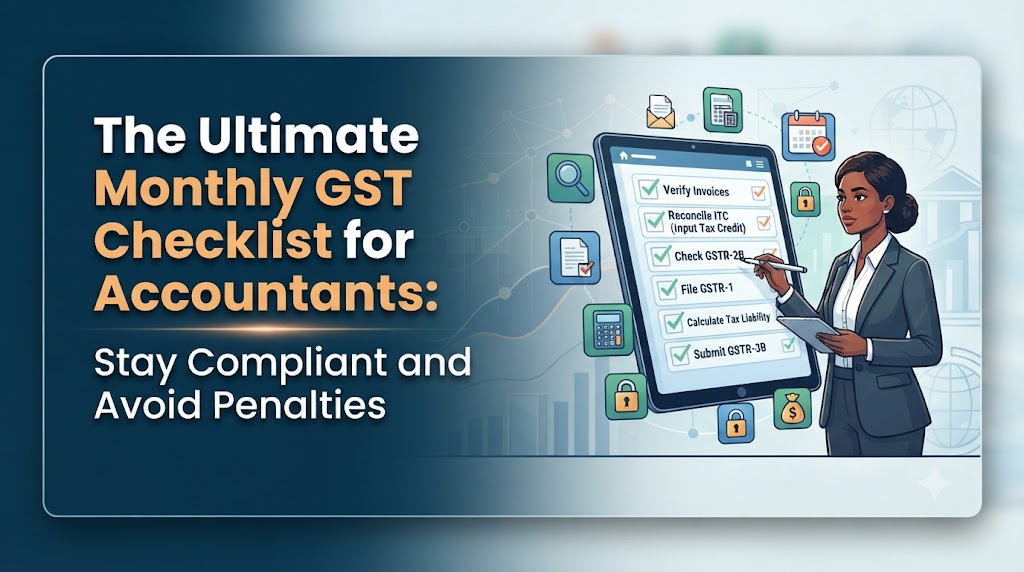
This guide provides a practical, step-by-step monthly GST checklist designed to help accountants keep their filing process organized, accurate, and completely stress-free.
What Is a Monthly GST Checklist?
A monthly GST checklist is an operational guide that outlines every single task an accountant must complete from the last day of a tax period until the final return is successfully submitted.
Think of it like a pilot’s pre-flight checklist. Even seasoned accountants handle hundreds of invoices, tax codes, and vendor adjustments. Relying purely on memory increases the chance of missing a crucial step, such as matching purchase registers with electronic credit ledgers.
Why a Structured GST Checklist Matters
Without a clear workflow, GST compliance becomes a reactive emergency every month-end.
- Prevents Financial Loss: Catching missing input tax credit (ITC) claims before filing saves real money.
- Protects Cash Flow: Timely filing ensures that your customers can claim their tax credits without delay, keeping business relationships smooth.
- Reduces Stress: A systematic approach eliminates last-minute scrambles and server-crash panic on due dates.
- Avoids Penalties: Missing deadlines attracts late fees and daily compounding interest that eats directly into profit margins.
Step-by-Step Monthly GST Checklist for Accountants
Step 1: Gather and Organize All Financial Data
Before touching any tax portal, get your house in order internally.
- Collect all sales invoices, debit notes, credit notes, and export documents issued during the month.
- Collect all purchase invoices, expense bills, and import documents (Bills of Entry).
- Ensure your accounting software (like Tally, Zoho Books, or SAP) is fully updated with the month’s transactions.
Step 2: Run Sales Reconciliations and File GSTR-1
GSTR-1 is your outward supply return where you report all sales made to registered and unregistered buyers.
- Match your internal sales register with the e-invoices and e-way bills generated during the month.
- Ensure GSTINs (GST Identification Numbers) of your business clients are active and correctly entered.
- Classify supplies accurately into B2B (Business to Business), B2C (Business to Consumer), exports, and exempt supplies.
- Submit and file GSTR-1 securely on the GST portal before the standard due date (usually the 11th of the following month).
Step 3: Perform Input Tax Credit (ITC) Reconciliations
This is the most critical step for protecting a company’s cash flow. You can only claim tax credits on purchases if your suppliers have correctly reported their sales.
- Pull the auto-populated GSTR-2B statement from the GST portal.
- Compare GSTR-2B data against your internal purchase register.
- Identify three buckets of invoices:
- Matched: Safe to claim immediately.
- Missing from GSTR-2B: Follow up with the respective vendors to upload their invoices.
- Mismatched: Check values, tax rates, or invoice numbers for typos.
- Reverse any ITC claimed previously on goods or services used for personal consumption or exempt supplies.
Step 4: Calculate Net Tax Liability
Once your sales and eligible purchases are locked in, calculate what you actually owe the government.
- Total Output Tax Liability (GST collected on sales) = ₹X
- Total Eligible Input Tax Credit (GST paid on purchases from GSTR-2B) = ₹Y
- Net Tax Payable = $X – Y$
- Verify if you have any cash balance or electronic credit ledger balances to offset this liability.
Step 5: File GSTR-3B and Pay Taxes
GSTR-3B is your summary return where you declare total sales, eligible credits, and pay your final tax dues.
- Enter your consolidated outward and inward supplies into the GSTR-3B form.
- Cross-verify the tax computation with your final balance sheet or trial balance.
- Generate the challan, make the electronic tax payment via net banking, UPI, or NEFT, and offset the liability.
- File GSTR-3B with an Electronic Verification Code (EVC) or Digital Signature Certificate (DSC) before the deadline (usually the 20th of the following month).
Step 6: Post-Filing Documentation and Archiving
Compliance doesn’t end with a successful filing confirmation message.
- Download and save the filing acknowledgements (PDFs and ARN receipts) in structured cloud storage or local secure folders.
- Update your internal ledger accounts for tax payments and credit offsets.
- Send reconciliation exception reports to vendors who failed to upload invoices so they can fix them in the next cycle.
Essential GST Monthly Checklist Table
| Phase | Key Task | Common Tool / Source | Standard Timeline |
| Data Prep | Collect sales & purchase records | Accounting Software | Days 1 to 5 of next month |
| Sales | Reconcile sales & file GSTR-1 | GST Portal / E-invoice system | By 11th of next month |
| Purchases | Match ITC with GSTR-2B | GSTR-2B Portal vs Purchase Register | Days 10 to 18 of next month |
| Filing | Calculate liability & file GSTR-3B | GST Portal Payment Gateway | By 20th of next month |
| Closure | Save receipts & notify vendors | Cloud Storage / Email | By 25th of next month |
Common Mistakes Accountants Should Avoid
Even experienced professionals can run into trouble if they fall into these common traps:
- Waiting Until the Last Day: Portal traffic spikes on due dates, leading to slow loading times and transaction timeouts. Always aim to file at least 48 hours early.
- Ignoring Vendor Non-Compliance: Claiming ITC on invoices missing from GSTR-2B creates future audit risks and sudden tax recovery notices from authorities.
- Failing to Reconcile E-Way Bills: Discrepancies between your physical goods movement values reported in e-way bills and your GSTR-1 sales invite scrutiny.
- Overlooking Reverse Charge Mechanism (RCM): Forgetting to calculate and pay tax under RCM on applicable professional fees or freight charges leads to short-payment penalties.
Key Terms Every Accountant Should Know
- GSTIN: A unique 15-digit code assigned to every registered taxpayer under the GST system.
- GSTR-1: A monthly or quarterly statement detailing all outward supplies (sales) made by a taxpayer.
- GSTR-3B: A simplified summary return filed monthly to declare liabilities and claim input tax credits.
- GSTR-2B: An auto-generated static input tax credit statement available monthly to help businesses track eligible credits.
- Input Tax Credit (ITC): The tax a business pays on its purchases that it can use to reduce the tax liability it owes on its sales.
- Reverse Charge Mechanism (RCM): A rule where the recipient of goods or services pays the tax directly to the government instead of the supplier.
Frequently Asked Questions
What happens if I miss the GSTR-3B filing deadline?
Missing the deadline attracts a late fee (a combined daily amount for CGST and SGST) plus interest calculated at an annual percentage on the unpaid tax amount from the due date until the actual date of payment.
Can I claim ITC if an invoice is not reflecting in my GSTR-2B?
As per current tax rules, you can only claim input tax credit if the respective invoice or debit note is furnished by your supplier in their GSTR-1 and reflects in your GSTR-2B statement.
Is GSTR-1 filing mandatory even if there were no sales in a month?
Yes. If a business has zero transactions during a specific tax period, you must still file a “Nil” GSTR-1 and GSTR-3B return to maintain compliance and avoid late fees.
How far back can I claim missed Input Tax Credit?
Generally, ITC pertaining to a financial year can be claimed up to the date of filing the return for November of the following financial year, or when the annual return is filed, whichever is earlier.
What is the difference between GSTR-1 and GSTR-3B?
GSTR-1 is an invoice-level detailed statement of all your sales. GSTR-3B is a high-level summary return where you declare your total sales, total eligible purchases, net tax payable, and make the actual tax payment.
Conclusion
Staying compliant with GST does not have to be an overwhelming monthly fire drill. By following a disciplined, step-by-step checklist, accountants can catch discrepancies early, protect company cash flow through accurate ITC claims, and eliminate last-minute errors. Build this checklist into your standard routine, file early, and turn tax season into a smooth, predictable process.
Leave a Reply