Introduction
Tax season can feel confusing. Many people think that once their employer deducts tax from their salary, their tax journey for the year is completely finished. However, if you earn money from freelance work, capital gains, bank interest, or rental properties, your regular deductions might not cover the full amount you owe.
When you sit down to file your tax return and discover a remaining balance due, you are looking at self-assessment tax. Ignoring this or delaying payment leads to interest penalties and can even delay your tax filing process. This guide breaks down what self-assessment tax is, how to calculate what you owe, and the exact steps to pay it online without stress.
What Is Self-Assessment Tax?
Self-assessment tax is the tax you calculate and pay on your own when filing your income tax return.
When you earn money during a financial year, the government expects tax payments throughout the year. This happens in two main ways:
- TDS (Tax Deducted at Source): Money deducted by your employer or clients before they pay you.
- Advance Tax: Direct tax installments paid by taxpayers during the financial year if their total tax liability exceeds a specific threshold.
After the financial year ends, you calculate your total taxable income, subtract the TDS and advance tax you already paid, and check the final balance. If you still owe money to the government, that final payment is your self-assessment tax.
Why It Matters
Paying your self-assessment tax correctly ensures that your tax return matches government records. If you file your return without paying this due amount, your return becomes defective, and the tax department will send you a notice to clear the dues along with penalty interest.
How Self-Assessment Tax Works
The process of paying self-assessment tax is straightforward once you understand your total tax liability. Here is how the sequence flows from earning to final payment:
- Calculate Total Income: Add up all income sources for the financial year, including salary, freelance earnings, capital gains from stocks or property, and bank interest.
- Deduct Exemptions and Deductions: Apply eligible deductions (such as retirement savings or health insurance) to arrive at your net taxable income.
- Compute Tax Liability: Apply the relevant income tax slab rates to find out your total tax for the year.
- Subtract Previous Payments: Deduct any TDS already cut by your company or clients and any advance tax installments you deposited during the year.
- Determine the Balance: If the resulting number is positive, that is your self-assessment tax amount. You must pay this balance before submitting your income tax return.
Why Do People Owe Self-Assessment Tax?
Most taxpayers end up with a self-assessment tax liability due to unexpected or variable income sources. Common reasons include:
- Extra Investment Earnings: High interest earned on fixed deposits or savings accounts that was not accounted for during employer TDS calculations.
- Capital Gains: Profits made from selling mutual funds, stocks, or real estate late in the financial year.
- Freelance or Side Income: Secondary income streams where clients did not deduct TDS.
- Job Changes: Switching jobs where new employers did not accurately account for income earned from previous employers.
Common Mistakes to Avoid
Taxpayers often make avoidable errors when handling self-assessment tax payments. Knowing these mistakes helps you protect your finances.
- Mistake 1: Paying under the wrong head. People often confuse self-assessment tax with advance tax when filling out online challans.
- Why it happens: Choosing a random category out of habit.
- Consequence: The tax department tracks the payment incorrectly, showing your tax as unpaid.
- What to do instead: Always select Self-Assessment Tax (Minor Head 300) when generating your online payment challan.
- Mistake 2: Forgetting to include interest.
- Why it happens: Paying only the basic tax amount without adding late filing or delayed payment interest.
- Consequence: Receiving a demand notice later for the unpaid interest balance.
- What to do instead: Let your tax filing software calculate total dues including interest, or verify your calculation before making the online transfer.
- Mistake 3: Waiting until the last minute.
- Why it happens: Procrastinating until the ITR filing deadline day.
- Consequence: Gateway failures, bank server downtime, or payment processing delays.
- What to do instead: Clear your tax dues a few days before filing your return.
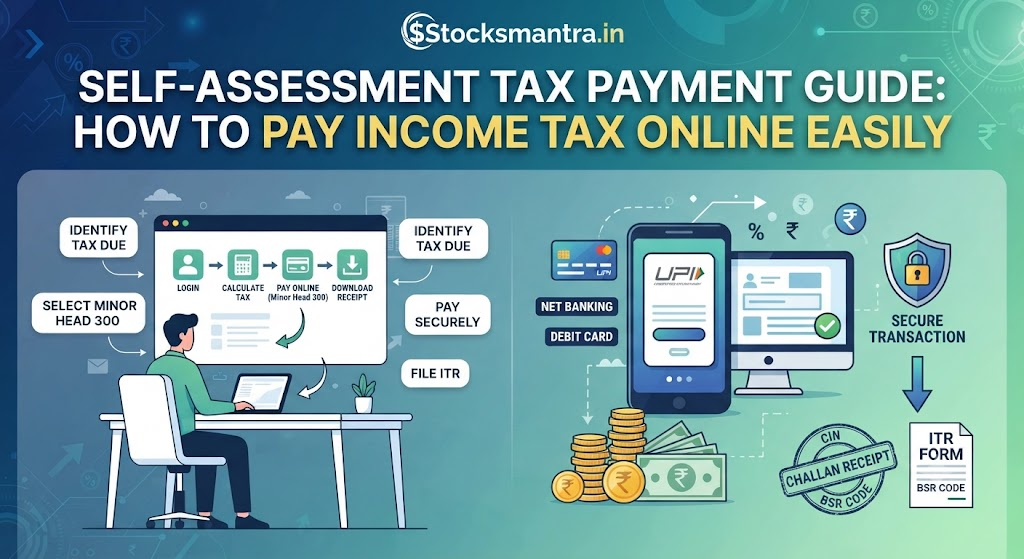
Step-by-Step Online Payment Guide
You can clear your self-assessment tax dues entirely online in just a few minutes through the official income tax portal.
Step 1: Log Into the E-Filing Portal
Go to the official income tax e-filing website and log in using your PAN or Aadhaar number and password.
Step 2: Navigate to e-Pay Tax
Once logged in, go to the e-File menu, select e-Pay Tax, and click on New Payment.
Step 3: Select Income Tax
Choose the Income Tax tile and click proceed. Select the correct assessment year (the year following the financial year for which you are paying taxes).
Step 4: Choose the Correct Minor Head
Under the type of payment, select Self-Assessment Tax (Minor Head 300). This is a critical step to ensure your payment links correctly to your return.
Step 5: Enter the Tax Breakdown
Input the exact amount under the correct heads (such as tax amount, interest, or fee). The portal will auto-calculate the total sum.
Step 6: Complete the Payment
Choose your preferred payment method—such as net banking, debit card, UPI, or credit card—and complete the transaction securely.
Step 7: Save the Receipt
Once the payment is successful, download and save the Challan Receipt. This receipt contains the BSR code and Challan Identification Number (CIN), which you will need to enter when filing your ITR.
Risks and Limitations
While paying online is efficient, certain operational challenges can occur.
- Payment Lag: Sometimes online payments take 24 to 48 hours to reflect in your tax credit statement (Form 26AS or Annual Information Statement). Do not panic if your payment does not show up instantly. Wait a business day before filing your return.
- Incorrect Challan Details: Entering the wrong assessment year or minor head can cause severe reconciliation delays with the tax department. Always double-check your inputs before authorizing payment.
Decision-Making Framework: When to Pay
Use this simple framework to decide your next steps regarding tax dues:
- Check Your Form 26AS: Verify all TDS credits against your actual earnings.
- Calculate Net Dues: Compute your total tax liability minus credits.
- Check for Delay: If the financial year has ended and you haven’t paid advance tax, expect minor interest charges.
- Pay Immediately: Generate a Self-Assessment Tax challan and pay before submitting your ITR to prevent notices.
Checklist Before Filing Your ITR
- All income sources (salary, freelance, capital gains, interest) are documented.
- Form 26AS and AIS have been reviewed for matching TDS details.
- Self-assessment tax amount has been calculated accurately, including any applicable interest.
- Payment has been made under Minor Head 300.
- Challan receipt with BSR code and CIN has been downloaded and saved.
- Challan details have been entered correctly into the ITR form before final submission.
Key Terms
- Assessment Year (AY): The year in which income earned in the previous financial year is evaluated and taxed.
- Challan: The official payment receipt generated when you deposit taxes online, containing tracking numbers like BSR code and CIN.
- Minor Head 300: The specific payment classification code designated for self-assessment tax payments.
- Form 26AS: An official consolidated tax statement showing all taxes deducted, deposited, or collected against your PAN.
- Advance Tax: Income tax paid in installments throughout the financial year rather than in a single lump sum.
FAQs
What is the difference between advance tax and self-assessment tax?
Advance tax is paid in installments during the ongoing financial year when your tax liability crosses a certain limit. Self-assessment tax is paid at the end of the year when you file your return to cover any remaining balance.
Can I pay self-assessment tax after filing my ITR?
No. You must pay self-assessment tax before or at the time of filing your return. If you file your return with unpaid dues, your return may be treated as defective, or you will receive a demand notice for unpaid tax plus interest.
What should I do if I paid tax under the wrong minor head?
If you accidentally selected the wrong minor head (like paying advance tax instead of self-assessment tax), you generally cannot change it online directly. You may need to file a correction request or claim credit during return filing if allowed, but it is best to consult a tax professional to resolve challan classification errors.
Is interest charged on self-assessment tax?
Yes. If you delayed paying your advance tax installments during the year, interest under specific sections of tax law will apply and must be paid along with your self-assessment tax.
How long does it take for a self-assessment tax payment to reflect in my account?
Usually, payments reflect in your tax credit statement within 2 to 3 working days. It is recommended to wait a couple of days after payment before submitting your final income tax return.
Do I need to attach the challan receipt to my ITR?
You do not need to physically attach the receipt, but you must enter the Challan Identification Number (CIN), BSR code, date of payment, and amount accurately into your ITR form.
What payment methods are accepted for paying self-assessment tax online?
The e-filing portal supports multiple payment gateways, including net banking from major banks, debit cards, UPI, credit cards, and NEFT/RTGS transfers.
Can I get a refund if I pay extra self-assessment tax by mistake?
Yes. If you pay more tax than you actually owe, you can claim a refund by filing your income tax return correctly. The tax department will credit the excess amount back to your verified bank account after processing your return.
Conclusion
Managing and paying your self-assessment tax is a standard part of staying compliant with financial obligations. By calculating your dues accurately, selecting the correct minor head, and clearing payments before filing your return, you protect yourself from avoidable penalties and notices. Keep your challan receipts organized, double-check your numbers, and complete your tax filing smoothly.