Introduction
Every year, many taxpayers pick an ITR form out of habit. They used ITR-1 last year, so they use it again. Then they sold some shares, rented a second flat, or earned a freelance fee. The old form no longer fits.
This mistake is common and it matters. A wrong form can mean a defective return, a notice from the department, or delays in your refund. In some cases you may have to file again.
This guide explains the three most-used forms in plain words. You will learn who qualifies for each one, what each form can and cannot hold, which mistakes to avoid, and how to choose with a simple checklist.
What Is an ITR Form, and Why Are There Different Ones?
An Income Tax Return (ITR) is the report you send to the tax department each year. It shows your income, deductions, and taxes paid.
The department uses different forms because people earn money in different ways. A salaried person with one bank account does not need pages for foreign assets or business accounts. A trader does.
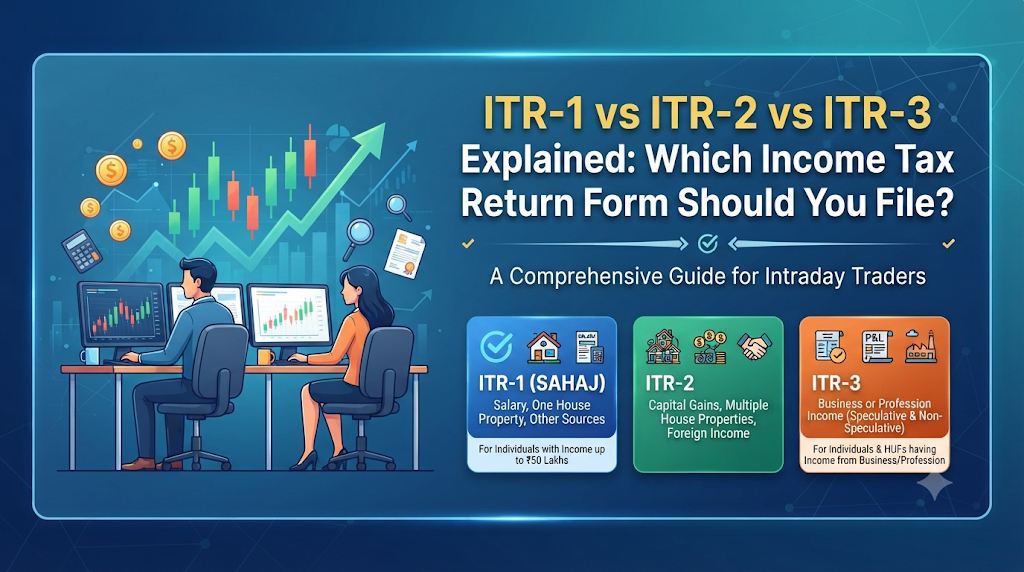
So the forms are built in layers. ITR-1 is short and has few fields. ITR-2 adds schedules for capital gains, more properties, and foreign assets. ITR-3 adds schedules for business and professional income, such as a profit and loss account and a balance sheet.
Why it matters: the form you choose must match your income. You cannot leave out a type of income just because your form has no space for it.
ITR-1 (Sahaj): The Simple Form
Who Can Use It
For AY 2026-27, ITR-1 is generally for a resident individual (not an RNOR) whose total income is up to ₹50 lakh and comes only from these sources:
- Salary or pension
- Up to two house properties
- Other sources, such as savings interest, fixed deposit interest, and family pension
- Long-term capital gains under Section 112A (listed shares and equity-oriented mutual funds) up to ₹1.25 lakh, with no capital losses brought forward or carried forward
- Agricultural income up to ₹5,000
Two of these points are fairly new. Earlier, ITR-1 allowed only one house property, and any capital gain pushed you to ITR-2. Now two properties and a small Section 112A gain are allowed.
Who Cannot Use It
You cannot use ITR-1 if any of these apply:
- You are a company director
- You held unlisted equity shares during the year
- You have foreign assets or foreign income
- You have business or professional income
- You are a HUF, an NRI, or an RNOR
- Tax was deducted under Section 194N (large cash withdrawals)
- You have deferred tax on eligible ESOPs
Example
Riya works for a company. She has a salary, interest from a fixed deposit, and one rented flat. She also sold some equity mutual fund units for a long-term gain below ₹1.25 lakh. She has no foreign assets and no other income. Riya can file ITR-1.
ITR-2: For Individuals and HUFs With Complex Income But No Business
Who Should Use It
ITR-2 is for individuals and HUFs who have no income from business or profession, but who do not fit ITR-1. Common cases:
- Capital gains beyond the small ITR-1 limit, such as short-term gains on shares or gains from selling property
- More than two house properties
- Total income above ₹50 lakh
- Foreign assets or foreign income
- NRI or RNOR status
- Agricultural income above ₹5,000
- Being a company director or holding unlisted shares
Why Capital Gains Often Cause the Switch
Capital gains are profits you make when you sell an asset, such as shares or property, for more than you paid. If you hold for a short time, it is a short-term gain. If you hold for longer, it is a long-term gain. The holding period that counts depends on the asset type.
Many salaried people move to ITR-2 simply because they sold shares or mutual funds during the year. A short-term gain on listed shares, for example, takes you out of ITR-1.
Example
Arjun is a salaried employee. During the year he sold shares he had held for a few months and made a profit. He also earned interest from his savings account. He has no business income. Arjun should file ITR-2.
ITR-3: For Business or Professional Income
Who Should Use It
ITR-3 is for individuals and HUFs who have income from business or profession (called PGBP in tax language) and who are not using, or cannot use, the simple presumptive route.
Common cases:
- Freelancers and consultants who maintain full books of accounts
- Small business owners who are not opting for presumptive taxation
- Partners in a firm who receive salary, interest, or profit share
- Traders in futures and options (F&O), which the department treats as business income
- Intraday share trading, which is treated as speculative business income
- People with both salary and business income
ITR-3 can also carry everything ITR-2 can: salary, house property, capital gains, and other sources. It is the widest of the three.
ITR-3 vs ITR-4: A Point Many People Miss
There is also ITR-4 (Sugam) for resident individuals, HUFs, and firms who choose presumptive taxation. Under that scheme, you declare income at a fixed percentage of turnover or receipts, and you skip detailed accounts. It is available only up to certain limits and conditions.
If your business income is eligible and simple, ITR-4 can be easier than ITR-3. But if you do not qualify, or if you want to show actual profit or loss, you use ITR-3.
Example
Meera is a freelance designer. She earns professional fees, keeps proper records, and has interest income too. If she is not eligible for, or does not choose, the presumptive scheme, she files ITR-3. If she qualifies and opts for presumptive taxation, ITR-4 may be the simpler form.
Example : The Trader
Kabir has a salary and also trades in F&O. Even if the net result is a loss, the income is business income. He should use ITR-3 and report the trading result in the business section.
Side-by-Side Comparison
| Point | ITR-1 (Sahaj) | ITR-2 | ITR-3 |
|---|---|---|---|
| Who can file | Resident individuals | Individuals and HUFs | Individuals and HUFs |
| Business or profession income | Not allowed | Not allowed | Allowed |
| Total income limit | Up to ₹50 lakh | No limit | No limit |
| House property | Up to 2 | Any number | Any number |
| Capital gains | Only Section 112A LTCG up to ₹1.25 lakh | Yes, all types | Yes, all types |
| Foreign assets or income | Not allowed | Allowed | Allowed |
| NRI or RNOR | Not allowed | Allowed | Allowed |
| Books of accounts, P&L, balance sheet | No | No | Yes |
| Typical user | Simple salaried person or pensioner | Investor, NRI, multi-property owner | Freelancer, trader, business owner |
How to Choose: A Simple Decision Process
Step 1: List every source of income. Include salary, interest, rent, dividends, sale of shares, sale of property, freelance fees, and trading. Use your AIS (Annual Information Statement) and Form 26AS to catch items you forgot.
Step 2: Check for business or professional income. If you have any, ITR-1 and ITR-2 are out. Look at ITR-3 or ITR-4.
Step 3: Check your residential status. NRIs and RNORs cannot use ITR-1.
Step 4: Check for complexity. Foreign assets, more than two properties, income above ₹50 lakh, or capital gains beyond the small limit all push you to ITR-2 (or ITR-3 if you also have business income).
Step 5: Choose the simplest form that covers everything. If you qualify for ITR-1, use ITR-1. If you do not, move up. Never pick a simpler form that cannot hold all your income.
Quick Situation Guide
| Your situation | Likely form |
|---|---|
| Salary, FD interest, one or two houses | ITR-1 |
| Salary plus small long-term equity gain (up to ₹1.25 lakh, no losses) | ITR-1 |
| Salary plus short-term share gains | ITR-2 |
| Salary plus property sale | ITR-2 |
| Salary plus foreign shares or foreign bank account | ITR-2 |
| Salary plus freelance income (full accounts) | ITR-3 |
| Salary plus F&O or intraday trading | ITR-3 |
| Eligible small business using presumptive scheme | ITR-4 |
Real-World Points People Overlook
1. A Small Side Income Changes the Form
Even a small freelance fee counts as professional income. It can move you out of ITR-1 and ITR-2. Many people assume only large business income matters. It does not work that way.
2. Mutual Fund and Share Sales Count
If you sold units or shares, the gain must be reported. Whether it fits in ITR-1 depends on the type and size of the gain. Check your broker’s capital gains statement before you choose the form.
3. Foreign Assets Need Special Care
If you hold foreign shares, a foreign bank account, or similar assets, you must disclose them in the foreign asset schedule, which is only in ITR-2 and ITR-3. This applies even if the account earned nothing. Employees who received foreign company stock should check this carefully.
4. Virtual Digital Assets
Gains from crypto and other virtual digital assets have their own reporting rules and cannot be reported on ITR-1. Check the current instructions for the right form and schedule.
5. Choosing the Tax Regime
You also choose between the old and new tax regimes. If you have business income, the rules for switching are stricter than for salaried people, and you may need to submit a specific form. Read the current rules on the official portal before choosing.
Common Mistakes and How to Avoid Them
Mistake 1: Reusing last year’s form.
Why people do it: It feels safe and familiar.
Why it causes problems: Your income may have changed. A new property, a share sale, or freelance work can change the form.
What to do instead: Review all your income sources every year before choosing.
Mistake 2: Ignoring small capital gains.
Why people do it: The amount looks tiny, or the sale happened through an app.
Why it causes problems: The gain may still need reporting, and it may change the form.
What to do instead: Download your capital gains statement from your broker or fund house and check it against your AIS.
Mistake 3: Calling freelance or trading income “other income.”
Why people do it: It seems simpler.
Why it causes problems: The department may treat it as business income, and your return may not match your AIS.
What to do instead: Report it under the correct head, and use ITR-3 or ITR-4 as needed.
Mistake 4: Leaving out foreign assets.
Why people do it: The account earned no income, so it feels irrelevant.
Why it causes problems: Non-disclosure can lead to serious penalties.
What to do instead: Disclose all foreign assets in the proper schedule on ITR-2 or ITR-3.
Mistake 5: Not checking AIS and Form 26AS.
Why people do it: They rely only on their Form 16.
Why it causes problems: The department already holds information on interest, dividends, share sales, and more. A mismatch can trigger a notice.
What to do instead: Compare your own records with AIS and 26AS before filing.
Mistake 6: Forgetting to e-verify.
Why people do it: They think submitting is the last step.
Why it causes problems: An unverified return is treated as not filed.
What to do instead: Verify within the time allowed, which is currently 30 days from filing. Check the portal for the latest limit.
Risks and What Can Go Wrong
- Wrong form: The return may be treated as defective. You may get a notice and a chance to correct it within a set time. If you miss that, the return can be treated as invalid.
- Underreported income: Interest and tax may follow, and in serious cases penalties.
- Missed deadlines: For AY 2026-27, the usual due date for non-audit salaried and investor cases (ITR-1 and ITR-2) was 31 July 2026. Non-audit business and professional cases using ITR-3 or ITR-4 had 31 August 2026. A belated return is generally possible up to 31 December 2026, but with a late fee and interest, and some benefits such as carry-forward of certain losses may be lost. Check the portal for the exact current dates and conditions.
- Wrong residential status: This can change both the form and the income that is taxable in India.
How to reduce these risks: Prepare early, keep your documents together, check AIS, and if your case is mixed or complex, speak to a qualified tax professional.
When Not to Use Each Form
- Do not use ITR-1 if you have anything outside its limits, even if only one item seems small.
- Do not use ITR-2 if you have any business or professional income.
- Do not use ITR-3 if you only have eligible presumptive income and want a simpler return. ITR-4 may suit you better.
Documents Checklist Before You File
- PAN and Aadhaar linked and working
- Form 16 from your employer (if salaried)
- Form 26AS and AIS downloaded and reviewed
- Bank statements and interest certificates (savings, FD)
- Rent receipts, home loan interest certificate, and property details
- Broker’s capital gains statement and mutual fund statements
- Records of any foreign assets or foreign income
- Books of accounts, invoices, and expense records (for freelancers and traders)
- Proofs of deductions you plan to claim
- Details of the bank account for refunds, with pre-validation done
Key Terms
- Assessment Year (AY): The year in which your income is assessed. For income earned in FY 2025-26, the AY is 2026-27.
- Financial Year (FY): The year in which you earn the income, from April to March.
- Resident, NRI, RNOR: Your tax residency status. It decides which form you can use and how much of your income is taxed in India.
- Capital gains: Profit from selling an asset such as shares or property.
- STCG and LTCG: Short-term and long-term capital gains, based on how long you held the asset.
- Section 112A: The rule for long-term gains on listed equity shares and equity-oriented mutual funds.
- PGBP: Profits and Gains of Business or Profession. It is the income head for business and professional income.
- Presumptive taxation: A simple scheme where income is assumed at a fixed percentage of turnover or receipts.
- F&O: Futures and options trading, treated as business income.
- AIS: A statement showing financial transactions linked to your PAN.
- Form 26AS: A statement of tax deducted or paid against your PAN.
- Belated return: A return filed after the due date.
- Revised return: A corrected return filed after you spot an error.
FAQs
1. Can a salaried person file ITR-2?
Yes. Salaried people often file ITR-2 when they have short-term capital gains, more than two properties, foreign assets, or higher income.
2. Can I use ITR-1 if I sold shares?
Only if the gain is a long-term gain under Section 112A up to ₹1.25 lakh and you have no losses to carry forward. Short-term gains need ITR-2.
3. I earned a small freelance fee. Do I need ITR-3?
It is business or professional income, so ITR-1 and ITR-2 do not apply. You may file ITR-4 if you qualify for the presumptive scheme, or ITR-3 if not.
4. Which form should intraday and F&O traders use?
Both are treated as business income, so ITR-3 is generally used.
5. Can NRIs use ITR-1?
No. NRIs and RNORs file ITR-2, or ITR-3 if they have business income.
6. Can a HUF file ITR-1?
No. A HUF without business income files ITR-2.
7. What if I choose the wrong ITR form?
The department may treat the return as defective and send a notice. You can usually correct it within the time given, but delays can cause problems.
8. Is ITR-3 only for businesses?
No. It also covers professionals, freelancers, traders, and partners in firms. It can include salary and other income as well.
9. If I have salary and a rented flat, which form is right?
Usually ITR-1 if you have up to two properties and meet the other conditions. More than two properties need ITR-2.
10. Do I need to report foreign assets even if they earned nothing?
Yes. They must be disclosed in the foreign asset schedule in ITR-2 or ITR-3.
11. Which form is the safest if I am unsure?
Choose the simplest form that can hold all your income. If you are unsure, check with a qualified tax professional before filing.
Conclusion
The three forms differ in one main way: how complex and what type of income you have. ITR-1 is for simple income. ITR-2 is for more complex income without business. ITR-3 is for business or professional income outside the presumptive scheme.
Before you file, list all your income, check your AIS and Form 26AS, and match your situation to the form. Do not reuse last year’s form without checking, and do not leave out small gains or side income. If your case mixes salary, trading, foreign assets, or freelance work, get advice from a qualified tax professional. Always confirm the latest rules and dates on the official e-filing portal.
Leave a Reply