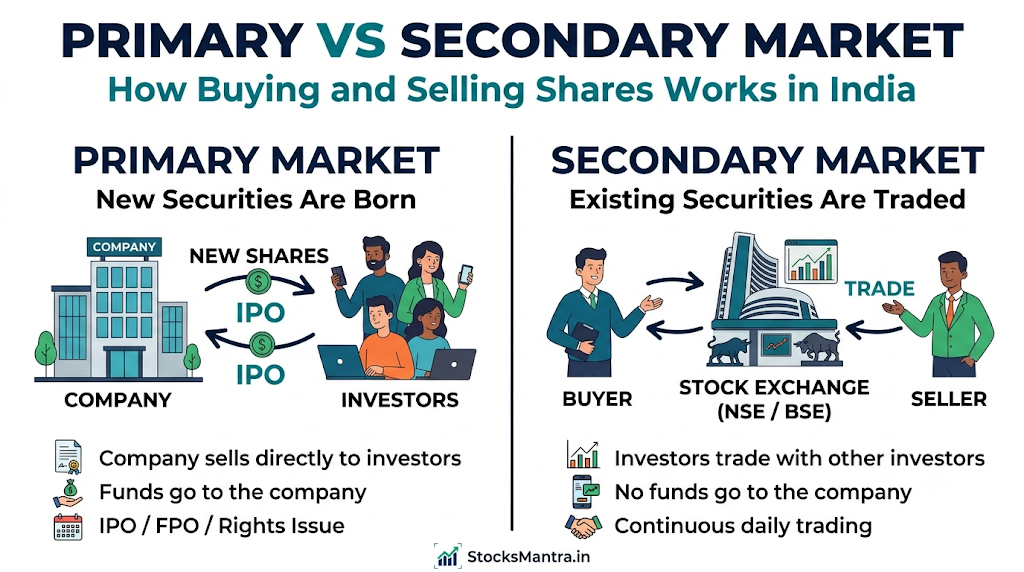
When an investor buys shares of a company, that transaction happens in one of two distinct stages of the capital market. If you apply for a company’s Initial Public Offering (IPO), you are buying shares directly from the company in the primary market. If you open your brokerage app and purchase shares of an already listed company like Reliance Industries or HDFC Bank, you are buying from another investor in the secondary market.
Both markets form the backbone of India’s financial system, regulated by the Securities and Exchange Board of India (SEBI). However, the way shares are priced, bought, sold, and settled in each market works very differently. Understanding these differences helps investors make informed decisions about where to put their money and how liquidity and risk operate at each stage.
Where Shares Are Born: The Role of the Primary Market
The primary market is where securities are created and sold for the very first time. Companies enter this market when they need to raise fresh capital—whether to expand operations, pay off existing debt, fund new projects, or allow early investors to exit.
In the primary market, the transaction happens directly between the issuing company and the investor. Because the shares have never been traded publicly before, this is often called the New Issue Market (NIM).
Common Ways Companies Raise Money in the Primary Market
- Initial Public Offering (IPO): A private company offers its shares to the general public for the first time and subsequently lists on stock exchanges like the NSE (National Stock Exchange) or BSE (Bombay Stock Exchange).
- Follow-on Public Offer (FPO): An already listed company issues additional new shares to the public to raise more capital.
- Rights Issue: Existing shareholders are given the right to buy additional shares at a discounted price, usually in proportion to their current holdings.
- Private Placement / Preferential Allotment: Shares are sold directly to a select group of institutional investors, mutual funds, or high-net-worth individuals rather than the general public.
Once the primary market subscription window closes and shares are allotted to successful applicants, the company receives the funds. From that point onward, the company is no longer directly involved when those shares change hands.
Where Everyday Trading Happens: The Secondary Market
The secondary market is what most people picture when they think of the stock market. After a company completes its IPO and lists on an exchange like the NSE or BSE, its shares begin trading among investors on the open market.
In the secondary market, investors trade with other investors. If you buy 50 shares of Tata Motors through your broker, you are purchasing them from another shareholder who decided to sell—not from Tata Motors itself. The company does not receive any money from daily stock price movements or secondary trades.
How Secondary Market Trading Operates
- Continuous Liquidity: Buyers and sellers place orders throughout market hours (9:15 AM to 3:30 PM IST on Indian exchanges), allowing investors to enter or exit positions quickly.
- Electronic Order Matching: Exchanges use automated order-matching systems that pair buy and sell orders based on price and time priority.
- Clearing and Settlement: Clearing corporations guarantee trades and handle the transfer of shares to the buyer’s Demat account and funds to the seller’s bank account, currently operating on a T+1 settlement cycle (one business day after the trade date) in India.
Key Differences Between Primary and Secondary Markets
While both markets deal with company shares, their structure, participants, and mechanics serve completely different purposes.
| Feature | Primary Market | Secondary Market |
| Core Purpose | Capital formation for companies | Liquidity and price discovery for investors |
| Parties Involved | Issuing company and investors | Buyer (investor) and seller (investor) |
| Who Receives the Money? | The company issuing the shares | The selling investor |
| Frequency of Share Sale | Shares are sold only once (at issuance) | Shares can be traded repeatedly |
| Price Determination | Fixed price or book-building price band set by the company and underwriters | Determined continuously by market supply and demand |
| Trading Location | No physical or centralized exchange floor; handled via ASBA/UPI applications | Centralized stock exchanges (NSE, BSE) |
| Role of Intermediaries | Merchant bankers, underwriters, registrars | Stockbrokers, depositories (NSDL/CDSL), clearing houses |
| Liquidity | Low until the shares get listed on an exchange | High, depending on stock volume and market interest |
How Pricing and Share Trading Mechanics Differ
One of the biggest practical differences for retail investors lies in how share prices are decided and how orders are executed.
1. Price Discovery vs. Fixed Price Bands
In a primary market IPO, you cannot negotiate the price. In a book-building IPO, the company and its investment bankers announce a price band (for example, ₹480 to ₹505 per share). Retail investors bid within this band, and the final cut-off price is decided after the bidding window closes based on overall demand.
In the secondary market, prices fluctuate every second. News, quarterly earnings, interest rate changes, and investor sentiment constantly shift supply and demand. You can place a market order to buy at the current live price or a limit order to buy only if the stock reaches your target price.
2. Guaranteed Execution vs. Lottery Allotment
When you buy shares in the secondary market, your order executes immediately as long as there is a matching seller at your price. You know right away how many shares you own and at what cost.
In the primary market, getting shares is not guaranteed. If an IPO is oversubscribed—meaning demand exceeds the number of shares available—allotment is conducted through a computerized lottery system for retail investors. You might apply for multiple lots and receive only one lot, or none at all.
3. Holding Period and Exit Flexibility
In the secondary market, you have full control over timing. You can buy a stock in the morning and sell it the same afternoon (intraday trading), hold it for a few weeks, or keep it for decades.
In the primary market, your money is blocked in your bank account via ASBA (Application Supported by Blocked Amount) or UPI mandate from the day you apply until the allotment date. You cannot sell those shares until the official listing day. Furthermore, certain categories like anchor investors face mandatory lock-in periods before they can sell.
How Both Markets Depend on Each Other
Although they operate differently, the primary and secondary markets cannot function effectively without one another.
- The Secondary Market Supports the Primary Market: Investors are willing to put money into IPOs largely because they know a vibrant secondary market exists where they can later sell those shares for cash. Without secondary market liquidity, primary market investing would be far riskier.
- The Primary Market Fuels the Secondary Market: Stock exchanges need a steady pipeline of growing businesses going public to expand investment opportunities. Every company traded on the NSE or BSE today originally entered the public ecosystem through the primary market.
- Valuation Benchmarks: Secondary market valuations of listed peers help merchant bankers decide how to price new IPOs in the primary market.
Practical Considerations for Investors
Both markets carry distinct risk-return profiles, and participating in either requires careful evaluation rather than relying on market hype.
- Evaluating Primary Market Offerings: When looking at an IPO, read the Red Herring Prospectus (RHP) to understand why the company is raising money. Check whether the funds are going toward business growth (Fresh Issue) or simply paying out existing promoters and early investors (Offer for Sale). High subscription numbers or grey market premiums do not guarantee listing gains.
- Evaluating Secondary Market Stocks: Because secondary market stocks have an established trading history, you have access to past quarterly results, financial ratios, price-to-earnings (P/E) history, and institutional holding patterns. Focus on business fundamentals, valuation comfort, and your own risk tolerance before placing trades.
Disclaimer: This article is for educational and informational purposes only and does not constitute investment advice. Stock market investments are subject to market risks. Investors should conduct their own research or consult a SEBI-registered financial advisor before making investment decisions.
Frequently Asked Questions (FAQs)
Can I buy shares in the primary market without a Demat account?
No. To apply for an IPO or any public issue in India, you must have an active Demat account to receive the allotted shares, along with a PAN card and an ASBA-enabled bank account or UPI ID.
Does a company make money when its share price rises in the secondary market?
Not directly. The company only receives funds when shares are sold in the primary market. However, a higher share price in the secondary market increases the company’s market capitalization, improves its brand credibility, and makes it easier to raise capital in the future.
Which market is riskier for beginners: primary or secondary?
Both carry market risk, though for different reasons. Primary market IPOs often have limited public track records and can be aggressively priced during bull markets. Secondary market stocks offer transparent historical financial data, making them easier to analyze, though daily price volatility can still lead to losses if you trade without a clear strategy.
What is the difference between a Fresh Issue and an Offer for Sale (OFS) in an IPO?
In a Fresh Issue, the company creates new shares and keeps the proceeds to fund expansion, debt repayment, or working capital. In an Offer for Sale (OFS), existing promoters or early investors sell their stake to the public, and the money goes to those selling shareholders rather than the company.
Can I sell IPO shares on the very first day they list?
Yes. For retail investors, there is no lock-in period after IPO allotment. Once the shares are credited to your Demat account and begin trading on the stock exchange on listing day, you can sell them anytime during market hours.
Final Takeaway
The primary market and the secondary market represent two phases of a share’s lifecycle. The primary market is the entry point where companies raise capital directly from investors to fund growth, while the secondary market is the ongoing marketplace where investors trade those shares among themselves for liquidity and wealth creation. Recognizing how pricing, capital flow, and execution differ between the two allows you to approach both IPO applications and daily stock trading with realistic expectations.