Open almost any Indian stock-trading app, search for a company like Tata Motors or Infosys, and your screen splits into two choices: NSE or BSE. To a newcomer, clicking one over the other feels like picking between two identical checkout lanes at the same supermarket.
In reality, those two buttons connect your order to two separate market engines with distinct histories, company rosters, derivative ecosystems, and order-book behaviors. Knowing how their internal setups, product shelves, and daily trading mechanics diverge puts you in far better control of your execution price.
Two Different Blueprints: How Each Exchange Was Built
Although both exchanges answer to the Securities and Exchange Board of India (SEBI), their corporate DNA comes from opposite ends of India’s financial timeline.
From Mumbai’s Trading Rings to Corporate Ownership
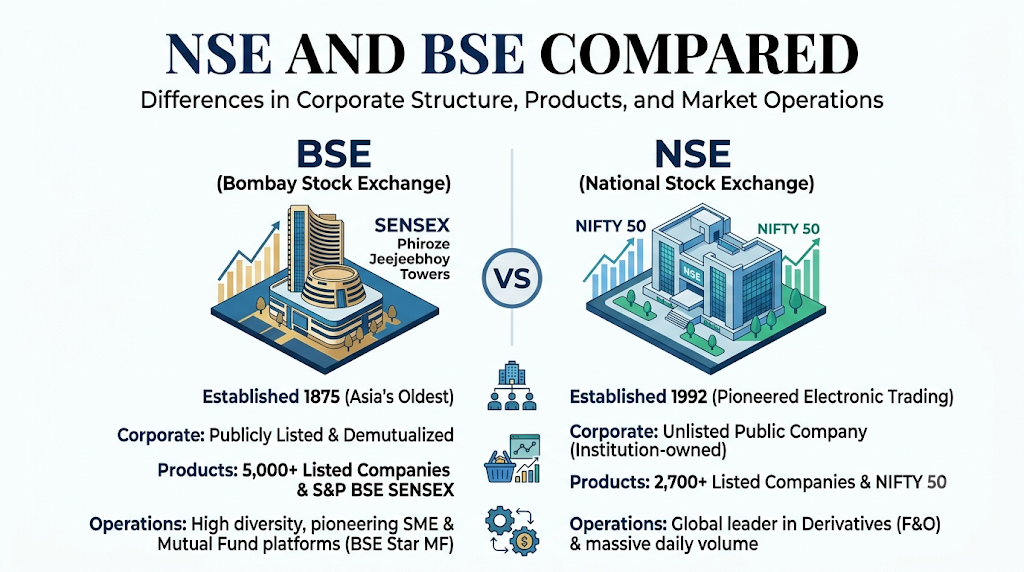
BSE began life in 1875 as a physical gathering of brokers in Mumbai—making it the oldest stock exchange in Asia. For over a hundred years, trades happened face-to-face through hand signals and vocal bids before the exchange shifted to screen-based terminals in the mid-1990s. Today, BSE operates as a publicly traded company whose own shares are listed and traded on the NSE (since Indian regulations prohibit an exchange from listing its own stock on its own board).
Born Digital from Day One
NSE entered the picture in the early 1990s (going live in 1994) with a clean slate. Backed by major Indian banks and financial institutions, it was engineered specifically to replace floor-based trading with a nationwide satellite and electronic network. Unlike BSE’s early broker-association roots, NSE separated exchange ownership from trading memberships right from the start and continues to operate as an unlisted public company held by domestic and global institutional shareholders.
The Product Shelf: What You Can Trade on Each Platform
If you stick purely to well-known blue-chip stocks, both exchanges look nearly identical. Step outside the top 100 companies—or look at derivatives—and clear differences appear.
Breadth of Listed Businesses
- BSE’s Wide Net: BSE hosts well over 5,000 listed companies. Because its entry rules around minimum net worth and paid-up capital are more accommodating for growing firms, hundreds of regional, micro-cap, and small-cap companies trade exclusively on BSE.
- NSE’s Curated Roster: NSE lists roughly half as many companies (around 2,700+), applying stricter financial and public-shareholding filters before granting a listing. Nearly every large-cap and mid-cap Indian enterprise trades on both exchanges, but emerging small-caps frequently start on BSE first.
Flagship Market Barometers
- Sensex (BSE): Tracks 30 large, established companies across major Indian industries, serving as the country’s oldest continuous market benchmark.
- Nifty 50 (NSE): Tracks 50 high-liquidity companies across a broader mix of sectors, making it the primary reference point for institutional funds and index derivatives.
Where Derivatives and Specialized Segments Dominate
Both platforms support cash equities, exchange-traded funds (ETFs), corporate debt, and sovereign gold bonds, yet traders gravitate to different shelves depending on the instrument:
- Equity Futures and Options (F&O): NSE captures the vast majority of India’s F&O turnover, driven by deep participation in Nifty 50, Bank Nifty, and single-stock contracts. BSE has rebuilt meaningful options volume around Sensex and Bankex contracts, though overall market share remains smaller.
- Mutual Funds and SMEs: BSE commands strong adoption in non-equity-F&O niches—especially BSE StAR MF (a major backend distribution rail for mutual fund platforms) and BSE SME, which has helped hundreds of small businesses raise public capital.
Inside the Matching Engine: How Daily Operations Differ
Once market hours begin, both exchanges rely on automated order-matching software governed by price-time priority—meaning the best price wins first, and earlier orders beat later ones at the exact same price. Even with identical matching rules, live trading conditions vary in three practical ways.
1. Order-Book Depth and Fill Speed
Because NSE attracts heavier daily turnover across cash equities and derivatives, its order books typically hold larger clusters of buyers and sellers at every paise increment. When you place a sizable order on NSE, it usually fills immediately without nudging the stock’s price. On BSE, top-tier stocks enjoy strong liquidity, whereas smaller stocks can have sparse order books where large orders take longer to absorb.
2. Micro Price Gaps and Spreads
NSE and BSE do not merge their order books; each exchange matches buyers and sellers inside its own pool. As a result, a dual-listed share might quote at ₹1,420.15 on NSE and ₹1,420.40 on BSE at the exact same second.
- Tighter Spreads on High-Volume Counters: Heavy order flow keeps the gap between the highest bid and lowest ask razor-thin on NSE.
- Slippage Risk on Thin Counters: If you submit a market order on a lightly traded BSE stock with a wide bid-ask gap, your trade may execute several rupees away from the last traded price.
Whenever a noticeable price gap opens between the two exchanges, automated arbitrage desks simultaneously buy on the cheaper exchange and sell on the higher one, pulling both prices back together within fractions of a second.
3. Clearing Houses and Demat Portability
Every executed trade passes through a dedicated clearing arm—NSE Clearing Limited for NSE and Indian Clearing Corporation Limited for BSE—which guarantees funds and share delivery under SEBI’s T+1 settlement cycle (one working day after the trade).
Importantly, neither exchange stores your shares. Once settled, your holdings sit inside your Demat account with CDSL or NSDL under a single International Securities Identification Number (ISIN). That means shares bought on BSE can be sold on NSE later—and vice versa—as long as the stock is listed on both.
Quick Reference: How the Two Exchanges Compare
| Dimension | National Stock Exchange (NSE) | Bombay Stock Exchange (BSE) |
| Starting Era | 1990s (electronic from launch) | 1875 (evolved from physical floor) |
| Ownership Model | Unlisted public company | Publicly listed company (trades on NSE) |
| Company Count | ~2,700+ listed firms | ~5,000+ listed firms |
| Core Index | Nifty 50 (50 stocks) | Sensex (30 stocks) |
| Primary Strength | Deep cash liquidity & F&O dominance | Broad small-cap access & mutual fund rails |
| Clearing Arm | NSE Clearing Limited | Indian Clearing Corporation Limited |
Common Questions Retail Investors Ask
Can I buy a stock on BSE today and sell it on NSE tomorrow?
Yes. Once shares settle into your Demat account under their common ISIN, they are not tied to the exchange where you bought them. You can sell them on whichever exchange offers better liquidity at the time of sale (though intraday buy-and-sell trades must stay on the same exchange).
Why do some small companies appear only on BSE?
NSE sets higher thresholds for minimum net worth, paid-up capital, and financial track record. Growing companies frequently list on BSE’s main board or SME platform first and apply for NSE listing later once they meet those benchmarks.
Does choosing NSE or BSE change my brokerage or taxes?
Government levies—such as Securities Transaction Tax (STT), GST, and stamp duty—remain identical across both exchanges. However, each exchange charges a small transaction fee that differs slightly between NSE and BSE, which your broker passes along in your contract note.
Which exchange should beginners pick for delivery investing?
For large, actively traded companies, either exchange works fine. For mid-cap and small-cap stocks, glance at the daily traded volume and bid-ask spread on your broker screen, choose the exchange with higher volume, and use a limit order to lock in your exact price.
Conclusion
Choosing between NSE and BSE is less about picking a “better” exchange and more about matching the right marketplace to your trade. If you are trading high-volume large-cap stocks or equity derivatives, NSE’s deep order books usually give you faster fills and tighter spreads. If you are exploring emerging small-cap businesses or specific mutual fund and SME listings, BSE opens up opportunities you will not find anywhere else. Before placing your next order, check the live bid-ask spread on both tabs—letting the two exchanges compete for your order is one of the simplest habits to improve your trade execution.