Introduction
Cloud infrastructure is no longer just about ensuring high availability and fast deployments. A new challenge has emerged for modern engineering teams: uncontrolled cloud spending. The ease of launching virtual resources has led to massive financial waste across organizations globally. Consequently, mastering infrastructure efficiency has become a critical skill for technical professionals.
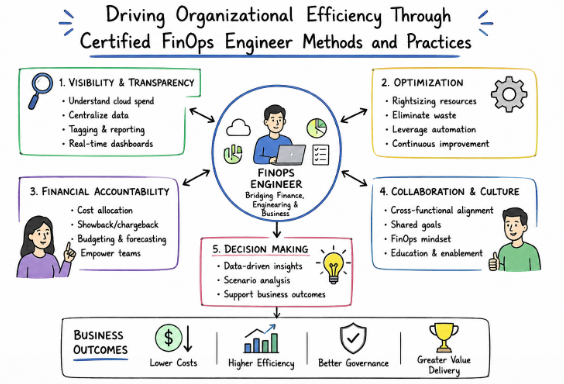
To solve this problem, a specialized methodology known as FinOps has taken center stage. This practice brings cultural shift and financial accountability to the variable cost model of cloud computing. It allows engineering, operations, and finance teams to work together to make data-driven architectural choices. Technical experts must understand how to optimize cloud configurations to balance performance with cost.
Following a verified training framework is highly recommended to acquire these optimization skills. This comprehensive guide details the pathway for the Certified FinOps Engineer program. It explains how this specialized credential helps engineers control cloud budgets and secure high-value roles in the modern enterprise landscape.
What is Certified FinOps Engineer
The Certified FinOps Engineer designation is a technical validation crafted specifically for IT professionals. It validates an individual’s competency in applying engineering solutions to minimize cloud computing expenses. The program focuses on architectural practices that keep infrastructure highly efficient.
Unlike high-level financial certifications, this engineering-centric roadmap focuses on actionable technical remedies to eliminate cloud waste. It deepens knowledge in programmatic tagging, infrastructure rightsizing, automated scheduling, and cloud billing architectures. It enables engineers to write infrastructure code that optimizes budget utilization automatically.
Why it Matters Today?
Modern software rely completely on cloud platforms, but unmonitored deployments can rapidly erode corporate profitability. In the current business climate, enterprises prioritize financial sustainability just as much as rapid feature delivery.
System engineers who focus solely on uptime are no longer sufficient for modern teams. Companies actively seek out professionals who can scale distributed systems while keeping monthly cloud bills flat. Understanding the direct financial impact of code and configuration choices has become a mandatory skill.
Why Certified FinOps Engineer Certifications are Important
Earning a formal credential in cloud financial management offers significant professional benefits. It provides clear proof to employers that engineering decisions are guided by financial awareness. It distinguishes technical professionals in a crowded job market where cost control is a primary objective.
This structured validation establishes a clear methodology for identifying and stopping financial leakage in cloud accounts. It provides engineers with the precise terminology needed to communicate with financial managers and executives. It converts traditional developers into key business contributors who optimize both engineering velocity and company revenue.
Why Choose Finopsschool?
Finopsschool stands out as a dedicated learning institution built exclusively around cloud financial operations and engineering. It delivers intensive, hands-on training courses created by working industry specialists. The technical curriculum blends practical infrastructure adjustments with core cloud accounting principles.
Enrolling in this specialized school guarantees access to premium study aids and interactive sandbox environments. The learning materials are continuously modified to cover the latest multi-cloud pricing changes and optimization strategies. It connects students to a global network of peers who are actively managing cloud spend at scale.
Certification Deep-Dive
What is this certification?
The Certified FinOps Engineer program validates an engineer’s ability to implement cost-saving architectures across cloud environments. It confirms mastery over automated governance, container cost tracking, and infrastructure waste reduction.
Who should take this certification?
This technical path is designed for cloud engineers, DevOps practitioners, platform architects, site reliability engineers, and systems administrators who manage cloud infrastructure daily.
Certification Overview Table
| Track | Level | Who it’s for | Prerequisites | Skills Covered | Recommended Order |
| Cloud Cost Essentials | Foundational | IT Associates, Finance Analysts | Basic Cloud Awareness | Billing structures, cost visibility, tagging | First |
| FinOps Applied Engineering | Professional | Systems & Cloud Engineers | Cloud Admin Background | Automation, serverless scaling, rightsizing | Second |
| Strategic Enterprise FinOps | Advanced | Principal Architects, SRE Leads | Professional Certificate | Multi-vendor governance, unit economics | Third |
| Analytics & KPI Optimization | Specialist | Monitoring & Data Engineers | Basic Costing Concepts | Metric dashboards, API tracking, reporting | Fourth |
Skills You Will Gain
- Granular Allocation: Designing complex tag structures to track every single cloud resource back to its specific project.
- Anomalous Cost Detection: Implementing automated detection mechanisms to flag sudden budget overruns immediately.
- Compute Optimization: Analyzing performance metrics to safely downgrade over-provisioned cloud instances.
- Orphaned Resource Cleanup: Scripting automated tools to find and delete abandoned storage volumes and unassigned addresses.
- Microservices Cost Attribution: Calculating and distributing shared infrastructure expenses within complex Kubernetes setups.
Real-World Projects You Should Be Able to Do After This Certification
- Automated Scaling Optimization Engine: Create a monitoring system that evaluates daily system workloads and automatically scales down underutilized database nodes.
- Kubernetes Shared Cost Calculator: Set up an internal accounting pipeline that measures pod resource consumption to distribute costs among different product teams fairly.
- Off-Hours Resource Hibernation Script: Write automated serverless functions that safely stop non-essential staging environments during weekends and holidays.
- Centralized Multi-Cloud Spend Dashboard: Build an interactive visual interface that aggregates waste metrics, such as idle load balancers and outdated snapshots, across multiple cloud providers.
Preparation Plan
7–14 Days Plan
- Day 1-4: Deep attention is paid to cloud billing structures, invoice data formats, and foundational cost allocation principles.
- Day 5-8: Core optimization practices such as storage tiering, lifecycle configurations, and commitment pricing models are studied.
- Day 9-14: Sample exam questions are analyzed, practice evaluations are completed, and weak knowledge areas are reviewed thoroughly.
30 Days Plan
- Week 1: Cloud expense structures, metadata tagging policies, and visibility principles are mastered.
- Week 2: Infrastructure adjustments are explored deeply, focusing on server pricing models, network traffic fees, and data archiving options.
- Week 3: Automated governance pipelines, container scaling limits, and metric collection tools are studied.
- Week 4: Mock examinations are completed repeatedly, hands-on configuration labs are reviewed, and key formulas are practiced.
60 Days Plan
- Month 1: A comprehensive understanding of multi-cloud billing frameworks is established, backed by weekly practical labs focused on tracking idle assets.
- Month 2: Advanced corporate policy enforcement, shared cluster tracking models, and extensive mock exam simulations are completed to build testing confidence.
Common Mistakes to Avoid
- Neglecting Unattributed Expenses: Failing to map untagged shared services like core networking or central logging creates huge blind spots in reports.
- Relying on Manual Maintenance: Attempting to optimize cloud resources by hand instead of deploying automated remediation scripts leads to recurring waste.
- Ignoring Non-Compute Categories: Focusing entirely on virtual servers while ignoring high database storage fees and data transfer costs.
- Failing to Consult Product Teams: Changing resource specifications without communicating with development squads can lead to unexpected service interruptions.
Best Next Certification After This
Same Track
Strategic Enterprise FinOps certification to learn large-scale financial governance and multi-cloud optimization patterns.
Cross-Track
Certified Kubernetes Administrator (CKA) to master internal container scheduling, resource boundaries, and cluster management.
Leadership / Management
Certified FinOps Practitioner or Leadership credential to focus on company-wide cultural shifts, corporate budget planning, and stakeholder alignment.
Choose Your Learning Path
DevOps Learning Path
This roadmap is optimized for specialists focusing on continuous deployment pipelines. It introduces automated cost validation steps directly into CI/CD workflows. Infrastructure-as-Code configurations are scanned for cost limits before any real cloud resources are built.
DevSecOps Learning Path
This specialized track fuses budget defense with infrastructure security. Security compliance tools are modified to identify both hidden security vulnerabilities and costly, abandoned cloud nodes. Automated policies are utilized to maintain secure, low-waste environments.
Site Reliability Engineering (SRE) Learning Path
This path serves professionals tasked with keeping enterprise applications stable and responsive. The core focus rests on balancing high service reliability against operational infrastructure spend. SREs learn to optimize application limits without over-purchasing excessive redundancy.
AIOps / MLOps Learning Path
This course of study benefits engineers dealing with resource-intensive machine learning workflows. Data training frameworks are re-engineered to significantly decrease compute time on expensive GPU systems. Job queues are automated to run during low-demand hours on discounted cloud instances.
DataOps Learning Path
This sequence is created for data architects and analytical pipeline developers. It highlights strategies for shrinking storage footprints and accelerating data query speeds. Techniques are practiced to automatically move legacy business data into cheaper archive vaults.
FinOps Learning Path
This serves as the definitive track for dedicated cloud financial managers. It encompasses the complete cycle of cloud financial management across large institutions. Leaders are taught to drive inter-departmental collaboration to meet corporate efficiency targets.
Role → Recommended Certifications Mapping
| Role | Recommended Primary Certification | Secondary Validation | Focus Area |
| DevOps Engineer | Certified FinOps Engineer | Infrastructure-as-Code Specialist | CI/CD Financial Guards |
| Site Reliability Engineer | Certified FinOps Engineer | Advanced Performance Metrics | Uptime vs Cloud Spend |
| Platform Engineer | Certified FinOps Engineer | Cloud Architecture Expert | Shared Core Infrastructure |
| Cloud Engineer | Certified FinOps Engineer | Multi-Cloud Architecture | Multi-Provider Efficiency |
| Security Engineer | DevSecOps Specialist | FinOps Fundamentals | Compliance & Risk Waste |
| Data Engineer | DataOps Professional | FinOps Engineering | Big Data Storage Layouts |
| FinOps Practitioner | Certified FinOps Practitioner | FinOps Engineer | Inter-Departmental Alignment |
| Engineering Manager | FinOps Leadership | Technical Project Management | Corporate Forecasts & Targets |
Next Certifications to Take
One Same-Track Certification
The Strategic Enterprise FinOps path can be pursued to gain advanced skills in multi-organization financial management and corporate unit economics.
One Cross-Track Certification
The Certified Kubernetes Administrator program can be selected to master pod scheduling logic, cluster resource optimization, and container scaling configurations.
One Leadership-Focused Certification
The FinOps Leadership track can be chosen to focus on establishing cost optimization cultures, managing large IT budgets, and demonstrating clear business value to executives.
Training & Certification Support Institutions
DevOpsSchool
Immersive training bootcamps and intensive laboratory exercises are delivered by this platform. Technical candidates are guided through intricate cloud management architectures. A major priority is placed on ensuring students successfully pass international technical examinations.
Cotocus
Bespoke enterprise educational solutions and hands-on skill workshops are provided by this firm. Targeted modules covering cloud optimization frameworks and modern platform management are offered. The practical knowledge required to operate enterprise IT systems is heavily emphasized.
ScmGalaxy
Extensive learning documentation, expert blog posts, and active peer forums are maintained here for configuration management tools. Career advancement roadmaps are structured carefully to help engineers master new paradigms. The practical application of modern cloud systems is continuously supported.
BestDevOps
Interactive virtual classrooms detailing modern cloud utilities and resilience engineering are hosted. Students are supported with practical, step-by-step guidance through advanced technology concepts. Intricate cloud architecture principles are simplified for worldwide audiences.
devsecopsschool.com
Specialized training tracks concentrating on embedding automated security into deployment pipelines are managed here. Continuous compliance testing and secure delivery systems are taught. Engineering groups are prepared to satisfy demanding corporate governance rules.
sreschool.com
Learning programs focused exclusively on system reliability, distributed monitoring, and high availability are provided. Candidates are trained to maintain, monitor, and scale enterprise applications. Real-world incident studies are leveraged to teach advanced system troubleshooting.
aiopsschool.com
Advanced courses structured around automated IT operations and machine learning insights are delivered. Predictive infrastructure tracking and automated anomaly detection techniques are thoroughly taught. Engineers are trained to manage high-volume system telemetry.
dataopsschool.com
Targeted instructional sequences focused on data pipeline design and continuous information flows are supplied. Data quality enforcement, warehousing efficiency, and data lifecycles are deeply covered. Analytics professionals are assisted in streamlining information delivery.
finopsschool.com
The primary destination for comprehensive education in cloud financial engineering. Certified learning pathways and deep study materials are provided to a global student base. Both technology and finance professionals are empowered to achieve peak cloud efficiency.
FAQs Section
- Is this professional certification difficult to pass?
The validation features a moderate level of difficulty, requiring a strong understanding of cloud provisioning, system metrics, and basic billing mechanics. - What is the general preparation time needed?
A timeline of 30 to 45 days is typically sufficient if a few hours are dedicated to study and labs every day. - Are there mandatory prerequisites to register?
No official prerequisites are enforced by the provider, but practical familiarity with cloud platforms is highly recommended. - What is the ideal order for taking these certifications?
The foundational course should be completed first, followed by the technical engineering validation, and ending with the advanced enterprise framework. - How does this certification boost career growth?
Excellent career advancement is unlocked because cloud efficiency is highly valued by modern corporations, driving strong demand for certified individuals. - Which specific IT roles benefit from this program?
Cloud engineers, DevOps operators, platform managers, and technical team leads gain immense value from this curriculum. - Can someone completely new to IT attempt this?
It is highly recommended that basic cloud administration experience is acquired before taking on these advanced cost management topics. - Does the training material cover multiple cloud vendors?
Yes, core architectural principles are taught that apply evenly across AWS, Microsoft Azure, and Google Cloud Platform. - What is the validity duration of the certificate?
The credential stays active for a standard period of two years, with recertification pathways provided before expiration. - Are practical laboratories required during preparation?
Yes, hands-on practice with cost monitoring tools, automation scripts, and budget alerts is strongly encouraged. - Does this track emphasize financial accounting or system engineering?
The engineering certification focuses heavily on technical automation, architecture adjustments, and system scripts rather than traditional bookkeeping. - In what ways does this course help an Engineering Manager?
Clear visibility into operational spending is provided, enabling accurate project forecasting and smarter resource allocations.
Certified FinOps Engineer Specific FAQs
- Where can the exact registration and curriculum details be found?
All official schedules and detailed course outlines are hosted at certified-finops-engineer for easy access. - Which major public clouds are referenced during technical lessons?
Core architectural patterns are demonstrated using examples from AWS, Azure, and Google Cloud Platform environments. - Are microservices and container cost allocations detailed in this course?
Yes, deep focus is directed toward tracking Kubernetes cluster resources, namespace expenses, and pod configuration limits. - Will I learn how to create automated cleanup policies?
Yes, engineers are trained to write specialized scripts that find idle instances and terminate waste without human intervention. - What is the standard testing format for the final exam?
The evaluation consists of multiple-choice questions designed to measure conceptual understanding alongside practical, scenario-based engineering problems. - How does this training help engineers eliminate monthly cloud waste?
Proven strategies are shared to isolate unlinked storage disks, downsize underutilized VMs, and build scheduled environments. - Are commitment options like Savings Plans or Reserved Instances taught?
Yes, the engineering mechanics behind purchasing, tracking, and maximizing long-term cloud commitment models are fully analyzed. - Is metadata tagging enforcement treated as a core topic?
Yes, building automated infrastructure pipelines that enforce strict tag governance is taught as a fundamental requirement.
Testimonials
Kabir
Complete mastery over cloud spend visualization was achieved through this course. The automated cleanup scripts were immediately deployed into our staging environments, which dropped our unnecessary cloud costs dramatically.
Divya
The way cloud architecture is handled by our department was completely transformed. Applications are no longer designed just for scaling; cost efficiency is now prioritized during the initial design phase.
Arjun
Immense confidence was built regarding how we track our distributed container bills. The shared cost distribution techniques picked up during training allowed our teams to isolate Kubernetes spending with perfect precision.
Sai
The communication disconnect between our development teams and financial managers was successfully solved. A clear technical methodology for embedding budget safety rails without slowing down feature releases was delivered.
Priya
Strategic planning capabilities were greatly enhanced by this comprehensive program. A dependable framework for evaluating cloud usage trends and establishing clear team accountability was put into action.
Conclusion
Maximizing the efficiency of cloud environments requires specialized engineering expertise. The Certified FinOps Engineer framework delivers the exact technical skills needed to eliminate waste and establish automated cost controls. It seamlessly connects software architecture choices with financial accountability.
Securing this certification provides excellent long-term career advantages for cloud professionals. It redefines the role of an engineer, turning them into a strategic asset who drives operational excellence. Strategic planning and preparation for this certification are highly recommended for anyone looking to excel in modern cloud management.
Leave a Reply