Introduction
In the early days of software management, a system was often viewed as a “black box.” If a server was running and the application responded, the environment was considered healthy. However, as architectures have shifted toward microservices and global cloud deployments, this simple view is no longer sufficient. Today, a system can appear to be “up” while still failing to deliver the correct experience to a subset of users. This complexity has birthed a new requirement for engineering teams: the ability to observe and understand the internal state of a system based purely on the data it exports.
The Master in Observability Engineering (MOE) has been established to bridge the gap between basic monitoring and true system insight. It is a curriculum designed for those who recognize that “knowing” is better than “guessing.” By mastering the art of telemetry—logs, metrics, and traces—engineers are empowered to diagnose issues in real-time and build systems that are inherently resilient. This guide explores the depth of the MOE program and how it reshapes the career trajectory of modern technical professionals.
The Core Essence of the Master in Observability Engineering (MOE)
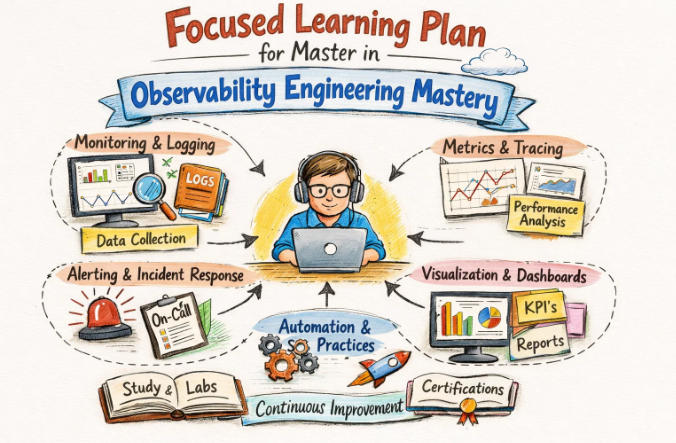
The Master in Observability Engineering (MOE) is an advanced professional track that moves beyond the surface level of IT operations. It is a specialized program where the focus is placed on the three pillars of observability: logs, metrics, and distributed tracing. Rather than simply reacting to alerts, students are taught how to build an infrastructure that provides constant, high-fidelity feedback. This ensures that even the most subtle performance regressions are identified before they escalate into major outages.
Why Deep Visibility is Essential in Modern Environments
The software ecosystem is now driven by automation and scale. When hundreds of services interact across multiple regions, a single failure can trigger a cascading effect that is difficult to trace. Traditional tools often provide fragmented data, leaving engineers to piece together a puzzle during high-pressure incidents. Observability is vital because it provides a unified lens through which the entire request lifecycle can be viewed.
In an environment where “Mean Time to Recovery” (MTTR) is a critical business metric, having the skills to navigate complex telemetry data is a significant advantage. Furthermore, as organizations lean into AIOps, the quality of the underlying observability data determines the success of automated healing. Without a master-level understanding of these concepts, the full potential of cloud-native technologies cannot be realized.
The Significance of Professional Validation in Engineering
For the individual contributor, a certification is more than just a piece of paper; it is a structured validation of specialized expertise. It demonstrates a commitment to a specific discipline that is currently in high demand. In many cases, the process of preparing for a master-level certification reveals technical gaps that might have been overlooked during day-to-day work.
For leadership, these credentials serve as a benchmark for team capability. When an entire engineering department is aligned with the principles of observability engineering, a culture of data-driven decision-making is fostered. It allows for more predictable delivery cycles and ensures that the platform is built on a foundation of reliability and transparency.
Why Choose DevOpsSchool?
A decision to train with DevOpsSchool is often driven by the institution’s reputation for practical, hands-on learning. The curriculum is not static; it is constantly updated to reflect the shifting tools and methodologies used by top-tier technology companies. Every module is designed to solve actual production problems that engineers face in high-scale environments.
At DevOpsSchool, the focus is removed from rote memorization and placed on the development of a troubleshooting mindset. Learners are provided with access to advanced lab environments where complex scenarios can be simulated and resolved. The goal is to ensure that every participant gains the tactical skills required to lead observability initiatives within their respective organizations.
Deep-Dive: Master in Observability Engineering (MOE)
What is this certification?
The MOE is a specialized credential that validates an engineer’s ability to design and implement comprehensive telemetry frameworks. It focuses on gaining deep insights into application performance and infrastructure health through advanced data analysis.
Who should take this certification?
This program is highly recommended for Cloud Engineers, SREs, and Backend Developers who are responsible for maintaining large-scale distributed systems. It is also suitable for technical leads who need to establish observability standards across multiple teams.
Certification Overview Table
| Track | Level | Who it’s for | Prerequisites | Skills Covered | Recommended Order |
| DevOps | Intermediate | Automation Leads | Basic Scripting | CI/CD, Containerization | 1 |
| SRE | Expert | Reliability Leads | DevOps Basics | Error Budgets, SLIs/SLOs | 2 |
| DevSecOps | Advanced | Security Analysts | Cloud Fundamentals | Security Observability | 3 |
| AIOps/MLOps | Specialized | ML Engineers | Python, Statistics | Model Monitoring, Automation | 4 |
| DataOps | Specialized | Data Architects | Data Engineering | Pipeline Visibility | 5 |
| FinOps | Management | Cost Analysts | Cloud Billing | Usage Tracking, Budgeting | 6 |
Skills You Will Gain
- The deployment of distributed tracing across various programming languages.
- The creation of high-impact visualization dashboards for stakeholder reporting.
- The configuration of intelligent alerting systems to reduce “alert fatigue.”
- The ability to correlate diverse data sets to find the root cause of system failures.
- The implementation of OpenTelemetry standards across a microservices architecture.
Real-World Projects Post-Certification
- A cross-service tracing architecture is implemented for a global e-commerce platform.
- A predictive alerting model is developed using historical metric data.
- An end-to-end logging pipeline is built using the ELK or PLG stack.
- A service-level dashboard is created to track real-time SLO compliance.
Preparation Plan
7–14 Days Plan (Focused Review):
The focus is placed on the theoretical pillars of observability. The core differences between monitoring and observability are studied. Documentation for the most common open-source tools is reviewed, and basic instrumentation exercises are completed.
30 Days Plan (Tactical Mastery):
Daily sessions are dedicated to setting up monitoring stacks in a local environment. Hands-on labs involving log parsing and metric collection are prioritized. Practice scenarios are used to test troubleshooting speed and accuracy.
60 Days Plan (Professional Excellence):
The first month is spent on foundational tools and concepts. The second month is dedicated to advanced topics such as eBPF-based observability and large-scale data storage strategies. Comprehensive case studies of major system outages are analyzed and reconstructed.
Common Mistakes to Avoid
- Treating observability as a “tooling problem” rather than a cultural shift.
- Setting up alerts for every single metric, leading to a loss of focus during incidents.
- Failing to clean and structure log data before it is ingested into a central system.
- Ignoring the cost implications of high-cardinality data in cloud environments.
Best Next Certification After This
- Same Track: SRE Master Certification for reliability-focused leadership.
- Cross-Track: DataOps Masterclass to apply observability to data pipelines.
- Leadership: Certified Engineering Manager for those moving into organizational oversight.
Choose Your Learning Path
1. The DevOps Path
This journey is intended for those who wish to integrate visibility into the very beginning of the software lifecycle. It ensures that every piece of code deployed is already instrumented for performance tracking.
2. The SRE Path
Best suited for those whose primary mission is uptime. This path focuses on using observability data to manage risk and maintain strict service level agreements for global users.
3. The DevSecOps Path
This path is chosen by engineers who want to use system data to identify security threats. It teaches how to monitor for anomalies that could indicate a breach or unauthorized access.
4. The AIOps / MLOps Path
Designed for the future of automation. This path leverages telemetry data to train machine learning models that can eventually predict and fix system issues without human intervention.
5. The DataOps Path
Focused on the integrity of the data itself. This path is for those managing data lakes and warehouses who need to ensure that data flows are consistent and error-free.
6. The FinOps Path
This is the strategic path for cost management. It teaches how to use observability metrics to understand exactly where cloud spend is going and how to optimize it for better ROI.
Role → Recommended Certifications Mapping
| Role | Core Certification | Secondary Specialization | Leadership Goal |
| DevOps Engineer | Master in DevOps | MOE Certification | Platform Architect |
| SRE | MOE Certification | Advanced SRE | VP of Reliability |
| Platform Engineer | Cloud Infrastructure | MOE Certification | Head of Platform |
| Cloud Engineer | Multi-Cloud Admin | FinOps Practitioner | Cloud Director |
| Security Engineer | DevSecOps Master | MOE Certification | Security Architect |
| Data Engineer | DataOps Master | MLOps Specialist | Chief Data Officer |
| FinOps Practitioner | FinOps Certified | Cloud Economics | Financial Controller |
| Engineering Manager | MOE Certification | Leadership Foundations | CTO |
Next Certifications to Take
Following the completion of the MOE, a natural progression into other specialized areas is recommended.
- Same-Track: The Site Reliability Engineering (SRE) Masterclass should be pursued to apply observability to reliability engineering.
- Cross-Track: A DevSecOps Certification is an excellent choice for learning how to secure the telemetry pipeline.
- Leadership: For those aiming for executive roles, a program in Strategic Technology Management is suggested.
Training & Certification Support Institutions
DevOpsSchool
This institution is highly regarded for its intensive, expert-led training programs. It provides a comprehensive ecosystem for learning DevOps, SRE, and Observability with a strong emphasis on career outcomes.
Cotocus
A global leader in technical education that focuses on modern cloud-native architectures. The training delivered here is designed to help engineers master the latest tools in the observability space.
ScmGalaxy
This platform is a major hub for technical knowledge and community-driven learning. It provides deep insights into software configuration and infrastructure management through a variety of resources.
BestDevOps
The focus here is placed on practical skill acquisition. The courses are tailored to meet the demands of the current job market, ensuring that students are ready for senior-level engineering roles.
devsecopsschool.com
A specialized school for mastering the intersection of security and modern operations. It teaches how to build security into every layer of the technology stack using data-driven methods.
sreschool.com
This institution is dedicated purely to the principles of Site Reliability Engineering. It provides a structured path for learning how to manage complex systems at scale.
aiopsschool.com
The curriculum here is focused on the application of artificial intelligence to IT operations. It prepares engineers for the next wave of automated system management.
dataopsschool.com
A dedicated training provider for data professionals. It focuses on the reliability and observability of large-scale data pipelines and processing environments.
finopsschool.com
This school addresses the financial side of cloud engineering. It teaches how to manage cloud costs effectively through the use of detailed usage and performance metrics.
Comprehensive FAQ Section
- Is the MOE certification suitable for beginners?
The program is designed for those with some background in IT. While it starts with foundations, the content quickly moves into advanced engineering topics. - What is the average time commitment for this program?
Most professionals find that 5 to 10 hours per week over a period of two months is sufficient to master the material. - Are the exams purely theoretical?
No, a significant portion of the assessment involves practical tasks where candidates must demonstrate their ability to configure and troubleshoot systems. - Does this certification help with career transitions?
Yes, it is highly valued by hiring managers who are looking for specialized skills in system reliability and modern monitoring. - What kind of support is available during the training?
Learners are typically provided with access to mentors, discussion forums, and detailed lab guides to help them through the curriculum. - How is observability different from monitoring?
Monitoring tells you when a specific metric goes out of bounds, while observability allows you to ask “why” by exploring the raw telemetry data. - Is a specific programming language required?
A basic understanding of languages like Python or Go is helpful, as these are commonly used for instrumenting applications. - Can the certification be taken from any country?
Yes, the program is delivered online, making it accessible to a global audience of engineering professionals. - Are there group discounts for corporate teams?
Most institutions, including DevOpsSchool, offer specialized pricing for teams looking to upskill together. - How often is the MOE curriculum updated?
The content is reviewed and refreshed regularly to ensure it includes the latest open-source tools and industry best practices. - What is the primary benefit for an Engineering Manager?
It provides a deeper understanding of the technical challenges their teams face, allowing for better resource planning and goal setting. - Are there any hands-on projects included?
Yes, the program concludes with several capstone projects that simulate real-world production environments.
Additional FAQs for Master in Observability Engineering (MOE)
- Does MOE cover both on-premise and cloud systems?
The principles taught are universal, though there is a strong emphasis on cloud-native technologies like Kubernetes and serverless. - Will I learn about OpenTelemetry in this course?OpenTelemetry is a core component of the curriculum, as it has become the industry standard for telemetry data collection.
- How does this certification impact salary expectations?Engineers with specialized observability skills often command a premium in the market due to the high demand for system reliability expertise.
- What is the pass rate for the MOE exam?
While the exam is rigorous, those who complete the hands-on labs and follow the study guide have a very high success rate. - Are there any prerequisite certifications?
There are no mandatory prerequisites, but a basic DevOps or Cloud Practitioner certification is often helpful. - Can I retake the exam if I do not pass the first time?
Yes, most providers offer a retake policy that allows students to refine their knowledge and try again after a short period. - Does the course cover log management in detail?
Yes, log aggregation, parsing, and searching are covered extensively as one of the primary pillars of observability. - How do I maintain my certification after I earn it?
Continued professional development and advanced specialization courses are encouraged to keep your skills sharp in a fast-moving field.
Industry Testimonials
Karthik
The shift in mindset was the most valuable part of this experience. Instead of just looking at dashboards, the ability to dive into traces to find the exact line of code causing a delay has been a game-changer.
Anjali
The practical labs provided a safe space to fail and learn. The confidence gained in managing complex ELK stacks has allowed for a much more proactive approach to system maintenance at work.
Rohan
A clear path was provided to move from a general DevOps role into a specialized SRE position. The focus on observability has made the daily tasks much more data-driven and far less stressful.
Meera
The community of learners and mentors was incredibly supportive. Complex concepts like high-cardinality metrics were broken down into simple, understandable steps that were easy to apply immediately.
Siddharth
As someone managing a platform team, this certification provided the technical depth needed to better support my engineers. The visibility into our systems has improved significantly since we implemented these standards.
Conclusion
The Master in Observability Engineering (MOE) represents a significant step forward for any technologist. As the world becomes more dependent on complex software systems, the role of the engineer who can “see” through that complexity becomes more vital. This certification is not just about learning a new set of tools; it is about adopting a philosophy of transparency and reliability that will serve a professional throughout their entire career.
Strategic planning and a commitment to continuous upskilling are the hallmarks of a successful engineering leader. By embracing the principles of observability, a foundation is built for long-term growth and technical excellence. The future of software is observable, and the journey toward mastering it begins with a single, purposeful step into specialized education.
Leave a Reply