Introduction
Filing taxes can feel like learning a secret language. Every year, millions of taxpayers stare at a screen full of forms labeled ITR-1, ITR-2, ITR-3, ITR-4, and so on, wondering which one applies to them.
The government does not use a single form for everyone because people earn money in very different ways. A salaried office worker has a completely different financial life than a freelance designer or a shop owner.
Choosing the wrong form is one of the most common filing mistakes. When you file the wrong form, the tax department considers your return invalid. Fixing this later takes extra time, causes stress, and can delay your tax refund.
This guide will help you understand how the Indian tax system categorizes income so you can pick the exact ITR form you need without any confusion.
What Is an ITR Form?
An Income Tax Return (ITR) form is an official document that you submit to the government to declare your total income and the taxes you have paid during a financial year.
Think of it as a financial report card that you give to the tax department. It lists:
- How much money you earned.
- Which sources generated that money.
- How much tax was already deducted (like TDS from your salary).
- Whether you owe extra tax or are eligible for a refund.
Because everyone earns money differently, the government provides different forms. Each form is tailored to specific sources of income and types of taxpayers.
Why Choosing the Right ITR Form Matters
The tax department uses automated computer systems to process millions of tax returns within seconds. These systems check if the data you entered matches the form you selected.
If you file your taxes using a simpler form than required—for example, filing ITR-1 when you actually sold shares that generated capital gains—the system flags the mismatch.
- Defective Return Notice: You will receive a notice under Section 139(9) stating your return is defective.
- Correction Window: You are given a limited time (usually 15 days) to correct the mistake and file the correct form.
- Delayed Refunds: Your tax refund gets stuck until the corrected form is processed.
Selecting the right form the first time saves you from unnecessary legal notices and ensures your refund arrives on time.
Overview of Major ITR Forms
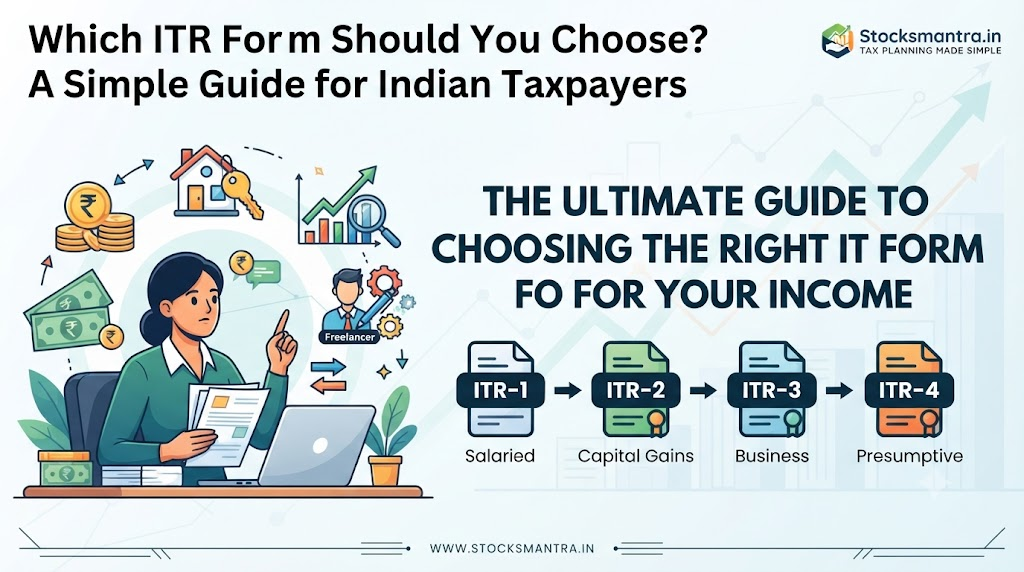
To choose the correct form, you need to match your income sources with what each form is designed for. Here is a breakdown of the most common ITR forms used by individual taxpayers in India.
1. ITR-1 (Sahaj)
ITR-1 is designed for everyday salaried individuals with straightforward financial lives.
- Who can use it: Resident individuals whose total income does not exceed 50 Lakh rupees.
- Allowed income sources: Salary or pension, income from one house property (excluding brought-forward losses), and income from other sources (like savings bank interest, fixed deposits, or family pension).
- Who cannot use it: Anyone with income from business or profession, capital gains (like selling shares or property), more than one house property, or foreign assets/income.
2. ITR-2
ITR-2 is meant for individuals and Hindu Undivided Families (HUFs) who have income from investments or multiple properties, but no business or professional income.
- Who can use it: Individuals whose income exceeds 50 Lakh rupees, or those who have capital gains, foreign assets, income from more than one house property, or are directors in a company.
- Allowed income sources: Salary, multiple house properties, capital gains (profits from selling mutual funds, stocks, or real estate), and foreign income.
- Who cannot use it: Anyone who earns money from a business, freelance profession, or running a shop (they need ITR-3 or ITR-4).
3. ITR-3
ITR-3 is a detailed form built for individuals and HUFs who earn money through a business, trade, or profession.
- Who can use it: Business owners, traders, and professionals (like doctors, lawyers, consultants, or software developers) who maintain regular books of accounts.
- Allowed income sources: Income from a proprietary business or profession, along with salary, capital gains, house property, and other sources.
4. ITR-4 (Sugam)
ITR-4 is a simplified form for small business owners and freelancers who want to use presumptive taxation.
- Who can use it: Resident individuals, HUFs, and partnership firms (excluding LLPs) with total income up to 50 Lakh rupees who opt for the presumptive taxation scheme under Sections 44AD, 44ADA, or 44AE.
- What is presumptive taxation: A system where the government assumes you made a certain profit percentage, saving you from maintaining complex accounting books. For example, eligible professionals can declare 50% of their gross receipts as profit and pay tax only on that amount.
Step-by-Step Decision Framework
To figure out your exact form, walk through these simple steps:
- Check Your Residential Status: Are you a Resident Indian, Resident but Not Ordinarily Resident (RNOR), or a Non-Resident Indian (NRI)? (If you are an NRI, ITR-1 is automatically ruled out).
- Identify All Income Sources: Make a list of where your money came from this year. Is it just a salary, or did you sell mutual funds, rent out a second house, or earn freelance income?
- Check the Income Limit: Is your total taxable income above 50 Lakh rupees? If yes, ITR-1 and ITR-4 are generally ruled out.
- Look for Business or Capital Gains: Did you buy and sell stocks, crypto, or property? That points toward ITR-2. Do you run a business or work as an independent consultant? That points toward ITR-3 or ITR-4.
- Match with the Form Rules: Once you have your categories clear, match them against the official criteria for ITR-1 through ITR-4 to select your form.
Common Mistakes to Avoid
- Assuming Salary is the Only Factor: Just because you have a full-time job does not mean you automatically use ITR-1. If you sold shares during the year, you must move to ITR-2.
- Ignoring Dividend Income: Dividend income from stocks and mutual funds is taxable under “Income from Other Sources.” While small amounts fit in basic forms, failing to report them correctly causes mismatches with your Annual Information Statement (AIS).
- Choosing Presumptive Taxation Incorrectly: If you use ITR-4 under presumptive schemes, ensure your business turnover or professional receipts stay within the legal limits defined by the Income Tax Act.
Key Terms
- Capital Gains: Profits made from selling an asset like real estate, gold, stocks, or mutual funds.
- House Property Income: Rental income earned from renting out a house or apartment you own.
- Defective Return: A notice sent by the tax department when there is a mismatch between the reported income and the chosen ITR form.
- Presumptive Taxation: A simplified tax scheme where small businesses and professionals can declare a fixed percentage of income as profit, avoiding detailed audits and bookkeeping.
- Annual Information Statement (AIS): A comprehensive statement provided by the tax department that shows all your financial transactions, including salary, interest, dividends, and stock sales.
Frequently Asked Questions
Can I file ITR-1 if I have capital gains from stocks?
No. If you have capital gains from selling stocks, mutual funds, or property, you must file using ITR-2 (or ITR-3 if it is part of a trading business).
What happens if I file the wrong ITR form by mistake?
The Income Tax Department will issue a notice for a defective return. You will need to revise your return by filing the correct form within the time specified in the notice.
Can freelancers use ITR-1?
No. Freelancers earn professional income, which cannot be reported on ITR-1. Freelancers typically use ITR-4 (if opting for presumptive taxation) or ITR-3.
Is ITR-1 applicable if I own two house properties?
No. ITR-1 only allows income from one house property. If you own two or more houses (even if one is vacant or rented out), you must switch to ITR-2.
Does savings account interest need to be reported?
Yes. Interest earned from savings bank accounts and fixed deposits must be reported under “Income from Other Sources” in whichever ITR form you choose.
What is the income limit for filing ITR-1?
Your total income must not exceed 50 Lakh rupees if you want to use ITR-1. If your income crosses this threshold, you must use ITR-2 or higher.
Conclusion
Choosing the right ITR form does not have to be intimidating. Start by listing your sources of income—whether it is salary, rental property, stock market gains, or freelance work—and match them against the rules for each form. Taking a few minutes to verify your details before filing prevents tax notices, avoids processing delays, and ensures your tax season goes smoothly.