Introduction
Managing taxes is a yearly puzzle for many working professionals. When March approaches, people often rush to buy random financial products just to lower their tax liability. This last-minute panic usually leads to poor choices, locked-in money, and financial stress.
Section 80C of the Income Tax Act is designed to encourage people to save and invest for their future. However, navigating the long list of eligible options can feel overwhelming. The goal of this guide is to break down Section 80C in clear, everyday language so you can build a smart tax-saving plan well before the financial year ends.
What Is Section 80C?
Section 80C is a specific provision within the Indian tax code that rewards you for saving money.
- Simple meaning: The government says, “If you set aside a portion of your earnings for long-term safety, retirement, or essential family needs, we will not tax that money.”
- Why it matters: Without this provision, a larger portion of your hard-earned salary goes directly to taxes. Section 80C lets you keep more of your money working for you.
- The Limit: The maximum deduction you can claim under Section 80C (along with its sub-sections like 80CCC and 80CCD) is capped at ₹1.5 lakh per financial year.
For example, if your annual taxable income is ₹8 lakh and you invest ₹1.5 lakh in eligible Section 80C options, the tax department calculates your tax based on ₹6.5 lakh instead of ₹8 lakh.
How Section 80C Works
To claim these deductions, you must invest in or spend money on government-approved channels during the financial year (April 1 to March 31). When you file your income tax return (ITR), you declare these investments or expenses along with the necessary proof, such as statement summaries, premium receipts, or tuition fee challans.
Your employer’s payroll team or the income tax department then subtracts this amount from your gross total income.
The Core Components
Section 80C covers a wide variety of financial products. They generally fall into three categories:
- Market-linked investments: Equity-Linked Savings Schemes (ELSS).
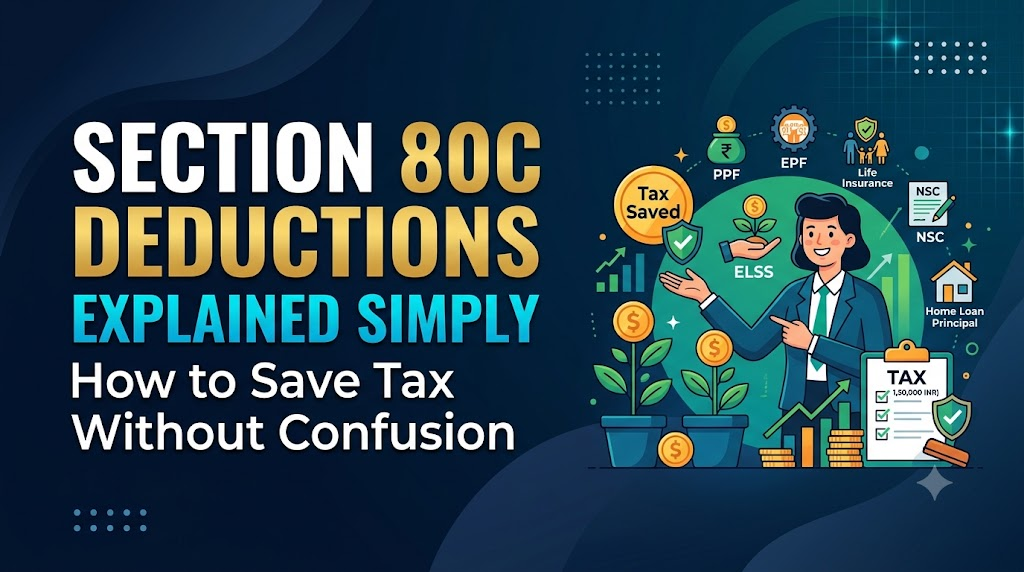
- Fixed-return / Government-backed instruments: Public Provident Fund (PPF), Employee Provident Fund (EPF), National Pension System (NPS – Tier 1 basic contribution counts under 80C up to limits), National Savings Certificate (NSC), Tax-Saving Fixed Deposits (FDs), and Sukanya Samriddhi Yojana (SSY).
- Essential expenses & insurance: Life insurance premiums, principal repayment on home loans, and children’s tuition fees.
Why Section 80C Matters for Your Financial Health
Many beginners view Section 80C purely as a tax-saving checklist. Experienced planners view it as the foundation of long-term wealth creation.
When used strategically, Section 80C forces you to build an emergency cushion, fund your retirement, and secure your family’s future through term insurance or children’s education funds. The tax savings are an immediate bonus; the true value lies in cultivating disciplined saving habits.
Popular Section 80C Investment Options Compared
Not all Section 80C options serve the same purpose. Here is a look at the most common choices, their locking periods, and their risk levels:
| Option | Risk Level | Lock-in Period | Best Suited For |
| ELSS (Mutual Funds) | Moderate to High | 3 Years | Growth-focused investors comfortable with market ups and downs. |
| PPF (Public Provident Fund) | Very Low (Safe) | 15 Years | Long-term risk-free accumulation and retirement safety. |
| EPF (Employee Provident Fund) | Very Low (Safe) | Until Retirement / Job Change | Salaried individuals building automated retirement savings. |
| Tax-Saving Fixed Deposit | Low | 5 Years | Risk-averse savers wanting guaranteed returns. |
| Sukanya Samriddhi Yojana | Very Low (Safe) | Until Girl Child Turns 21 | Parents wanting high-interest security for a daughter’s future. |
Practical Examples: How Different People Use Section 80C
1. The Salaried Beginner
Rohan is a software engineer earning ₹7 lakh a year. Without realizing it, his employer automatically deducts a portion of his salary every month toward his Employee Provident Fund (EPF). If his EPF contribution totals ₹80,000 in a year, he has already used up more than half of his ₹1.5 lakh limit. To cover the remaining ₹70,000, Rohan decides to invest in an Equity-Linked Savings Scheme (ELSS) to grow his money faster over a shorter 3-year lock-in period.
2. The Young Family Provider
Priya has two school-going children and a home loan. She pays ₹60,000 a year for her children’s school tuition fees and ₹50,000 toward the principal repayment of her home loan. These two necessary expenses already total ₹1.1 lakh. To max out her remaining ₹40,000 limit, she opts for a term life insurance policy for income protection. Priya saves tax without making any extra standalone investments outside her normal family budget.
Common Mistakes Beginners Make
- Delaying investments until March: Rushing to buy products at the end of the financial year often leads to picking poor-performing insurance policies or high-cost products. Plan your 80C allocations in April or May.
- Ignoring the lock-in period: Tax-saving FDs lock your money for 5 years, and PPF locks it for 15 years. Putting emergency cash into these vehicles leaves you unable to access money during a crisis.
- Treating life insurance purely as an investment: Mixing insurance with investment (like traditional endowment plans) often yields low returns. Buy a pure term insurance policy for protection and separate investments for wealth creation.
- Exceeding the ₹1.5 lakh cap: Pouring ₹3 lakh into various 80C instruments will not give you extra deductions. The tax benefit stops strictly at ₹1.5 lakh.
Risks and Limitations
- Liquidity Risk: Most 80C options come with lock-in periods ranging from 3 to 15 years. You cannot pull out cash quickly if an unexpected emergency arises.
- Inflation Risk: Instruments that offer guaranteed returns (like Tax-Saving FDs or traditional policies) may sometimes yield returns that barely match or lag behind long-term inflation.
- Concentration Trap: Putting all your money into safe, low-yield debt options might keep your capital secure, but your wealth may not grow fast enough to beat rising living costs over 10 or 20 years.
Decision-Making Framework: How to Fill Your ₹1.5 Lakh Limit
- Calculate automated deductions: Check your salary slip to see how much goes into EPF every year.
- Account for mandatory expenses: Include eligible expenses you are already paying, such as children’s tuition fees or home loan principal repayment.
- Assess the gap: Subtract your EPF and eligible expenses from ₹1.5 lakh. The remaining amount is what you need to actively invest.
- Match your risk appetite: If you want growth and can handle market swings, pick ELSS. If you prefer guaranteed safety and long-term security, look at PPF or Tax-Saving FDs.
- Spread it out: Set up monthly Systematic Investment Plans (SIPs) for ELSS or automatic transfers for PPF to avoid last-minute cash crunches.
Key Terms
- Deduction: An amount you can subtract from your total gross income to lower the final amount on which tax is calculated.
- Lock-in Period: The mandatory duration during which you cannot withdraw or sell your invested funds.
- ELSS (Equity-Linked Savings Scheme): A type of mutual fund that invests primarily in stock markets and qualifies for tax deductions under Section 80C with a 3-year lock-in.
- PPF (Public Provident Fund): A long-term, government-backed savings scheme offering tax-free returns over a 15-year tenure.
- Principal Repayment: The portion of your home loan EMI that goes toward paying back the actual borrowed amount, excluding the interest component.
- Taxable Income: The remaining portion of your income after all permissible deductions and exemptions have been subtracted.
Frequently Asked Questions
Can I invest more than ₹1.5 lakh under Section 80C?
Yes, you are legally free to invest as much as you want in instruments like PPF or ELSS. However, the maximum tax deduction you can claim under Section 80C remains strictly capped at ₹1.5 lakh per financial year.
Does health insurance (mediclaim) fall under Section 80C?
No. Health insurance premiums do not qualify under Section 80C. They fall under a completely different section, Section 80D, which has its own separate limits.
Are the returns from Section 80C investments completely tax-free?
It depends on the instrument. PPF and ELSS (subject to capital gains tax rules) offer tax-efficient returns, whereas interest earned on Tax-Saving FDs is fully taxable according to your income tax slab.
Can I claim deductions for children’s college tuition fees?
No, Section 80C covers tuition fees paid specifically for full-time education (up to two children) in schools, colleges, or universities in India. Development fees, donation charges, or hostel charges do not qualify.
What happens if I withdraw money from an ELSS fund before 3 years?
You cannot withdraw money from an ELSS fund before the completion of 3 years from the date of purchase. The lock-in is legally mandatory.
Is EPF mandatory for all salaried employees?
EPF is mandatory for organizations registered under the Employees’ Provident Funds and Miscellaneous Provisions Act, 1952, for employees whose basic salary falls below specified thresholds, though voluntary contributions are also permitted.
Can homemakers invest in PPF under Section 80C?
Yes, homemakers can open a PPF account in their own name. However, since they may not have taxable income, they cannot claim Section 80C deductions, though the returns earned remain tax-free.
Conclusion
Section 80C is more than just a box to check before filing your taxes. When approached thoughtfully, it helps you build a disciplined routine of saving, investing, and securing your family’s future.
Start evaluating your options early in the financial year, match your choices to your personal risk tolerance, and avoid last-minute panic buying. By building a balanced mix of safe funds and growth-oriented investments, you can lower your tax burden while steadily building long-term financial security.