Introduction
A GST refund can improve business cash flow, but claiming it is not as simple as entering an amount on the GST portal. Many beginners discover excess cash, accumulated input tax credit, tax paid under the wrong head, or GST connected with exports, but they do not know whether the amount is legally refundable. Confusion about Form GST RFD-01, supporting documents, refund periods, bank validation, return filing, and departmental notices can lead to avoidable delays. A small mismatch between returns, invoices, shipping documents, ledgers, or bank details may affect the application. This guide explains the GST Refund Process Explained Step by Step in practical language. It is designed for small business owners, exporters, accountants, consultants, e-commerce sellers, and registered taxpayers who want to understand the process before filing. The purpose is not to promise approval, but to help readers prepare accurate records, select the correct category, respond properly to notices, and obtain professional help when the facts are complex.
Understanding GST Refunds in Simple Words
A GST refund is the return of eligible tax, interest, input tax credit, or another amount that has been paid or accumulated under circumstances recognised by GST law.
A refund does not arise merely because money appears in a GST ledger. The taxpayer must first determine:
- Why the amount became refundable
- Whether the law permits a refund in that situation
- Which refund category applies
- Whether the time limit has been followed
- Whether all required returns have been filed
- Whether documentary evidence supports the claim
- Whether the tax burden was passed to another person
Most GST refund claims are filed electronically in Form GST RFD-01. However, refund of IGST paid on export of goods generally follows a separate Customs-linked process in which the shipping bill is treated as the refund application, subject to the applicable conditions.
Beginner-Friendly Example
Suppose a business deposits ₹1,00,000 into its electronic cash ledger but uses only ₹70,000 for tax payments. The remaining ₹30,000 may be claimed under the category “Refund of excess balance in Electronic Cash Ledger.”
The portal generally auto-populates the available cash ledger balance. The taxpayer enters the amount being claimed under the appropriate tax heads, selects a validated bank account, previews the application, and submits it. The claimed amount is then debited from the electronic cash ledger.
Common Misunderstanding
A common misunderstanding is that every unused input tax credit balance can be withdrawn into a bank account. This is incorrect.
Refund of unutilised input tax credit is generally permitted only in specified situations, particularly zero-rated supplies made without payment of tax and eligible accumulation caused by an inverted duty structure. Restrictions and exclusions may apply depending on the nature of inputs, output supplies, export duty, drawback, and notified goods or services.
Practical Takeaway
Before calculating a refund amount, identify the legal reason for the refund. Selecting the wrong category may result in portal errors, a deficiency memo, a notice, or rejection.
Why the GST Refund Process Is Important
GST refunds can directly affect the working capital of a business. Exporters, manufacturers operating under an inverted duty structure, businesses that made excess tax payments, and taxpayers with unused cash ledger balances may have money blocked in the tax system.
Effect on Business Cash Flow
Money blocked in a GST ledger cannot normally be used for rent, salaries, inventory, loan payments, marketing, or business expansion. A properly prepared refund claim can release eligible funds and improve cash-flow planning.
Effect on Accounting Accuracy
An unreviewed GST refund balance can create differences between:
- Books of account
- GST returns
- Electronic cash ledger
- Electronic credit ledger
- Receivable balances
- Export documentation
- Bank records
Regular reconciliation helps the business understand whether a balance is actually refundable, adjustable against future tax, disputed, or unsupported.
Effect on Tax Compliance
Refund applications allow tax officers to examine the relationship between invoices, returns, tax payments, ITC records, exports, turnover, and supporting documents. Filing a refund without correcting earlier return mismatches can increase scrutiny.
Effect on Financial Planning
Businesses should not treat a proposed GST refund as confirmed cash until it is sanctioned and credited to the bank account. Refunds may be reduced, adjusted against outstanding demands, withheld, rejected, or delayed because of documentation and verification issues.
Practical Scenario
A small exporter expects a GST refund of ₹4,00,000 and immediately uses that amount while preparing a working-capital plan. The application later receives a deficiency memo because invoice details do not match the refund statement.
A better approach is to treat the refund as a receivable subject to verification and avoid committing the entire expected amount until the application has progressed.
The Real Problems Readers Face With GST Refunds
The main difficulty is usually not the portal button. The real difficulty is proving that the refund is legally due and correctly calculated.
Lack of Awareness
Many taxpayers do not know the difference between:
- Excess cash ledger balance
- Excess payment of tax
- Unutilised input tax credit
- Export refund
- SEZ-related refund
- Inverted duty structure refund
- Deemed export refund
- Refund of tax paid under the wrong head
These categories may involve different conditions, statements, calculations, and documents.
Confusing Online Advice
Online articles often mix older manual procedures with the current electronic process. Some still refer to obsolete forms or physical submission requirements.
Under the electronic process, the refund application and supporting documents are transmitted to the jurisdictional officer through the GST system. The ARN date is generally treated as the filing date for processing purposes.
Weak Reconciliation
Refund applications frequently depend on information already reported in GSTR-1, GSTR-3B, electronic ledgers, invoice statements, export documents, and other records. A refund statement cannot safely be prepared in isolation.
Missing the Limitation Period
Section 54 generally requires a refund application to be made within two years from the applicable “relevant date.” The relevant date varies according to the nature of the refund. Special rules may apply to particular categories.
Dependence on Social Media Advice
A short video may show where to click, but it rarely reviews the taxpayer’s invoices, tax heads, returns, unjust-enrichment position, export realisation, ITC eligibility, or limitation period.
Not Knowing the Next Step
After submission, taxpayers may not understand the meaning of RFD-02, RFD-03, RFD-08, RFD-09, RFD-05, or RFD-06. As a result, important notices may remain unanswered.
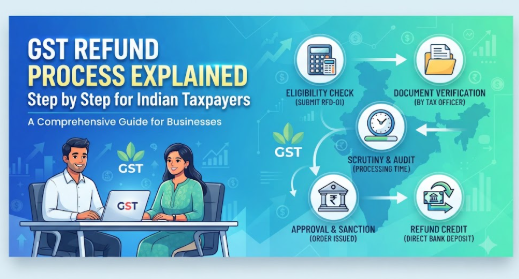
GST Refund Process Explained Step by Step
Step 1: Identify the Correct Reason for the Refund
Start by identifying exactly why the amount is being claimed. It may relate to excess balance in the electronic cash ledger, excess tax payment, exports, supplies to an SEZ, accumulated ITC under an inverted duty structure, deemed exports, tax paid under the wrong head, or another legally recognised reason. This matters because the GST portal asks the applicant to select a refund category, and the category determines the statements, calculations, validations, and documents required. For example, a taxpayer with unused cash in the electronic cash ledger should not select an accumulated ITC category. The common mistake is to select whichever option appears closest to the issue. The better approach is to prepare a short written note describing how the amount arose and match it with the applicable law and portal category.
Step 2: Check Eligibility and the Relevant Date
Confirm that the refund is legally available and has not become time-barred. For many refund categories, the general limitation is two years from the relevant date, but the definition of relevant date changes according to the transaction. In exports, it may connect with shipment, export report, or receipt of payment depending on whether goods or services are involved. For deemed exports, the relevant return date may matter. The mistake is to count two years from the date on which the business first noticed the refund. The better approach is to calculate the relevant date category-wise, retain a written limitation calculation, and seek professional review where multiple periods or special transactions are involved.
Step 3: File Required GST Returns and Reconcile the Data
Before filing, check whether all applicable returns due up to the application date have been filed. Refund claims may be blocked or questioned when return filing is incomplete. Reconcile GSTR-1, GSTR-3B, invoice records, electronic credit ledger, electronic cash ledger, purchase records, export statements, shipping documents, and financial books. For example, export turnover in the refund statement should be supported by invoices and corresponding return disclosures. A common mistake is to prepare the refund directly from a ledger balance. The better approach is to create a period-wise reconciliation and investigate every difference before submitting the application. Official guidance states that the applicable returns due before the refund application generally need to be furnished.
Step 4: Calculate the Eligible Refund Carefully
Calculate the refund according to the selected category. An excess cash ledger refund is generally limited to the available balance under the relevant tax heads. Refunds involving accumulated ITC may be limited by prescribed formulas, eligible turnover, net ITC, adjusted turnover, tax payable on output supplies, ledger balances, and specific exclusions. The amount shown in the electronic credit ledger is not automatically the refundable amount. For example, credit relating to ineligible purchases, blocked credits, capital goods, or periods outside the claim may require separate treatment depending on the category. The common mistake is claiming the entire closing ITC balance. The better approach is to prepare a calculation sheet that connects every figure with returns and supporting records.
Step 5: Organise the Supporting Documents
Prepare the documents before opening the refund application. Depending on the category, these may include invoices, refund statements, declarations, certificates, shipping bills, export general manifests, bank realisation evidence, foreign inward remittance records, LUT details, SEZ endorsements, tax payment evidence, agreements, working calculations, and proof that the tax incidence was not passed to another person. The GST portal currently allows supporting documents to be uploaded with the application, subject to portal limits and category requirements. A common mistake is uploading unlabelled files or combining unrelated records into one unreadable document. The better approach is to create a numbered document index and use clear file names such as “01_Refund_Calculation,” “02_Invoice_Reconciliation,” and “03_Bank_Evidence.”
Step 6: File Form GST RFD-01 on the GST Portal
Log in to the GST portal and go to Services > Refunds > Application for Refund. Select the correct category, choose the relevant period, complete the required statement, enter the claim amount under the correct tax heads, select the bank account, upload documents, preview the form, and submit it using the permitted authentication method. Once successfully filed, an Application Reference Number is generated and communicated through the registered contact details. A debit may be made from the electronic cash or credit ledger for the amount claimed, depending on the refund category. The common mistake is submitting without downloading and reviewing the preview. The better approach is to compare the preview against the calculation sheet and document index before final submission.
Step 7: Monitor Acknowledgements, Deficiencies, and Notices
After filing, the officer examines the application and attachments. A complete application may receive an acknowledgement in Form GST RFD-02. If deficiencies are found, Form GST RFD-03 may be issued, requiring the taxpayer to correct the problems and file a fresh application. Official guidance states that RFD-02 or RFD-03 should generally be issued within 15 days from the ARN date. If a show-cause notice is issued in Form GST RFD-08, the taxpayer should submit a reply in Form GST RFD-09 within the permitted period, commonly 15 days unless another time is specified. The mistake is assuming that no email means no action is required. The better approach is to check the portal dashboard regularly and maintain a notice-response calendar.
Step 8: Track Sanction and Bank Disbursal
The officer may issue a provisional refund order in Form GST RFD-04 in eligible cases, followed by a final sanction or rejection order in Form GST RFD-06. The payment order or advice is issued in Form GST RFD-05. A refund may also be withheld or adjusted against an outstanding demand where permitted. Taxpayers can track the application through Services > Refunds > Track Application Status. Bank validation and disbursal status can also involve PFMS processing. A common mistake is keeping an inactive, mismatched, or unvalidated bank account in the application. The better approach is to confirm the account details before filing and monitor both the GST portal status and bank validation status until the amount is credited.
Key Factors That Influence a GST Refund
Documentation Quality
Documents should establish why the refund is due and how it was calculated. Invoices, statements, returns, ledgers, export records, payment proofs, and declarations should tell the same story.
A common mistake is uploading documents only because they appear on a generic checklist. The better approach is to connect each document with a specific eligibility condition or calculation figure.
Filing Accuracy
The application should match GST returns and portal data. Errors in GSTIN, invoice number, date, tax amount, tax head, turnover, shipping bill, or refund period can create discrepancies.
Review the final PDF preview instead of relying only on the data-entry screen.
Record Keeping
Maintain category-wise and period-wise records. Refund applications may be examined months after the underlying transaction.
Keep both original records and a separate refund working file.
Compliance Deadlines
The limitation period is a legal requirement, not merely a portal preference. A technically valid refund can still face rejection if filed after the permissible period.
Create a refund eligibility calendar and review possible claims every month or quarter.
Invoice Discipline
Invoice data should match returns, e-invoices where applicable, export records, customer records, and books.
Correct genuine errors through the permitted return or amendment process rather than changing working papers merely to make them match.
Electronic Ledger Position
The refundable amount may be restricted by the balance available in the relevant electronic ledger and the rules applicable to the selected category.
Review head-wise balances in IGST, CGST, SGST or UTGST, and cess.
Bank Account Validation
Refund disbursal depends on successful bank validation. Incorrect account details can produce a “Bank Account validation failed” status and delay payment.
Confirm the account number, IFSC, account status, registered name, and portal records before filing.
Professional Review
Professional review becomes important where the claim involves exports, SEZ transactions, deemed exports, inverted duty calculations, old periods, unjust enrichment, incorrect tax heads, notices, or substantial amounts.
Awareness helps taxpayers prepare records, but category-specific legal advice may still be required.
Detailed Breakdown of GST Refund Categories
Refund of Excess Balance in the Electronic Cash Ledger
This category applies when money remains unused in the electronic cash ledger after tax, interest, penalty, fee, or other liabilities have been considered.
The available balance is generally auto-populated. The taxpayer enters the amount to be claimed under each relevant head. The refund amount cannot exceed the available balance in that head. On filing, the claimed amount is debited from the electronic cash ledger.
This refund should not be confused with excess tax payment. A cash ledger balance may arise because too much money was deposited, while excess tax payment involves tax actually discharged beyond the correct liability.
Refund of Excess Tax Payment
Excess tax may arise because of duplicate payment, incorrect calculation, tax paid on a transaction that was later cancelled, or another adjustment that could not be handled through the normal return mechanism.
Before filing a separate claim, check whether the matter should instead be corrected through a credit note or return adjustment. CBIC guidance indicates that certain returned-goods or post-supply situations should be managed through credit notes rather than a separate refund application.
Refund of Unutilised ITC on Zero-Rated Supplies
Exports and eligible supplies to SEZ units or developers are treated as zero-rated under the GST framework, subject to applicable conditions.
A registered person making zero-rated supplies without payment of integrated tax under a bond or Letter of Undertaking may claim eligible accumulated ITC through Form GST RFD-01.
The refund calculation may depend on zero-rated turnover, adjusted total turnover, net ITC, ledger balances, and exclusions prescribed under the rules.
Refund of IGST Paid on Export of Goods
For export of goods with payment of IGST, the shipping bill is generally treated as the refund application. Processing is connected with Customs data, the export manifest or report, and the GST return information.
This is different from a standard RFD-01 refund application and should be reconciled through shipping bill, invoice, Customs, return, and bank records.
Rule 96(10), which previously restricted certain IGST export refunds where specified exemption benefits had been used, was omitted through a 2024 amendment. Historical claims may still require careful period-specific review because the legal position during the relevant export period can matter.
Refund of Tax Paid on Export of Services
Export of services may involve conditions concerning the supplier, recipient, place of supply, receipt of payment, and relationship between the parties.
Where services are exported with payment of tax, the refund application is filed through the relevant RFD-01 category. Supporting evidence may include export invoices, agreements, foreign currency realisation documents, bank records, and return reconciliation.
Refund for Supplies to an SEZ Unit or Developer
Refund may be available for eligible supplies made to an SEZ unit or SEZ developer with or without payment of tax, subject to zero-rating conditions and evidence that the supply was made for authorised operations.
Endorsements, invoice details, returns, and SEZ-related documents should be properly maintained. Merely mentioning an SEZ customer on the invoice may not be sufficient.
Refund Under an Inverted Duty Structure
An inverted duty structure generally arises where the tax rate on eligible inputs is higher than the tax rate on output supplies, causing input tax credit to accumulate.
The refund is calculated according to the formula prescribed under Rule 89. Restrictions apply to certain goods and situations, and not every accumulated ITC balance is refundable. The treatment of input services and capital goods also requires careful review.
Refund Relating to Deemed Exports
Specified supplies may be treated as deemed exports even though the goods do not leave India.
Depending on the applicable conditions, the supplier or recipient may claim the refund. The same invoice cannot ordinarily be reused in another refund application unless the earlier application is withdrawn or receives a deficiency memo.
Refund of Tax Paid Under the Wrong Head
A taxpayer may treat a supply as intra-state and pay CGST and SGST, but the transaction may later be held to be inter-state, requiring IGST. The reverse can also occur.
The taxpayer generally pays the correct tax and may claim refund of the tax paid under the incorrect head, subject to Section 77 of the CGST Act, Section 19 of the IGST Act, Rule 89, limitation rules, and supporting evidence.
Refund Under the “Any Other” Category
This category should not be treated as a convenient alternative when another specific category exists.
Use it only where the facts and legal provision genuinely support that classification. Explain the nature of the claim clearly in the application and attach a detailed note.
Common Mistakes Beginners Make With GST Refunds
Selecting the Wrong Refund Category
This happens when the taxpayer focuses on the balance rather than the reason it arose. The wrong category may trigger incorrect statements, validations, and calculations.
Prepare an eligibility note before opening the application.
Claiming the Entire ITC Balance
The electronic credit ledger balance and the legally refundable amount may be different.
Remove ineligible credit, unrelated periods, restricted components, and amounts not covered by the prescribed formula.
Filing Before Return Reconciliation
Refund statements may be compared with GSTR-1, GSTR-3B, invoices, and portal data.
Complete reconciliation first and explain genuine differences.
Ignoring the Relevant Date
A taxpayer may have valid invoices but still lose the claim because of limitation.
Calculate the relevant date invoice-wise or period-wise instead of relying on the financial year-end.
Uploading Poor-Quality Documents
Unreadable scans, password-protected files, missing pages, unclear file names, and unindexed attachments increase processing difficulty.
Use searchable PDFs, clear labels, and a document index.
Using Incorrect Bank Details
An inactive or mismatched bank account may delay disbursal after sanction.
Validate the account before submission and monitor the payment status.
Ignoring RFD-03
A deficiency memo ends the processing of that application. The taxpayer generally has to correct the deficiencies and file a fresh RFD-01 with a new ARN.
Do not submit the same documents again without addressing every point raised.
Giving a Weak RFD-09 Reply
A general reply such as “all documents already submitted” may not answer the officer’s concerns.
Respond point by point, attach supporting evidence, and reconcile disputed figures.
Passing the Tax Burden to Another Person
Refund law may require proof that the applicant did not pass the tax incidence to another person, subject to category-specific exceptions.
Review invoices, credit notes, customer recoveries, accounting treatment, and declarations.
Depending Only on Portal Calculations
Portal validation does not guarantee legal eligibility.
Maintain an independent calculation and legal basis for the amount claimed.
“Don’t Do This” Checklist
- Do not select a category without understanding its conditions.
- Do not claim the complete ledger balance automatically.
- Do not use altered or unsupported invoices.
- Do not file with pending return mismatches.
- Do not ignore the two-year limitation rule.
- Do not upload unreadable or unlabelled documents.
- Do not overlook notices on the GST portal.
- Do not reply with unsupported explanations.
- Do not use another person’s bank account.
- Do not assume ARN generation means refund approval.
- Do not treat an expected refund as guaranteed working capital.
- Do not share GST login credentials or OTPs with unauthorised persons.
Practical Real-Life Examples of GST Refunds
Example 1: Excess Cash Deposited by a Small Retailer
A retailer accidentally deposits ₹80,000 instead of ₹8,000 into the electronic cash ledger. The mistake is trying to reduce the next return liability artificially. The better action is to review pending liabilities and claim the genuinely excess cash ledger balance under the correct category. The learning is that a deposit error and an excess tax payment are not always the same issue.
Example 2: Exporter With Unreconciled Invoices
An exporter files a refund using internal sales data, but several invoice numbers differ from GSTR-1. The application receives a deficiency memo. The better action is to reconcile export invoices, shipping records, returns, and refund statements before filing. The learning is that a correct total is not enough when transaction-level data does not match.
Example 3: Manufacturer Under an Inverted Duty Structure
A manufacturer pays a higher GST rate on inputs than on finished products and sees ITC accumulating. The mistake is claiming the entire credit ledger balance. The better action is to identify eligible inputs, remove restricted credits, calculate the refund under the prescribed formula, and review notified exclusions. The learning is that accumulated credit and refundable credit are different.
Example 4: Consultant Who Paid Tax Under the Wrong Head
A consultant treats a supply as intra-state and pays CGST and SGST, but later determines that IGST should have been paid. The mistake is claiming a refund before discharging the correct tax. The better action is to review the transaction, pay the correct tax, and follow the specific refund procedure for the incorrect tax head. The learning is that correction and refund must follow the required legal sequence.
Example 5: Business With Failed Bank Validation
A taxpayer receives a refund sanction, but the payment status shows bank account validation failure. The challenge is not the refund order but incorrect bank details. The better action is to update the bank account through the refund section and monitor reissuance. The learning is that accurate bank information is part of GST refund compliance, not merely an administrative formality.
Table 1: Major GST Refund Situations
| Refund situation | Typical applicant | Main preparation focus | Frequent mistake |
|---|---|---|---|
| Excess electronic cash ledger balance | Any eligible registered taxpayer | Cash ledger balance, liabilities, bank account | Confusing deposit balance with excess tax payment |
| Export without payment of tax | Exporter operating under LUT or bond | Export invoices, returns, ITC, turnover, export evidence | Claiming unreconciled or ineligible ITC |
| Export of services with tax payment | Service exporter | Invoice, agreement, tax payment, foreign remittance evidence | Weak proof of export-of-service conditions |
| Supply to SEZ | Supplier to SEZ unit or developer | Authorised-operation evidence, endorsement, invoice, return | Assuming every supply to an SEZ is automatically eligible |
| Inverted duty structure | Manufacturer or supplier with qualifying rate inversion | Eligible inputs, output tax, formula, notified restrictions | Claiming input services or other restricted credit incorrectly |
| Deemed exports | Eligible supplier or recipient | Notification conditions, invoices, declarations, return details | Both parties claiming on the same invoice |
| Tax paid under wrong head | Taxpayer who paid CGST/SGST instead of IGST or vice versa | Correct tax payment, classification evidence, limitation | Applying before paying tax under the correct head |
| Excess tax payment or another eligible reason | Taxpayer with supported overpayment | Payment proof, liability calculation, accounting treatment | Using “Any Other” without explaining the legal basis |
Table 2: Important GST Refund Forms
| Form | Purpose | What the taxpayer should do |
|---|---|---|
| GST RFD-01 | Main refund application | Select the correct category, calculate accurately, and attach supporting evidence |
| GST RFD-01W | Withdrawal of refund application | Use before the permitted processing stage when the filed claim needs withdrawal |
| GST RFD-02 | Acknowledgement | Confirm that the application has been accepted as complete for processing |
| GST RFD-03 | Deficiency memo | Correct every deficiency and file a fresh application |
| GST RFD-04 | Provisional refund order | Review the provisionally sanctioned amount and continue monitoring |
| GST RFD-05 | Payment order or advice | Track bank validation and disbursal |
| GST RFD-06 | Final sanction or rejection order | Review sanctioned, rejected, adjusted, and re-credit amounts |
| GST RFD-07 | Withholding or adjustment-related order | Identify the demand, withholding reason, and available remedy |
| GST RFD-08 | Show-cause notice | Prepare a point-wise factual and legal response |
| GST RFD-09 | Reply to RFD-08 | Submit the reply and evidence within the allowed time |
| GST PMT-03 | Re-credit order in relevant rejection cases | Confirm whether the rejected credit amount has been restored |
Tools, Methods, and Frameworks Readers Can Use
GST Refund Eligibility Note
Create a one-page note stating:
- Nature of refund
- Legal category
- Refund period
- Relevant date
- Amount expected
- Returns involved
- Documents required
- Special risks
This prevents the application from being prepared without a clear legal basis.
Return Reconciliation Workbook
Use a spreadsheet with separate sheets for:
- GSTR-1
- GSTR-3B
- Sales register
- Purchase register
- Electronic credit ledger
- Electronic cash ledger
- Export or SEZ documents
- Refund calculation
- Difference explanations
The workbook helps identify mismatches before the officer identifies them.
Refund Document Index
Prepare a numbered list containing the name, purpose, period, and page numbers of every attachment.
This helps the officer find the relevant evidence and reduces the risk of an important document being overlooked.
Compliance Calendar
Record:
- Applicable relevant date
- Last date for filing
- Return due dates
- ARN date
- RFD-02 or RFD-03 status
- Notice response deadline
- Follow-up date
- Sanction date
- Bank disbursal status
This method prevents missed limitation and notice deadlines.
Refund Calculation Review
Use a three-level review:
- Source review: Verify invoices, ledgers, and returns.
- Formula review: Verify category-specific computation.
- Submission review: Match the final RFD-01 preview with the approved working.
This prevents numbers from changing between preparation and filing.
Bank Validation Check
Before filing, confirm that the selected bank account:
- Is active
- Belongs to the applicant
- Has the correct account number
- Has the correct IFSC
- Is updated in GST registration records
- Can receive electronic payments
This avoids a sanctioned refund becoming stuck at the disbursal stage.
Notice Response File
For every notice, prepare a response matrix containing:
- Notice point
- Officer’s allegation or question
- Taxpayer’s response
- Supporting document
- Relevant calculation
- Page reference
This creates a clear, point-wise RFD-09 reply.
Expert Tips to Make Better GST Refund Decisions
1. Start With Eligibility, Not the Amount
First establish why the refund is legally available. A large balance does not create a refund right by itself. Write down the relevant category and conditions before calculating the claim.
2. Reconcile Transaction-Level Data
Matching only the total turnover is insufficient. Compare invoice numbers, dates, taxable values, tax amounts, shipping details, and amendments. Transaction-level reconciliation helps prevent deficiency memos.
3. Review the Limitation Period Early
Do not wait until every document is perfect before checking the deadline. Calculate the relevant date when the refund possibility first arises and prioritise claims approaching limitation.
4. File Periods in a Logical Sequence
Some refund categories are expected to be filed chronologically. Maintain a category-wise filing tracker so that later periods are not filed while earlier eligible periods remain unresolved without explanation.
5. Separate Refundable and Non-Refundable ITC
Prepare a clear working for eligible inputs, input services, capital goods, blocked credits, common credits, and unrelated credits. Apply the rules of the selected refund category rather than using the complete ledger balance.
6. Explain Unusual Transactions
Where an invoice value, export date, payment date, amendment, credit note, or tax head appears unusual, attach a short explanation. Clear disclosure is better than allowing the officer to guess.
7. Use Consistent Document Names
File names such as “scan001” or “finalnew2” provide no context. Use numbered, descriptive names that match the document index.
8. Check the Application Preview
The preview is the final opportunity to identify wrong periods, bank accounts, tax heads, refund amounts, and declarations. Review it independently before authentication.
9. Monitor the Portal After Filing
Do not depend only on email or SMS. Check the GST portal for acknowledgements, deficiency memos, notices, orders, and payment status.
10. Reply to Notices Point by Point
Copy each issue raised in RFD-08 into a response matrix. Answer it with facts, calculations, and document references instead of submitting a general letter.
11. Keep Expected Refunds Separate From Available Cash
A refund claim remains uncertain until sanctioned and disbursed. Use conservative cash-flow planning and avoid depending entirely on the expected amount for urgent commitments.
12. Seek Professional Review for Complex Claims
Professional assistance is useful for exports, SEZ supplies, inverted duty calculations, deemed exports, wrong-head payments, old periods, substantial claims, and contested notices. The cost of review may be lower than the cost of a rejected or time-barred claim.
Case Studies: How Better Understanding Changes Decisions
Case Study 1: Exporter Receiving a Deficiency Memo
Profile: A software services company provides services to foreign clients.
Situation: The company files an RFD-01 refund claim for accumulated ITC relating to exports under LUT.
Problem: The export invoices match the books, but the refund statement includes a period that does not match the return disclosures. Some foreign remittance documents are also missing.
Wrong approach: The accountant plans to submit the same application again with only the missing bank documents.
Better approach: The business reviews every invoice, matches GSTR-1 and GSTR-3B, separates the correct refund period, adds remittance evidence, and prepares a document index addressing each deficiency.
Result or learning: The fresh application is based on reconciled data rather than a repeated incomplete claim. The case shows that RFD-03 should trigger a complete review, not a minor cosmetic correction.
Key takeaway: Correct the cause of the deficiency before filing a fresh application.
Case Study 2: Manufacturer Claiming Excess ITC
Profile: A manufacturer purchases inputs taxed at a higher rate and sells finished products at a lower rate.
Situation: ITC continues to accumulate in the electronic credit ledger.
Problem: The finance team assumes that the entire year-end ITC balance is refundable.
Wrong approach: It includes credits relating to capital goods, input services, and unrelated periods without reviewing the inverted-duty formula and restrictions.
Better approach: The company classifies the credit, identifies eligible inputs, reconciles output turnover and tax, removes unsupported amounts, and applies the prescribed calculation.
Result or learning: The revised claim is lower than the original estimate but better supported. The business avoids claiming amounts that may have been rejected.
Key takeaway: A defensible refund is more useful than an inflated claim.
Case Study 3: Refund Sanctioned but Not Received
Profile: A trading business claims excess balance from its electronic cash ledger.
Situation: Form GST RFD-06 sanctions the refund, but the amount does not reach the bank account.
Problem: The GST portal shows that bank account validation failed.
Wrong approach: The owner repeatedly contacts the tax officer without checking the bank details in the refund status.
Better approach: The accountant verifies the account number and IFSC, updates the bank information through the relevant refund option, and monitors the reissuance status.
Result or learning: The business understands that sanction and disbursal are separate stages.
Key takeaway: Continue monitoring until the refund is credited to the bank account.
Risk Awareness: What Readers Must Check First
Eligibility Risk
The business may believe that a balance is refundable even though the law permits only adjustment against future liabilities.
Reduce this risk by identifying the statutory category before preparing the claim.
Limitation Risk
A refund may become time-barred if the application is filed after the applicable period.
Maintain a relevant-date register and review it monthly.
Documentation Risk
Missing invoices, endorsements, payment evidence, shipping records, or declarations can weaken an otherwise valid claim.
Use a category-specific checklist and document index.
Return-Mismatch Risk
Differences between refund statements and GST returns may lead to questions, deficiency memos, partial sanction, or rejection.
Reconcile all relevant returns before filing.
Ineligible ITC Risk
Blocked, unsupported, reversed, or category-restricted ITC may be incorrectly included.
Review ITC eligibility separately from the refund formula.
Unjust-Enrichment Risk
A taxpayer may seek a refund even though the tax burden was recovered from a customer.
Review invoices, credit notes, customer balances, and accounting treatment.
Outstanding-Demand Risk
A sanctioned refund may be adjusted against an outstanding tax demand where legally permitted.
Check the electronic liability position and pending orders before assuming the full refund will be paid.
Bank Validation Risk
Incorrect bank information can stop disbursal after sanction.
Verify the account before filing and monitor PFMS-linked status.
Cybersecurity Risk
Fraudsters may ask for GST credentials, OTPs, Aadhaar OTPs, bank passwords, or remote access while promising faster refunds.
Use only authorised persons and official systems. A genuine tax officer or professional does not need unrestricted access to personal banking credentials.
Misinformation Risk
Old videos and templates may describe procedures that have changed.
Verify portal functionality and legal requirements at the time of filing.
Readers should confirm category-specific requirements and consult a qualified GST professional where the amount, facts, or legal position is significant.
Checklist Before Filing a GST Refund
- The legal reason for the refund has been identified.
- The correct GST refund category has been selected.
- The relevant date and filing deadline have been calculated.
- All applicable returns due before filing have been submitted.
- GSTR-1 and GSTR-3B have been reconciled.
- Books, invoices, and electronic ledgers have been reconciled.
- Export, SEZ, or deemed-export documents have been reviewed where relevant.
- The eligible refund amount has been calculated independently.
- Ineligible or restricted ITC has been removed.
- The amount has been checked head-wise.
- Unjust-enrichment requirements have been reviewed.
- Supporting documents are clear and readable.
- A numbered document index has been prepared.
- The selected bank account is active and accurate.
- Aadhaar authentication requirements have been checked where applicable.
- The application preview has been reviewed.
- A copy of the filed application and ARN has been saved.
- Portal notices will be checked regularly.
- A response deadline tracker has been created.
- The expected refund has not been treated as guaranteed cash.
- Professional advice has been considered for complex matters.
Use this checklist as a final control sheet. The preparer should sign and date it, and a second person should review major claims before submission.
Strategic Insights for Better GST Refund Management
Build Documentation Discipline Throughout the Year
Refund preparation should not begin at the end of the quarter or financial year. Capture invoice, return, export, payment, and endorsement records when the transaction occurs.
This reduces the need to reconstruct evidence later.
Create a Refund Receivable Policy
Businesses should define when a GST refund is recognised as a receivable in internal management reports.
Possible stages include:
- Refund identified
- Eligibility reviewed
- Application prepared
- ARN generated
- RFD-02 issued
- Provisional refund sanctioned
- Final refund sanctioned
- Amount credited to bank
A stage-based policy prevents management from treating an early estimate as confirmed cash.
Use Root-Cause Analysis for Repeated Refunds
A recurring cash ledger refund may indicate poor payment controls. Repeated wrong-head refunds may indicate place-of-supply errors. Regular inverted-duty refunds may require working-capital planning.
Do not treat every refund as an isolated portal activity. Identify why the amount repeatedly arises.
Separate Preparation and Review Responsibilities
The person who prepares the calculation may overlook assumptions already accepted during preparation.
A second reviewer should check:
- Category
- Limitation
- Returns
- Formula
- Tax heads
- Supporting evidence
- Bank account
- Declarations
Maintain an Audit Trail
Retain the original working, revised working, documents submitted, application preview, ARN, acknowledgements, notices, replies, orders, and bank credit proof.
An audit trail is valuable during future departmental review, statutory audit, due diligence, or financial reporting.
Review Old Deficiency Memos and Rejections
Create a register of reasons previously raised by officers.
Common themes may include:
- Invoice mismatch
- Wrong period
- Missing export proof
- Incorrect calculation
- Ineligible ITC
- Weak unjust-enrichment evidence
- Bank mismatch
Use this history as a prevention checklist for future applications.
Key Terms Explained for Beginners
- GST Refund: An amount returned to an eligible applicant under the GST law after verification of the claim.
- Form GST RFD-01: The main electronic application used for most GST refund categories.
- ARN: The Application Reference Number generated after successful filing. It helps identify and track the refund application.
- Electronic Cash Ledger: The GST portal ledger showing cash deposited and utilised by the taxpayer.
- Electronic Credit Ledger: The portal ledger containing eligible input tax credit available to the registered person.
- Input Tax Credit: Credit of eligible GST paid on business purchases, subject to statutory conditions and restrictions.
- Zero-Rated Supply: Eligible exports and supplies to SEZ units or developers that receive special GST treatment under the applicable law.
- Letter of Undertaking: A facility that may allow eligible exporters to make zero-rated supplies without payment of integrated tax, subject to conditions.
- Inverted Duty Structure: A situation where the tax rate on inputs is higher than the tax rate on output supplies, leading to credit accumulation.
- Relevant Date: The legally defined date from which the time limit for filing a refund is calculated.
- Deficiency Memo: Form GST RFD-03 issued when a refund application is considered incomplete or deficient.
- Show-Cause Notice: Form GST RFD-08 explaining why the refund may be rejected fully or partly and asking the taxpayer to respond.
- Provisional Refund: An eligible portion of the refund sanctioned before final verification through Form GST RFD-04.
- Refund Sanction Order: Form GST RFD-06 recording the final amount sanctioned, rejected, adjusted, or otherwise decided.
- Unjust Enrichment: The principle that a person should generally not receive a refund of tax whose economic burden has already been passed to another person, subject to statutory exceptions.
Who Should Read This Blog
Beginners
It explains GST refund forms, steps, records, notices, and risks without assuming advanced tax knowledge.
Students
Commerce, finance, law, and accounting students can use it to understand how GST refund provisions operate in practice.
Salaried Employees
Most salaried individuals do not file GST refunds personally. However, the guide may help employees managing accounts, finance, procurement, or compliance responsibilities.
Small Business Owners
They can understand whether excess cash, overpaid tax, exports, or accumulated ITC may require a refund review.
Exporters
The guide helps distinguish between export under LUT, export with payment of tax, export of goods, and export of services.
Accountants and GST Practitioners
They can use the checklists, reconciliation methods, document index, and notice-response framework.
New Investors and Traders
People operating GST-registered investment education, advisory, brokerage-support, or related businesses may find the general compliance process useful. Ordinary investment losses do not create a GST refund.
Loan Seekers
A pending GST refund may affect business cash-flow planning, but it should not be treated as guaranteed money while evaluating repayment capacity.
Crypto Learners and Businesses
GST-registered businesses operating in crypto-related services should obtain specialised advice because transaction classification and tax treatment can be complex.
Casino Content Creators and Affiliates
GST-registered publishers or affiliates may need professional advice concerning place of supply, export of services, invoicing, and foreign receipts. The refund rules should not be applied without reviewing the underlying business model.
Finance Bloggers
They can use this guide to understand the difference between educational explanations and transaction-specific tax advice.
People Improving Financial Awareness
The process demonstrates the importance of records, deadlines, reconciliation, risk review, and professional guidance.
Frequently Asked Questions
1. What is the GST Refund Process Explained Step by Step?
It begins with identifying the refund category, checking eligibility and limitation, filing required returns, reconciling records, calculating the claim, preparing documents, and submitting Form GST RFD-01. The taxpayer must then monitor acknowledgements, notices, orders, bank validation, and disbursal.
2. Who can apply for a GST refund?
Any eligible person may apply where the GST law recognises a refundable amount. Common applicants include exporters, suppliers to SEZs, businesses with excess cash ledger balances, taxpayers who paid excess tax, and persons with eligible accumulated ITC.
3. Which form is used for a GST refund application?
Most GST refund claims are filed through Form GST RFD-01. Some categories follow different processes. For example, the shipping bill generally acts as the refund application for IGST paid on export of goods, subject to applicable conditions.
4. What is the time limit for filing a GST refund?
The general rule under Section 54 is two years from the applicable relevant date. However, the relevant date differs by refund category. Special situations may have separate rules, so the calculation should be reviewed carefully.
5. Can the complete electronic credit ledger balance be refunded?
No. The full ledger balance is not automatically refundable. Refund of unutilised ITC is generally permitted only in specified categories and is subject to formulas, conditions, restrictions, available balances, and documentary support.
6. What happens after Form GST RFD-01 is filed?
An ARN is generated and the application is sent electronically to the jurisdictional officer. The officer may issue an acknowledgement, deficiency memo, provisional order, show-cause notice, final order, payment order, withholding order, or adjustment order.
7. What should I do after receiving RFD-03?
RFD-03 is a deficiency memo. Review every point, correct the deficiencies, update the documents and calculations, and file a fresh RFD-01 where appropriate. Repeating the same application without correction may create further problems.
8. How can I check my GST refund status?
Log in to the GST portal and navigate to Services > Refunds > Track Application Status. Search using the filing year or ARN. Bank validation and payment processing may also be tracked through the applicable PFMS-linked process.
9. How long does a GST refund take?
The law provides a time-bound framework, but actual completion depends on the claim, documents, verification, notices, bank validation, outstanding demands, and officer processing. Section 56 deals with interest where eligible refunds are not made within the prescribed period.
10. Why is my sanctioned GST refund not credited?
Possible reasons include bank validation failure, an inactive account, incorrect account details, payment reissuance pending, withholding, adjustment against a demand, or PFMS processing. Check both the final order and payment status.
11. What is the biggest mistake in the GST Refund Process Explained Step by Step?
The biggest mistake is filing from the ledger balance without proving legal eligibility. A strong application connects the selected category, limitation period, returns, invoices, calculation, documents, and bank details.
12. Should I use a GST professional for a refund?
Professional help is advisable for exports, SEZ supplies, inverted duty structure, deemed exports, wrong-head payments, old periods, large claims, deficiency memos, and show-cause notices. The professional should still rely on complete and accurate records supplied by the taxpayer.
Conclusion
The GST Refund Process Explained Step by Step is best understood as a compliance and evidence exercise rather than a simple portal transaction. A taxpayer must establish why the amount is refundable, identify the correct category, calculate the relevant date, file applicable returns, reconcile transaction-level data, remove ineligible amounts, prepare clear documents, and submit the correct application. After filing, the work continues through ARN tracking, acknowledgement review, deficiency correction, notice response, final order examination, bank validation, and confirmation of actual credit. Beginners should remember that a cash ledger balance, an ITC balance, an export transaction, or an apparent overpayment does not automatically create an approved refund. The legal conditions and documentary evidence must support the claim. Businesses should build a monthly refund review into their accounting process instead of waiting until funds have remained blocked for a long period. They should maintain a relevant-date register, reconciliation workbook, document index, notice tracker, and refund receivable report. Expected refunds should be used conservatively in financial planning because a claim may be reduced, adjusted, withheld, delayed, or rejected. Where the matter involves exports, SEZ supplies, inverted duty calculations, deemed exports, incorrect tax heads, substantial amounts, old periods, or disputed facts, advice from a qualified GST professional can reduce avoidable risk.