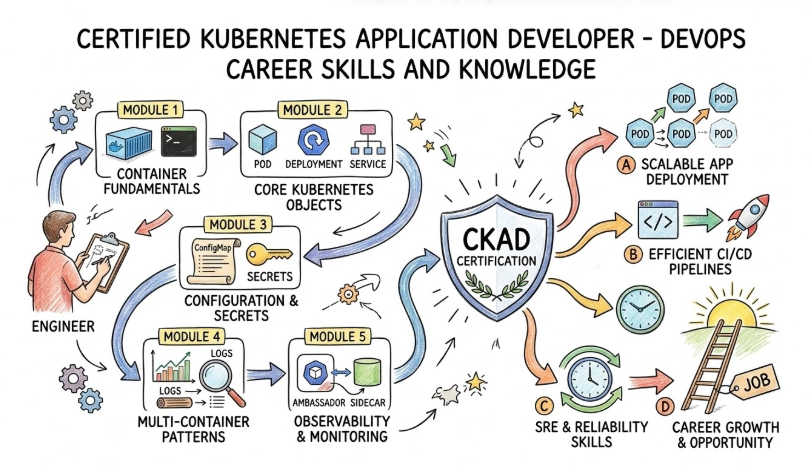
Introduction
The world of software development has changed drastically over the last few years. Moving code from a local machine to a live server is no longer a simple task of copying files. Containers have become the standard way for building and deploying modern applications because they make software run reliably in any environment. Among all the tools available today, Kubernetes stands out as the most important platform for managing these containers at a large scale. For any developer or engineer, learning how to work with this system is a critical step in building a successful and long-lasting career in the tech industry.
What is Certified Kubernetes Application Developer (CKAD)?
The Certified Kubernetes Application Developer (CKAD) is a hands-on, performance-based exam that tests your real-world technical skills. It is specifically designed to verify if a person can design, build, and configure cloud-native applications directly for the Kubernetes environment. Unlike traditional exams that rely on multiple-choice questions, this exam requires you to solve actual problems in a live command-line interface. It serves as a gold standard to prove that you have the practical skills needed to handle containerized applications in a professional setting.
Why it matters in today’s software, cloud, and automation ecosystem ?
Most companies across the globe are moving their operations to the cloud to stay competitive. In this new landscape, automation and scaling are no longer just optional features; they are absolute necessities for business survival. If an application cannot handle thousands of users at once or update itself without going offline, it is considered a failure. Kubernetes provides the essential framework to make these complex tasks possible and repeatable. By mastering the CKAD curriculum, an engineer learns how to use the full power of the cloud to make software faster, safer, and much more reliable for the end user.
Why certifications are important for engineers and managers
Certifications serve as a very clear and helpful roadmap for professional learning. For engineers, it provides a structured way to gain deep technical knowledge without getting lost in too much information. For managers, these certifications act as a reliable way to verify that their team members have a standard level of expertise and can be trusted with critical systems. In a crowded and competitive job market, holding a recognized certificate shows a deep commitment to professional growth. It demonstrates that you are willing to put in the hard work to reach a level of technical excellence that sets you apart from others.
Certification Overview Table
| Track | Level | Who it’s for | Prerequisites | Skills Covered | Recommended Order |
| Application Development | Intermediate | Software Engineers, DevOps, Cloud Engineers | Basic Linux & Docker knowledge | Pods, Deployments, Services, ConfigMaps, Security Contexts | After basic Docker training |
Provider: DevOpsSchool
Why Choose DevOpsSchool?
When you are planning a big career move, having the right support system makes all the difference in the world. DevOpsSchool is chosen by thousands of professionals because the focus is always kept on real-world skills rather than just theory. The training provided by this institution is not just about helping you pass an exam; it is about making sure you understand how these tools work in a real production environment. This practical approach helps students feel ready to handle actual work challenges as soon as they finish the course.
The instructors at DevOpsSchool bring many years of deep industry knowledge into the classroom. This ensures that every learner gets practical insights and “tricks of the trade” that simply cannot be found in a standard textbook. Even the most complex and intimidating topics are broken down into simple, manageable lessons that anyone can follow. Additionally, the strong community support and constantly updated study materials help students stay ahead of the curve in a fast-changing tech world. You are never left to study alone; there is always a mentor or a peer ready to help you move forward.
Certification Deep-Dive: CKAD
What is this certification?
This is a strictly practical exam that verifies your ability to build, monitor, and troubleshoot applications within a Kubernetes cluster. It focuses on the core tasks that an application developer performs on a daily basis in a modern cloud environment. It is widely recognized as one of the best ways to prove you are ready for a cloud-native developer role.
Who should take this certification?
This certification is perfect for Full-stack and Backend Developers who want to manage their own deployments. It is also highly recommended for DevOps Engineers looking to specialize in application patterns. Even System Administrators who are moving toward cloud-based roles will find this valuable. Finally, Engineering Managers who lead technical teams often take this to better understand the tools their developers are using every day.
Skills you will gain
- Creating and configuring Application Pods to run your code.
- Setting up Multi-container Pod patterns for more complex services.
- Managing Network Policies to keep your application traffic secure.
- Configuring Persistent Volume Claims so your data is never lost.
- Troubleshooting application failures quickly to reduce downtime.
Real-world projects you should be able to do
- Deploy a scalable web application that can handle traffic spikes easily.
- Perform zero-downtime updates so users never see an error page.
- Secure an application by using secrets and configuration maps properly.
- Set up resource limits to make sure one app doesn’t crash the whole server.
- Configure self-healing apps that restart automatically if they stop working.
Preparation Plan
- 7–14 Days Plan: This short plan is for those who already use Kubernetes. You should focus entirely on the official curriculum. Spend your time practicing the
kubectlcommand-line tool every single day to build muscle memory. It is vital to memorize the basic YAML structures for Pods and Services so you don’t waste time looking them up. - 30 Days Plan: This is the most common path for working professionals. Spend the first two weeks deeply studying the core concepts and objects. Use the remaining two weeks to take mock exams under a timer. A big part of the test is speed, so learn how to navigate the official documentation very quickly to find the answers you need.
- 60 Days Plan: This plan is the best choice for beginners who are new to containers. Spend the entire first month learning the basics of Linux and Docker. Once you have a strong foundation, spend the second month deep-diving into Kubernetes objects and complex networking. This slower pace ensures that you actually understand the “why” behind every command.
Common mistakes to avoid
- Spending too much time on one difficult question instead of moving on to easier ones.
- Typing out long YAML files manually, which leads to small errors that are hard to find.
- Forgetting to switch to the correct namespace, which can cause you to lose points even if your work is perfect.
- Not spending enough time practicing in a real terminal, which is very different from reading a book.
Best next certification after this
- Same track: Certified Kubernetes Administrator (CKA) is the natural next step to learn how the whole cluster is built.
- Cross-track: Certified Kubernetes Security Specialist (CKS) is great if you want to focus on protecting the system.
- Leadership / management: Certified Kubernetes Cloud Native Associate (KCNA) provides a high-level view of the entire ecosystem.
Choose Your Learning Path
DevOps Path This path is best for those who want to bridge the gap between writing code and running it on a server. It focuses heavily on building CI/CD pipelines and using automation to make the software delivery process as smooth as possible.
DevSecOps Path This is the best route for security-minded engineers who believe that safety should be part of the code from the start. It combines development and operations with a heavy focus on protecting the software supply chain from hackers and bugs.
Site Reliability Engineering (SRE) Path This path is best for people who love systems that are stable and perform well under pressure. It uses software engineering principles to solve operational problems, ensuring that systems stay online and work perfectly for the users at all times.
AIOps / MLOps Path This is a great choice for data science enthusiasts who want to see their models actually working in the real world. This path is designed for deploying and managing machine learning models at a very large scale using the power of Kubernetes.
DataOps Path This is the best fit for data engineers who need to move large amounts of information safely. It focuses on managing data pipelines and ensuring that data is always accurate and available across the entire organization.
FinOps Path This path is designed for cloud architects and managers who care about the bottom line. The goal here is to optimize cloud spending and bring financial accountability to the tech department so that the cloud remains affordable as it grows.
Role → Recommended Certifications Mapping
- DevOps Engineer: Start with CKAD, then move to CKA, and finish with CKS for full mastery.
- Site Reliability Engineer (SRE): Begin with CKAD, followed by the Prometheus certification and CKA.
- Platform Engineer: Focus on CKAD, then master HashiCorp Terraform and CKA.
- Cloud Engineer: Take CKAD first, then look into specific AWS, Azure, or GCP developer certificates.
- Security Engineer: Use CKAD as a base, then move to CKS and other specialized cloud security roles.
- Data Engineer: Start with CKAD to learn the platform, then focus on Apache Spark or Kafka.
- FinOps Practitioner: Take CKAD to understand the tech, then move into the FinOps Certified Practitioner role.
- Engineering Manager: Start with KCNA for the big picture, then take CKAD to understand the developer’s work.
Next Certifications to Take
When you look at the current market for software engineers, certain certifications stand out as being very helpful for career growth. Based on industry data, here are the most recommended steps to take after you finish your CKAD.
- One same-track certification: The Certified Kubernetes Administrator (CKA) is the best follow-up because it teaches you how to manage the actual cluster itself, not just the applications.
- One cross-track certification: Learning HashiCorp Certified: Terraform Associate is highly recommended. This allows you to manage all your cloud infrastructure using code, which is a skill every modern engineer needs.
- One leadership-focused certification: The Certified Cloud-Native Professional is a great choice for those who want to move into a more strategic role. It helps you understand how different technologies fit together to solve big business problems.
Training & Certification Support Institutions
DevOpsSchool This is a top-rated institution that provides very detailed, hands-on training for cloud and DevOps roles. Their programs are built by experts who have spent many years working in the field. This ensures that what you learn in class is exactly what you will need to do when you get hired for a new job.
Cotocus A very specialized institution that focuses on high-level technical consulting and training. They are known for helping experienced professionals master very complex tools through intense practical workshops. Their goal is to turn students into experts who can lead large-scale projects.
ScmGalaxy This is a massive resource hub that has been around for a long time. It provides a huge collection of tutorials and guides for Software Configuration Management and DevOps. It is a fantastic place for engineers at all levels to find answers to specific technical questions.
BestDevOps This platform is dedicated to keeping the community updated with the latest news and trends in the DevOps world. They focus on taking very complex new technologies and making them simple enough for any engineer to understand and use in their daily work.
devsecopsschool.com This site is a dedicated place for learning how to combine security with DevOps. Their courses are very specific and help engineers learn how to build security into every single step of the software building process, rather than leaving it for the end.
sreschool.com This institution focuses entirely on the principles of Site Reliability Engineering. It is widely considered the best place to learn how to build systems that can handle millions of users while remaining stable and fast.
aiopsschool.com This school provides specialized training for those who want to use Artificial Intelligence in IT operations. It is a perfect choice for engineers who want to learn how to use smart algorithms to automate the monitoring and fixing of complex systems.
dataopsschool.com A great training ground for data professionals who want to bring the speed of DevOps to the world of data management. They teach you how to build data systems that are flexible, fast, and very reliable.
finopsschool.com This school offers unique courses that focus on the financial side of the cloud. It helps technical teams and managers understand their cloud bills and find ways to save money without slowing down their development.
FAQs Section
General FAQs
- Is the CKAD exam very hard?
It is considered an intermediate exam. It is challenging because it is all practical, so you cannot guess the answers. - How long do I need to study?
Most people who are working full-time find that 4 to 8 weeks is the perfect amount of time to prepare. - Do I need a degree to take this?
No, there are no formal requirements. If you know how to use Linux and Docker, you can start today. - What order should I take the exams in?
Most people start with CKAD or CKA, and then move on to the security-focused CKS exam. - Will this certification help me get a job?
Yes, it is very highly respected by hiring managers and often helps candidates get more interviews. - Who should hire someone with a CKAD?
Any company that uses the cloud or containers needs engineers who have these specific skills. - Do I have to go to a testing center?
No, the exam is taken online from your own home or office while someone watches via webcam. - Does the certificate expire?
Yes, like most high-end tech certifications, it is usually valid for three years before you need to renew it. - Can I look at notes during the test?
You are not allowed to use personal notes, but you can open one tab to look at the official Kubernetes documentation. - What happens if I don’t pass the first time?
Most exam vouchers come with one free retake, so you can try again without paying more. - Is the salary better for certified engineers?
Industry reports show that being certified in Kubernetes often leads to a significant pay increase. - Should I take this or an AWS certificate?
If you are a developer, CKAD is often better because it teaches you skills that work on any cloud, not just one.
CKAD Specific FAQs
13. Is the exam updated often?
Yes, the exam is updated several times a year to make sure it matches the latest version of Kubernetes.
14. How many tasks are on the exam?
You will usually be asked to complete between 15 and 20 different technical tasks.
15. How much time do I get?
You are given exactly 2 hours to complete all the tasks in the exam environment.
16. Can I use a mouse?
Most of the work is done in a terminal using a keyboard, but you can use a mouse to navigate the screen.
17. Is knowing YAML very important?
Yes, being able to read and edit YAML files is one of the most important parts of the exam.
18. Do I need to know how to install Kubernetes?
No, the cluster is already set up for you. Your job is to deploy and manage the applications on it.
19. What is the most important tool for the exam?
You must be very fast and comfortable using the kubectl command-line tool.
20. Is there a notepad in the exam?
Yes, a digital notepad is built into the testing screen so you can keep track of your thoughts.
Testimonials
Aarav, DevOps Engineer “Studying for this certification changed the way I work every day. It helped me understand the right way to set up my applications so they don’t break. I feel much more professional now.”
Sanya, Site Reliability Engineer “I used to be afraid when things broke in production, but not anymore. Now I have the confidence to find the problem and fix it in minutes. This was a huge step for my career.”
Michael, Cloud Engineer “This certification gave me exactly what I needed to move from a basic role to a much more advanced one. It cleared up all the confusion I had about how cloud apps really work.”
Priya, Security Engineer “I work in security, but I needed to understand how developers build things. This certification showed me how they think, which makes it much easier for me to keep our systems safe.”
David, Engineering Manager “I took this exam so I could lead my team more effectively. Now that I understand the technology they use, I can make much better decisions for our company’s future.”
Conclusion
The Certified Kubernetes Application Developer (CKAD) certification is much more than just a piece of paper to hang on your wall. It is a real-world validation of the skills that are most in demand in the tech world today. By following a clear and structured learning path, any engineer can secure their future in an industry that is moving more toward the cloud every day. The long-term career benefits are clear: better job roles, higher pay, and the chance to work on the most exciting projects. Taking the time to plan your certification journey today is truly the best investment you can make for your professional life.
Leave a Reply