Introduction
Some software is judged most harshly at the exact moment it is needed most. Think of a portfolio tracker during a sharp market move, or a price-alert service on a busy trading morning. Traffic rises, users watch closely, and a delay of a few minutes feels much longer. Teams that run this kind of software often discover that “it works” and “it is reliable” are two different statements.
Site Reliability Engineering, usually shortened to SRE, is a way of closing that gap. It treats reliability as a feature that can be measured, planned, and improved, instead of something people hope for. But adopting SRE is not a switch you flip. It is a journey that needs a sensible order.
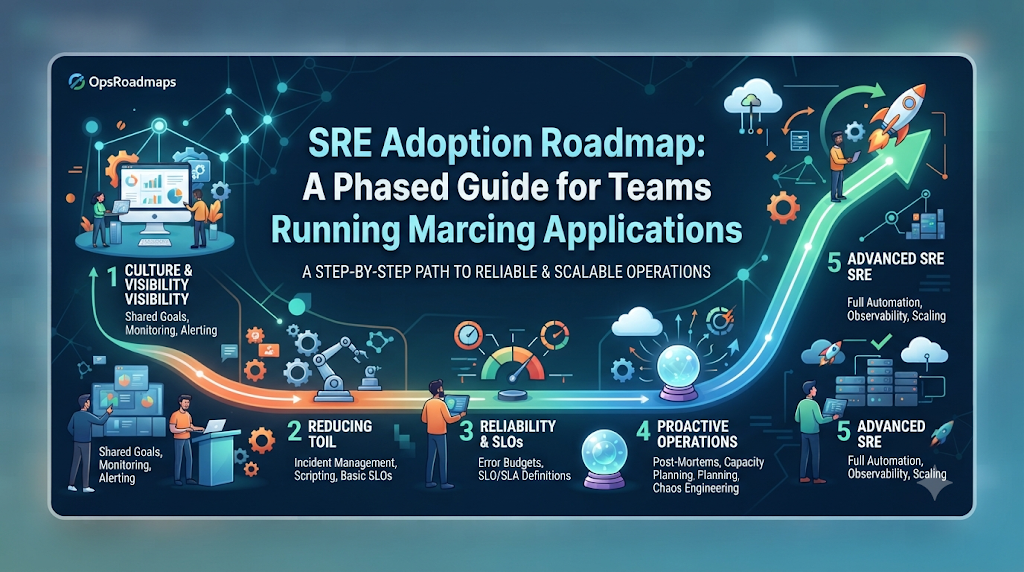
This article lays out a practical SRE adoption roadmap in five phases. For each phase, you will find the goal, the main activities, and the evidence that shows the phase is done. The guide is written for engineers, managers, and technology leaders. It uses plain language and no code, so that people from different backgrounds can follow it.
Why Market-Facing Software Is Unforgiving
Market-facing applications share a few traits that make reliability planning important:
- Uneven demand. Usage can jump at the opening of a market session or on days with major news, then fall quickly.
- Time-sensitive data. Old information can be worse than no information. A delayed alert may be wrong by the time it arrives.
- High user attention. People check these apps more often when they are worried, so problems are noticed fast.
- Many moving parts. Data feeds, databases, message queues, and web services all need to work together.
None of this means every team needs the strictest possible targets. It means the team should choose its targets on purpose, using what its users truly need.
Before You Start: Three Honest Questions
An SRE program works better when it starts from facts. Ask these questions first:
- What are we protecting? List the few user journeys that matter most, such as logging in, viewing live data, or receiving an alert.
- What happens today when something breaks? Describe the real process, even if it is messy.
- Who will own the change? Without a named owner, adoption tends to fade after a few weeks.
A short production readiness assessment of your most important service can answer the first two questions with evidence. A broader DevOps maturity assessment can show how the whole team compares across delivery, automation, and security.
The Five Phases
Phase 1: Understand Your Current State
Goal: See clearly where you are today.
Main activities:
- Map the services that support your critical user journeys.
- Note who owns each service and who responds when it fails.
- Review the last several incidents. How were they found, and how long did recovery take?
- Review basic readiness items, such as those in a Kubernetes production readiness checklist, if your workloads run on Kubernetes.
Evidence of completion: A written service list with owners, and a short summary of recent incidents.
Phase 2: Make the System Visible
Goal: Know what the system is doing without guessing.
Main activities:
- Collect core signals for every critical service: how many requests arrive, how many fail, and how long they take.
- Build one shared view that the whole team reads the same way.
- Set alerts that reflect user impact rather than technical noise.
An observability maturity model helps describe progress here. At an early stage, a team may only know whether a server is switched on. At a later stage, it can follow a single request through many services and connect alerts to what users feel.
Evidence of completion: A live view of each critical journey, plus an alert history showing that alerts are useful and not constant.
Why this phase comes second: Reliability targets in the next phase mean nothing if you cannot measure them.
Phase 3: Set Reliability Targets
Goal: Turn “reliable” into a number the team agrees on.
Main activities:
- Choose a few service-level indicators, which are simple measures such as the share of requests that succeed or respond quickly.
- Set service-level objectives, which are targets for those measures over a period of time.
- Define an error budget, which is the amount of failure the target allows.
Here is simple arithmetic to make the idea concrete. A 30-day month has 43,200 minutes. A target of 99.9% success allows about 43 minutes of failure in that month. A target of 99.5% allows about 216 minutes, which is 3.6 hours. A target of 99.99% allows only about four minutes. A tighter target gives users more reliability, but it takes more effort and money, so the right number depends on what your users truly need.
The error budget becomes a shared decision tool. When the budget is healthy, the team can release changes faster. When it is nearly used up, the team slows down and focuses on stability.
Evidence of completion: Written targets for each critical journey, agreed by engineers and product owners.
Phase 4: Prepare for Incidents
Goal: Respond calmly and quickly when things go wrong.
Main activities:
- Create an on-call schedule with a clear path for escalation.
- Write short runbooks for the most likely failures, and test them by asking someone who did not write them to follow them.
- Hold blame-free reviews after incidents to record causes and decide on changes.
An incident management maturity model can describe growth in this area. Early teams react informally. Later teams practice drills, share findings, and track whether the same problem returns.
Runbooks should cover known technical problems too. For example, Kubernetes CrashLoopBackOff troubleshooting should be a documented procedure. CrashLoopBackOff means a container keeps starting and failing. A good runbook tells the responder to read the pod’s status, events, and previous logs before making any change, and it clearly marks which actions alter production, so the person on call knows when to ask for approval.
Evidence of completion: A current on-call schedule, tested runbooks, and at least one completed incident review.
Phase 5: Review, Reduce Toil, and Expand
Goal: Keep improving, and free engineers from repetitive manual work.
Main activities:
- Track toil, the repeated manual tasks that add no lasting value, and automate the worst ones.
- Review targets and alerts regularly as the product changes.
- Extend the practice to more services in order of importance.
- Link reliability work with related programs, such as a DevSecOps implementation roadmap, a cloud cost optimization roadmap, or a platform engineering adoption roadmap.
Evidence of completion: A recurring review meeting, a toil list with progress, and an updated service list.
How the Phases Depend on Each Other
| Phase | Needs first | Unlocks |
|---|---|---|
| 1. Current state | Nothing | A shared, honest starting point |
| 2. Visibility | Service list and owners | Measurement and useful alerts |
| 3. Targets | Reliable measurements | Error budgets and clearer trade-offs |
| 4. Incident readiness | Alerts and ownership | Faster, calmer recovery |
| 5. Review and expansion | All earlier phases | Steady improvement over time |
Teams sometimes jump straight to Phase 3 and set ambitious targets they cannot measure. That usually leads to arguments and little progress. Respecting the order saves effort.
A Hypothetical Example
Imagine a small team that runs a portfolio-tracking app with live price alerts. Users complain that alerts arrive late on busy mornings. The team starts with Phase 1 and finds that two services share one database, and nobody owns it. In Phase 2, they add a view of alert delay and find that delays rise sharply when traffic peaks. In Phase 3, they agree on a target for alert delay on the busiest mornings. In Phase 4, they write a runbook for slow database responses and name an owner. Over several months, they review the target and the toil list.
The point is not that the problem disappears. The point is that the team now sees it, owns it, and can decide what to improve next.
The People Side of Adoption
Tools are the smaller part of SRE. The larger part is how people work together.
- Product and engineering share the targets. If only engineers care about reliability, trade-offs become fights.
- Blame-free reviews build honesty. People report problems earlier when they are not punished for them.
- Start small. Adopt the practice with one important service, learn from it, and then expand.
- Match the size of the change to the size of the team. A five-person team does not need the same process as a large organization.
Measuring Progress, and Its Limits
Progress can be tracked with simple signs: fewer surprise incidents, faster recovery, fewer noisy alerts, and a shrinking toil list. These are indicators, not guarantees.
A self-assessment reflects what the team reports and can prove. It is not an independent audit, a formal certification, or a promise of compliance. Where your business must meet formal requirements, an outside review is a separate step. No roadmap can promise a specific reliability outcome. It can only improve your chances and your ability to respond.
Where OpsRoadmaps Fits
OpsRoadmaps is an engineering operations assessment and improvement platform. According to its published description, it offers a free operational health scan that needs no account, plus more detailed production readiness and reliability assessments for signed-in users. It uses published, versioned scoring rules and explainable scoring, and it keeps a clear line between self-reported maturity and independent audits. Its library includes roadmaps, checklists, and runbooks, including SRE adoption guidance, which teams can use alongside the approach in this article.
Common Mistakes
- Setting targets before measuring. Targets without data are guesses.
- Chasing perfect reliability. Higher targets cost more, and some users do not need them.
- Alerting on everything. Too many alerts teach people to ignore them.
- Treating SRE as a new job title. It is a set of habits that the whole team shares.
- Skipping reviews. Targets and alerts drift out of date as the product changes.
FAQs
1. How long does an SRE adoption take?
It depends on team size and starting point. Many teams see value after the first one or two phases on a single service, and full adoption continues over time.
2. Do we need a dedicated SRE team?
Not always. Some organizations have a dedicated team, while others spread the practices across existing engineers.
3. What is the difference between an indicator and an objective?
An indicator is a measurement, such as the share of successful requests. An objective is the target you set for that measurement.
4. Can a small team use an error budget?
Yes. The idea scales down well. Even a simple budget helps a team decide when to ship and when to stabilize.
5. How is SRE different from DevOps?
They overlap. DevOps focuses on collaboration between development and operations, while SRE adds a strong emphasis on measurable reliability targets.
6. Where should we begin?
Choose one important service, write down its owners, and make its health visible. Everything else builds on that.
Conclusion
Reliability is not luck. For market-facing software, where attention peaks at the busiest moments, it is a skill that teams can build step by step. A clear SRE adoption roadmap gives that effort an order: understand where you are, make the system visible, set honest targets, prepare for incidents, and keep reviewing. Start with one service, respect the dependencies, and treat every result as a guide and not a guarantee. Steady progress will matter more than a perfect plan.