Introduction
Managing taxes is often one of the most stressful parts of running a small business or working independently. If you run a small retail shop, a digital agency, or work as an independent consultant, traditional tax accounting requires you to track every penny earned and spent. You need professional accountants, ledger books, invoices, and receipts to survive mandatory audits. For someone trying to grow a business, this paperwork feels like a massive distraction.
The Presumptive Taxation Scheme was introduced to solve this exact problem. It cuts through the red tape. By allowing eligible taxpayers to calculate their income based on a fixed statutory percentage, the government removes the burden of rigorous bookkeeping.
However, skipping paperwork does not mean ignoring the rules. While the scheme is a powerful tool for saving compliance costs, using it blindly without checking your actual profit margins can sometimes backfire. This guide breaks down how the Presumptive Taxation Scheme works, who is eligible, its major benefits, its hidden trade-offs, and how you can decide whether it is the right fit for your financial situation.
What Is the Presumptive Taxation Scheme?
At its core, the Presumptive Taxation Scheme is an alternative method of computing taxable business or professional income.
In a normal taxation system, your net taxable income is calculated using a simple formula:
Net Taxable Income=Total Gross Receipts−Allowed Business Expenses
Proving every expense requires keeping detailed bills, vouchers, and ledger accounts. Under the Presumptive Taxation Scheme, the law bypasses actual expense tracking entirely. Instead, the tax department states:
“We assume your business expenses equal a fixed percentage of your revenue. You only need to pay tax on the remaining balance, regardless of how much you actually spent.”
Professional Term Breakdown
- Gross Receipts: Simple meaning — The total amount of money collected from your customers or clients before deducting any expenses. Why it matters — This is the baseline figure used to calculate your presumptive income. Example — If your freelance writing clients paid you a total of $40,000 this year, your gross receipts are $40,000.
- Books of Accounts: Simple meaning — Formal financial ledgers and records tracking day-to-day business transactions. Why it matters — Maintaining them is legally mandatory for businesses, but presumptive schemes exempt you from this chore.
- Tax Audit: Simple meaning — A formal examination of financial records by a qualified chartered accountant. Why it matters — It is expensive and time-consuming; presumptive taxation helps small earners bypass it.
How the Presumptive Taxation Scheme Works
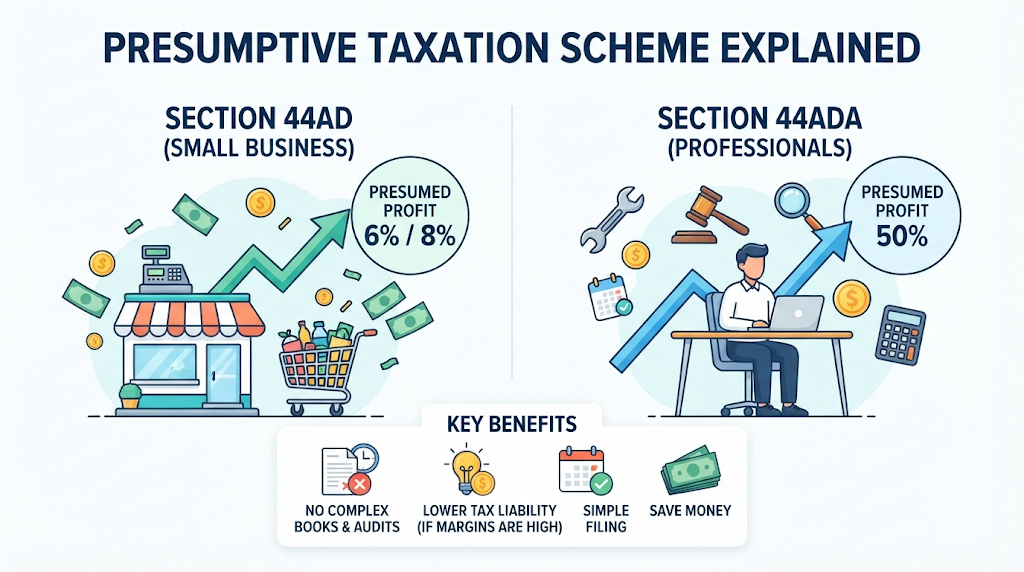
The mechanism relies on statutory sections under tax regulations (such as Section 44AD for businesses and Section 44ADA for specified professionals). Depending on your category, a minimum profit rate is legally presumed.
1. For Small Businesses (Section 44AD)
If you operate an eligible business, the law presumes your net profit is a minimum of 8% (or 6% for digital transactions received via banking channels) of your total turnover or gross receipts.
- Example: If your retail shop generates $100,000 in gross sales, and 100% of your payments are received digitally, the government presumes your net taxable profit is 6% of $100,000, which equals $6,000. You pay tax only on this $6,000, even if your actual expenses were very low and your real profit was $20,000.
2. For Professionals (Section 44ADA)
If you practice a notified profession—such as engineering, legal, medical, accounting, interior decoration, or technical consulting—the rules differ slightly. The law presumes your net profit is a minimum of 50% of your gross professional receipts, provided your total gross receipts do not cross a specified threshold limit.
- Example: If you work as an independent graphic designer and earn $50,000 in gross fees, your presumed taxable income is 50% of $50,000, which equals $25,000.
Why the Scheme Matters: The Core Benefits
The Presumptive Taxation Scheme offers several distinct operational and financial advantages for small-scale earners.
- Exemption from Bookkeeping: You are legally excused from maintaining detailed ledger books, cash books, and journal entries.
- No Mandatory Tax Audits: You save thousands of dollars in professional audit fees because you do not need a chartered accountant to certify complex accounts.
- Lower Effective Tax Outflow: If your actual profit margins are higher than the presumed rate (e.g., a digital consultant with near-zero overhead expenses), you still only pay tax on the lower presumptive percentage.
- Reduced Compliance Stress: Filing taxes becomes a straightforward exercise rather than a painstaking accounting audit.
Important Eligibility Rules and Turnover Limits
You cannot simply opt into this scheme regardless of your business scale or structure. Strict boundaries govern who can use it.
| Category | Applicable Section | Maximum Turnover / Gross Receipt Limit | Presumed Profit Rate |
|---|---|---|---|
| Small Businesses | Section 44AD | Up to specified statutory limits (often enhanced if cash transactions are minimal) | 6% (Digital) / 8% (Cash) |
| Eligible Professionals | Section 44ADA | Up to specified statutory limits for service professionals | 50% |
| Goods Carriage Owners | Section 44AE | Based on the number of heavy or light goods vehicles owned | Fixed amount per vehicle per month |
When Should You NOT Use Presumptive Taxation?
While the scheme sounds attractive, it is not universally beneficial. You should think twice before opting for it in specific scenarios:
- When Your Actual Profit Is Lower Than the Presumed Rate: If your business suffered heavy losses or your actual profit margin is lower than 6% or 50%, presumptive taxation can penalize you. Under the scheme, you must declare income at or above the statutory minimum rate. You cannot declare a lower profit unless you maintain regular books of accounts and undergo an audit.
- When You Want to Carry Forward Business Losses: If your business incurred a net loss in a financial year, opting for presumptive taxation generally restricts your ability to carry forward that loss to offset future profits.
- When Scaling Rapidly Requires Formal Financial Statements: Banks, venture capitalists, and institutional lenders prefer audited financial statements and formal books of accounts when evaluating business loans for large expansions. Lack of formal books can complicate credit approvals.
Common Mistakes Beginners Make
- Mixing Up Cash and Digital Receipts: Applying the 8% cash rate to digital transactions instead of taking advantage of the lower 6% rate for digital/bank-channel receipts. Always segregate your cash and digital inflows.
- Ignoring Turnover Thresholds: Assuming the scheme applies indefinitely even after your business gross receipts cross statutory revenue ceilings.
- Failing to Declare Higher Actual Profits: Believing that because the law presumes a profit rate, you cannot declare a higher profit if your actual earnings were greater. You are legally allowed (and required) to report higher income if your real earnings exceed the presumptive floor.
- Opting In and Out Too Frequently: Some tax jurisdictions impose “cooling-off” periods if you opt out of presumptive taxation after choosing it, making it illegal to switch back for a set number of years. Always check local jurisdictional rules before switching.
Decision-Making Framework: Is It Right for You?
Use this step-by-step checklist to evaluate whether you should choose the Presumptive Taxation Scheme:
- Calculate Your Gross Revenue: Estimate your total annual earnings to confirm they fall below the statutory turnover ceiling.
- Analyze Your Real Expenses: Calculate your true operational expenses. If your actual expenses are very low (common in freelance writing, design, or coding), presumptive taxation yields significant tax savings because you pay tax on only a fraction of your revenue.
- Check Loss Status: Confirm whether your business incurred losses this year. If you are in a loss-making phase, stay away from presumptive taxation.
- Evaluate Administrative Bandwidth: Ask yourself if you have the time and budget to maintain formal books of accounts. If bookkeeping drains your energy, presumptive taxation provides immediate relief.
- Consult a Tax Professional: Before filing, run your numbers past a certified tax advisor to ensure no local cooling-off restrictions apply to your filing history.
Key Terms
- Turnover: The total net sales or gross revenue generated by a business over a financial period.
- Compliance Cost: The time, effort, and money spent meeting legal, accounting, and tax filing requirements.
- Gross Receipts: Total cash and digital inflows received from clients or customers before any deductions.
- Audit Exemption: A legal waiver releasing a taxpayer from the obligation of getting their accounts examined by a certified auditor.
- Statutory Rate: A fixed percentage mandated by law to calculate specific financial obligations or income metrics.
FAQs
Can freelancers use the Presumptive Taxation Scheme?
Yes. Specified professionals like software developers, consultants, designers, engineers, and accountants can use Section 44ADA, provided their gross receipts remain within the legal threshold limit.
What happens if my actual profit is lower than the presumed percentage?
If your actual profit is lower than the statutory rate (e.g., 50% for professionals), you cannot declare the lower figure under presumptive rules unless you maintain formal books of accounts and undergo a regular tax audit.
Do I need to keep expense receipts if I choose presumptive taxation?
No. Since the scheme assumes your expenses automatically based on a fixed percentage, you are not legally required to track, file, or present day-to-day expense vouchers.
Can I claim deductions for home office expenses or depreciation separately?
No. All eligible deductions for business expenses, depreciation on assets, and operational costs are deemed to have been accounted for within the statutory presumptive profit rate.
Is Goods and Services Tax (GST) compliance affected by presumptive income?
Presumptive taxation only applies to your income tax calculations. It has no direct connection to GST rules; if your turnover crosses GST registration thresholds, you must still collect, file, and pay GST separately.
Can a partnership firm opt for presumptive taxation?
Partnership firms (excluding LLPs for certain sections) can opt for presumptive taxation under Section 44AD, and they can also deduct partner salary and interest payments within permissible statutory limits from that presumed income.
Conclusion
The Presumptive Taxation Scheme bridges the gap between legal tax compliance and administrative sanity for small business owners and independent professionals. By trading complex ledger bookkeeping for a flat percentage calculation, it saves time, minimizes professional fees, and simplifies tax season.
However, it is not a universal shortcut. Before opting in, calculate your true profit margins, check your loss status, and verify your gross revenue limits. When used with a clear understanding of its trade-offs, presumptive taxation transforms a stressful annual chore into a streamlined, cost-effective routine.