Walk onto any financial news channel or open a stock brokerage app in India, and you will immediately see companies grouped by their “market cap.” A stock trading at ₹3,500 per share might actually be much smaller as a business than a company whose shares trade at ₹400. Share price alone tells you almost nothing about how big a company really is.
To measure a publicly traded company’s actual size in the stock market, investors look at market capitalisation. Understanding this single metric helps you judge company scale, compare businesses within the same sector, and balance risk across your investment portfolio.
Understanding Market Capitalisation in Plain Terms
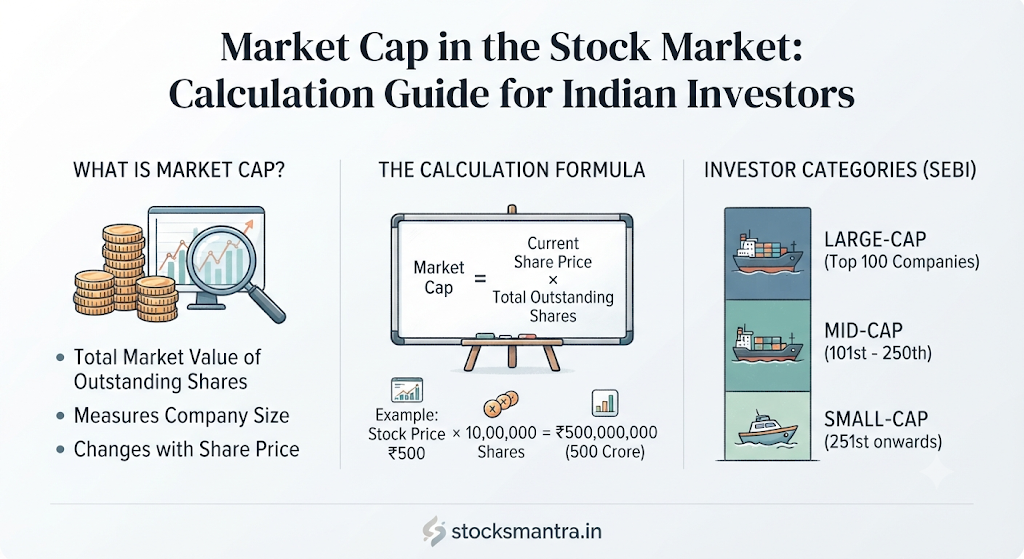
Market capitalisation—commonly shortened to market cap—is the total market value of a publicly listed company’s outstanding shares. In simple words, it represents what the stock market currently estimates the entire equity of a company to be worth.
Because share prices fluctuate every second during trading hours on exchanges like the National Stock Exchange (NSE) and the Bombay Stock Exchange (BSE), a company’s market capitalisation changes constantly throughout the trading day.
Investors use this figure as a quick yardstick to gauge company size rather than relying on revenue or asset figures, which only update once every quarter.
The Market Capitalisation Formula (With an Example)
Calculating market capitalisation requires only two numbers, both of which are publicly available on stock exchange websites and financial portals.
$$\text{Market Capitalisation} = \text{Current Market Price per Share} \times \text{Total Number of Outstanding Shares}$$
Breaking Down the Two Components
- Current Market Price per Share: The price at which the stock is currently trading on the exchange.
- Total Number of Outstanding Shares: The total number of shares currently held by all shareholders, including promoters, institutional investors, and retail public investors. (This excludes shares the company has bought back and held in its treasury.)
A Step-by-Step Calculation Example
Suppose Company A, listed on the NSE, has 50 crore (500 million) outstanding shares. If the stock is currently trading at ₹300 per share, its market capitalisation is calculated as:
$$\text{Market Cap} = ₹300 \times 50,00,00,000 = ₹15,000\text{ Crore}$$
Now consider Company B in the same industry, trading at ₹1,500 per share—five times higher than Company A’s stock price. However, Company B only has 4 crore (40 million) outstanding shares:
$$\text{Market Cap} = ₹1,500 \times 4,00,00,000 = ₹6,000\text{ Crore}$$
Even though Company B has a much higher share price, Company A is two-and-a-half times larger in total market value. This is why experienced investors never judge whether a stock is “cheap” or “expensive” based solely on its share price.
Full Market Cap vs. Free-Float Market Cap
When looking up stock data in India, you will often see two variations of market capitalisation: Full Market Cap and Free-Float Market Cap.
| Feature | Full Market Capitalisation | Free-Float Market Capitalisation |
| Shares Included | All outstanding shares (promoters, government, locked-in shares, and public). | Only shares readily available for public trading in the open market. |
| Promoter Holdings | Included in the calculation. | Excluded from the calculation. |
| Primary Use Case | Measuring total company size and SEBI cap classification. | Calculating stock market index weights (such as Nifty 50 and BSE Sensex). |
Major Indian benchmark indices like the Nifty 50 and BSE Sensex use the free-float methodology. If a company has a ₹1,00,000 crore full market cap, but 75% of its shares are held by promoters and locked away from daily trading, only the remaining 25% (₹25,000 crore) counts toward its index weightage. This ensures that indices reflect actual tradable liquidity in the market.
How SEBI Classifies Large-Cap, Mid-Cap, and Small-Cap Stocks
In India, the Securities and Exchange Board of India (SEBI) defines market cap categories strictly by company rank rather than fixed rupee thresholds. Because overall stock market values grow over time, fixed rupee limits would quickly become outdated.
Under SEBI’s mutual fund categorization framework (maintained by the Association of Mutual Funds in India, or AMFI, and updated every six months):
- Large-Cap Companies: Ranked 1st to 100th in terms of full market capitalisation. These are established industry leaders with strong balance sheets, steady cash flows, and lower daily volatility.
- Mid-Cap Companies: Ranked 101st to 250th in terms of full market capitalisation. These businesses are generally in a growth phase—more agile than large-caps, carrying higher growth potential alongside moderate-to-high risk.
- Small-Cap Companies: Ranked 251st and beyond in terms of full market capitalisation. These include emerging businesses and niche players. While they offer substantial long-term upside if they scale well, they are vulnerable to sharp price swings and economic downturns.
Factors That Cause Market Capitalisation to Change
A company’s market cap is dynamic and shifts due to two primary drivers:
- Daily Share Price Movements: Earnings reports, interest rate decisions, sector news, and shifts in investor sentiment push share prices up or down every second, immediately altering market cap.
- Corporate Actions Affecting Share Count: If a company issues new shares through a Follow-on Public Offer (FPO) or converts warrants into equity, the total share count rises. Conversely, if a company executes a share buyback, the total number of outstanding shares decreases.
Note on Stock Splits and Bonus Issues: A stock split or bonus share issue increases the number of shares while proportionally reducing the share price. Because both changes offset each other, a stock split or bonus issue does not directly change a company’s market capitalisation.
Common Misconceptions About Market Capitalisation
New investors frequently misinterpret what market cap actually measures. Keeping these distinctions clear prevents costly analytical mistakes:
- Market Cap Is Not the Cost to Buy the Company: If an acquirer wanted to buy 100% of a business, paying the current market cap wouldn’t be enough. Acquirers must also take on the company’s debt (while factoring in its cash reserves) and usually pay a takeover premium to convince existing shareholders to sell. For buyout valuations, analysts use Enterprise Value (EV) instead.
- Market Cap Does Not Equal Book Value or Revenue: Market cap reflects investor expectations about future profits, not the accounting value of assets on the balance sheet. A fast-growing technology company can have a higher market cap than a traditional manufacturing firm with ten times the physical assets.
- A Larger Market Cap Does Not Guarantee Safety: While large-cap companies are generally more stable than small-caps, high market capitalisation does not make a business immune to poor management, industry disruption, or overvaluation.
Frequently Asked Questions
Can a company’s market capitalisation ever be zero?
No, not while it remains actively listed and traded on a stock exchange. Even if a company faces severe financial distress, its shares will trade at a minimal fraction of a rupee until trading is suspended or the company is formally delisted.
Does paying dividends reduce a company’s market cap?
Technically, yes, on the ex-dividend date. When a company pays out cash dividends, that cash leaves the company’s balance sheet, and the share price typically adjusts downward by roughly the dividend amount on the ex-dividend date, lowering the market cap slightly.
Where can I check the market cap of Indian stocks?
You can find real-time full and free-float market capitalisation figures directly on the official websites of the NSE (nseindia.com) and BSE (bseindia.com) under each company’s stock quote page, as well as on SEBI-registered brokerage platforms.
Why do mutual funds follow AMFI’s six-month market cap list?
SEBI mandates that equity mutual funds stick to their stated investment mandate (for example, a Large-Cap Fund must invest at least 80% of its assets in the top 100 companies). AMFI updates the list every January and July based on the previous six months’ average market cap so fund managers maintain consistent portfolio classifications.
Putting Market Capitalisation Into Practice
Market capitalisation gives you a clear lens to look past misleading share prices and see a company’s true scale in the stock market. By multiplying the current share price by the total number of outstanding shares, you can immediately compare peers in the same sector and understand where a business sits on SEBI’s large-cap, mid-cap, or small-cap spectrum. While market cap alone will not tell you whether a stock is undervalued or financially healthy, pairing it with fundamental metrics like earnings growth, debt levels, and cash flow helps you build a balanced portfolio aligned with your risk tolerance.