Artificial intelligence has officially transitioned from a futuristic experimental concept into the core operational engine of modern global commerce. Across industries, organizations are restructuring their workflows, optimizing logistics, automating customer experiences, and redesigning products around intelligent systems. However, this rapid technological shift has created a significant challenge: a widening gap between the speed of AI innovation and the availability of qualified talent, structured guidance, and enterprise-ready strategies.
Professionals find themselves trying to keep pace with a fast-moving ecosystem, while businesses struggle to implement AI securely, efficiently, and at scale. Navigating this environment requires more than occasional online tutorials or scattered reading materials; it demands a unified, reliable approach to knowledge acquisition and implementation.
This is where AIUniverse steps in. Designed as a comprehensive ecosystem, AIUniverse bridges the divide between theoretical knowledge and practical execution. By offering structured learning paths, professional certifications, corporate training, consulting, and deep technology resources, the platform supports individuals, developers, and enterprises as they build their future in an AI-driven world.
The conversation around artificial intelligence is no longer restricted to research laboratories or specialized engineering departments. Today, artificial intelligence touches nearly every professional discipline, from marketing and finance to software architecture and executive leadership.
As automation and digital transformation accelerate, organizations are investing heavily in intelligent systems to remain competitive. Yet, technology alone is not enough. The success of any AI initiative depends entirely on the people behind it. Professionals who understand how to work alongside intelligent systems, manage automated workflows, and interpret data-driven insights are becoming indispensable.
At the same time, the sheer speed of development makes continuous learning non-negotiable. Algorithms evolve, deployment methodologies shift, and operational standards mature. Without a structured approach to education, professionals risk obsolescence, and businesses risk misallocating resources into poorly planned technology investments. True competence requires a steady foundation, practical exposure, and an understanding of how to move from basic concepts to production-grade implementation.
What is AIUniverse?
AIUniverse was created to solve the fragmentation inherent in modern technology education and enterprise adoption. Rather than treating education, business strategy, and technical resources as isolated silos, the platform integrates them into a cohesive ecosystem.
Vision and Purpose
The fundamental vision of AIUniverse is to make advanced artificial intelligence knowledge accessible, structured, and actionable for everyone, from absolute beginners to enterprise leaders. The platform was developed to address common industry pain points: the lack of clear learning roadmaps, the scarcity of practical training for emerging fields like MLOps and Agentic AI, and the difficulty organizations face when attempting to align technology investments with actual business needs.
Core Ecosystem
The AIUniverse ecosystem is built around several interconnected pillars:
Structured Education: Providing clear learning roadmaps and certification programs that cover foundational concepts through advanced operational frameworks.
Enterprise Transformation: Helping organizations design AI strategies, upskill workforce capabilities, and integrate intelligent systems securely.
Consulting Support: Assisting businesses in evaluating readiness, planning deployment architectures, and navigating governance challenges.
Knowledge Sharing: Curating technology resources, tool comparisons, and implementation guides that empower practitioners to stay informed.
By unifying these elements, AIUniverse serves as a centralized hub where individuals can build careers and enterprises can execute sustainable digital transformations.
Who Should Use AIUniverse?
The AIUniverse platform is designed to accommodate a diverse spectrum of learners and organizations, ensuring that every participant finds relevant, high-value guidance tailored to their specific responsibilities.
Students and Beginners
Entering the world of artificial intelligence can feel overwhelming due to complex terminology and rapidly shifting frameworks. AIUniverse helps those starting their AI journey by providing structured learning paths that demystify foundational concepts. Beginners receive clear guidance on where to start, how to build core competencies step-by-step, and how to avoid getting lost in advanced theories before mastering the basics.
Developers and Software Engineers
For software professionals looking to expand their skill sets, the platform offers pathways to explore modern AI technologies, practical implementations, and specialized engineering concepts. Developers can access resources that explain how to integrate intelligent capabilities into applications, manage data pipelines, and pursue recognized credentials, including Agentic AI certification courses, MLOps certification course options, and AIOps certification course programs.
Data Scientists, ML Engineers, and AI Professionals
Experienced practitioners require more than introductory material; they need deep, technical insights into production environments, lifecycle management, and advanced systems. AIUniverse supports these professionals by focusing on scalable machine learning operations, automated IT operations, and complex agentic workflows. This helps practitioners strengthen their expertise and align their technical skills with modern industry standards.
Businesses, Startups, and Enterprise Teams
Organizations face unique hurdles when moving from experimentation to enterprise-wide AI deployment. AIUniverse helps companies navigate these challenges through tailored corporate AI training, workforce upskilling frameworks, and strategic guidance. Businesses can leverage these offerings to ensure their teams share a unified understanding of AI capabilities, security requirements, and operational best practices.
Technology Leaders and Decision Makers
CTOs, IT directors, product managers, and executive leaders need high-level clarity rather than raw code. AIUniverse equips decision-makers with the insights required to evaluate AI strategy, understand governance frameworks, plan long-term technology roadmaps, and assess return on investment without getting bogged down in technical minutiae.
Researchers and Continuous Learners
For educators, independent researchers, and technology enthusiasts who want to remain at the leading edge of innovation, AIUniverse provides curated insights, tool breakdowns, and industry trends. The platform serves as a reliable reference point for monitoring how the technology landscape evolves over time.
AIUniverse Ecosystem
The strength of AIUniverse lies in its comprehensive ecosystem, where each component reinforces the others to create a well-rounded educational and operational environment.
AI Certification Programs
Structured credentials validate competence and provide clear milestones for professional growth. AIUniverse offers specialized programs designed around contemporary industry demands, including rigorous AI certification courses online. These programs cover specialized domains such as Agentic AI certification course modules, MLOps certification course tracks, and AIOps certification course curricula, ensuring learners acquire verified, high-demand skills.
Corporate AI Training and AI Consulting
Organizations often struggle not with acquiring technology, but with preparing their workforce to utilize it effectively. AIUniverse addresses this through structured corporate AI training initiatives and specialized AI consulting services. These programs help companies evaluate their internal readiness, design custom upskilling programs, and implement intelligent workflows that align with their corporate goals.
AI Learning Resources and Practical Knowledge
Theoretical understanding alone is insufficient for modern technology roles. The platform offers curated learning paths, tutorials, and implementation guides. These resources are designed to help users move beyond abstract concepts and understand how systems function in real-world operational environments.
AI Tools, Comparisons, and Research
Navigating the vast market of software solutions can be challenging for both developers and business leaders. AIUniverse provides objective evaluations and comparisons to help users identify the right solutions for their needs. This includes exploring the best prompt management tools, understanding various federated learning platforms, evaluating the best MLOps tools, and identifying the best AI tools for business integration.
Enterprise AI Adoption and Best Practices
Successful deployment requires careful attention to strategy, security, and governance. The platform offers deep dives into enterprise adoption frameworks, helping organizations establish responsible AI practices, protect sensitive data, maintain operational transparency, and scale automation safely across departments.
Continuous Learning and Future AI Trends
Because the technology sector never stands still, AIUniverse emphasizes continuous skill development. The platform ensures that its community stays updated with emerging paradigms, shifting industry standards, and forward-looking methodologies.
How AIUniverse Supports Different Learning Goals
Every learner approaches the platform with unique objectives. Whether an individual wants to master a specific operational discipline or build a broad foundation, AIUniverse provides targeted support.
For those focusing on fundamentals, the platform breaks down complex mathematics and computer science principles into digestible concepts. For engineers aiming to build production-ready systems, AIUniverse emphasizes software reliability, model deployment, and scaling strategies.
Operations professionals benefit from dedicated materials covering MLOps and AIOps, which teach how to monitor, maintain, and automate machine learning models and IT infrastructure efficiently. Meanwhile, those exploring autonomous systems can dive into specialized Agentic AI resources, understanding how multi-agent architectures operate and coordinate tasks in complex environments.
AIUniverse for Businesses
Enterprise adoption requires a strategic approach that balances innovation with risk management. AIUniverse provides comprehensive support for organizations undergoing digital transformation.
Corporate AI Training and Workforce Upskilling
Internal resistance and skill gaps are primary reasons digital initiatives fail. Through structured corporate AI training, companies can systematically upskill their workforce, ensuring that employees across departments understand how to leverage intelligent automation safely and effectively.
AI Readiness and Strategic Planning
Before deploying complex systems, organizations must evaluate their data infrastructure, security protocols, and operational workflows. AIUniverse helps business leaders assess their AI readiness, design realistic transformation roadmaps, and integrate technologies in a manner that delivers measurable value.
Consulting and Advisory Support
Navigating vendor selection, ethical compliance, and architecture design requires experienced guidance. The platform’s advisory resources help organizations make informed decisions, avoiding costly pitfalls and accelerating time-to-value for their technology investments.
AIUniverse for Developers
Software engineering in the age of intelligence requires mastery of new tools, deployment pipelines, and operational paradigms. AIUniverse provides developers with the resources needed to transition from traditional software development to intelligent system engineering.
Through practical learning pathways and structured AI certification courses online, developers learn how to manage model lifecycles, integrate machine learning services into existing codebases, and maintain high system performance. By focusing on production-grade concepts, the platform ensures that developers are prepared to build resilient applications that can withstand the demands of enterprise environments.
AIUniverse for Technology Leaders
For CTOs, CIOs, and engineering directors, the primary challenge is alignment—ensuring that technology investments support long-term business strategy while maintaining security and governance.
AIUniverse provides technology leaders with the strategic insights needed to evaluate architecture proposals, oversee workforce development, and establish internal governance policies. By maintaining a focus on enterprise-grade security, scalability, and ethical implementation, the platform helps leaders steer their organizations toward sustainable, long-term success.
AIUniverse Knowledge Hub
A vital component of the platform is its extensive knowledge hub, designed to help practitioners make sense of the crowded software and tool marketplace.
Tool Comparisons: Detailed breakdowns help teams evaluate the best MLOps tools and identify the best AI tools for business deployment.
Specialized Guides: Comprehensive resources cover essential operational components, such as evaluating the best prompt management tools for generative workflows and exploring secure federated learning platforms for privacy-preserving data collaboration.
Research and Implementation: Regular updates provide technical articles and practical implementation guides that translate academic research into actionable business practices.
Step-by-Step Guide to Getting Started with AIUniverse
Embarking on an educational or enterprise transformation journey is most effective when approached methodically. Follow this structured roadmap to maximize your experience with AIUniverse:
Identify Your Learning Objective: Determine whether your primary goal is personal skill development, developer upskilling, or enterprise transformation.
Explore Suitable AI Certifications: Review available programs, including the Agentic AI certification course, MLOps certification course, and AIOps certification course tracks, to find credentials matching your career goals.
Build Practical Skills: Engage with foundational materials and hands-on learning resources to bridge the gap between theory and execution.
Complete Practical Modules: Work through structured projects and implementation guides to reinforce your understanding of real-world scenarios.
Explore Technology Resources: Utilize tool comparisons, such as guides on the best prompt management tools and best MLOps tools, to understand current industry standards.
Expand Into Advanced Topics: Progress toward specialized enterprise domains, governance frameworks, and automated operations.
Apply Knowledge in Professional Settings: Implement learned best practices within your projects, team workflows, or organizational strategy.
Continue Learning: Regularly revisit the platform’s updated resources to stay aligned with emerging industry trends and technological advancements.
Common Mistakes to Avoid
When learning artificial intelligence or attempting enterprise adoption, certain pitfalls frequently derail progress. Being aware of these mistakes helps ensure a smoother journey:
Learning Only Theory: Memorizing mathematical formulas without understanding practical implementation leads to a severe skills gap in real-world environments.
Choosing Tools Randomly: Adopting software without evaluating organizational needs or compatibility often results in wasted resources and technical debt.
Skipping Structured Paths: Jumping randomly between advanced topics without mastering foundational concepts creates confusion and weakens long-term competence.
Ignoring Governance and Security: Implementing automated systems without robust compliance, data privacy, and ethical guidelines exposes organizations to significant risk.
Overlooking Production Concepts: Focusing solely on prototype creation while ignoring deployment, monitoring, and MLOps principles prevents systems from scaling successfully.
Stagnating Skill Development: Treating AI education as a one-time event rather than a continuous process leaves professionals vulnerable to rapid industry changes.
Best Practices for Learning and Implementing AI
To achieve long-term success with artificial intelligence, adopt these proven practices:
Build a Structured Roadmap: Follow a clear educational or strategic sequence that moves logically from fundamentals to advanced applications.
Practice Regularly: Combine conceptual study with hands-on application to reinforce technical understanding.
Prioritize Production Readiness: Always design systems and workflows with scalability, monitoring, and maintenance in mind from day one.
Embrace Continuous Learning: Stay curious, monitor industry shifts, and regularly update your knowledge base through reliable resources.
Maintain Responsible Standards: Incorporate ethical considerations, data privacy, and robust governance into every deployment and strategy decision.
AIUniverse Resources and Capabilities Overview
AIUniverse Resource
Purpose
Primary Users
Practical Benefit
Structured Certifications
Validate technical competence in specialized domains
Developers, ML Engineers, Professionals
Verified credentials and structured skill mastery
Corporate Training
Align team capabilities with business automation goals
Enterprise Teams, Business Leaders
Unified workforce upskilling and readiness
Technology Comparisons
Evaluate software, platforms, and operational tools
CTOs, Developers, Decision Makers
Informed tool selection and reduced technical debt
Consulting Services
Guide strategic planning and enterprise deployment
Organizations, Executives
Tailored roadmaps and risk mitigation
Mapping Learning Goals to AIUniverse Solutions
Learning Goal
Recommended AIUniverse Resource
Expected Outcome
Mastering Advanced Operations
MLOps and AIOps Certification Tracks
Ability to build, monitor, and scale production AI pipelines
Enterprise Workforce Transformation
Corporate Training and Advisory Services
A skilled, aligned team capable of safely executing AI projects
Evaluating Software and Infrastructure
Tool Comparisons and Technology Guides
Clear understanding of the best MLOps tools and platforms
Mastering Autonomous Workflows
Agentic AI Certification Course
Deep expertise in multi-agent system design and coordination
Key Benefits of AIUniverse
Centralized, all-in-one ecosystem for education, consulting, and resources
Industry-aligned certification programs covering modern specializations
Practical, action-oriented learning paths for individuals and teams
Comprehensive corporate training and strategic advisory for businesses
Objective technology comparisons, including insights into the best AI tools for business
Continuous updates ensuring alignment with emerging industry standards
Support for a diverse audience ranging from beginners to enterprise executives
Frequently Asked Questions (FAQs)
What is AIUniverse?
AIUniverse is a comprehensive ecosystem designed to support individuals, developers, and enterprises through structured learning, professional certifications, corporate training, consulting, and technology resources.
Who should use AIUniverse?
The platform is built for students, software developers, data scientists, business leaders, enterprise teams, and researchers looking to deepen their AI expertise or guide organizational adoption.
What is an Agentic AI certification course?
It is a specialized educational program focused on teaching learners how to design, build, and deploy multi-agent autonomous systems capable of executing complex, multi-step workflows.
What is an MLOps certification course?
This course focuses on machine learning operations, teaching practitioners how to manage the complete lifecycle of machine learning models from development to production deployment and monitoring.
What is an AIOps certification course?
An AIOps program teaches IT and engineering professionals how to apply artificial intelligence and machine learning to automate IT operations, incident management, and infrastructure monitoring.
How does Corporate AI Training help organizations?
Corporate training helps companies upskill their workforce, bridge internal knowledge gaps, and ensure that employees across departments understand how to leverage intelligent systems securely and effectively.
What industries can benefit from AIUniverse?
Virtually every modern industry, including finance, healthcare, retail, manufacturing, software development, and logistics, can benefit from the platform’s educational and strategic resources.
Does AIUniverse offer consulting services?
Yes, the platform provides advisory and consulting support to help businesses evaluate their AI readiness, design deployment architectures, and navigate complex transformation strategies.
How can beginners start learning AI?
Beginners can start by exploring foundational learning pathways on AIUniverse that break down complex concepts into structured, manageable steps without requiring advanced prior knowledge.
Why is structured AI learning important?
Structured learning prevents the confusion caused by scattered tutorials, ensures a strong grasp of fundamentals before advancing to complex topics, and provides a clear roadmap for professional growth.
Conclusion
The artificial intelligence revolution is reshaping how the world works, builds, and solves problems. Success in this new era requires more than curiosity; it demands structured education, strategic foresight, and practical execution capabilities. Whether you are an individual looking to build a future-proof career, a developer mastering production operations, or an enterprise leader steering an organization through digital transformation, having a reliable partner makes all the difference.
AIUniverse provides the roadmap, resources, and community needed to navigate this complex landscape with confidence. By combining rigorous certifications, corporate training, consulting, and deep technology insights, the platform empowers everyone to move forward productively. Explore structured AI learning pathways today and take your next step toward mastering artificial intelligence.
Starting an export business can be exciting, but GST requirements often confuse new exporters, freelancers, consultants, manufacturers, and service providers. One important decision is whether to export after paying IGST or furnish a Letter of Undertaking and export without paying IGST. A filing mistake can affect invoices, working capital, refund claims, and compliance records. This GST LUT Filing Guide for Exporters explains the process in simple language, including eligibility, documents, portal steps, invoice wording, export timelines, and record management. It is designed to help beginners understand their responsibilities, avoid rushed decisions, and develop a practical compliance system instead of depending on incomplete social media advice.
Understanding GST LUT Filing in Simple Words
What Is a GST LUT?
LUT stands for Letter of Undertaking. Under the GST system, it is an undertaking furnished by an eligible registered person who wants to export goods or services without paying Integrated Goods and Services Tax at the time of supply.
Exports and certain supplies to Special Economic Zone units or developers are treated as zero-rated supplies under the IGST framework. A registered person making eligible zero-rated supplies may generally claim eligible benefits through the route permitted under the applicable law.
The LUT is furnished electronically in Form GST RFD-11 on the GST portal. The official GST portal guidance states that registered taxpayers making zero-rated supplies of goods or services must furnish the LUT before making such supplies when using the export-without-tax-payment route.
How Does the LUT Route Work?
Under the LUT route, the exporter:
Furnishes Form GST RFD-11.
Receives a LUT reference number.
Issues an export invoice with the required endorsement.
Exports the goods or services without charging IGST.
Reports the transaction correctly in GST returns.
Maintains export and payment-realisation records.
Claims eligible refund of unutilised input tax credit separately, where applicable.
Rule 96A requires a registered person using the export-without-IGST option to furnish a bond or LUT before export and comply with the prescribed export or payment-realisation conditions.
Beginner-Friendly Example
Suppose an Indian software consultant provides development services to a company located outside India. The consultant is GST-registered and the transaction meets the conditions for export of services.
After furnishing a valid LUT, the consultant may issue an export invoice without charging IGST. The invoice, foreign remittance record, contract, bank documents, GST returns, and LUT acknowledgement should all be maintained together.
Common Misunderstanding
A common misunderstanding is that LUT filing removes every GST responsibility.
It does not.
The LUT only supports the permitted export-without-payment-of-IGST route. The exporter must still:
Issue a valid tax invoice.
Report the supply in GST returns.
Maintain supporting documents.
Satisfy export conditions.
Track payment realisation for services.
Reconcile turnover and refund records.
Renew the LUT when required.
Practical Takeaway
Think of the LUT as one part of a complete export compliance process. It does not replace invoice discipline, return filing, foreign-remittance evidence, customs records, or professional review.
Why GST LUT Filing Is Important
Protecting Working Capital
Without the LUT route, an exporter following the tax-payment route may have to arrange funds for IGST and later complete the applicable refund process.
For a small exporter, blocking money in taxes and waiting for a refund may create pressure on:
Salaries
Vendor payments
Inventory purchases
Freight expenses
Software subscriptions
Business expansion
Daily operating costs
Exporting under LUT can reduce the immediate tax-payment burden, subject to eligibility and compliance.
Supporting Zero-Rated Export Treatment
Zero-rated treatment is intended to prevent eligible exports from carrying the burden of domestic indirect tax, while preserving the ability to claim eligible input tax credit under the applicable conditions.
A LUT helps connect the exporter’s invoice and return reporting with the export-without-payment-of-IGST option.
Improving Invoice Accuracy
A valid LUT helps the exporter follow a consistent invoicing process.
Export invoices under the LUT route should carry the applicable prescribed endorsement indicating that the supply is meant for export or supply to an SEZ without payment of integrated tax. Rule 46 contains invoice endorsement requirements for export and SEZ supplies.
Supporting Better Record Keeping
LUT compliance encourages exporters to organise:
Export invoices
Shipping bills
Bills of export
Contracts
Purchase orders
Foreign inward remittance records
Bank realisation documents
GST return workings
Input tax credit records
Refund applications
Reducing Avoidable Compliance Errors
A structured LUT process reduces the risk of:
Charging IGST accidentally
Using an expired LUT
Applying under the wrong financial period
Reporting exports incorrectly
Missing payment realisation
Claiming refund using incomplete records
Creating mismatches between invoices and returns
Practical Scenario
A small design agency begins serving overseas clients. It issues export invoices without IGST but forgets to furnish a LUT before the supplies.
During review, the accountant identifies that the documentation and tax treatment require correction. The agency must then examine the legal and procedural consequences with a GST professional.
A better approach would have been to complete LUT filing before issuing the first export invoice and preserve the acknowledgement in a compliance folder.
The Real Problems Exporters Face With GST LUT Filing
Lack of Basic Awareness
Many new exporters learn about LUT only after sending their first invoice. They may know that exports are zero-rated but may not understand the procedure for exporting without paying IGST.
Confusing Online Advice
Online explanations often mix together:
Export of goods
Export of services
SEZ supplies
LUT filing
Bond filing
Refund of unutilised ITC
Refund of IGST
Customs procedures
Foreign exchange requirements
These are connected subjects, but they are not identical.
Poor Timing
Some exporters furnish the LUT after beginning export supplies. Rule 96A refers to furnishing the bond or LUT before export when using the no-payment route.
Incorrect GST Portal Information
Errors may occur when entering:
Previous LUT details
Witness information
Authorised signatory details
Place of filing
Designation
Supporting documents
Taxpayer declaration
Weak Documentation
The LUT application itself may be simple, but export compliance requires more than the acknowledgement.
Exporters may fail to maintain:
Client contracts
Invoice copies
Proof of delivery
Shipping documents
Bank remittance evidence
Foreign Inward Remittance Certificates, where available or relevant
Bank Realisation Certificates, where relevant
Return reconciliation
Input tax credit workings
Unrealistic Expectations
Some exporters assume that filing LUT automatically results in a GST refund.
LUT filing and refund filing are separate processes. For eligible refund of accumulated input tax credit on exports without payment of integrated tax, the application is generally filed separately in Form GST RFD-01 through the GST portal.
Depending Only on Social Media
Short videos may demonstrate portal clicks but fail to explain:
Eligibility restrictions
Export conditions
Time limits
Invoice requirements
Foreign exchange rules
Return reporting
Refund documentation
Consequences of non-compliance
Not Knowing the Next Step
After obtaining the LUT acknowledgement, exporters often do not know how to connect it with their invoicing, GST returns, accounting software, bank records, and refund process.
The better approach is to create an end-to-end export compliance workflow.
How GST LUT Filing Works Step by Step
Step 1: Confirm GST Registration and Export Activity
First, confirm that the business has an active GST registration and is making, or intends to make, eligible zero-rated supplies. This matters because LUT is connected with GST-registered export activity, not merely with receiving an international enquiry or opening a foreign-currency account. Review the nature of supply, place-of-supply rules, customer location, payment terms, and available documents. For example, a consultant serving an overseas client should confirm whether all conditions for export of services are met. A common mistake is assuming that every invoice raised to a foreign customer is automatically an export. The better approach is to review the complete transaction before selecting the GST treatment.
Step 2: Check Whether LUT Filing Is Available
Determine whether the taxpayer is eligible to furnish an LUT instead of a bond. Eligibility can be affected by the statutory conditions and any prosecution history covered by the applicable notification or rules. Do not select LUT merely because the portal option is available. For example, a newly registered exporter with no disqualifying history may ordinarily use LUT subject to the applicable requirements. A common mistake is ignoring the declaration contained in Form GST RFD-11. The better approach is to have the authorised person and tax adviser verify eligibility before filing.
Step 3: Collect Required Information and Records
Prepare the GSTIN, legal name, trade name, address, authorised signatory details, previous LUT reference where applicable, witness details, and any supporting documents needed for internal verification or portal filing. The GST portal’s official user guide provides the online filing flow for furnishing the LUT. A common mistake is entering temporary or incorrect witness information without maintaining supporting records. The better approach is to use identifiable witnesses and retain their names, addresses, and occupations in the compliance file.
Step 4: Open the LUT Filing Service on the GST Portal
Log in to the GST portal using valid credentials. Navigate to the service for furnishing a Letter of Undertaking, select the relevant financial period, review the declarations, and enter the required details. The portal process leads to electronic submission and generation of an acknowledgement or reference number. A common mistake is selecting the wrong period or leaving an application unfinished. The better approach is to review the filing period and download the final acknowledgement immediately after successful submission.
Step 5: Complete the Declaration and Authorisation
Read each declaration carefully before filing. The authorised signatory must understand that the exporter is undertaking to comply with the export conditions and pay the applicable tax and interest if those conditions are not fulfilled. Rule 96A contains consequences where goods are not exported or payment for exported services is not received within the prescribed framework. A common mistake is treating the declaration as a routine checkbox. The better approach is to connect each declaration with a monthly monitoring process.
Step 6: File With DSC or EVC
Submit the application using the permitted authentication method, such as a Digital Signature Certificate or Electronic Verification Code, depending on the constitution and portal requirements. Verify that the filing is successful and that a reference number has been generated. A common mistake is assuming the form was filed merely because data was saved. The better approach is to check the status, download the acknowledgement, and save it in both the tax folder and the invoice-management system.
Step 7: Update the Export Invoice Format
Configure the accounting or invoicing system so that export invoices under LUT do not charge IGST and carry the correct endorsement. Also include the normal invoice particulars required under GST, such as invoice number, date, supplier details, recipient details, description, value, currency information where used, and applicable classification. A common mistake is removing the tax amount but forgetting the endorsement. The better approach is to create a dedicated “Export Under LUT” invoice template and lock it for consistent use.
Step 8: Monitor Export Completion, Payment and Returns
After filing LUT, track every export invoice until the goods leave India or the service payment is realised under the applicable requirements. Reconcile invoices with shipping bills, bank records, GST returns, turnover, and refund workings. For exported services, payment-realisation monitoring is particularly important. A common mistake is reviewing export compliance only at year-end. The better approach is to prepare a monthly export register showing invoice date, value, LUT reference, shipping or service proof, payment status, return period, and refund status.
Key Factors That Influence GST LUT Compliance
Documentation
Documentation is the foundation of export compliance. The LUT acknowledgement alone cannot prove every element of an export transaction.
Incorrect details can create inconsistencies between the LUT, invoices, GST returns, refund applications, bank evidence, and accounting books.
Always verify:
GSTIN
Legal name
Tax period
Signatory
Witness information
Previous LUT reference
Invoice treatment
Return reporting
Record Keeping
Export documents should be stored invoice-wise, not scattered between email, accounting software, banking platforms, and employee laptops.
Use a standard naming system such as:
Compliance Timing
The LUT should be furnished before making supplies under the no-payment route, and export or payment-realisation conditions must be monitored under Rule 96A.
Do not wait until annual return preparation to discover missed timelines.
Professional Review
A qualified GST professional becomes particularly important when:
Export conditions are uncertain
Intermediary services may be involved
Place of supply is disputed
Goods are exported through third parties
Advance payments are received
Transactions involve SEZ units
Refund values are significant
Foreign exchange realisation is delayed
Notices or mismatches have arisen
Penalty and Tax Risk
Failure to comply with LUT conditions may lead to tax, interest, recovery proceedings, restrictions on using the LUT route, or disputes concerning refund eligibility, depending on the facts and applicable law.
Invoice Discipline
Every invoice should follow a controlled numbering system and the correct tax treatment. Avoid manually editing invoice language each time.
Tax Planning Awareness
Tax planning should mean selecting a lawful and properly documented route. It should never mean hiding turnover, backdating documents, misclassifying domestic supplies as exports, or claiming unsupported refunds.
Detailed Breakdown of GST LUT Filing
Meaning of Zero-Rated Supply
Zero-rated supplies generally include exports and qualifying supplies to SEZ developers or units under the IGST framework.
Zero-rated does not mean that the transaction can be ignored in GST returns. It means that the law provides a special treatment, including eligible input tax credit and refund routes subject to prescribed conditions.
Exporting Under LUT Versus Paying IGST
An exporter may encounter two broad routes:
Export without payment of IGST under a valid LUT or bond and claim eligible refund of accumulated input tax credit.
Use the tax-payment route where legally available and claim the corresponding refund under the applicable procedure.
The suitable route depends on:
Eligibility
Nature of supply
Working-capital position
Input tax credit balance
Current legal restrictions
Documentation
Refund readiness
Professional advice
The LUT route should not be selected merely because it appears simpler.
Form GST RFD-11
Form GST RFD-11 contains the Letter of Undertaking.
Through it, the taxpayer undertakes to follow the prescribed export conditions and meet the tax and interest liability if those conditions are not fulfilled.
Important pointsinclude:
It is filed electronically.
It relates to the relevant financial period.
It must be accepted and used before zero-rated supplies under the LUT route.
The acknowledgement should be preserved.
The details should be communicated to the accounting and invoicing teams.
LUT Validity and Renewal
An LUT is generally furnished for a financial year and should be renewed for each relevant financial year.
Do not assume that the previous LUT continues automatically.
At the start of each financial year:
Check the current legal and portal requirements.
Furnish the new LUT.
Download its acknowledgement.
Update invoice templates.
Inform the export, finance, sales, and logistics teams.
Stop using the previous reference for new-period invoices.
Eligibility and Bond Requirement
Most eligible registered exporters may use the LUT route. However, taxpayers covered by disqualifying prosecution-related conditions may need to furnish a bond and security instead.
Because eligibility can involve legal interpretation and taxpayer history, businesses with past GST, customs, excise, or service-tax proceedings should obtain professional advice.
Required Witnesses
The electronic LUT process requires details of independent witnesses.
Maintain:
Full name
Address
Occupation
Identification record, where kept as part of internal control
Connection with the applicant, if any
Avoid entering false, incomplete, or random witness information.
Export Invoice Requirements
An export invoice should contain the applicable details required under GST and the correct endorsement for export without payment of integrated tax.
The invoice process should also distinguish among:
Export of goods
Export of services
Supply to an SEZ developer
Supply to an SEZ unit
Domestic supply
Deemed export, where relevant
Do not use the same generic invoice template for every category.
Export of Goods Under LUT
For goods, the exporter should connect the commercial invoice with customs and logistics documents.
Important records may include:
Tax invoice
Shipping bill
Bill of lading or airway bill
Packing list
Export General Manifest-related evidence
Customs acknowledgement
Customer order
Bank realisation documents
Freight and insurance records
Rule 96A requires exported goods to leave India within the applicable prescribed period, subject to permitted extension or other relief where available.
Export of Services Under LUT
Export of services requires careful review of statutory conditions. Merely billing a foreign customer does not prove export status.
Review:
Supplier location
Recipient location
Place of supply
Payment receipt
Permitted currency treatment
Relationship between supplier and recipient
Contract terms
Nature of service
The exporter should retain evidence that the service was provided, accepted, and paid for according to the applicable rules.
Foreign Payment Realisation
Payment for exported services must be monitored within the relevant period or any permitted extension.
Maintain a receivables tracker showing:
Invoice number
Invoice date
Customer
Currency
Invoice value
Due date
Receipt date
Amount received
Exchange difference
Bank charges
Outstanding balance
Ageing
Follow-up status
Late payment should be reviewed by the finance and tax teams rather than silently carried forward.
GST Return Reporting
LUT exports must still be reported in the applicable GST returns.
The invoice values in returns should reconcile with:
Sales register
Export register
Financial statements
Shipping records
Bank receipts
Refund applications
Foreign exchange records
Do not report an invoice as zero-rated merely because the customer is located outside India. Confirm the legal conditions first.
Refund of Unutilised Input Tax Credit
An exporter supplying without payment of IGST under LUT may be eligible to claim refund of unutilised input tax credit, subject to legal conditions, formulae, restrictions, documentation, and return filing.
The refund application is generally made separately in Form GST RFD-01.
The exporter should reconcile:
Eligible turnover
Adjusted total turnover
Net input tax credit
Relevant tax period
Ineligible credit
Blocked credit
Common credit reversals
Invoice availability
Return data
Electronic credit ledger
LUT Does Not Replace Other Laws
Exporters may also need to consider:
Customs law
Foreign exchange requirements
Income tax
Transfer pricing
SEZ procedures
Export promotion schemes
Industry licences
Data protection
Contract law
Banking documentation
LUT filing should therefore be part of a wider export-compliance plan.
Common Mistakes Beginners Make With GST LUT Filing
Filing LUT After Starting Exports
This happens because the exporter learns about LUT only after issuing invoices.
It is risky because the no-payment treatment is meant to operate under a valid undertaking furnished before the export route is used.
Better approach: Complete LUT filing before the first eligible export invoice.
Selecting the Wrong Financial Period
A taxpayer may accidentally select the previous or upcoming period.
This can create confusion during invoice review and refund filing.
Better approach: Confirm the applicable financial period before submission and save the acknowledgement with a clearly labelled file name.
Assuming Every Foreign Invoice Is an Export
A foreign customer’s address alone does not establish export status.
The transaction must satisfy the legal conditions relevant to goods or services.
Better approach: Use an export-eligibility checklist before finalising the invoice.
Forgetting the Invoice Endorsement
Removing IGST from the invoice is not sufficient.
The prescribed export or SEZ endorsement must also be considered under Rule 46.
Better approach: Create a system-generated LUT invoice template.
Not Tracking Payment Realisation
Service exporters may issue invoices but fail to monitor foreign payment receipt.
This can cause problems under Rule 96A and other applicable laws.
Better approach: Review the export receivables ageing every month.
Treating LUT as a Refund Application
The LUT permits the export-without-payment route. It does not itself create or process an input tax credit refund.
Better approach: Maintain separate LUT and refund workflows.
Claiming Ineligible Input Tax Credit
Refund claims may include blocked, unsupported, reversed, or otherwise ineligible credit.
Better approach: Reconcile purchase invoices, GSTR-2B, books, credit ledger, reversals, and refund workings before filing.
Ignoring Return Mismatches
Export turnover in GSTR-1, GSTR-3B, books, shipping records, and refund applications may differ.
Better approach: Complete monthly reconciliation before returns and quarterly refund preparation.
Depending on Verbal Instructions
An employee may be told to “invoice without GST” without receiving a written process.
Better approach: Prepare a written standard operating procedure covering eligibility, LUT verification, invoicing, documentation, reporting, and review.
Failing to Renew the LUT
A business may continue using the previous financial year’s LUT.
Better approach: Add LUT renewal to the annual compliance calendar before the beginning of export invoicing for the new period.
Don’t Do This Checklist
Do not export without IGST merely because the customer is overseas.
Do not use an expired or previous-period LUT reference.
Do not backdate invoices or acknowledgements.
Do not enter false witness information.
Do not leave export invoices outside GST returns.
Do not ignore unpaid foreign invoices.
Do not claim unsupported input tax credit refunds.
Do not mix domestic and export invoice formats.
Do not depend only on screenshots or social media videos.
Do not share GST portal credentials casually.
Do not ignore portal notices or refund deficiencies.
Do not assume LUT covers customs and foreign exchange compliance.
Practical Real-Life Examples of GST LUT Filing
Example 1: Freelance Software Developer
Situation: A GST-registered developer begins providing software services to an overseas company.
Challenge: The developer prepares an invoice without IGST but has not checked whether all export-of-service conditions are satisfied.
Better action: Review the contract, place of supply, foreign customer status, payment terms, LUT acknowledgement, and invoice endorsement before billing.
Learning: A foreign customer does not by itself prove export status.
Example 2: Small Manufacturer
Situation: A manufacturer receives an export order for customised machine parts.
Challenge: The sales team plans to issue an export invoice before the finance team completes LUT filing.
Better action: Furnish the LUT first, update the invoice template, and connect invoice details with customs and shipping documentation.
Learning: Tax, sales, logistics, and customs processes must work together.
Example 3: Digital Marketing Agency
Situation: An agency serves several international clients and receives payments through a payment platform.
Challenge: Payment statements do not clearly identify the invoice, bank charges, exchange rate, and final amount received.
Better action: Prepare an invoice-wise remittance reconciliation and preserve platform and bank records.
Learning: Payment evidence should connect clearly with each export invoice.
Example 4: SEZ Supplier
Situation: A registered business supplies services to an SEZ unit.
Challenge: The supplier treats the transaction like an ordinary overseas export and does not collect proper SEZ-related evidence.
Better action: Verify the recipient’s SEZ status, authorised operations, required endorsements, supporting documentation, and return reporting.
Learning: SEZ supplies require their own documentation discipline.
Example 5: Exporter Claiming ITC Refund
Situation: An exporter files LUT correctly and later applies for refund of accumulated input tax credit.
Challenge: The refund calculation includes invoices not reflected properly in records and returns.
Learning: Correct LUT filing does not correct an inaccurate refund claim.
Table 1: Export Under LUT Versus Export With IGST Payment
Point
Export Under LUT
Export With IGST Payment
Tax at time of export
IGST is generally not paid, subject to valid LUT and compliance
IGST is paid where the route is legally available
Main document
Form GST RFD-11 acknowledgement
Tax-paid invoice and relevant export documents
Working-capital effect
Usually avoids immediate IGST payment
Funds or available credit may be used for IGST
Refund route
Eligible refund of unutilised ITC may be claimed separately
Eligible refund of IGST may be claimed under applicable provisions
Invoice wording
Must contain applicable without-payment endorsement
Must contain applicable with-payment endorsement
Key compliance focus
LUT validity, export conditions and ITC refund records
Tax payment, export validation and refund records
Suitable for
Exporters eligible and prepared to follow LUT conditions
Cases where the tax-payment route is legally permitted and appropriate
Professional review
Recommended when export status or refund eligibility is uncertain
Recommended due to changing restrictions and refund requirements
Table 2: Common LUT Mistakes and Better Controls
Common Mistake
Possible Problem
Better Control
Filing after export begins
Incorrect tax treatment or compliance dispute
File before the first LUT-based export
Wrong financial period
LUT reference mismatch
Verify period before submission
Incorrect invoice endorsement
Invoice non-compliance
Use a locked export invoice template
Missing payment records
Difficulty proving service-export conditions
Maintain an invoice-wise receipt tracker
Missing shipping records
Weak evidence of goods export
Reconcile invoice and shipping bill
Unreconciled returns
Refund delay or notice
Complete monthly return reconciliation
Expired LUT
Incorrect continuation of no-tax route
Use an annual renewal reminder
Unsupported ITC refund
Rejection, deficiency or recovery risk
Validate credit before claiming
Poor credential security
Unauthorised portal activity
Limit access and use maker-checker controls
No professional review
Misinterpretation of complex transactions
Obtain advice for uncertain cases
Tools, Methods, and Frameworks Exporters Can Use
LUT Compliance Calendar
A compliance calendar records:
LUT renewal date
GST return due dates
Refund preparation periods
Payment-realisation review
Shipping-document reconciliation
Professional-review dates
It helps beginners avoid relying on memory.
Export Invoice Checklist
Before issuing an invoice, confirm:
Customer identity
Nature of supply
Export or SEZ eligibility
Valid LUT
Invoice endorsement
Currency
Classification
Tax treatment
Contract reference
Supporting documents
This prevents the mistake of treating all foreign transactions alike.
Export Register
Maintain an invoice-wise register with:
Invoice number and date
Customer
Country
Goods or service description
Taxable value
Currency
Exchange rate used
INR value
LUT number
Shipping bill
Payment receipt
GSTR-1 period
GSTR-3B period
Refund period
Outstanding action
Payment-Realisation Tracker
This method is essential for service exporters.
Use ageing categories such as:
Not yet due
Due within 30 days
Overdue
Partially received
On hold
Under dispute
Extension required
Closed
It prevents overdue export invoices from remaining unnoticed.
GST Return Reconciliation Sheet
Compare:
Sales register
GSTR-1
GSTR-3B
Export register
Shipping records
Bank receipts
Financial statements
Refund application
This catches mismatches before they become notices.
Document Naming Framework
A structured naming system improves audit readiness.
Maker-Checker Review
One person prepares the LUT, invoice, return data, or refund working. Another person reviews it before filing.
This helps avoid:
Wrong periods
Duplicate invoices
Typing errors
Unsupported claims
Incorrect declarations
Missing documents
Risk Checklist
Before approving export treatment, ask:
Is this genuinely an export or qualifying SEZ supply?
Is the LUT valid?
Are invoice details correct?
Is the supply documented?
Can payment be traced?
Are returns reconciled?
Is ITC eligible?
Does professional advice need to be obtained?
Expert Tips to Make Better GST LUT Decisions
1. Verify Export Status Before Invoicing
A foreign customer address is only one fact. Review the full legal conditions for the supply. This prevents domestic or intermediary transactions from being incorrectly treated as exports.
2. File the LUT Before the First Eligible Export
Do not postpone LUT filing until return preparation. Complete it before using the no-payment route and circulate the acknowledgement internally.
3. Use a Separate Export Invoice Template
Create a system-controlled template containing the correct endorsement and required invoice fields. This avoids manual wording errors.
4. Preserve the LUT Acknowledgement
Download the acknowledgement and store it in multiple controlled locations. Link its reference number to the export register and invoice process.
5. Review Receivables Monthly
Prepare an ageing report for foreign invoices. Follow up on delayed, short, disputed, or unidentified receipts before they become serious compliance problems.
6. Reconcile GST Returns With Books
Compare export turnover in the accounting ledger, GSTR-1, GSTR-3B, customs data, bank records, and refund applications. Investigate differences immediately.
7. Separate LUT Filing From Refund Filing
LUT is the undertaking for export without payment of IGST. Refund filing is a separate process with its own calculations and supporting records.
8. Validate Input Tax Credit Carefully
Do not claim every credit appearing in books. Check eligibility, documentation, GSTR-2B reflection, reversals, blocked credits, and linkage with business activities.
9. Keep Customer Contracts Clear
Contracts should identify the parties, services or goods, payment currency, delivery terms, acceptance criteria, and dispute mechanism. Clear contracts support tax analysis and payment collection.
10. Control Portal Access
Give GST portal access only to authorised personnel. Use secure devices, controlled email accounts, strong passwords, and internal approval before filings.
11. Prepare for Financial-Year Renewal
Add LUT renewal to the annual closing checklist. Do not wait until the first export invoice of the new period is ready.
12. Maintain Invoice-Level Evidence
Store documents against individual invoices rather than keeping a general folder containing unrelated papers. Invoice-level evidence makes reconciliation and notice response easier.
13. Investigate Short Payments
A lower bank receipt may arise from bank charges, withholding taxes, exchange differences, deductions, or disputes. Record and explain the difference instead of automatically closing the invoice.
14. Review Complex Services Professionally
Marketing, intermediary, agency, online platform, installation, consultancy, and bundled services may involve complex place-of-supply questions. Obtain professional advice before assigning export treatment.
15. Update the Process When Rules Change
GST law, portal functions, refund restrictions, and procedural requirements can change. Verify current official guidance before filing or claiming a material refund.
Case Studies: How Better Understanding Changes Decisions
Case Study 1: Overseas Consulting Firm
Profile: A small Indian consulting company with four employees.
Situation: The company signs a six-month contract with a foreign client and plans to invoice monthly.
Problem: The founder believes that mentioning dollars on the invoice is enough to treat the service as an export.
Wrong approach: Issue invoices without IGST, ignore LUT filing, and wait until annual return preparation to organise bank documents.
Better approach: Review export-of-service conditions, furnish the LUT before invoicing, create a compliant invoice template, and maintain monthly payment evidence.
Result or learning: The company develops a controlled process and can identify missing payments or records each month.
Key takeaway: Export status depends on legal conditions and evidence, not only invoice currency.
Case Study 2: Engineering Goods Exporter
Profile: A manufacturer exporting components through a logistics partner.
Situation: The company obtains a LUT but keeps customs records separately from the GST records.
Problem: Invoice numbers, shipping bill details, and return values do not reconcile easily.
Wrong approach: Prepare the refund application using only the accounting ledger.
Better approach: Create a shipping-bill-wise reconciliation connecting invoice, packing list, customs value, GSTR-1 reporting, bank receipt, and refund period.
Result or learning: Differences are identified before the refund application is submitted.
Key takeaway: LUT compliance and customs documentation must be reconciled at invoice level.
Case Study 3: Digital Agency With Delayed Payments
Profile: A marketing agency providing services to clients in several countries.
Situation: The LUT is filed correctly, but some customers pay after long delays.
Problem: The finance team records revenue but does not monitor the applicable payment-realisation conditions.
Wrong approach: Assume that the LUT remains valid regardless of whether export invoices are collected.
Better approach: Introduce a monthly foreign-receivables report, escalate overdue accounts, document disputes, and seek professional advice where an extension or tax action may be required.
Result or learning: Management can act before delayed payments create larger tax and foreign-exchange issues.
Key takeaway: LUT filing begins the compliance process; it does not end it.
Risk Awareness: What Exporters Must Check First
Legal and Compliance Risk
This is the risk that a transaction does not qualify for the tax treatment selected.
Reduce it by:
Reviewing the legal conditions
Maintaining written analysis
Using official guidance
Consulting a qualified professional
Keeping transaction evidence
Tax and Interest Risk
Failure to meet LUT conditions may create tax and interest exposure under the applicable rules.
Reduce it by:
Filing LUT on time
Monitoring goods export
Tracking service payments
Reviewing overdue cases
Correcting errors promptly
Refund Risk
A refund may be delayed, reduced, questioned, or rejected because of:
Return mismatch
Ineligible ITC
Missing documents
Incorrect formula
Wrong tax period
Unreconciled turnover
Invalid export treatment
Reduce it through pre-filing reconciliation and maker-checker review.
Documentation Risk
A genuine transaction may become difficult to establish if evidence is incomplete.
Reduce it by storing contract, invoice, delivery, customs, bank, return, and refund documents invoice-wise.
Foreign Exchange Risk
Currency movement can create exchange gains or losses and differences between the invoice value and bank receipt.
Reduce it through proper accounting entries and invoice-wise reconciliation.
Payment-Realisation Risk
The customer may delay, dispute, or default on payment.
Reduce it through controlled access, encryption, secure backups, password management, and careful sharing.
Cybersecurity Risk
Fraudsters may send fake bank-change requests, refund messages, portal alerts, or phishing emails.
Reduce it by verifying requests independently and accessing government portals through trusted methods.
Misinformation Risk
Outdated blogs or short social posts may present old procedures as current rules.
Reduce it by checking official portal guidance and obtaining professional advice for significant transactions.
Operational Risk
Sales, accounts, logistics, and tax teams may follow different processes.
Reduce it through a written standard operating procedure and clearly assigned responsibilities.
Checklist Before Exporting Under LUT
GST registration is active.
The transaction has been reviewed for export or SEZ eligibility.
The correct financial period has been selected.
LUT eligibility has been checked.
Form GST RFD-11 has been successfully furnished.
The acknowledgement and reference number have been downloaded.
The authorised signatory details are correct.
Witness details are complete and genuine.
The contract or purchase order is available.
The correct export invoice template is being used.
The required invoice endorsement is present.
IGST treatment has been checked.
Goods-export or service-export conditions are understood.
Shipping documentation is planned for goods.
Service completion evidence is planned for services.
Payment terms and currency are clearly documented.
Foreign receipts can be matched with invoices.
GSTR-1 reporting has been mapped.
GSTR-3B reporting has been mapped.
Input tax credit eligibility is being reviewed.
Refund records are maintained separately.
Portal credentials are protected.
Monthly reconciliation responsibilities are assigned.
Overdue payments will be escalated.
Professional advice has been considered for complex transactions.
Exporters should complete this checklist before issuing the first invoice and review it periodically. It is better to identify a missing condition before the supply than to correct the tax treatment after returns or refund applications have been filed.
Strategic Insights for Better Decision-Making
Documentation Discipline
Treat each export invoice as a separate compliance file.
A complete invoice file should answer:
Why is this an export?
Which LUT applies?
What was supplied?
When was it supplied?
How was it delivered?
When was payment received?
Where was it reported?
Was any refund claimed?
Filing Accuracy
Do not treat GST return filing as a data-entry exercise. Each reported figure should have a traceable source.
Professional advice is most valuable before an uncertain transaction is invoiced, not only after receiving a notice.
Obtain a written review for:
High-value transactions
New business models
Intermediary arrangements
Related-party transactions
SEZ supplies
Delayed realisation
Complex refund claims
Mixed domestic and export activities
Compliance Calendar Planning
Create monthly, quarterly, and annual controls.
Monthly controls:
Export invoice review
Payment ageing
Return reconciliation
Shipping-document follow-up
Quarterly controls:
Refund readiness
ITC validation
Customer balance confirmation
Process-error review
Annual controls:
New LUT
Invoice-template update
Policy review
Staff training
Year-end reconciliation
Exception-Based Management
Management does not need to review every routine invoice. It should focus on exceptions such as:
Invoice without LUT reference
Missing shipping bill
Payment overdue
Partial receipt
Return mismatch
Unusual place of supply
High refund value
Customer dispute
Incorrect currency
Manual invoice amendment
Long-Term Compliance Thinking
A disciplined export process provides more than GST compliance. It also supports:
Cleaner financial statements
Faster collection
Better customer records
Easier audits
More reliable refund claims
Improved cash-flow forecasting
Stronger internal controls
Key Terms Explained for Beginners
Letter of Undertaking: A declaration furnished by an eligible registered exporter to supply eligible zero-rated goods or services without paying IGST, subject to prescribed conditions.
Form GST RFD-11: The GST form used for furnishing the LUT or relevant undertaking for exports without payment of integrated tax.
Zero-Rated Supply: A category generally covering exports and qualifying supplies to SEZ units or developers, with input tax credit and refund treatment subject to law.
Export of Goods: Taking goods from India to a place outside India, supported by customs and shipping documentation.
Export of Services: A supply of service that meets all applicable statutory conditions relating to supplier, recipient, place of supply, payment, and relationship.
IGST: Integrated Goods and Services Tax, generally applicable to inter-state supplies and relevant to export tax-payment or zero-rated mechanisms.
Input Tax Credit: Eligible GST paid on business purchases that may be used or refunded according to the law and applicable restrictions.
Refund of Unutilised ITC: A separate refund claim that eligible exporters under LUT may make for accumulated input tax credit, subject to conditions and calculations.
Shipping Bill: A customs document used in the export of goods and connected with the shipment, invoice, and export records.
Bank Realisation Certificate: A banking or export-related record used to evidence realisation of export proceeds where applicable.
Foreign Inward Remittance: Money received from outside India through permitted banking channels, which should be linked with the relevant export invoice.
Place of Supply: The location determined under GST rules that helps decide whether a service transaction qualifies for the intended tax treatment.
SEZ Unit: A business unit operating in a notified Special Economic Zone. Supplies to an SEZ require specific eligibility and documentation review.
Authorised Signatory: A person approved to file GST forms and declarations on behalf of the registered taxpayer.
GST Reconciliation: The process of matching accounting books, invoices, returns, shipping records, bank receipts, tax credit, and refund claims.
Who Should Read This Blog
Beginners
New exporters can understand the meaning, purpose, and basic process of LUT filing before issuing export invoices.
Students
Commerce, accounting, taxation, and business students can use the guide to understand how zero-rated supplies work practically.
Salaried Employees Starting Freelance Work
Employees earning overseas freelance income can learn why GST registration, export conditions, LUT, invoicing, and payment records require separate review.
Small Business Owners
Small businesses can establish a reliable process for exports, returns, refunds, invoicing, and document storage.
New Exporters
Businesses exporting goods or services for the first time can use the step-by-step workflow and pre-export checklist.
Accountants
Accountants can use the reconciliation formats, invoice controls, and record-management framework to support clients or employers.
Tax Professionals
Professionals may use the structure as an educational checklist while applying their judgement to individual transactions.
Freelancers and Consultants
Service providers can understand the importance of contracts, place of supply, foreign receipts, invoice wording, and LUT renewal.
Manufacturers
Manufacturers can connect GST records with customs, logistics, shipping bills, inventory, and refunds.
SEZ Suppliers
Suppliers to SEZ units or developers can recognise that special documentation and eligibility checks are necessary.
Finance Bloggers
Finance writers can explain LUT filing responsibly without presenting every foreign transaction as an automatic export.
People Improving Tax Awareness
Readers seeking better GST knowledge can understand why documentation and compliance timing matter as much as portal filing.
Frequently Asked Questions
1. What is a GST LUT?
A GST LUT is a Letter of Undertaking furnished by an eligible registered person who wants to export eligible goods or services without paying IGST. It is submitted electronically in Form GST RFD-11 and remains subject to the prescribed export conditions.
2. Why is the GST LUT Filing Guide for Exporters important?
The GST LUT Filing Guide for Exporters helps businesses understand eligibility, portal filing, invoice wording, documentation, return reporting, and payment tracking. It also explains that LUT filing and GST refund filing are separate compliance processes.
3. Is LUT filing mandatory for every exporter?
LUT is relevant when an eligible registered exporter chooses the permitted export-without-payment-of-IGST route. An exporter using another legally available route may follow different requirements. The correct option should be checked under current law.
4. Which form is used to furnish a GST LUT?
The Letter of Undertaking is furnished in Form GST RFD-11 through the GST portal. The taxpayer should complete the declarations, authenticate the filing, download the acknowledgement, and preserve the reference number.
5. When should an exporter file the LUT?
The LUT should be furnished before making the eligible export or zero-rated supply without payment of IGST. Exporters should not wait until return filing or refund preparation to complete it.
6. How long is a GST LUT valid?
An LUT is generally furnished for the relevant financial year. Exporters should complete a fresh filing for the next financial year and update their invoice and compliance records before continuing the no-payment route.
7. Does filing LUT automatically provide a GST refund?
No. LUT filing allows eligible exports without payment of IGST. Refund of unutilised input tax credit is a separate process that generally requires Form GST RFD-01, return reconciliation, supporting documents, and eligibility verification.
8. What documents should exporters maintain after LUT filing?
Exporters should maintain contracts, purchase orders, LUT acknowledgement, export invoices, shipping records, service-delivery evidence, bank remittance documents, GST returns, input tax credit records, and refund calculations.
9. Can a freelancer file LUT under GST?
A GST-registered freelancer may furnish LUT when providing services that qualify as exports and when the freelancer meets the applicable eligibility conditions. Foreign customer location alone is not enough; all export-of-service conditions should be reviewed.
10. What is the biggest GST LUT mistake beginners make?
One major mistake is issuing invoices without IGST before confirming export eligibility and furnishing the LUT. Other frequent errors include missing invoice endorsements, weak payment tracking, incorrect return reporting, and failure to renew the LUT.
11. Can an exporter claim input tax credit while exporting under LUT?
Eligible input tax credit may generally remain available for zero-rated supplies, subject to GST conditions, restrictions, documentation, return filing, and refund rules. Blocked, unsupported, reversed, or otherwise ineligible credit should not be claimed.
12. What should exporters do after reading this GST LUT Filing Guide for Exporters?
They should verify their transaction type, check LUT eligibility, prepare the required information, furnish Form GST RFD-11 before export, update invoice templates, and establish monthly reconciliation. Complex cases should be reviewed by a qualified GST professional.
Conclusion
GST LUT filing helps eligible exporters supply goods or services without paying IGST at the time of export, but it must be supported by correct documentation, valid export classification, accurate invoices, timely return filing, payment tracking, and proper record maintenance. Exporters should file Form GST RFD-11 before making supplies under the LUT route, download the acknowledgement, update the invoice format, and maintain an invoice-wise export register. Goods exporters should reconcile invoices with shipping bills and customs records, while service exporters should carefully monitor contracts, place-of-supply conditions, and foreign payment realisation. LUT filing should not be confused with refund filing because a refund of unutilised input tax credit requires a separate process and supporting calculations. Beginners should avoid depending only on social media advice or assuming that every foreign customer transaction qualifies as an export. A monthly reconciliation system, compliance calendar, secure portal access, and professional review for complex cases can help reduce mistakes. Careful planning and disciplined record keeping allow exporters to manage GST compliance responsibly while protecting working capital and supporting long-term business growth.
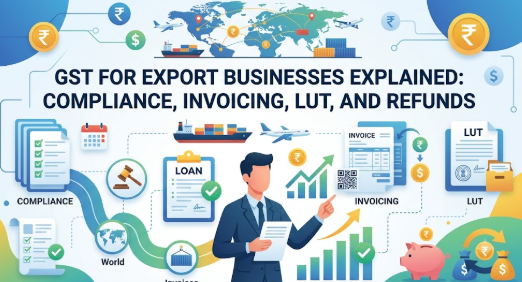
Receiving an overseas order can be exciting, but GST compliance often becomes confusing as soon as the exporter starts preparing invoices, shipping documents, returns, and refund claims. Many beginners assume that exports are completely outside GST because tax may not be collected from the foreign customer. In reality, eligible exports are generally treated as zero-rated supplies, which provides tax benefits while still requiring proper registration, documentation, return reporting, and reconciliation. A missing LUT, incorrect invoice endorsement, mismatched shipping bill, delayed payment realization, or wrong return entry can affect cash flow and refund processing. This guide explains GST for export businesses in practical language so that exporters can understand their options, maintain reliable records, avoid preventable mistakes, and seek professional support when a transaction becomes complex.
What is GST for Export Businesses ?
GST for export businesses refers to the tax treatment, documentation, reporting, input tax credit, and refund rules that apply when an Indian business supplies eligible goods or services outside India.
Under GST, exports are generally classified as zero-rated supplies. Zero rating does not mean the transaction should be ignored in GST records. It means an eligible exporter may make the supply without charging integrated tax under a Letter of Undertaking or may use an eligible tax-payment route and claim a refund, subject to the applicable law and restrictions.
Section 16 of the Integrated Goods and Services Tax Act covers zero-rated supplies. It includes exports of goods or services and eligible supplies to Special Economic Zone developers or units for authorised operations. A registered person making zero-rated supplies may be eligible to claim a refund of unutilised input tax credit, subject to statutory conditions.
A Simple Export Example
Suppose an Indian software company provides development services to a foreign client. The company raises an export invoice, receives payment in an acceptable foreign currency or another permitted manner, reports the transaction in its GST returns, and maintains proof that the conditions for export of services are satisfied.
The company may supply the service without payment of IGST after furnishing a valid LUT and may claim a refund of eligible accumulated input tax credit.
Common Misunderstanding
A common misunderstanding is:
The foreign customer does not pay Indian GST, so I do not need to report the invoice.
This is incorrect. A zero-rated export remains a supply that may need to be reported in GST returns and supported with appropriate documents.
Practical Takeaway
Treat every export as a complete compliance transaction. Connect the sales invoice, customer contract, shipping or service evidence, GST return entry, bank receipt, input tax credit, and refund records.
Why GST Compliance Is Important for Export Businesses
Correct GST treatment affects much more than tax collection. It influences working capital, pricing, bookkeeping, customer documentation, input tax credit, refunds, audit readiness, and business credibility.
Protecting Business Cash Flow
Exporters usually purchase goods or services in India and pay GST to suppliers. When the outward export is made without payment of IGST, eligible input tax credit may accumulate in the electronic credit ledger.
A properly prepared refund claim can release eligible credit back into the business. Poor documentation or return mismatches can delay this process and keep working capital blocked.
Supporting Accurate Pricing
An exporter should know whether quoted prices include:
Product or service cost
Packaging and freight
Insurance
Customs-related costs
Banking charges
Currency-conversion costs
Domestic GST exposure
Refund-related working-capital cost
Without this understanding, the exporter may quote a price that looks profitable but produces weak cash flow after compliance costs.
Maintaining Tax Discipline
Export businesses normally deal with GST records, foreign remittances, shipping evidence, customs information, purchase invoices, contracts, and financial accounts. A disciplined system reduces the risk of inconsistent reporting.
Improving Financial Planning
Export refunds are not the same as sales income. Businesses should not build their monthly expenditure plan around an assumed refund date. Refund eligibility and processing depend on documentation, filing accuracy, and verification.
Practical Scenario
A small exporter purchases packaging material and finished products after paying GST. It exports under LUT but forgets to classify several invoices correctly in its return. The sales appear in the books, but the GST data does not match the refund statement. The refund application requires correction and supporting explanations.
A better approach is to reconcile export invoices before every return is filed.
The Real Problem Readers Face With GST for Exports
The major problem is not the idea of zero rating. The real difficulty is connecting multiple documents and compliance conditions correctly.
Lack of Awareness
New exporters may not understand the difference between:
Exempt supply
Nil-rated supply
Zero-rated supply
Export with LUT
Export with payment of IGST
Refund of tax
Refund of unutilised input tax credit
Using these terms interchangeably can result in incorrect accounting and return reporting.
Confusing Online Advice
Export rules can change through amendments, notifications, circulars, portal updates, and judicial decisions. An old article may describe a procedure that is no longer appropriate for a particular exporter.
Weak Documentation
An exporter may have a valid commercial sale but incomplete GST support. Common gaps include:
Missing LUT acknowledgement
Incorrect invoice endorsement
Incomplete shipping details
Missing foreign inward remittance evidence
Mismatch between invoice and shipping bill
Incorrect GSTIN
Wrong tax period
Unsupported input tax credit
Missing proof of service delivery
Unrealistic Refund Expectations
Some businesses assume that every amount visible in the credit ledger can be refunded. Refund eligibility depends on the nature of credit, statutory restrictions, the refund formula, supporting documents, filing status, and the facts of the transaction.
Depending Only on Social Media Advice
A short video may explain one export route without discussing exceptions. Blindly copying a method can be risky when the exporter’s product, service, customer location, payment terms, or input structure is different.
Not Knowing the Next Step
Many exporters understand that they need an LUT or refund but do not know the correct sequence. The better approach is to establish a transaction workflow from customer order to final reconciliation.
How GST for Export Businesses Works Step by Step
Step 1: Confirm Whether the Transaction Qualifies as an Export
The first step is to determine whether the transaction legally qualifies as an export of goods or export of services. For goods, the movement and removal of goods from India are central to the analysis. For services, conditions relating to the supplier, recipient, place of supply, receipt of payment, and relationship between establishments must be reviewed.
This matters because selling to a foreign person does not automatically make every transaction an export. For example, the place-of-supply rules may affect certain services.
A practical example is an Indian consultant providing a report to an overseas company. The consultant should review where the recipient is located, where the service is treated as supplied, how payment is received, and whether the parties are merely establishments of the same person.
The common mistake is relying only on the foreign billing address.
The better approach is to document how each legal condition is satisfied before assigning export treatment.
Step 2: Complete the Required Business Registrations
The exporter should review GST registration requirements along with other business registrations applicable to the activity. A goods exporter may also need an Importer Exporter Code and customs-related setup, while a service exporter may have different operational requirements.
GST registration is particularly important when the exporter intends to claim a refund of eligible input tax credit. CBIC guidance explains that exports are zero-rated and registration is needed where the exporter seeks GST refunds.
The common mistake is assuming that having an Importer Exporter Code automatically completes GST compliance.
The better approach is to maintain a registration checklist covering GST, customs, banking, sector-specific permissions, and export documentation.
Step 3: Choose the Appropriate Export Tax Route
An eligible exporter generally evaluates two broad routes:
Export without payment of integrated tax under a valid LUT or bond and claim refund of eligible unutilised input tax credit.
Use an eligible export-with-payment route and seek refund of the integrated tax paid, where legally permitted and operationally available.
CBIC guidance recognises export under bond or LUT with refund of eligible unutilised credit and, subject to applicable provisions, export on payment of integrated tax with a related refund route.
This decision matters because the two routes affect cash flow, credit utilisation, documentation, and refund processing differently.
The common mistake is choosing a route only because another exporter uses it.
The better approach is to consider available ITC, cash flow, product restrictions, refund history, system readiness, and professional advice.
Step 4: Furnish the LUT Before Making Eligible Supplies
An LUT is an undertaking through which an eligible exporter supplies goods or services without payment of integrated tax, subject to compliance with prescribed conditions.
The LUT can be furnished electronically through the GST portal under the user-services section. The official portal guide describes the path as Services > User Services > Furnish Letter of Undertaking.
The exporter should verify:
Correct financial year
Authorised signatory
Witness details, where required by the portal
Acceptance or acknowledgement
LUT reference number
Internal communication to billing and finance teams
The common mistake is raising export invoices before confirming that the LUT is valid for the relevant period.
The better approach is to complete LUT filing at the beginning of the applicable financial year and store the acknowledgement in a shared compliance folder.
Step 5: Prepare a Correct Export Invoice
The export invoice should contain the mandatory particulars applicable to a tax invoice and the correct export endorsement based on the selected route.
The invoice should ordinarily connect clearly with:
Exporter’s legal name and GSTIN
Customer details
Invoice number and date
Description of goods or services
HSN or SAC, where applicable
Quantity and value
Currency
Place-of-supply information
LUT or tax-payment treatment
Shipping details for goods, when available
Contract or purchase-order reference
Payment terms
The common mistake is using a normal domestic invoice template without export-specific information.
The better approach is to create separate reviewed templates for domestic sales, export of goods, and export of services.
Step 6: Complete Export and Payment Documentation
For goods, the exporter should maintain customs and logistics evidence such as the shipping bill, transport documents, invoice, packing list, and export-general-manifest-related information where relevant.
For services, the exporter should maintain:
Agreement or purchase order
Scope of work
Evidence of service completion
Email acceptance or delivery confirmation
Invoice
Bank advice
Foreign inward remittance evidence
Currency-conversion working
Place-of-supply analysis
The common mistake is treating the bank receipt as the only evidence of a service export.
The better approach is to create a complete transaction file containing commercial, tax, banking, and delivery evidence.
Step 7: Report Export Transactions Correctly in GST Returns
Export invoices must be reported in the appropriate sections of the applicable GST returns. The values should agree with the sales register, general ledger, invoice records, shipping documents, and refund statements.
Before filing, the exporter should reconcile:
Invoice number
Invoice date
Taxable value
Tax amount, if applicable
Shipping bill number and date
Port code
Customer location
Currency value and INR value
Credit notes
Amendments
LUT status
The common mistake is filing returns directly from unreviewed accounting data.
The better approach is to prepare an export reconciliation and obtain an internal review before submission.
Step 8: Claim and Track the Eligible Refund
An exporter using the LUT route may apply for refund of eligible unutilised input tax credit through Form GST RFD-01. The GST portal guidance states that refund applications for exports without payment of integrated tax are filed through RFD-01 and may cover multiple tax periods where permitted.
The refund file should be checked for:
Eligible tax period
Correct refund category
Valid LUT
Filed returns
Export turnover
Adjusted total turnover
Net eligible ITC
Invoice statements
Bank details
Required declarations
Supporting evidence
Prior deficiency memos or notices
The common mistake is submitting the refund application without matching the figures to books and returns.
The better approach is to prepare a refund working paper that explains every major figure and links it to source records.
Key Factors That Influence GST for Export Businesses
Documentation Discipline
Export GST depends heavily on evidence. A valid transaction may face difficulty during refund verification if documents are incomplete, inconsistent, or not easily traceable.
Maintain one digital folder for each export invoice or shipment.
Filing Accuracy
GST returns, customs data, accounting records, and refund applications should reflect consistent information. Even a small difference in invoice number formatting may create reconciliation problems.
Input Tax Credit Quality
Refund claims depend on eligible ITC. Businesses should verify supplier invoices, receipt of goods or services, business purpose, return reflection, payment conditions, and restrictions under GST law.
Invoice Discipline
Invoice numbering should be sequential, controlled, and unique. Cancelled invoices, amendments, debit notes, and credit notes should be documented clearly.
Payment Realisation
Exporters of services should pay close attention to the prescribed conditions and time requirements relating to receipt of export consideration. Foreign remittance documents should be matched to individual invoices.
Compliance Calendar
LUT filing, return filing, refund applications, bank-realisation follow-up, reconciliations, and notice responses should be tracked through a formal calendar.
Professional Review
Place-of-supply rules and refund eligibility can be complex. A qualified GST professional should review unusual transactions, related-party arrangements, intermediary-service concerns, bundled supplies, and high-value refund claims.
Penalty and Recovery Risk
Incorrect export treatment may lead to tax demand, interest, penalty, refund rejection, or recovery of benefits. Early review is safer than correcting a large volume of historical transactions.
Detailed Breakdown of GST for Export Businesses
Exports as Zero-Rated Supplies
Zero rating is designed to prevent domestic GST from becoming a cost in eligible export transactions. It allows the supply to carry a zero-rated treatment while preserving access to eligible input tax credit.
This is different from a normal exempt supply. In an exempt supply, input tax credit may be restricted or require reversal. In an eligible zero-rated supply, credit may remain available subject to the law.
Export of Goods
Export of goods generally involves taking goods from India to a place outside India. The GST records should align with customs and shipping records.
A goods exporter should reconcile:
Commercial invoice
Tax invoice
Packing list
Shipping bill
Bill of lading or airway bill
Export-general-manifest status, where relevant
Bank realisation
GST return
Stock movement
Purchase and production records
Common Goods-Export Mistake
The invoice is reported in GST returns, but the shipping bill contains a different invoice number or value.
Better Approach
Use a pre-shipment document review. Confirm the invoice number, date, currency, value, port details, product code, and tax treatment before customs submission.
Export of Services
Export of services requires more than issuing an invoice to an overseas customer. The prescribed conditions should be reviewed for each arrangement.
Important questions include:
Is the supplier located in India?
Is the recipient located outside India?
Is the place of supply outside India?
Has payment been received in permitted foreign exchange or another legally permitted manner?
Are the supplier and recipient merely establishments of the same person?
Does any special place-of-supply rule apply?
Common Service-Export Mistake
An Indian company bills its foreign group entity and assumes that the transaction is automatically an export.
Better Approach
Review the agreement, relationship between entities, nature of services, place-of-supply provisions, and payment documentation.
LUT Route
Under the LUT route, eligible exporters make zero-rated supplies without payment of integrated tax and claim refund of eligible accumulated ITC.
This route may support cash flow because the exporter does not first pay output IGST. However, it requires disciplined LUT filing, invoice wording, return reporting, and refund preparation.
Export With Payment of IGST
The tax-payment route can involve paying integrated tax on the export and seeking refund, subject to current legal eligibility and system requirements.
Exporters should not assume that this route is available in every situation. Restrictions, notifications, product categories, compliance conditions, and procedural requirements must be checked before use.
Input Tax Credit for Exporters
An exporter may incur GST on:
Raw materials
Packaging materials
Professional services
Software subscriptions
Office expenses
Warehousing
Domestic freight
Advertising
Machinery
Job work
Business-support services
Not every GST amount is automatically refundable. Credit must first be eligible under the GST law. Certain credits may be blocked, restricted, apportioned, or excluded from the applicable refund calculation.
Refund of Unutilised ITC
Rule 89 provides the framework for refund applications and the calculation applicable to zero-rated supplies made without payment of tax. The formula depends on legally defined components such as net ITC, turnover of eligible zero-rated supplies, adjusted total turnover, and the relevant period.
A refund claim should therefore be calculated from verified data rather than the closing balance of the credit ledger alone.
Refund of IGST on Export of Goods
For eligible exports of goods with payment of IGST, customs and GST data integration plays an important role. Invoice and shipping-bill details should match.
The GST portal provides a facility to track the status of invoice data shared with ICEGATE for export refunds.
Invoice Amendments and Credit Notes
An export value may change because of:
Short supply
Product rejection
Price revision
Discount
Foreign-exchange adjustment
Service-scope reduction
Cancellation
Quantity difference
The exporter should issue and report appropriate documents and maintain an explanation linking the original invoice to the adjustment.
Foreign-Currency Conversion
GST reporting generally requires values in Indian rupees even when the commercial invoice is issued in a foreign currency.
The business should maintain a consistent conversion policy based on the applicable legal rule. It should not use arbitrary rates selected only to match the bank receipt.
Records and Audit Trail
A strong export GST file should allow a reviewer to move from one document to another without confusion:
Customer order → contract → invoice → shipping or service evidence → GST return → bank receipt → ITC records → refund application → accounting entry.
Common Mistakes Beginners Make With GST for Exports
Treating Zero-Rated Supply as an Unreported Supply
This happens because exporters hear the word “zero” and assume no GST entry is needed.
The risk is incomplete return reporting, refund mismatches, and inaccurate turnover.
Instead, report eligible export invoices in the correct return section.
Exporting Without a Valid LUT
This may happen when the finance team assumes that last period’s LUT continues indefinitely.
The risk is a dispute over the tax treatment and potential tax, interest, or procedural consequences.
Instead, verify the LUT before the first eligible export of the relevant period.
Using an Incorrect Invoice Endorsement
A domestic invoice format may not show whether the export is under LUT or with payment of IGST.
This can create inconsistency between the invoice, return, and refund route.
Instead, lock the correct endorsement into the accounting template.
Incorrectly Treating a Service as an Export
A foreign customer or foreign currency alone may not be enough.
The place-of-supply rule or relationship between establishments may change the treatment.
Instead, complete an export-of-services condition checklist.
Claiming Unsupported ITC
Businesses sometimes include credit without checking invoice validity, business use, receipt, supplier reporting, or blocked-credit restrictions.
This can lead to refund rejection, reversal, interest, or notices.
Instead, perform an invoice-level ITC eligibility review.
Failing to Reconcile Shipping Bills
A mismatch in invoice number, date, value, tax amount, or GSTIN may affect automated processing.
Instead, reconcile GST and customs data shipment by shipment.
Ignoring Payment Realisation
Service exporters may issue invoices and file returns but fail to track whether export proceeds are received within the permitted framework.
Instead, maintain an ageing report for export receivables.
Depending on Refunds for Immediate Expenses
A refund is subject to processing and verification.
Instead, maintain a working-capital reserve and treat the refund as a recoverable amount rather than guaranteed monthly cash.
Sharing Sensitive Credentials
GST portal passwords, digital-signature access, bank credentials, and one-time passwords should not be shared casually.
Instead, use controlled access and authorised users.
Ignoring Notices
A notice or deficiency memo may contain a response deadline.
Instead, record the notice immediately, assign responsibility, prepare supporting evidence, and obtain professional review.
“Don’t Do This” Checklist
Do not treat every foreign invoice as an export.
Do not export under LUT without checking its validity.
Do not use a domestic invoice template blindly.
Do not claim the full credit-ledger balance as a refund automatically.
Do not submit mismatched invoice and shipping data.
Do not ignore export-payment ageing.
Do not claim personal or blocked expenses as business ITC.
Do not file returns without book reconciliation.
Do not depend only on short social-media explanations.
Do not share portal credentials with unauthorised people.
Do not delay responses to GST notices.
Do not make unusual export decisions without professional review.
Practical Real-Life Examples of GST for Export Businesses
Example 1: Small Handicraft Exporter
Situation: A small manufacturer ships handmade products to an overseas buyer under LUT.
Challenge: The shipping bill records the invoice as EXP-41, while the GST return records it as 41/EXP.
Better action: The exporter corrects the reporting and introduces a document-validation checklist before filing.
Learning: Consistent invoice numbering supports customs-GST reconciliation and refund processing.
Example 2: Software Freelancer
Situation: A freelancer provides software support to a foreign company and receives payment through a banking channel.
Challenge: The freelancer keeps the invoice and bank credit but has no written scope of work or service-completion evidence.
Better action: The freelancer maintains the agreement, work logs, delivery emails, invoice, remittance evidence, and place-of-supply review.
Learning: Payment evidence alone may not explain the complete nature of a service export.
Example 3: Garment Export Business
Situation: A garment exporter purchases fabric, packaging, and job-work services after paying GST.
Challenge: The business assumes all ITC is refundable without checking eligibility.
Better action: The accounts team classifies eligible, blocked, common, capital-goods, and refund-relevant credits separately.
Learning: Credit-ledger balance and refundable ITC are not always the same.
Example 4: Marketing Agency
Situation: An Indian agency manages digital campaigns for an overseas group company.
Challenge: The company treats the invoice as an export only because the recipient is abroad.
Better action: It obtains a professional review of the agreement, establishments, place of supply, and nature of service.
Learning: Related-party and cross-border service transactions need fact-specific analysis.
Example 5: Engineering-Goods Exporter
Situation: An exporter pays IGST on an eligible goods export and expects an automatic refund.
Challenge: The invoice details in the shipping bill do not match the GST return.
Better action: The exporter corrects the mismatch and begins checking ICEGATE-related invoice status after every filing cycle.
Learning: Accurate data integration is essential for system-based refund processing.
Table 1: LUT Route and IGST-Payment Route
Area
Export Under LUT or Bond
Eligible Export With IGST Payment
Output tax at export stage
Supply is made without payment of IGST
IGST is paid, subject to current legal eligibility
Main refund type
Eligible unutilised input tax credit
Eligible integrated tax paid on export
Cash-flow effect
Usually avoids output-tax payment at export stage
May require tax payment or credit utilisation before refund
Main documents
LUT, invoice, return data, export evidence, ITC records
Invoice, tax payment, shipping or export evidence, matched return data
Data mismatch, ineligible route, incorrect tax payment
Better for
Businesses with regular eligible exports and accumulating ITC
Cases where the route is legally permitted and operationally suitable
Decision method
Review credit pattern, refund process, and compliance ability
Review restrictions, working capital, systems, and professional advice
Table 2: Common Export GST Mistake and Better Control
Common Mistake
Possible Effect
Better Control
Invalid or missing LUT
Tax, interest, or procedural exposure
Verify LUT before the first export invoice
Wrong invoice endorsement
Inconsistent tax treatment
Use reviewed export invoice templates
Shipping-bill mismatch
Delayed or blocked refund processing
Reconcile each shipment before return filing
Incorrect export-of-service classification
Tax demand or refund dispute
Complete a place-of-supply and condition review
Unsupported ITC
Refund rejection or credit reversal
Review ITC invoice by invoice
Missing remittance evidence
Weak support for service-export conditions
Maintain invoice-wise bank realisation records
Return and books mismatch
Notices and refund differences
Perform monthly GST-to-ledger reconciliation
Poor notice tracking
Missed response deadline
Maintain a notice register with owners and due dates
Tools, Methods, and Frameworks Readers Can Use
Export Invoice Register
An export invoice register records the invoice number, date, customer, country, currency, INR value, LUT status, shipping details, payment status, return period, and refund status.
It helps beginners view the complete lifecycle of every export transaction and prevents invoices from being missed in returns or refund claims.
LUT Control Sheet
The control sheet should record:
Financial year
Filing date
Acknowledgement reference
Authorised signatory
Validity review
Copy location
First invoice issued under LUT
It helps prevent exports from being made under an expired or missing undertaking.
Shipping Bill Reconciliation
This method compares the export invoice register with customs and shipping records.
Review:
Invoice number
Shipping bill number
Dates
Port code
Export value
Tax amount
Currency
Quantity
Product details
Refund status
It helps detect mismatches before they affect return filing or refund processing.
Export-of-Services Condition Checklist
A service exporter should complete a checklist covering supplier location, recipient location, place of supply, payment conditions, relationship between establishments, contract terms, and delivery evidence.
This avoids classification based only on the customer’s foreign address.
ITC Eligibility Matrix
The matrix divides inward supplies into:
Eligible inputs
Eligible input services
Capital goods
Blocked credit
Common credit
Personal or non-business expenses
Credits requiring further evidence
Credits relevant to refund calculation
It helps prevent unsupported refund claims.
Refund Working Paper
A refund working paper should contain:
Relevant period
Refund category
Turnover details
Net eligible ITC
Formula calculation
Invoice statements
Reconciliation to GSTR-1
Reconciliation to GSTR-3B
Credit-ledger balance
Supporting documents
Explanations for differences
This creates an audit trail and makes professional review easier.
Foreign Receivable Ageing Report
The report classifies unpaid export invoices by age and tracks expected receipt dates, actual receipts, partial payments, bank references, and follow-up action.
It helps service exporters monitor payment-realisation conditions and credit risk.
Monthly GST Closing Framework
At month-end, the accounts team should complete five checks:
Sales-register reconciliation
Export-document reconciliation
Input-tax-credit review
Return-draft review
Refund-readiness review
This prevents compliance work from accumulating until the refund application stage.
Expert Tips to Make Better GST Decisions
1. Confirm Export Status Before Invoicing
Determine whether the transaction satisfies the relevant export conditions before selecting GST treatment. Correcting classification after return filing can be more difficult than reviewing it at the beginning.
2. File the LUT Early
Furnish and verify the LUT before issuing export invoices under the without-payment route. Share the acknowledgement with billing, finance, and compliance teams.
3. Use Separate Invoice Templates
Maintain different templates for domestic supplies, export of goods, and export of services. This reduces the risk of missing endorsements and export-specific particulars.
4. Reconcile Every Export Invoice
Do not wait until the refund application. Match the invoice to the shipping bill, service evidence, return entry, bank receipt, and accounting record every month.
5. Separate ITC Eligibility From Refund Eligibility
First determine whether input tax credit is legally available. Then determine whether that credit is included in the relevant refund calculation.
6. Maintain Invoice-Wise Payment Tracking
Link each foreign receipt to one or more invoices. Record partial payments, deductions, bank charges, exchange differences, and outstanding balances.
7. Review Place of Supply Carefully
For services, the recipient’s overseas address is not the only factor. Review the exact nature of the service and the relevant place-of-supply rule.
8. Avoid Informal Document Storage
Do not keep important export evidence only in personal email accounts or messaging applications. Use a controlled digital folder with clear naming conventions.
9. Protect Working Capital
Plan expenses without assuming that a GST refund will arrive immediately. Maintain enough liquidity to manage normal processing or correction periods.
10. Track Amendments Separately
Create an amendment register for credit notes, revised values, cancelled invoices, shipping corrections, and return amendments. This preserves the transaction history.
11. Review Supplier Compliance
Refund claims depend partly on the quality of inward-supply records. Follow up on missing or incorrect supplier invoices before claiming related credit.
12. Create a Notice-Response Process
Record the notice date, issue, amount, response deadline, owner, evidence required, professional reviewer, and submission acknowledgement.
13. Keep Accounting and GST Data Connected
The sales ledger, GST returns, customs records, bank receipts, and refund applications should not operate as separate systems. Use common invoice references across all records.
14. Obtain Professional Review for Complex Transactions
Seek advice for intermediary-service questions, related-party services, bundled supplies, unusual payment structures, export restrictions, and high-value refund claims.
15. Review the Process Quarterly
Even when returns are filed monthly, conduct a deeper quarterly review of LUT use, receivables, ITC quality, refund status, shipping mismatches, and notices.
Case Studies: How Better Understanding Changes Decisions
Case Study 1: The Manufacturer With Delayed Refunds
Profile: A small manufacturer exports machine components and purchases raw materials after paying GST.
Situation: The company regularly exports under LUT and files refund claims every quarter.
Problem: Refund applications are repeatedly delayed because invoice numbers in GST returns do not match the shipping bills.
Wrong approach: The accounts team prepares returns from accounting software, while the logistics team independently prepares shipping documents. Neither team performs a final comparison.
Better approach: The company creates a shared export register. Logistics enters shipping details, accounts enters GST data, and a reviewer validates both before filing.
Result or learning: The company develops a clearer audit trail and reduces avoidable invoice-level differences. It also identifies errors before submitting refund claims.
Key takeaway: Export GST compliance requires coordination between sales, logistics, accounts, and tax teams.
Case Study 2: The Consultant With a Foreign Client
Profile: An independent consultant provides business-analysis services to a foreign customer.
Situation: The consultant issues invoices in foreign currency and receives payments in a bank account.
Problem: The consultant has no formal contract, limited delivery evidence, and no documented place-of-supply review.
Wrong approach: The consultant assumes that every foreign payment is automatically a zero-rated export of service.
Better approach: The consultant signs a clear agreement, documents the customer’s location, retains reports and acceptance emails, records remittance details, and obtains professional confirmation of the GST treatment.
Result or learning: The transaction file now explains what was supplied, to whom, where the recipient is located, how the service was delivered, and how payment was received.
Key takeaway: A bank receipt supports payment but does not replace the complete export-of-services analysis.
Case Study 3: The Exporter Claiming the Entire Credit Balance
Profile: A trading company exports consumer products and also makes domestic taxable supplies.
Situation: Its electronic credit ledger contains GST from inventory, professional fees, vehicles, employee expenses, and common overheads.
Problem: The business prepares a refund application using the entire closing credit balance.
Wrong approach: It assumes all credits are eligible and fully attributable to exports.
Better approach: The finance team reviews ITC eligibility, blocked credits, common credits, domestic utilisation, relevant turnover, and the prescribed refund formula.
Result or learning: The revised claim is lower but better supported. The company also improves purchase coding so future refund workings can be prepared efficiently.
Key takeaway: A well-supported refund claim is safer than an aggressive claim based only on the credit-ledger balance.
Risk Awareness: What Exporters Must Check First
Classification Risk
The transaction may not satisfy the conditions for export treatment.
Why it matters: Incorrect classification can result in tax, interest, penalty, or refund recovery.
Risk reduction: Complete a legal-condition checklist and seek professional review for unusual services.
Documentation Risk
Documents may be missing, inconsistent, or difficult to trace.
Why it matters: Weak evidence can delay refunds and create audit concerns.
Risk reduction: Maintain invoice-wise digital files and a document-retention policy.
Input Tax Credit Risk
The claimed credit may be blocked, unsupported, duplicated, personal, or unrelated to business.
Why it matters: Ineligible ITC can lead to reversal, interest, and notices.
A refund may be reduced, rejected, delayed, or questioned.
Why it matters: The exporter’s working capital may remain blocked.
Risk reduction: Reconcile figures before filing and maintain a complete calculation file.
Payment-Realisation Risk
The exporter may not receive the foreign customer’s payment as expected.
Why it matters: This creates commercial credit risk and may affect compliance conditions for service exports.
Risk reduction: Set credit limits, collect advances where appropriate, monitor ageing, and document follow-up.
Customs and GST Mismatch Risk
Goods-export information may differ across GST and customs systems.
Why it matters: Automated processing can be interrupted.
Risk reduction: Validate invoice and shipping details before and after filing.
Foreign-Exchange Risk
The value of foreign-currency receivables may change before payment.
Why it matters: The final INR receipt can differ from the invoice value.
Risk reduction: Track exchange differences separately and use an approved accounting policy.
Fraud Risk
Fake overseas buyers, altered bank instructions, and fraudulent refund agents can cause financial loss.
Why it matters: Cross-border recovery can be difficult.
Risk reduction: Verify customers, confirm bank-detail changes independently, and use authorised professionals.
Data-Privacy Risk
Export documents may contain customer details, banking information, signatures, and business data.
Why it matters: Unauthorised access can cause fraud or confidentiality breaches.
Risk reduction: Use role-based access, secure storage, and controlled credential sharing.
Compliance-Change Risk
Rules, portal procedures, and restrictions may change.
Why it matters: An older process may no longer be suitable.
Risk reduction: Verify current official guidance and obtain updated professional advice before major claims.
Checklist Before Taking Export GST Action
The transaction qualifies as an export of goods or services.
GST registration and other applicable registrations are active.
The correct export route has been selected.
A valid LUT is available where the without-payment route is used.
The export invoice contains the required particulars and endorsement.
Customer and place-of-supply details have been reviewed.
Shipping or service-delivery evidence is available.
Export values agree with accounting records.
GST return data has been reconciled.
Shipping-bill and customs information has been checked.
Foreign remittances are linked to invoices.
Input tax credit has been reviewed for eligibility.
Blocked or unsupported credits have been excluded.
The refund formula has been checked independently.
Bank details on the GST portal are correct.
Credit notes and amendments have been recorded.
Return-filing and refund deadlines are being monitored.
Portal credentials and financial data are protected.
Notices and deficiency memos are tracked.
A qualified professional has reviewed complex issues.
Use this checklist before return filing and again before submitting a refund application. One review confirms transaction reporting; the second confirms refund readiness.
Strategic Insights for Better GST Decision-Making
Build Documentation at Transaction Level
Do not create refund evidence several months after the export. Build the file while the transaction is taking place.
For example, attach the purchase order, invoice, shipping bill, bank receipt, and return reference to the same invoice record.
Maintain a Compliance Calendar
A practical calendar should cover:
LUT filing
GSTR-1 preparation
GSTR-3B preparation
Shipping-bill reconciliation
Export-receivable review
Refund preparation
Notice response
Quarterly ITC review
Annual record review
Assign an owner and reviewer to every activity.
Use Exception-Based Review
Instead of manually reviewing every detail repeatedly, create exception reports for:
Missing shipping bill
Missing bank receipt
Invalid LUT reference
Invoice value mismatch
Unreported credit note
Unmatched ITC
Overdue receivable
Refund-pending invoice
Duplicate invoice number
This allows the team to focus on transactions requiring action.
Separate Commercial and Tax Decisions
A commercial team may accept a customer’s payment terms, but the tax team must independently assess GST conditions and documentation.
For example, a customer may request invoicing to one entity and payment from another. That arrangement should be reviewed before acceptance.
Connect Refund Planning With Working Capital
Estimate eligible refund amounts conservatively. Track claimed, acknowledged, sanctioned, withheld, rejected, and received amounts separately.
Do not treat the application date as the cash-receipt date.
Conduct Professional Review Before Large Claims
A high-value refund claim should be reviewed for:
ITC eligibility
Turnover calculation
Relevant period
Export evidence
Return reconciliation
Credit-ledger position
Prior claims
Amendments
Restrictions
Declarations and supporting documents
Preserve an Audit Trail
Do not overwrite old workings. Save each version with a date, preparer, reviewer, and explanation of changes.
This helps the business respond when a transaction is questioned later.
Key GST Terms Explained for Beginners
Export of Goods: Taking goods from India to a place outside India. The exporter should maintain customs, shipping, invoice, and GST evidence.
Export of Services: A supply of services satisfying the prescribed conditions relating to supplier, recipient, place of supply, payment, and establishments.
Zero-Rated Supply: An eligible export or qualifying supply to an SEZ that receives special GST treatment while generally preserving access to eligible ITC.
Letter of Undertaking: An undertaking furnished by an eligible exporter to make zero-rated supplies without payment of integrated tax, subject to conditions.
Integrated GST: GST generally applicable to inter-state supplies and relevant to the tax treatment of exports.
Input Tax Credit: Eligible GST paid on business purchases that may be credited against tax liability or considered in an eligible refund claim.
Refund: An amount claimed back under the GST law, subject to eligibility, calculation, documentation, filing, and verification.
Shipping Bill: A customs document used in the export of goods. Its details should align with the export invoice and GST reporting.
Place of Supply: The location legally treated as the place where a supply occurs. It is especially important for determining whether a service qualifies as an export.
Foreign Inward Remittance: Money received from outside India through a banking or other permitted channel, supported by relevant bank documentation.
Export Invoice: The invoice issued for an export transaction containing the prescribed tax particulars and appropriate export endorsement.
Electronic Credit Ledger: The GST portal ledger where eligible input tax credit is recorded and utilised according to law.
GSTR-1: The return or statement used to report outward supplies, including export invoices and related amendments.
GSTR-3B: A summary return used to report tax liabilities, eligible ITC, and other prescribed information.
GST RFD-01: The form generally used to apply for several categories of GST refund, including eligible unutilised ITC on exports without payment of tax.
Who Should Read This Blog
Beginners
It explains export GST concepts without assuming advanced tax knowledge.
Students
Commerce, finance, taxation, and business students can use it to understand how zero-rated supplies work in practice.
Salaried Employees
Employees planning to start freelancing or cross-border consulting can learn the importance of contracts, invoicing, and payment evidence.
Small Business Owners
Owners can use the guide to build an export documentation and reconciliation process.
New Exporters
It helps first-time exporters understand LUT filing, invoice preparation, GST reporting, and refunds.
Traders
Export traders can learn how purchase ITC, shipping documentation, and return data connect.
Loan Seekers
Export businesses applying for finance can improve the quality of financial records and receivable tracking used in lending assessments.
Crypto Learners
People receiving cross-border consideration through emerging payment arrangements should understand that payment technology does not automatically determine GST treatment.
Casino Content Creators
Indian agencies or writers providing content services to overseas businesses can use the service-export sections to understand documentation and place-of-supply concerns.
Finance Bloggers
Writers can use the guide to explain export GST without confusing zero-rated supplies with exempt supplies.
People Improving Financial Awareness
The blog demonstrates how tax compliance, cash flow, risk, and record keeping are connected.
People Trying to Avoid Financial Mistakes
The checklists and case studies help readers identify problems before filing returns or refund claims.
Frequently Asked Questions
1. What does GST for Export Businesses Explained mean?
GST for Export Businesses Explained refers to understanding how GST applies to eligible exports of goods and services. It covers zero-rated supplies, LUT filing, export invoices, return reporting, ITC, payment evidence, and refund procedures.
2. Are exports completely exempt from GST?
Eligible exports are generally treated as zero-rated supplies rather than ordinary exempt supplies. This distinction is important because zero-rated treatment can preserve access to eligible input tax credit and refund benefits.
3. What is an LUT for exporters?
An LUT is an undertaking furnished by an eligible exporter to make zero-rated supplies without paying integrated tax at the export stage. It must be valid for the applicable period and used with correct invoice and return reporting.
4. Can an exporter claim a GST refund?
A registered exporter may be eligible to claim a refund of unutilised ITC under the LUT route or another eligible refund under the applicable export route. Eligibility depends on current law, supporting records, calculation, and filing compliance.
5. Is every sale to a foreign customer an export of service?
No. The transaction must satisfy the prescribed export-of-services conditions. The foreign address and foreign-currency invoice alone may not be enough if the place of supply or relationship between establishments does not support export treatment.
6. What documents should a goods exporter maintain?
A goods exporter should maintain invoices, purchase orders, packing lists, shipping bills, transport documents, customs evidence, GST returns, bank receipts, stock records, and refund workings relevant to the transaction.
7. What documents should a service exporter maintain?
A service exporter should maintain the agreement, scope of work, invoice, delivery evidence, customer acceptance, place-of-supply analysis, foreign remittance evidence, GST return records, and LUT acknowledgement.
8. Why are GST refunds sometimes delayed?
Refunds may be delayed because of invoice mismatches, incomplete documents, unsupported ITC, incorrect refund calculations, missing return filings, bank-detail problems, notices, or verification requirements.
9. Can the entire electronic credit-ledger balance be refunded?
Not automatically. The exporter must first establish ITC eligibility and then apply the relevant refund rules and formula. Certain credits may be blocked, excluded, apportioned, or already utilised.
10. How often should export invoices be reconciled?
Export invoices should ideally be reconciled every return period. Monthly reconciliation helps identify shipping, payment, invoice, ITC, and return differences before they affect refund claims.
11. Should a beginner take professional GST advice?
Professional advice is strongly recommended for complex services, related-party transactions, intermediary concerns, high-value refunds, unusual payment arrangements, notices, and cases involving uncertain place-of-supply treatment.
12. What is the best next step after reading GST for Export Businesses Explained?
Create an export compliance file containing registrations, LUT, invoice templates, transaction checklists, return reconciliations, payment records, ITC reviews, and refund workings. Have the process reviewed by a qualified GST professional.
Conclusion
GST for export businesses becomes easier when exporters follow a clear process for classification, LUT filing, invoicing, documentation, return reporting, and refund claims. Eligible exports are generally treated as zero-rated supplies, but businesses must still maintain accurate records and meet legal conditions. Exporters should reconcile invoices with shipping documents, bank receipts, GST returns, and input tax credit records every month. Service exporters must also review place-of-supply rules and payment-realisation conditions carefully. Before claiming any refund, check ITC eligibility and supporting documents. A disciplined compliance system can reduce mistakes, refund delays, and working-capital pressure. For complex transactions, notices, or high-value claims, consult a qualified GST professional.
Selling products online can appear simple until taxation, marketplace deductions, invoices, returns and interstate orders become involved. A seller may list handmade products, clothing, electronics, beauty products or household goods on an online marketplace without fully understanding whether GST registration is needed, which GST rate applies or how marketplace TCS appears in the GST account. Small mistakes can lead to incorrect invoices, blocked input tax credit, mismatched sales records or compliance notices. GST for e-commerce sellers in India therefore requires more than obtaining a GST number. Sellers need a practical system for registration assessment, product classification, invoicing, reconciliation, return filing and record maintenance. This guide explains those responsibilities in beginner-friendly language so online businesses can grow with better tax discipline rather than making rushed compliance decisions.
Understanding GST for E-Commerce Sellers in Simple Words
Goods and Services Tax, commonly called GST, is an indirect tax applied to the supply of taxable goods and services in India. For an online seller, GST can affect product pricing, customer invoices, marketplace settlements, business purchases and return filing.
An e-commerce seller is a person or business that sells goods or services through a digital platform. This can include:
A seller listing products on an online marketplace
A business selling through its own website
A home-based entrepreneur accepting orders online
A social-commerce merchant
A manufacturer using online platforms to reach customers
A service provider supplying through a digital platform
GST treatment depends on several factors, including:
What is being sold
Whether the seller is registered
Aggregate annual turnover
The state from which the business operates
Whether supplies are intrastate or interstate
Whether the marketplace is required to collect tax at source
Whether a special GST provision applies to the transaction
Why GST for E-Commerce Sellers in India Is Important
GST compliance influences almost every financial part of an online business.
It affects product pricing
A GST-registered seller must understand whether the displayed selling price is inclusive or exclusive of GST. Incorrect pricing can reduce the seller’s margin because the seller may later discover that tax must be paid from the amount already collected.
It affects working capital
Marketplaces may deduct commissions, shipping charges, advertising fees, service fees, TCS and other amounts before transferring the settlement. A seller who looks only at the bank deposit may misunderstand actual sales, expenses and taxes.
It affects input tax credit
A normally registered seller may be able to claim eligible input tax credit on business purchases when the legal conditions are satisfied. Missing invoices, incorrect GSTIN details or personal purchases recorded as business expenses can create problems.
It affects interstate expansion
Online selling often creates orders from multiple states. Place-of-supply rules determine whether CGST and SGST or IGST should be charged. A seller who enables interstate delivery without reviewing GST implications may issue incorrect invoices.
It affects marketplace reconciliation
The sales report, return report, cancelled-order report, commission invoice, shipping invoice, TCS report, bank settlement and GST returns must support one another.
It affects business credibility
Clean invoices and organised records help the seller respond to customer questions, accountant reviews, audits and GST notices.
Practical scenario
A seller records ₹80,000 received in the bank as monthly sales. However, the marketplace report shows gross sales of ₹1,10,000, returns of ₹10,000 and deductions of ₹20,000. GST reporting cannot be prepared only from the ₹80,000 bank deposit. The seller must reconcile the entire transaction trail.
The Real Problem Readers Face With GST for E-Commerce Sellers
The main difficulty is not always the GST law itself. The bigger problem is converting marketplace activity into accurate tax records.
Confusing online advice
Many online explanations repeat old rules without considering later changes for eligible unregistered suppliers and composition taxpayers. Sellers may therefore register unnecessarily or, more dangerously, sell without registration when they do not meet the conditions.
Weak understanding of marketplace deductions
A marketplace settlement may include:
Product sales
GST collected from customers
Returns and refunds
Marketplace commission
GST on marketplace commission
Shipping fees
Advertising charges
Penalties or adjustments
TCS
Other deductions
The net settlement is not the same as taxable turnover.
Incorrect product classification
GST rates are generally connected to the classification and nature of the goods or services. Sellers sometimes copy a competitor’s rate without checking whether their own product has the same material, composition, use or classification.
Poor documentation
Online sellers frequently lose purchase invoices, courier records, return proofs and marketplace fee invoices. This makes reconciliation and input tax credit review difficult.
Depending only on marketplace reports
Marketplace data helps with compliance, but the seller remains responsible for checking whether its accounting and GST reporting are correct.
No compliance calendar
Sellers may remember income-tax deadlines but overlook GST return filing, reconciliation and payment responsibilities.
Mixing personal and business transactions
Using one bank account and one payment channel for personal and business activity makes turnover verification difficult.
Not knowing the next step
A new seller may not know whether to:
Obtain GST registration
Apply for enrolment as an unregistered supplier
Choose the composition scheme
Remain under the regular GST scheme
Restrict sales to one state
Start interstate sales
Consult a GST practitioner
The better approach is to map the business model before choosing a compliance route.
How GST for E-Commerce Sellers Works Step by Step
Step 1: Identify What You Are Selling
Start by writing down every product or service offered through the online platform. Note the product description, material, intended use, brand ownership, package contents and whether the item is taxable, exempt or subject to a special treatment. This matters because registration, tax rate, invoice content and return reporting depend on the actual supply. For example, two products that appear similar to customers may have different classifications because of their composition or use. A common mistake is selecting a GST rate from a marketplace suggestion without reviewing the legal classification. A better approach is to maintain a product master containing the product name, stock-keeping unit, HSN or SAC code, GST rate and reason for the classification.
Step 2: Calculate Aggregate Turnover Properly
Aggregate turnover is broader than the amount received in the bank. It generally considers the combined value of relevant supplies made under the same Permanent Account Number across India, subject to the statutory definition and exclusions. Sellers should include sales made through every marketplace, their own website, offline stores and other channels when assessing turnover. A common mistake is checking the threshold separately for each marketplace account or state. The better approach is to prepare one consolidated turnover report for the complete business.
Step 3: Determine Whether Registration Is Required
Review the normal registration threshold, nature of supply, state-specific position, interstate activity and e-commerce provisions. Eligible unregistered suppliers may make intrastate supplies of goods through an e-commerce operator under specified conditions, but the benefit is conditional. The supplier generally needs to remain within the applicable threshold, make supplies only within one state or union territory under the facility, obtain the prescribed enrolment number and comply with the special procedure.
A common mistake is treating the relaxation as permission to sell goods anywhere in India without registration. A better approach is to document why registration is or is not required and have that conclusion reviewed when the business model changes.
Step 4: Choose the Appropriate GST Route
A seller may operate as:
An eligible unregistered supplier under the special e-commerce procedure
A regular GST-registered taxpayer
A composition taxpayer, where legally eligible
A supplier covered by another specific provision
Registered composition taxpayers have also been allowed to make intrastate supplies of goods through e-commerce operators, subject to the applicable conditions and special procedure. This change removed the earlier blanket restriction relating to goods supplied through such operators, but it does not mean that all online supplies or interstate transactions are permitted under composition.
The common mistake is choosing composition only because it appears simpler. The better approach is to compare customer type, input tax credit requirements, interstate plans, turnover and marketplace compatibility.
Step 5: Configure Products and Invoices Correctly
After selecting the GST route, configure the seller account with the correct GSTIN or enrolment details, business address, product codes, GST rates and place-of-supply settings. Test sample invoices before accepting a large number of orders. Check whether the invoice shows the correct seller name, address, document number, date, product description, taxable value and tax breakup. The common mistake is assuming the marketplace automatically guarantees tax accuracy. A better approach is to review invoices periodically and whenever a product or platform setting changes.
Step 6: Record Marketplace Settlements in Full
Record gross sales first, followed by returns, discounts, commissions, shipping charges, GST on platform services, TCS and settlement adjustments. Do not record only the amount credited to the bank. For example, when gross sales are ₹50,000 and the marketplace transfers ₹39,000 after deductions, accounting only for ₹39,000 understates revenue and hides expenses. The better approach is to post settlement entries using detailed marketplace reports and separate accounting ledgers.
Step 7: Reconcile TCS and GST Returns
E-commerce operators required to collect TCS report the relevant supplies and tax collected through Form GSTR-8. The TCS information becomes available to the supplier through the GST system, and the supplier must review and accept or reject the credit as applicable.
The common mistake is assuming TCS is the seller’s final GST liability. It is not a substitute for correctly reporting outward supplies and paying the applicable tax. A better approach is to reconcile marketplace TCS reports with GSTR-8 information and the electronic cash ledger.
Step 8: File Returns and Preserve Records
A regular registered seller generally needs to report outward supplies and discharge tax through the applicable return process. Form GSTR-1 is used for reporting details of outward supplies, while Form GSTR-3B is used for summary reporting and payment. Supplies made through e-commerce operators may require operator-wise information in the relevant tables.
The common mistake is filing from incomplete marketplace summaries and correcting everything later. The better approach is to close monthly books, reconcile data, review input tax credit and then file.
Key Factors That Influence GST for E-Commerce Sellers
Turnover, tax liability, place of supply, taxable value and input tax credit should be reported carefully. A return filed on time but containing incorrect information can still create compliance risk.
Record keeping
Marketplace transactions involve several moving parts. Sellers should preserve records channel-wise and month-wise instead of downloading them only when a return is due.
Compliance deadlines
Return frequency and due dates depend on the taxpayer’s registration type and applicable scheme. Sellers should check the current GST portal calendar rather than depending permanently on a handwritten date list.
Product classification
The HSN code and tax rate should match the actual product. Sellers should not classify products only according to popular marketplace categories.
Place of supply
The customer’s location, delivery location, seller location and nature of transaction can determine whether the supply is intrastate or interstate.
Invoice discipline
Each taxable transaction should be supported by the correct document. Returns, cancellations and price changes may require credit notes or other adjustments.
Professional review
A GST professional can help review registration requirements, classification, interstate supplies, input tax credit and complex marketplace settlements. Professional review is especially useful during expansion or after receiving a notice.
Penalty and interest risk
Late filing, delayed tax payment, incorrect credit and non-registration can create financial exposure. Sellers should prevent errors rather than treating penalties as a routine business expense.
Technology integration
Accounting software and marketplace connectors can reduce manual work, but their mapping must be checked. Automation can repeat errors at scale when settings are wrong.
Detailed Breakdown of GST for E-Commerce Sellers in India
GST Registration for Online Sellers
GST registration gives a business a GSTIN and brings it within the registered tax system. Registration may allow an eligible regular taxpayer to collect GST, issue tax invoices and claim input tax credit subject to legal conditions.
Registration does not automatically improve profitability. It adds responsibilities such as:
Maintaining GST-compliant records
Filing returns
Paying tax
Reconciling input tax credit
Updating marketplace accounts
Responding to discrepancies
A seller should not register only because a platform form asks for a GSTIN without first understanding whether an alternate enrolment facility is available. Similarly, a seller should not avoid registration merely to reduce paperwork when the law requires it.
Relaxation for Eligible Unregistered Sellers
Eligible unregistered persons can supply goods through e-commerce operators required to collect TCS without mandatory GST registration when the prescribed conditions are satisfied.
The facility is generally designed for small suppliers making intrastate supplies of goods within the applicable turnover threshold. Such suppliers must follow the specified enrolment and platform procedure. The e-commerce operator also has special responsibilities for supplies made by unregistered sellers.
Important limitations include:
The facility concerns eligible supplies of goods.
Supplies are restricted according to the prescribed intrastate conditions.
The supplier cannot treat the facility as permission for unrestricted nationwide sales.
Turnover must remain within the applicable registration threshold.
The seller must obtain the required enrolment number.
The marketplace must support and comply with the prescribed procedure.
A seller should review registration liability immediately when turnover or operations change.
Regular GST Scheme
A seller registered under the regular scheme generally charges GST on taxable supplies, reports outward supplies and may claim eligible input tax credit.
The regular scheme may be more suitable when:
The seller makes interstate taxable supplies
Business customers require tax invoices
Significant eligible input tax credit is available
The seller plans to scale across India
Multiple warehouses or states are involved
Marketplace and offline channels are combined
The main challenge is the increased compliance burden. The seller needs disciplined accounting rather than occasional record preparation.
Composition Scheme
The composition scheme is designed to simplify compliance for eligible small taxpayers. Composition taxpayers generally pay tax under simplified rules but face restrictions, including limitations relating to tax collection, input tax credit and the nature of supplies.
Registered composition taxpayers can make qualifying intrastate supplies of goods through e-commerce operators under the amended framework and prescribed procedure. However, composition should be selected only after reviewing eligibility and business consequences.
A composition seller should consider:
Whether customers need input tax credit
Whether the business will make interstate outward supplies
Whether the turnover remains within the scheme limit
Whether the product and business type are eligible
Whether the platform supports composition sellers
Whether the seller understands bill-of-supply requirements
Tax Collected at Source by Marketplaces
Under Section 52, qualifying e-commerce operators collect TCS on the net value of taxable supplies made through them where consideration is collected by the operator.
The operator reports these details in Form GSTR-8. Form GSTR-8 contains details of supplies made through the operator and the TCS collected.
For a seller, TCS creates three practical responsibilities:
Verify the taxable supply value reported by the marketplace.
Match returns and cancellations with marketplace data.
Claim or use the TCS credit correctly through the GST system.
TCS should not be confused with income-tax TDS, marketplace commission or GST charged on marketplace fees.
GST on Marketplace Fees
Marketplaces often charge sellers for:
Commission
Fulfilment
Shipping
Storage
Advertising
Subscription
Collection services
Penalties or other platform services
The marketplace may charge GST on taxable services supplied to the seller. A regular registered seller may review whether input tax credit is available, subject to possession of a valid tax invoice, receipt of the service, supplier reporting and other conditions.
A common mistake is claiming every GST amount appearing in a settlement report. The better approach is to verify the legal invoice, GSTIN, nature of expense and business use.
GST Invoices
A GST invoice should contain the information required for the applicable transaction. Sellers should check:
Legal name and GSTIN
Invoice number and date
Customer details where required
Product description
HSN code where applicable
Quantity
Taxable value
Discount treatment
GST rate
CGST, SGST, UTGST or IGST
Place of supply where required
Delivery and billing information
Incorrect address or GSTIN information can affect the customer’s credit and the seller’s reporting.
Returns, Refunds and Credit Notes
E-commerce businesses experience frequent returns. A returned product affects:
Sales value
Output tax
Marketplace commission
Shipping expense
Inventory
Customer refund
TCS calculation
GST reporting
The seller should identify whether the sale was cancelled before invoicing, returned after invoicing or refunded partially. Each situation may require different accounting treatment.
Never reduce sales merely because a bank refund was issued. Match the refund with the original order, invoice and marketplace return report.
Input Tax Credit
Input tax credit allows an eligible registered taxpayer to reduce output tax liability using GST paid on eligible business inputs and input services, subject to statutory conditions.
Potential e-commerce business inputs may include:
Inventory purchases
Packaging materials
Warehouse services
Marketplace fees
Eligible advertising services
Professional services
Business software
Certain logistics services
Credit may be restricted or unavailable when:
The invoice is missing
The GSTIN is incorrect
The supplier has not reported the invoice
Goods or services are used personally
The expense falls under blocked-credit provisions
Payment or other statutory conditions are not satisfied
The claimant is under the composition scheme
The seller is unregistered
The practical approach is to reconcile the purchase register with GSTR-2B and investigate differences before claiming credit.
Place of Supply
Place of supply helps determine which GST should be charged.
When the supplier location and place of supply are in the same state, CGST and SGST may generally apply. When they are in different states, IGST may generally apply, subject to the nature of supply and applicable rules.
A seller should verify:
Dispatch location
Delivery location
Billing details
Customer GSTIN
Marketplace warehouse arrangement
Movement of goods
Bill-to and ship-to arrangements
Incorrect place-of-supply reporting may send tax to the wrong state and require correction.
Multiple Warehouses and State Registrations
Marketplace fulfilment models may involve storing inventory in warehouses located in different states. This can create registration, stock-transfer and documentation implications.
Before enabling multi-state fulfilment, the seller should ask:
Who owns the inventory?
Where is the inventory stored?
From which location is the invoice issued?
Does the seller need registration in that state?
How are stock transfers documented?
Does the marketplace act only as a logistics provider?
Are e-way bill responsibilities triggered?
Warehouse expansion should be treated as a tax-planning decision, not only a delivery-speed decision.
E-Invoicing
E-invoicing requirements depend on the notified turnover criteria and transaction type. Where applicable, specified invoices must be registered through the Invoice Registration Portal and receive an Invoice Reference Number.
An e-commerce operator may generate an e-invoice on behalf of a supplier where the system and legal requirements permit, but responsibility for correct supplier information remains important. The official e-invoice portal explains that applicability is linked to the supplier’s turnover and that an operator can generate an IRN on the supplier’s behalf.
Because e-invoicing thresholds and technical requirements may change, sellers should verify the current notification before relying on an old turnover figure.
E-Way Bills
Movement of goods may require an e-way bill depending on consignment value, transaction type, distance and applicable exceptions. Sellers using marketplace logistics should establish whether the seller, marketplace, transporter or another party generates the document.
A common error is assuming that a shipping label automatically replaces an e-way bill. Sellers should verify the documentation required for each movement.
Common Mistakes Beginners Make With GST for E-Commerce Sellers
Assuming every marketplace deduction is GST
Marketplace settlements contain different deductions. TCS, commission, GST on commission and other fees should be recorded separately.
Recording only bank settlements as revenue
This understates gross sales and hides marketplace expenses. Record the complete settlement statement.
Using an incorrect GST rate
Copying another seller’s GST rate can create underpayment or overcharging. Review product classification independently.
Enabling interstate sales without a GST review
A seller using the unregistered intrastate facility may lose eligibility or create registration exposure by enabling interstate orders.
Ignoring cancelled and returned orders
Returns must be matched to original invoices and tax reporting. Unmatched returns create sales and GST differences.
Claiming unsupported input tax credit
A marketplace report is not always sufficient evidence. Verify the tax invoice and GSTR-2B reflection.
Treating TCS as the final GST payment
TCS is a credit mechanism connected with marketplace-reported supplies. It does not replace the seller’s return and output-tax responsibilities.
Using personal purchases as business credit
GST paid on personal or non-business items should not be claimed merely because the seller used the business GSTIN.
Missing marketplace fee invoices
Commission and advertising invoices may be necessary for expense booking and eligible credit review.
Filing before completing reconciliation
Submitting returns early without checking sales, returns, TCS and purchases can create avoidable amendments.
Following outdated social-media advice
GST rules for e-commerce have changed over time. Verify current official notifications or seek professional advice.
Ignoring notices
GST portal messages and notices should be reviewed promptly. Delayed responses can increase compliance risk.
Don’t Do This Checklist
Do not record only the bank settlement.
Do not select GST rates based only on a competitor’s listing.
Do not enable interstate sales without checking registration implications.
Do not claim input tax credit without valid support.
Do not treat TCS as marketplace commission.
Do not mix personal and business transactions.
Do not ignore returned orders.
Do not use the composition scheme without checking restrictions.
Do not assume a marketplace will correct every GST error.
Do not share GST portal credentials casually.
Do not delay reconciliation until the financial year-end.
Do not rely permanently on old tax articles or videos.
Practical Real-Life Examples of GST for E-Commerce Sellers
Example 1: Home-Based Handicraft Seller
Situation: A seller makes handmade décor items in Rajasthan and wants to sell only to customers within Rajasthan.
Challenge: She assumes marketplace selling automatically requires full GST registration.
Better action: She checks her turnover, product eligibility and the conditions for intrastate supplies by an eligible unregistered seller before selecting the enrolment route.
Learning: Registration decisions should be based on current rules and actual selling geography.
Example 2: Apparel Seller Recording Net Settlements
Situation: An apparel seller receives ₹1,60,000 in the bank during a month.
Mistake: He records ₹1,60,000 as sales without reviewing returns, commission, shipping charges or TCS.
Better action: He reconciles gross order value, returns, taxes and marketplace deductions before posting accounts.
Learning: Bank receipts are not a substitute for a marketplace sales register.
Example 3: Electronics Seller Using the Wrong GST Rate
Situation: A seller lists an electronic accessory using the rate shown on a similar product page.
Challenge: The actual product classification differs because of its function and specifications.
Better action: The seller reviews the HSN classification and keeps supporting product documents.
Learning: Marketplace categories and GST classifications serve different purposes.
Example 4: Multi-State Warehouse Expansion
Situation: A growing seller sends inventory to marketplace warehouses in three states.
Mistake: The seller treats the movement as a simple courier transfer and does not review state-registration implications.
Better action: Before transferring stock, the seller examines ownership, invoice flow, registrations and stock-transfer documentation.
Learning: Faster delivery can create additional GST responsibilities.
Example 5: Seller Ignoring TCS Mismatches
Situation: The marketplace report shows TCS, but the GST portal amount does not fully match.
Challenge: The seller assumes the difference will correct itself.
Better action: The seller compares GSTIN, period, returns and amended marketplace records before accepting the credit.
Learning: Small monthly mismatches are easier to correct than accumulated annual differences.
Table 1: Comparing Common E-Commerce GST Routes
GST route
General suitability
Main advantages
Important limitations
Eligible unregistered intrastate seller
Small seller of qualifying goods operating within one state and below the applicable threshold
Reduced registration and return burden
Conditional facility; generally not suitable for unrestricted interstate selling
Tax invoices, eligible ITC and broader operating flexibility
More accounting, return filing and reconciliation work
Composition scheme
Eligible small registered sellers with a simpler intrastate model
Simplified tax and compliance structure
No normal ITC benefit, customer-credit limitations and scheme restrictions
Multi-state regular registration
Sellers storing or dispatching inventory from several states
Supports wider fulfilment operations
State-wise registration, stock records and increased reconciliation requirements
Table 2: Common GST Mistake Versus Better Approach
Common mistake
Possible consequence
Better approach
Recording only bank settlements
Understated turnover and missing expenses
Record gross sales, returns, fees, taxes and TCS separately
Copying another seller’s GST rate
Incorrect tax collection or payment
Review the product’s HSN classification
Ignoring return orders
Sales and tax mismatch
Link every return to the original order and invoice
Claiming all GST shown by the marketplace
Ineligible input tax credit
Match valid invoices with the purchase register and GSTR-2B
Enabling interstate sales casually
Registration or compliance exposure
Review GST eligibility before changing delivery settings
Ignoring TCS reconciliation
Credit differences and cash-flow confusion
Match marketplace reports with GST portal data monthly
Mixing personal and business purchases
Incorrect accounts and credit claims
Use separate accounts and document business purpose
Filing without review
Repeated amendments and notices
Complete monthly reconciliation before submission
Tools, Methods and Frameworks Readers Can Use
GST Applicability Worksheet
Create a one-page sheet showing:
Products or services sold
Operating state
Sales channels
Expected turnover
Interstate plans
Warehouse locations
Registration status
Proposed GST route
This prevents decisions based on only one factor.
Product Master
Maintain a structured list containing:
SKU
Product name
Description
HSN code
GST rate
Unit of measurement
Tax-inclusive or exclusive pricing
Classification support
Review date
This helps avoid inconsistent rates across platforms.
Marketplace Settlement Reconciliation Sheet
The sheet should begin with gross sales and then account for:
Cancellations
Returns
Discounts
Commission
GST on fees
Shipping
Advertising
TCS
Other adjustments
Net bank settlement
Its purpose is to explain every difference between order value and money received.
GST Compliance Calendar
Track:
Book closure date
Marketplace report download date
Sales reconciliation
Purchase reconciliation
TCS review
Return preparation
Management approval
Filing status
Payment status
A calendar reduces dependence on memory.
Input Tax Credit Review Framework
Divide purchase invoices into:
Eligible and matched
Potentially eligible but unmatched
Ineligible or blocked
Personal or unsupported
Requiring professional review
This is safer than automatically claiming every invoice.
Return and Refund Tracker
Record the original order, invoice, refund date, quantity returned, taxable value, tax adjustment, credit note and inventory status.
This prevents returns from disappearing between marketplace and GST reports.
Document Folder System
Maintain separate folders for:
Sales invoices
Purchase invoices
Credit notes
Marketplace fees
Shipping documents
TCS reports
GST returns
Tax payment challans
Product classifications
Professional advice
Use month-wise naming so documents can be located quickly.
Monthly GST Review Meeting
Even a sole proprietor can conduct a 30-minute monthly review. Check:
Whether turnover is close to a threshold
Whether interstate orders have started
Whether new products need classification
Whether TCS matches
Whether credit is unsupported
Whether returns are pending
Whether a warehouse has been added
This prevents small operational changes from becoming tax problems.
Expert Tips to Make Better GST Decisions
1. Review GST Before Opening the Seller Account
Marketplace onboarding is a business decision and a tax decision. Identify registration requirements, selling states and product classifications before activating listings.
2. Keep Business Banking Separate
Use a dedicated business bank account wherever practical. This improves settlement reconciliation and helps distinguish personal transfers from customer receipts.
3. Record Gross Sales, Not Only Net Receipts
Marketplace deductions do not reduce the original sale automatically. Post revenue, returns, expenses and taxes under separate ledgers.
4. Build a Reliable Product Master
Review HSN codes and GST rates before uploading products. A controlled product master prevents different teams from using different tax treatments.
5. Check Interstate Settings Regularly
Marketplaces can change fulfilment or delivery settings. Confirm that interstate selling has not been enabled without your knowledge or approval.
6. Reconcile TCS Every Month
Compare marketplace TCS reports with portal information. Investigate differences while order-level data remains easily available.
7. Review Input Tax Credit Conservatively
Claim credit only when the legal conditions are met. Unsupported credit can create interest, reversal and notice risk.
8. Document Returns Carefully
Maintain a clear link between the original invoice and return adjustment. Returns should agree across inventory, customer refund, marketplace report and GST records.
9. Reassess Registration When the Business Changes
A decision made at launch may become outdated after turnover growth, interstate expansion, new warehouses or the addition of services.
10. Protect GST Login Credentials
Use authorised users, strong passwords and controlled access. Do not share credentials over unsecured chats or with unknown service providers.
11. Review Marketplace Fee Invoices
Match commissions, shipping and advertising charges with proper invoices. This supports expense accuracy and eligible-credit review.
12. Avoid Last-Day Filing
Complete books early enough to investigate mismatches. Filing under deadline pressure encourages unsupported adjustments.
13. Preserve Written Tax Positions
When a classification or registration decision is complex, maintain written reasoning and professional advice. This provides continuity when employees or advisers change.
14. Train Operations Staff
The person managing listings, warehouse settings or returns can create GST consequences. Basic tax awareness should not remain limited to the accountant.
15. Seek Advice Before Expansion
Consult a qualified GST professional before entering new states, adding warehouses, restructuring the business or launching a new product category.
Case Studies: How Better Understanding Changes Decisions
Case Study 1: Small Handicraft Business
Profile: Meera operates a home-based handicraft business and sells through social media.
Situation: She wants to join an e-commerce marketplace but expects limited sales within her home state.
Problem: A friend tells her every online seller needs immediate GST registration, while another person says no small seller ever needs registration.
Wrong approach: Accepting either statement without checking her product, turnover, selling area and marketplace procedure.
Better approach: Meera reviews the special facility for eligible unregistered suppliers, confirms that she will make qualifying intrastate supplies, obtains the required enrolment and creates a turnover-monitoring system.
Result or learning: She starts with a compliance route suited to her current model and creates a trigger to review registration before enabling interstate sales.
Key takeaway: GST registration should follow the business facts, not general marketplace rumours.
Case Study 2: Growing Fashion Seller
Profile: Arjun sells clothing through two marketplaces and his own website.
Situation: Sales are increasing, but his accounts record only bank settlements.
Problem: Marketplace sales reports do not match his bookkeeping or GST returns.
Wrong approach: Treating platform deductions as reductions in turnover and ignoring return-order timing differences.
Better approach: Arjun creates platform-wise clearing accounts, records gross sales, posts returns separately and reconciles commission, GST on fees, shipping and TCS.
Result or learning: His bank balance, marketplace balance and accounting records can now be explained. Return preparation becomes more reliable.
Key takeaway: Accurate marketplace accounting is the foundation of correct GST reporting.
Case Study 3: Seller Expanding to Fulfilment Warehouses
Profile: Nisha sells kitchen products and wants faster nationwide delivery.
Situation: A marketplace offers inventory storage in warehouses across several states.
Problem: She views the change only as a logistics upgrade.
Wrong approach: Sending stock before reviewing state registrations, invoicing flow and stock-transfer documentation.
Better approach: Nisha maps every proposed warehouse, confirms ownership of stock, reviews registration requirements and estimates the cost of additional compliance.
Result or learning: She activates only the states that provide a clear commercial benefit and establishes state-wise stock reconciliation.
Key takeaway: Expansion should be evaluated using tax cost, operational benefit and compliance capacity together.
Risk Awareness: What Readers Must Check First
Registration Risk
Registration risk arises when a seller operates without GST registration despite being legally required to register.
Why it matters: Tax, interest and penalties may become payable, and historical transactions may need correction.
Classification risk means selecting an incorrect HSN code or GST rate.
Why it matters: A lower rate may lead to short payment, while a higher rate can make products expensive and create customer disputes.
Risk reduction: Keep technical product descriptions and obtain expert classification advice for uncertain products.
TCS Reconciliation Risk
Marketplace-reported supplies may differ from the seller’s books because of returns, amendments, GSTIN errors or timing differences.
Why it matters: The seller may not receive the expected credit or may accept incorrect information.
Risk reduction: Compare operator reports, GSTR-8-related credit and order records each month.
Input Tax Credit Risk
Credit may be claimed without satisfying legal conditions.
Why it matters: Incorrect credit can require reversal, interest and explanation to tax authorities.
Risk reduction: Match invoices with GSTR-2B, verify business use and classify ineligible expenses separately.
Place-of-Supply Risk
The wrong state or tax type may be selected on an invoice.
Why it matters: Tax may be paid under the wrong head or to the wrong jurisdiction.
Risk reduction: Validate dispatch, billing, delivery and customer GSTIN information.
Data Privacy Risk
GST records include business identities, addresses, customer information, invoices and banking details.
Why it matters: Unauthorised access can lead to fraud or misuse.
Risk reduction: Restrict portal access, use strong authentication and review user permissions.
Marketplace Dependency Risk
Sellers may rely entirely on marketplace reports and settings.
Why it matters: Platform data can contain timing differences, changed formats or configuration errors.
Risk reduction: Maintain independent books and periodically test marketplace mappings.
Cash-Flow Risk
GST may become payable even when marketplace settlements are delayed or customer returns are under processing.
Why it matters: A profitable seller can still face tax-payment pressure.
Risk reduction: Maintain a separate tax reserve and forecast liabilities using gross sales.
Legal and Compliance Risk
GST notifications, return utilities and procedures can change.
Why it matters: A process that was correct earlier may become outdated.
Risk reduction: Verify important decisions through current official guidance and consult a qualified professional where necessary.
Misinformation Risk
Short videos and social posts may omit exceptions and conditions.
Why it matters: Sellers may apply a rule meant for another type of business.
Risk reduction: Treat online content as general education and verify material decisions using official notifications or professional advice.
Checklist Before Taking Action
Before starting or expanding online sales, confirm the following:
I have identified every product and service I will sell.
I have reviewed the applicable HSN or SAC classification.
I understand the likely GST rate.
I have calculated aggregate turnover across all sales channels.
I have checked whether GST registration is required.
I have reviewed whether the unregistered intrastate facility applies.
I understand the conditions attached to that facility.
I have checked composition-scheme eligibility where relevant.
I know whether interstate sales will be enabled.
I have reviewed all warehouse and dispatch locations.
My marketplace tax settings match my legal status.
Sample invoices have been reviewed.
I can explain the difference between gross sales and bank settlements.
Marketplace commission and GST on fees are recorded separately.
I have a system for returns, refunds and credit notes.
TCS will be reconciled monthly.
Input tax credit will be claimed only after review.
Personal and business transactions are separated.
GST portal access is protected.
I have a compliance calendar.
I know when to consult a GST professional.
I will reassess the position before entering a new state.
I will preserve invoices and supporting records.
I will not depend only on social-media advice.
I have kept funds available for tax payments.
Use this checklist during business launch, at the end of every quarter and before any major operational change. A “yes” recorded once should not be treated as permanent because turnover, marketplace settings and fulfilment locations can change.
Strategic Insights for Better GST Decision-Making
Documentation Discipline
Documentation should begin when the transaction occurs, not when the GST return is due. Develop a process in which every sale, return, fee and purchase invoice enters the accounting system promptly.
For example, marketplace commission invoices should be downloaded monthly rather than recovered several months later.
Filing Accuracy
Correct filing depends on correct books. A seller who prepares GST returns directly from dashboard totals may overlook cancellations, amendments and timing differences.
The strategic approach is:
Close sales records.
Reconcile marketplace settlements.
Match returns and credit notes.
Review purchase credit.
Compare TCS information.
Prepare the return.
Conduct a final review.
File and archive evidence.
Record Maintenance
Keep records in a format that another person can understand. An unexplained spreadsheet maintained by one employee creates dependency risk.
Use consistent file names, ledger names and month-wise folders.
Professional Review Triggers
Professional review should not be limited to notices. Create trigger events such as:
Turnover reaching 75% of the applicable threshold
First interstate order
First overseas order
Addition of a new warehouse
Entry into a new state
Launch of a new product category
Change from unregistered to registered status
Selection or exit from composition
Major input tax credit mismatch
Receipt of a GST notice
Compliance Calendar Planning
A compliance calendar should include internal deadlines earlier than legal due dates.
For example, if a return is due later in the month, marketplace reconciliation can be scheduled during the first week and management review during the second week.
Channel-Wise Profitability
GST compliance becomes easier when profitability is measured using complete data.
For each marketplace, calculate:
Gross sales
Product cost
Returns
Marketplace fees
Shipping
Advertising
GST cost not available as credit
TCS impact
Net contribution
This prevents a high-revenue marketplace from being mistaken for a profitable marketplace.
Threshold Monitoring
An unregistered seller should monitor turnover monthly rather than waiting until year-end. Keep a warning level below the statutory threshold so registration can be planned before liability arises.
Controlled Interstate Expansion
Do not enable nationwide selling merely because the platform offers it. Compare:
Expected additional sales
Shipping cost
Return rate
Registration impact
Warehouse requirements
Compliance capacity
Customer demand
Reconciliation as an Internal Control
Reconciliation is not just an accounting task. It can reveal:
Missing marketplace payments
Excess commissions
Unrecorded returns
Incorrect GST rates
Duplicate expenses
Suspicious transactions
Inventory differences
Written Decision Records
Record major decisions such as why a product was classified under a particular HSN code or why a registration was obtained in a state.
Written records improve consistency and support future reviews.
Key Terms Explained for Beginners
GST: Goods and Services Tax is an indirect tax charged on taxable supplies of goods and services in India.
GSTIN: GST Identification Number is the unique registration number assigned to a GST-registered person.
E-Commerce Operator: An e-commerce operator owns, operates or manages a digital platform that facilitates supplies through electronic commerce.
E-Commerce Seller: A business or individual who supplies goods or services through a website, application or online marketplace.
Aggregate Turnover: Aggregate turnover is the combined value of relevant supplies made under the same PAN across India, calculated according to the GST law.
HSN Code: The Harmonised System of Nomenclature code helps classify goods for taxation and reporting.
SAC Code: A Services Accounting Code is used to classify services under GST.
Taxable Value: Taxable value is the amount on which GST is calculated after considering legally permitted additions and deductions.
Intrastate Supply: An intrastate supply generally occurs when the supplier location and place of supply are in the same state or union territory.
Interstate Supply: An interstate supply generally occurs when the supplier location and place of supply are in different states or union territories.
Input Tax Credit: Input tax credit is eligible GST paid on business purchases that a registered taxpayer may use against output-tax liability, subject to conditions.
TCS: Tax Collected at Source is collected by qualifying e-commerce operators on specified net taxable supplies made through their platforms.
GSTR-1: GSTR-1 is the statement used by registered taxpayers to report details of outward supplies.
GSTR-3B: GSTR-3B is a summary return through which applicable tax liability and input tax credit are reported.
GSTR-8: GSTR-8 is the statement filed by e-commerce operators to report supplies and TCS collected.
Who Should Read This Blog
Beginners
New sellers can understand basic GST responsibilities before opening marketplace accounts.
Students
Commerce, finance and business students can learn how indirect taxation connects with online business operations.
Salaried Employees Starting Side Businesses
Employees selling products after work can assess whether turnover, registration and interstate sales create GST responsibilities.
Small Business Owners
Traditional businesses moving online can understand how marketplace settlements differ from offline cash or invoice sales.
Home-Based Sellers
Craft makers, bakers, designers and resellers can examine whether the conditional intrastate facility may apply.
New Investors and Entrepreneurs
Entrepreneurs evaluating e-commerce businesses can include GST compliance costs in their financial planning.
Traders and Resellers
Product traders can improve classification, purchase documentation and input tax credit controls.
Finance and Accounting Professionals
Accountants can use the frameworks to organise marketplace reconciliation and client reviews.
GST Practitioners
Professionals may use the practical examples as a communication structure when explaining compliance to new online sellers.
Marketplace Operations Teams
Employees managing listings, returns and warehouses can understand how operational settings affect tax reporting.
Finance Bloggers
Writers can create more responsible GST content by explaining conditions rather than publishing oversimplified claims.
People Trying to Avoid Financial Mistakes
Anyone planning an online business can use the checklists to avoid rushed registration, pricing and expansion decisions.
Frequently Asked Questions
1. What is GST for e-commerce sellers in India?
GST for e-commerce sellers in India refers to the tax registration, invoicing, reporting, payment and record-keeping rules that apply to businesses selling through online platforms. The exact requirements depend on turnover, product type, selling geography, platform structure and registration status.
2. Does every online seller need GST registration?
Not necessarily. Eligible unregistered persons may make specified intrastate supplies of goods through e-commerce operators under prescribed conditions. However, the facility is conditional, and sellers must review turnover, state restrictions, enrolment requirements and the nature of supplies before relying on it.
3. Can an unregistered seller make interstate sales through a marketplace?
The special relaxation for eligible unregistered suppliers is focused on prescribed intrastate supplies of goods. A seller planning interstate sales should review GST registration requirements before enabling nationwide delivery.
4. What is marketplace TCS under GST?
TCS is tax collected by a qualifying e-commerce operator on the net value of specified taxable supplies made through its platform when the operator collects consideration. The operator reports the details in GSTR-8, and the seller should reconcile the related credit.
5. Is GST TCS an additional cost for the seller?
TCS affects cash flow because the marketplace deducts an amount from settlements. For a registered seller, the reported amount may become available as credit in the electronic cash ledger after the prescribed process. It should still be reconciled carefully.
6. Can composition taxpayers sell through e-commerce platforms?
Eligible composition taxpayers can make qualifying intrastate supplies of goods through e-commerce operators under the amended rules and special procedure. They must continue to satisfy composition eligibility conditions and should not assume that interstate supplies are permitted.
7. Can an e-commerce seller claim GST paid on marketplace commission?
A regular registered seller may claim eligible input tax credit on marketplace services when all statutory conditions are satisfied. The seller should possess a valid invoice, verify business use and reconcile the invoice with GST records before claiming credit.
8. How should online sellers record marketplace settlements?
Record gross sales first and then post returns, discounts, commission, GST on platform fees, shipping, advertising, TCS and other adjustments separately. The amount received in the bank should be matched to the resulting settlement balance.
9. What is the biggest GST mistake made by online sellers?
One of the biggest mistakes is treating net marketplace deposits as total sales. This can understate turnover, hide expenses and create differences between accounting records, marketplace statements and GST returns.
10. How often should GST for e-commerce sellers in India be reviewed?
Sellers should reconcile transactions monthly and conduct a broader GST review whenever turnover grows, interstate sales begin, new products are launched or warehouses are added. Registration eligibility should be monitored continuously rather than only at year-end.
11. Does the marketplace handle all GST compliance for sellers?
No. A marketplace may generate invoices, collect TCS and provide reports, but the seller remains responsible for checking registration, product classification, sales reporting, tax liability and input tax credit.
12. When should an e-commerce seller consult a GST professional?
Professional advice is useful before registration, interstate expansion, composition selection, multi-state warehousing, complex product classification or responding to a notice. Advice should also be considered when marketplace and GST portal data do not reconcile.
Conclusion
GST for e-commerce sellers in India becomes manageable when it is treated as a regular business process rather than a return-filing exercise performed at the last moment. Sellers must first understand what they sell, where goods are dispatched, where customers are located, how turnover is calculated and which registration route fits the business. Eligible small suppliers may be able to make prescribed intrastate supplies of goods through e-commerce operators without obtaining full GST registration, while qualifying composition taxpayers may also use e-commerce channels under the amended framework. These facilities can help small businesses, but their conditions must be respected. They should never be interpreted as unrestricted permission to sell every product across India without registration. Regular GST-registered sellers need a stronger system covering product classification, invoicing, input tax credit, returns, marketplace fees, TCS and state-wise operations.
Modern businesses constantly navigate the complexities of digital growth, but managing multiple marketing tools often creates more friction than solutions. Companies frequently juggle one tool for keyword research, another for backlink monitoring, separate spreadsheets for campaign schedules, cloud drives for digital assets, and entirely different communication apps for team discussions. This fragmentation causes scattered project information, missed deadlines, duplicate work, and disjointed reporting.
To overcome these hurdles, growing enterprises, agencies, and lean startups are moving toward centralized digital marketing platforms. By unifying workflows, campaign tracking, and analytics under a single roof, organizations can eliminate operational silos. WizBrand is designed specifically to bring these diverse activities together, offering teams a cohesive environment to plan, execute, monitor, and scale their marketing initiatives without switching between dozens of disconnected applications.
2. What is WizBrand?
WizBrand is a comprehensive, all-in-one digital marketing and SEO management platform built to streamline modern marketing operations. It was created to solve a pervasive industry challenge: the extreme fragmentation of marketing tools and data that drains team productivity and obscures performance metrics.
By combining multiple digital marketing functions—ranging from technical site audits and rank tracking to team collaboration, digital asset management, and influencer marketing—into a single interface, WizBrand bridges the gap between raw data and actionable execution. Centralized management has become critical for growing businesses because it ensures data integrity, saves countless administrative hours, and gives managers complete visibility into campaign lifecycles from conception to final reporting.
3. Why Businesses Need an All-in-One Digital Marketing Platform
Operating with disconnected software ecosystems introduces everyday friction that compromises growth. Consider the practical problems organizations face without centralization:
Too Many Disconnected Tools: Subscribing to separate platforms for SEO, project tracking, and asset storage increases software costs and creates steep learning curves for new team members.
Scattered Project Information: When campaign details live in personal notebooks, chat threads, and random folders, finding critical information becomes time-consuming.
Difficulty Tracking SEO Performance: Disconnected keyword and rank trackers fail to provide a unified view of how organic visibility impacts broader marketing goals.
Poor Team Collaboration: Siloed communication leads to misaligned expectations between copywriters, designers, and developers.
Duplicate Work: Without centralized workflow visibility, different team members might inadvertently recreate existing marketing assets or duplicate outreach efforts.
Lost Digital Assets: Important graphic files, brand guidelines, and video clips get buried in personal hard drives or unorganized cloud storage.
Manual Reporting: Compiling data from five different sources into a single client or executive presentation consumes hours of valuable work time.
An integrated platform simplifies these processes by establishing a single source of truth where all campaigns, tasks, assets, and performance indicators live harmoniously.
4. Who Should Use WizBrand?
WizBrand accommodates a wide array of professionals and organizations seeking structured marketing workflows:
SEO Professionals
Manage keyword strategies, track ranking fluctuations, execute technical audits, and evaluate backlink profiles without jumping between multiple specialized SEO tools.
Digital Marketing Agencies
Organize multiple client projects, custom reports, concurrent campaigns, and cross-departmental team collaboration within distinct, secure workspaces.
Small Businesses
Streamline marketing activities, track basic SEO health, and manage digital assets without investing in multiple expensive enterprise software solutions.
Large Enterprises
Maintain centralized management and governance across multiple departments, regional teams, and complex product marketing campaigns.
Content Marketing Teams
Execute content planning, digital asset organization, cross-functional collaboration, and multi-channel publishing workflows smoothly.
Marketing Managers
Oversee campaign execution, track real-time progress, enforce deadlines, and gain complete visibility into team productivity and task bottlenecks.
Freelancers & Consultants
Keep client projects organized, monitor ongoing SEO health, deliver automated reporting, and manage daily tasks efficiently from a single dashboard.
Organizing these files prevents duplicate downloads, ensures brand consistency across all channels, and drastically improves everyday team productivity.
Influencer Marketing Marketplace
Brand Discovery: Connect brands with verified creators looking for relevant promotional partnerships.
Campaign Management: Track active influencer pushes alongside traditional digital marketing campaigns.
Performance Review: Measure engagement rates, reach, and overall return on investment from creator partnerships.
Analytics & Reporting
Campaign Reporting: Generate comprehensive performance summaries for internal stakeholders or external clients.
SEO Performance: Synthesize rank tracking, technical audit results, and backlink growth into digestible reports.
Team Reporting: Evaluate output volume, task completion rates, and individual productivity trends.
Marketing Insights: Translate complex data points into clear recommendations for future campaign adjustments.
WizBrand Features and Business Benefits
Feature
Purpose
Business Benefit
Technical SEO Site Audit
Scans web pages to uncover crawl errors, broken links, and metadata issues.
Improves site health and search engine crawlability without manual inspection.
Digital Asset Management
Stores, categorizes, and retrieves brand files, graphics, and documents.
Eliminates lost files and ensures brand consistency across all marketing outputs.
Influencer Marketplace
Connects brands with creators to manage collaborative partnerships.
Expands brand reach through structured, transparent influencer campaigns.
6. How Different Teams Can Work Together Using WizBrand
Digital marketing success depends on seamless coordination across multiple specialized roles. WizBrand brings these groups into a unified ecosystem:
SEO Team: Identifies target keywords and technical fixes, feeding insights directly into the platform.
Content Team: Picks up approved keyword briefs to draft optimized articles and landing page copy.
Marketing Team: Coordinates promotional distribution across email, social media, and paid channels.
Designers: Access the Digital Asset Management repository to upload graphics, banners, and video assets aligned with campaign briefs.
Developers: Review technical SEO site audit tickets to resolve broken links, site speed bottlenecks, and indexing barriers.
Management: Oversees progress through high-level dashboards, ensuring alignment across all departments.
Centralized workflows eliminate email chains and lost messages, ensuring every department operates from the same real-time information.
7. Step-by-Step Guide to Using WizBrand
Step 1: Create your workspace and invite core team members.
Step 2: Organize marketing projects by brand, client, or campaign type.
Step 3: Set up SEO campaigns to target primary keywords and regional markets.
Step 4: Track keyword rankings and monitor positional trends over time.
Step 5: Perform comprehensive technical site audits to uncover structural errors.
Step 6: Monitor backlink profiles and analyze referring domain quality.
Step 7: Manage digital assets by uploading images, brand guides, and resource files.
Step 8: Collaborate with teams through task assignments, comments, and approval gates.
Step 9: Generate automated reports for stakeholders and clients.
Step 10: Continuously optimize marketing activities based on real-time analytics and insights.
8. Practical Business Use Cases
Case A: Marketing agency managing multiple clients
Challenge: Juggling logins, tracking disparate keyword rankings, and compiling manual monthly reports for fifteen distinct clients led to missed deadlines and exhausted account managers.
Solution: The agency adopted WizBrand to create isolated workspaces for each client, centralizing rank tracking, technical audits, and asset sharing.
Practical Outcome: Reporting time dropped by 70%, client satisfaction increased, and account managers successfully handled additional accounts without burning out.
Case B: Startup building online visibility
Challenge: A newly funded tech startup struggled to coordinate marketing efforts between remote copywriters, freelance designers, and founders handling SEO.
Solution: The team utilized WizBrand’s workflow management and digital asset repository to align their content publishing schedule and track organic growth from scratch.
Practical Outcome: Organic traffic grew steadily within six months, and internal miscommunication decreased significantly.
Case C: E-commerce business tracking SEO campaigns
Challenge: An online retail store experienced frequent ranking drops due to unmonitored broken links, duplicate product descriptions, and unorganized keyword strategies.
Solution: The e-commerce team deployed WizBrand’s technical site audit and keyword tracking tools to monitor site health continuously.
Practical Outcome: Critical site errors were resolved within hours of discovery, leading to improved search engine indexing and higher organic conversion rates.
Case D: Corporate marketing department managing multiple teams
Challenge: Large internal divisions working across different geographic regions frequently duplicated marketing assets and launched uncoordinated campaigns.
Solution: The enterprise deployed WizBrand to establish centralized governance, uniform asset storage, and cross-departmental campaign visibility.
Practical Outcome: Eliminated redundant content creation costs and achieved seamless collaboration between regional marketing squads.
Case E: Content agency organizing assets and workflows
Challenge: A high-volume content agency lost valuable production hours searching for brand graphics, keyword files, and client revision notes spread across various cloud folders.
Solution: The agency integrated WizBrand’s digital asset management and task assignment features to keep all editorial workflows in one place.
Practical Outcome: Editorial turnaround times accelerated, and writer accountability improved across every project.
Common Marketing Challenges and Better Practices
Challenge
Business Impact
Better Practice
Using Too Many Marketing Tools
High subscription costs, fragmented data, and steep onboarding curves.
Adopting an all-in-one platform like WizBrand to unify daily operations.
Weak Reporting
Wasted hours manually pulling data from disparate sources into spreadsheets.
Utilizing automated analytics dashboards for real-time stakeholder reporting.
Unorganized Campaign Tracking
Missed deadlines, duplicate work, and poor visibility into task progress.
Implementing centralized project management and structured approval workflows.
9. Examples
Example 1
A digital marketing agency specializing in mid-market retail brands was struggling with operational drag caused by tool fragmentation. Team members spent hours moving data between separate rank trackers, project management boards, and cloud storage folders. By transitioning their daily operations to a centralized workspace on WizBrand, the agency unified their SEO monitoring, asset management, and client reporting. As a result, campaign execution became more predictable, administrative overhead decreased, and the team delivered structured performance insights to clients much faster.
Example 2
A growing software-as-a-service business needed to scale its organic search presence without expanding its marketing headcount. The marketing lead faced difficulties keeping track of technical site audits, backlink profiles, and content publishing calendars simultaneously. Implementing WizBrand allowed the company to automate regular technical health checks, organize keyword strategies, and collaborate directly with freelance writers within a single dashboard. Consequently, the business improved its search engine visibility, maintained strict brand consistency, and streamlined its overall marketing rhythm.
10. Benefits of Using WizBrand
Better collaboration: Connects remote team members and cross-functional departments through integrated task communication.
Centralized management: Brings diverse marketing functions together into a single, intuitive workspace.
Improved productivity: Eliminates the administrative friction of switching between disconnected software tools.
Organized marketing assets: Keeps graphics, brand guides, and documents securely stored and easy to retrieve.
Better SEO visibility: Provides robust rank tracking, keyword organization, and backlink analysis.
Easier reporting: Generates clear, automated performance reports for internal teams and external clients.
Campaign organization: Aligns marketing initiatives with broader business objectives and clear milestone schedules.
Team efficiency: Reduces duplicate work and establishes transparent accountability across tasks.
Simplified workflow management: Guides projects smoothly from initial strategy to final publishing and review.
Better decision-making: Translates complex marketing metrics into actionable insights for future growth.
11. Frequently Asked Questions
What is WizBrand? WizBrand is an all-in-one digital marketing and SEO management platform designed to unify rank tracking, technical site audits, team collaboration, and asset management into a single workspace.
Who should use WizBrand? The platform suits digital marketing agencies, SEO professionals, small businesses, large enterprises, content marketing teams, marketing managers, freelancers, and influencers.
Can agencies manage multiple client projects? Yes, agencies can set up dedicated workspaces to organize separate client projects, campaigns, reports, and team collaborations securely.
How does WizBrand help SEO professionals? It provides comprehensive keyword organization, rank tracking, backlink analysis, and technical site audit capabilities to monitor organic search performance.
What is digital asset management? It is a core feature that stores, categorizes, and organizes images, videos, documents, and marketing resources so teams can retrieve them instantly without losing files.
How does the workflow system improve team collaboration? It enables real-time comments, task assignments, milestone tracking, and approval gates directly within active projects, eliminating siloed communication.
Can teams manage multiple concurrent marketing campaigns? Yes, the platform allows users to structure, execute, and monitor multiple campaigns side by side with full visibility into deadlines and responsibilities.
Why is centralized marketing management important?Centralization eliminates software fatigue, prevents data silos, reduces manual reporting hours, and ensures all team members operate from a single source of truth.
Does WizBrand include technical SEO auditing? Yes, the platform scans websites to identify broken links, metadata issues, duplicate content, mobile usability errors, and indexing challenges.
How do automated analytics assist marketers? Automated reports synthesize SEO performance, campaign progress, and team productivity into digestible summaries, saving hours of manual data compilation.
12. Conclusion
In an era where digital marketing success relies on agility and precision, operating with fragmented tools and scattered workflows creates unnecessary barriers to growth. Centralized platforms have become indispensable for organizations seeking to eliminate operational silos, protect valuable digital assets, and elevate team productivity.
WizBrand provides a robust, integrated ecosystem that brings SEO management, project tracking, collaboration, and reporting together under one roof. Take a moment to evaluate how your team currently manages its digital marketing activities, identify existing bottlenecks in your tool stack, and consider transitioning toward a more organized, centralized workflow to support sustainable business expansion.
Guest posting has long stood as a pillar of organic content marketing. By publishing high-quality articles on relevant third-party websites, businesses, agencies, and individual content creators can expand their digital reach, establish authority within their industry, and connect with targeted audiences. However, managing a full-scale guest blogging strategy involves a maze of moving parts: researching sites, drafting tailored articles, designing featured visuals, negotiating with publishers, tracking editorial schedules, and monitoring published links.
As marketing operations grow, these manual processes quickly become inefficient. Managing spreadsheets, endless email threads, and multiple disconnected software tools can overwhelm even experienced digital marketing teams. To overcome these operational bottlenecks, many professionals are turning to centralized systems that integrate modern technology into everyday publishing tasks.
GuestPostAI addresses these challenges directly. Built as a comprehensive, centralized guest posting workspace, the platform combines content creation, visual asset generation, media discovery, scheduling, and campaign management into a single unified environment. This guide explores how GuestPostAI operates, why modern workflows are shifting toward intelligent content platforms, and how various teams can use it to streamline their publishing operations.
What is GuestPostAI?
GuestPostAI is a specialized digital platform engineered to organize and accelerate every phase of the guest posting lifecycle. Built with the understanding that traditional outreach and publishing methods are often fragmented, the platform acts as an all-in-one ecosystem for content buyers, marketers, writers, and digital publishers.
At its core, GuestPostAI serves a clear purpose: to eliminate administrative drag and repetitive operational tasks from guest blogging. Instead of requiring users to cycle through separate tools for content writing, graphic design, publisher outreach, and project tracking, GuestPostAI consolidates these steps into a single dashboard.
The vision behind GuestPostAI is to make content publishing accessible, structured, and predictable. By integrating an AI guest post generator, custom visual creators, a verified guest post marketplace, and robust management features, the platform allows users to maintain high editorial standards while executing campaigns far more efficiently than manual methods permit.
Why Traditional Guest Posting Can Be Time-Consuming
Executing a manual guest posting strategy requires significant time and manual coordination across multiple stages:
Manual Website Discovery: Marketers often spend hours hunting down relevant blogs, evaluating site quality, searching for editor contact details, and checking site relevance.
Drafting Articles from Scratch: Conceptualizing, outlining, and writing unique, high-quality content for each prospective host site demands heavy writing resources.
Visual Asset Creation: Sourcing or designing appropriate featured images and contextual graphics requires graphic design tools or additional creative budget.
Scattered Content Files: Keeping track of various article drafts, revisions, and media files across separate drives and cloud folders leads to visual clutter and missed assets.
Disjointed Communication: Managing outreach pitches, editor feedback, and publishing confirmations across cluttered email inboxes regularly leads to communication breakdowns.
Spreadsheet Dependency: Relying on static spreadsheets to log publication dates, live links, target keywords, and publisher contacts becomes difficult to scale across multiple client campaigns.
Without a structured management platform, these steps slow down campaign execution, increase administrative costs, and pull attention away from strategic marketing goals.
Why AI is Changing Guest Posting Workflows
Integrating artificial intelligence into content distribution workflows represents a fundamental shift in how publishing campaigns are managed. Rather than replacing human oversight, AI serves as an accelerator that handles repetitive operational tasks.
An intelligent SEO guest post generator assists with outline generation, draft creation, and structural formatting tailored to specific publisher guidelines. Beyond text, AI tools handle image generation, helping marketers create relevant featured images directly within their workspace.
By automating initial drafting, project tracking, and asset organization, modern teams can focus on strategic planning, thorough editorial review, and relationship building. This hybrid approach—combining AI efficiency with human quality control—enables marketers to execute consistent campaigns without sacrificing editorial standards.
Who Should Use GuestPostAI?
GuestPostAI provides practical solutions tailored to a wide spectrum of digital professionals and organizations:
Bloggers
Publishing Challenges: Managing editorial calendars while continually writing articles for partner sites can cause content burnout.
How GuestPostAI Helps: Provides structured drafting tools and instant visual generation to help bloggers prepare complete submissions quickly.
Workflow Benefit: Keeps content organized in one dashboard, freeing up time for personal site management.
SEO Professionals
Publishing Challenges: Scaling content outreach while maintaining strict relevance and editorial standards.
How GuestPostAI Helps: Functions as an automated guest post publishing and discovery hub that matches specific niches with appropriate publisher requirements.
Workflow Benefit: Simplifies link insertion contexts and campaign monitoring.
How GuestPostAI Helps: Offers standardized publishing management, clear submission queues, and direct host integration.
Workflow Benefit: Functions as a robust guest post marketplace for publishers to manage prospective guest authors seamlessly.
Influencers
Publishing Challenges: Cross-promoting content across authority blogs to expand audience reach beyond standard social channels.
How GuestPostAI Helps: Accelerates article creation and helps identify targeted blogging outlets.
Workflow Benefit: Diversifies online presence through structured guest authoring.
Educational Institutions
Publishing Challenges: Distributing academic research, course insights, and institutional news to targeted educational communities.
How GuestPostAI Helps: Provides structured content templates designed for educational and informational publication.
Workflow Benefit: Simplifies knowledge distribution to partner networks and niche education blogs.
Non-Profit Organizations
Publishing Challenges: Spreading awareness about charitable causes while operating on strict resource limitations.
How GuestPostAI Helps: Minimizes administrative overhead by automating repetitive asset production and site discovery steps.
Workflow Benefit: Helps non-profits share meaningful stories across wider media networks efficiently.
Growing Businesses
Publishing Challenges: Transitioning from sporadic, informal outreach to a repeatable content acquisition engine.
How GuestPostAI Helps: Unifies asset creation, site filtering, and order management under one scalable system.
Workflow Benefit: Establishes predictable publishing habits that support long-term search presence.
Core Features of GuestPostAI
GuestPostAI integrates several dedicated tools designed to handle every stage of the content distribution pipeline:
AI Guest Post Generator
Produces structured article drafts based on target keywords, preferred length, tone preferences, and core themes. It serves as an effective starting point for human editing.
AI Image Generation
Creates custom, high-resolution visual assets and featured header images within the dashboard, eliminating the need for stock photo subscriptions or third-party editing tools.
AI Content Templates
Includes pre-configured content layouts designed for various article types, such as how-to guides, industry analyses, opinion pieces, and product comparisons.
Prompt-Based Content Creation
Allows users to input specific instructions, custom subheadings, or unique perspectives to guide the text generation engine accurately.
Content Editing
Features a built-in rich text editor that lets writers refine generated text, insert contextual hyperlinking, adjust formatting, and polish prose before submission.
Draft Management
Organizes in-progress articles in a clean repository where team members can view status updates, make edits, and track draft revisions seamlessly.
Content Preview
Simulates how the finished draft and visual graphics will appear on external blog layouts prior to official submission.
Guest Post Marketplace
Acts as a multi-sided ecosystem where content buyers can discover vetted blogs open to accepting guest submissions across various niches.
Website Search
Allows users to quickly search for partner websites by keyword, primary industry, topic, or target domain parameters.
Website Filtering
Filters publishing opportunities based on essential metrics like niche focus, publishing turnaround times, and site categories.
Website Categories
Organizes host blogs into distinct verticals—such as Technology, Finance, Health, Lifestyle, Business, and Education—for easy browsing.
Website Comparison
Enables side-by-side evaluation of prospective host websites to help users choose the best target options for their campaigns.
Website Selection
Allows users to choose host platforms and assign prepared drafts directly to chosen blogs within the workflow.
Publishing Requests
Handles formal submission requests to blog owners, presenting complete content packages ready for review.
Instant Publishing
Facilitates immediate content push to connected publisher platforms upon editorial approval, reducing wait times.
Scheduled Publishing
Enables users to queue up content releases for specific future dates and times to support long-term editorial planning.
Publishing Calendar
Displays visual timelines of all scheduled, pending, and live articles across different campaigns for simple calendar management.
Campaign Management
Provides high-level dashboard oversight for managing multiple marketing initiatives simultaneously across different brands or clients.
Guest Post Project Management
Tracks individual task assignments, submission status, editor feedback, and publishing milestones in real time.
Website Management
Enables publishers and site managers to add, update, and oversee their listed web properties within the platform.
Publisher Management
Allows site owners to manage incoming submission queues, set publishing rules, and communicate with content submitters smoothly.
Role-Based Access
Permits team administrators to assign specific permission levels—such as Admin, Writer, Editor, or Manager—to safeguard account security.
Content Version Management
Tracks changes made across editorial rounds, allowing teams to reference or revert to previous text drafts easily.
Payment Management
Provides a safe workspace for processing transactions related to publishing fees, content services, or marketplace listings securely.
Order Tracking
Supplies step-by-step progress tracking from initial order placement through draft review, publisher acceptance, and final live link verification.
Activity History
Logs comprehensive audit trails of user actions, edits, status updates, and communications across all active projects.
Team Collaboration
Enables internal team members to leave contextual notes, flag draft revisions, and co-edit within the platform workspace.
Workflow Management
Standardizes the path content takes from raw topic idea through generation, review, site selection, submission, and final verification.
Reusable Templates
Saves customized prompts, formatting rules, and structural outlines as reusable templates to keep future content consistent.
Editorial Control
Ensures human oversight remains central to the process, allowing managers to approve all drafts before external distribution.
Reporting & Campaign Monitoring
Generates performance overviews, helping users review publication volumes, campaign progress, and platform utilization over time.
Step-by-Step Guide to Using GuestPostAI
Executing a streamlined content distribution campaign within GuestPostAI follows a logical, step-by-step process:
Choose a Guest Post Topic: Identify a relevant topic that aligns with your industry expertise and target audience interests.
Generate AI Content: Use the SEO guest post generator to create an initial draft by inputting your primary topic, target keywords, and tone preferences.
Review and Edit the Article: Refine the draft using the built-in editor, adding custom insights, brand voice adjustments, and accurate links.
Generate a Featured Image: Use the AI visual tool to create a relevant, high-quality featured header graphic for the article.
Select a Reusable Template: Apply a pre-saved structural template to format the post consistently according to standard web guidelines.
Search for Suitable Publishing Websites: Explore the guest post marketplace to discover blogs aligned with your topic focus.
Compare Available Websites: Evaluate candidate sites side-by-side using key filters like category, audience relevance, and review speeds.
Select a Publisher: Choose the host blog that best matches your target placement goals.
Submit the Publication Request: Package your reviewed text and images, then submit the complete draft to the publisher.
Choose Immediate or Scheduled Publishing: Select whether the content should go live immediately upon approval or publish on a planned future date.
Complete Payment: Process any required platform or listing fees through the integrated payment system.
Track Campaign Progress: Monitor the submission stage from publisher review to live link status using your central dashboard.
How Different Teams Can Collaborate Using GuestPostAI
Successful publishing campaigns rely on seamless coordination across multiple team roles:
SEO Teams identify valuable target topics, keyword parameters, and host site requirements, passing these parameters to content creators within the dashboard.
Content Teams use guided writing tools to generate drafts, refine messaging, and format content according to editorial briefs.
Editors & Managers review incoming drafts, approve text quality, manage role-based permissions, and oversee visual assets.
Outreach & Campaign Specialists handle site selection via the marketplace, submit final packages, and track publisher communications.
Publishers receive well-formatted, complete submissions with accompanying media, allowing for quick editorial review and approval.
Centralizing these interactions prevents miscommunication, reduces status check-in meetings, and ensures everyone operates within the same single source of truth.
How GuestPostAI Supports Different Marketing Goals
GuestPostAI adapts to support a wide range of content marketing objectives:
Thought Leadership: Helps executives and subject matter experts produce and place insightful industry commentary across prominent platforms.
Brand Awareness: Increases company visibility across complementary industry blogs, keeping the brand active across diverse online communities.
SEO Campaigns: Simplifies off-page content management, facilitating contextually relevant placements that support overall search strategy.
Link Building: Serves as a structured guest post management software hub for securing authoritative, content-driven backlinks in relevant niches.
PR Campaigns: Improves distribution speed for company announcements, media commentary, and product updates across external outlets.
Product Launch Campaigns: Coordinates simultaneous guest content releases across targeted blogs to generate launch momentum.
Educational Content Distribution: Helps organizations publish tutorials, case studies, and research across academic or professional feeds.
Authority Building: Establishes long-term topical presence across specialized publications over time.
Real Business Use Cases
1. Independent Blogger
Challenge: An independent technology blogger wants to build external readership through guest authoring but struggles to maintain regular post volume alongside personal blog management.
Solution: Using GuestPostAI, the blogger generates structured post outlines, refines text quickly in the editor, creates featured graphics, and selects target tech blogs via the marketplace.
Practical Outcome: Reduces total drafting time by half and maintains a consistent weekly guest posting routine.
2. Early-Stage Startup
Challenge: A fintech startup needs to establish industry presence quickly on a limited budget without hiring a full outreach agency.
Solution: The marketing lead uses the platform’s content templates and filtering tools to find finance blogs, submit drafted educational articles, and manage submissions directly.
Practical Outcome: Secures relevant placements on respected finance blogs within weeks while keeping operations in-house.
3. B2B SaaS Provider
Challenge: A software company needs to publish technical tutorials across specialized enterprise blogs to demonstrate expertise and capture qualified leads.
Solution: The content team utilizes prompt-based creation to draft technical outlines, reviews copy for accuracy, and schedules publications via the platform calendar.
Practical Outcome: Establishes predictable content distribution, positioning the brand as a dependable industry authority.
4. Digital Marketing Agency
Challenge: An agency managing 15 client accounts struggles with lost email threads, disconnected spreadsheets, and erratic content delivery schedules.
Solution: The agency adopts GuestPostAI to organize clients under separate project dashboards, assign team roles, and manage publisher payments centrally.
Practical Outcome: Standardizes guest posting operations across all accounts, lowering overhead costs and improving reporting clarity.
5. Enterprise Healthcare Brand
Challenge: A large corporate healthcare network requires strict editorial review across all public-facing articles to maintain compliance and brand safety.
Solution: The organization implements role-based permissions, requiring internal editorial sign-off on all AI-assisted drafts prior to publisher submission.
Practical Outcome: Protects brand integrity and maintains regulatory compliance while keeping publishing schedules on track.
6. Niche Blog Publisher
Challenge: A web publisher running a popular lifestyle blog receives poorly formatted email pitches daily, making content management exhausting.
Solution: The owner lists the site on the GuestPostAI marketplace, setting clear guidelines and accepting structured submissions directly through the publisher panel.
Practical Outcome: Streamlines editorial review, reduces inbox noise, and receives clean, pre-formatted content packages ready to publish.
7. Executive Personal Brand
Challenge: An industry consultant wants to share opinion pieces on prominent business blogs but lacks time to write lengthy drafts from scratch.
Solution: The consultant inputs core ideas and dictations into the prompt-based generator, polishes the output, and submits articles through the integrated marketplace.
Practical Outcome: Builds an active executive thought leadership presence with minimal time commitment.
8. Educational Non-Profit
Challenge: An environmental non-profit seeks to share sustainability guides across educational portals but operates on minimal administrative resources.
Solution: The communications team uses pre-built educational templates and accessible scheduling tools to organize public awareness campaigns.
Practical Outcome: Expands educational reach across partner publications efficiently without straining operational budgets.
Common Mistakes to Avoid in Guest Posting
Even with sophisticated management platforms, avoiding common campaign mistakes is essential for long-term success:
Choosing Irrelevant Websites: Submitting content to sites outside your niche lowers audience engagement. Focus strictly on topical alignment.
Publishing Unedited AI Content: Releasing AI drafts without thorough human editing can result in generic prose. Always review, fact-check, and personalize content.
Ignoring Publisher Guidelines: Overlooking specific site formatting requirements increases rejection rates. Adjust drafts to match host site standards.
Poor Campaign Planning: Publishing content sporadically reduces overall impact. Plan submissions ahead using structured calendars.
Weak Scheduling: Concentrating multiple posts in a single week followed by months of inactivity creates unnatural patterns. Maintain a steady cadence.
Inconsistent Formatting: Using varied typography, messy headings, or low-quality visuals hurts readability. Utilize standardized content templates.
Managing via Manual Spreadsheets: Relying on unorganized spreadsheets as campaigns grow leads to lost links and forgotten deadlines. Use a unified tracking system.
Publishing Duplicate Content: Submitting similar content across multiple host blogs can result in indexing issues. Ensure every article offers unique value.
Selecting Websites Solely by Metrics: Choosing hosts based exclusively on traffic numbers while ignoring reader intent leads to poor audience conversion. Prioritize context over metrics alone.
Overlooking Audience Relevance: Writing general articles that do not directly address the host blog’s readership reduces reader engagement. Tailor copy to match reader expectations.
Practical Tips for Efficient Guest Posting Workflows
To maximize efficiency and campaign performance, consider these operational best practices:
Refine Drafts Before Submission: Use AI to generate foundational text, then add human insights, expert commentary, and real-world examples.
Customize Content Templates: Save custom prompts and outline formats within your workspace to keep brand voice consistent across campaigns.
Filter Publishers Carefully: Use market filters to evaluate prospective hosts based on topic focus, audience overlap, and posting terms.
Queue Campaigns Early: Schedule content releases weeks in advance to accommodate publisher review times and prevent last-minute rushes.
Maintain Uniform Brand Voice: Ensure all contributors use pre-approved editorial rules to preserve brand consistency across third-party sites.
Organize Projects systematically: Separate client or department efforts into dedicated project workspaces to maintain clear reporting lines.
Monitor Submission Milestones: Track campaign progress routinely from draft creation to live publication to identify operational bottlenecks early.
Update Published Assets Periodically: Revisit published articles periodically to update outdated facts, links, or statistics where publisher terms allow.
How GuestPostAI Fits Into a Modern Content Marketing Strategy
A successful content marketing strategy requires continuous coordination across multiple production stages. GuestPostAI integrates these moving parts into a continuous, manageable loop:
By bringing ideation, content creation, visual asset generation, partner matching, scheduling, and tracking under one roof, GuestPostAI transforms guest blogging from a series of stressful manual tasks into a clean, predictable workflow.
Table 1: GuestPostAI Features, Purpose, and Practical Business Benefits
GuestPostAI Feature
Purpose
Practical Business Benefit
AI Guest Post Generator
Produces structured article drafts from target topics and keywords.
Accelerates initial content drafting while lowering production costs.
AI Image Generation
Generates customized header visuals and contextual graphics inside the platform.
Eliminates extra stock graphic costs and streamlines visual asset sourcing.
Guest Post Marketplace
Connects content creators with vetted host sites across diverse niches.
Cuts down manual outreach time by listing open publishing opportunities clearly.
Publishing Calendar
Provides visual timeline tracking for scheduled, pending, and live articles.
Ensures consistent publishing schedules across multiple campaigns.
Role-Based Access
Allows admins to assign specific user permissions across team members.
Protects account security and streamlines internal review workflows.
Order & Campaign Tracking
Tracks submission stages from draft creation to verified live link publication.
Delivers full transparency on project status without relying on manual spreadsheets.
Table 2: Traditional Guest Posting Workflow vs. GuestPostAI Centralized Workflow
Workflow Stage
Traditional Manual Workflow
AI-Powered Workflow with GuestPostAI
Website Discovery
Manual web searches, email hunting, and spreadsheet tracking.
Instant discovery through a filtered, categorized marketplace.
Content Creation
Manual drafting or coordinating multiple freelance writers from scratch.
Rapid AI-assisted generation combined with human editing and review.
Visual Asset Sourcing
Sourcing stock images or hiring external graphic designers.
Immediate in-dashboard visual generation matched to post themes.
Submission & Pitching
Unorganized cold email outreach with high rejection and bounce rates.
Direct, standardized submissions sent to active site managers.
Schedule Oversight
Disjointed calendars, email threads, and manual check-ins.
Centralized publishing calendars featuring automatic status updates.
Campaign Monitoring
Manually checking live links and keeping static spreadsheet records.
Centralized dashboard monitoring with complete activity histories.
Example 1: Scaling Agency Operations
A boutique digital marketing agency managed guest posting campaigns for ten B2B clients using traditional outreach. The team relied heavily on manual web research, outsourced writing, separate graphic design platforms, and complex tracking spreadsheets. As client requirements grew, staff spent more time managing administrative back-and-forth than refining strategy.
By switching to GuestPostAI, the agency unified its campaign management. Account managers created distinct project workspaces for each client, assigned draft creation to writers through the AI guest post generator, generated tailored featured images in-dashboard, and placed posts using the integrated marketplace. This shift streamlined operations, cut administrative hours significantly, and gave clients clear, real-time visibility into campaign progress.
Example 2: Streamlining Independent Creator Publishing
An independent financial planner running an educational blog wanted to guest-author articles on mainstream personal finance portals to reach new audiences. However, balancing financial consulting work with writing, designing header visuals, and emailing site editors proved difficult to maintain consistently.
Using GuestPostAI, the planner used structured prompt-based generation to create detailed article outlines based on core financial concepts. After reviewing and polishing the drafts in the rich text editor, the creator used the built-in image generation tool to design visual headers and submitted packages directly to participating finance blogs via the marketplace. This structured approach allowed the planner to maintain a reliable guest posting presence without sacrificing client consulting time.
Key Benefits of Using GuestPostAI
Centralized Workspace: Manages drafting, image creation, site discovery, and campaign tracking inside one platform.
AI-Assisted Writing: Speeds up content production while preserving full human editing and quality control.
Built-in Visual Generation: Creates customized featured graphics directly in the dashboard without third-party design tools.
Efficient Discovery: Replaces cold email outreach with a structured guest blogging marketplace.
Clear Project Tracking: Replaces messy spreadsheets with real-time status updates from draft through live publication.
Reusable Templates: Preserves brand consistency using saved outlines, custom prompts, and formatting presets.
Better Team Collaboration: Enables writers, editors, managers, and clients to coordinate smoothly using role-based permissions.
Flexible Scheduling Tools: Supports immediate publishing or queued releases using an integrated content calendar.
Scalable Operations: Allows growing businesses and agencies to expand campaign volume without increasing administrative overhead.
GuestPostAI is a centralized platform designed to streamline guest posting campaigns. It unifies content drafting, visual generation, publisher discovery, scheduling, and campaign management into one workspace.
Who should use GuestPostAI?
The platform serves bloggers, SEO specialists, digital marketing agencies, content writers, marketing managers, startups, enterprise teams, and web publishers looking to organize their publishing workflows.
How does AI content generation work on the platform?
Users input target keywords, topic outlines, and tone preferences. The platform generates a structured draft that can be edited, fact-checked, and refined in the built-in text editor.
Can digital agencies manage multiple client campaigns simultaneously?
Yes. Agencies can create separate project dashboards, assign team roles, set permission levels, and track progress for multiple client accounts independently.
Can website owners and publishers join GuestPostAI?
Yes. Publishers can list their blogs on the marketplace, set submission guidelines, review incoming content packages, and manage guest submissions through a publisher dashboard.
How does scheduled publishing work?
Users can choose to publish approved content immediately or schedule posts for specific dates and times using the platform’s central publishing calendar.
How do reusable templates help in GuestPostAI?
Reusable templates allow users to save preferred article outlines, formatting rules, and prompt parameters, ensuring brand voice consistency across multiple posts.
Can teams collaborate inside the platform?
Yes. GuestPostAI supports multi-user collaboration with role-based permissions, allowing writers, editors, SEO specialists, and managers to coordinate inside the dashboard.
How does the guest post marketplace work?
The marketplace connects content submitters with host sites. Users can search, filter, compare, and select blogs based on niche categories, audience relevance, and publishing criteria.
What makes GuestPostAI different from a manual workflow?
Unlike manual workflows that rely on disconnected spreadsheets, cold emails, and separate design tools, GuestPostAI integrates drafting, visual design, site selection, and tracking into a single unified platform.
Conclusion
Guest posting remains a highly effective strategy for building audience reach, establishing industry authority, and strengthening digital presence. However, traditional manual workflows often make the process slow, fragmented, and difficult to scale.
Centralized platforms represent a logical evolution in content distribution. By combining artificial intelligence, media generation, marketplace discovery, and campaign tracking into a single workspace, GuestPostAI removes operational drag from guest blogging. This integrated approach allows content teams to focus less on administrative tasks and more on strategy, content quality, and high-level marketing goals.
Organizations looking to improve their content distribution efficiency should evaluate their current publishing processes. Transitioning from scattered manual systems to an organized, platform-driven workflow can bring clarity, speed, and consistency to every campaign.
Every finance team knows the feeling of managing billing across disconnected systems. One team member generates invoices in accounting software, another checks payment gateway portals for incoming transactions, and someone else maintains a master spreadsheet to record settlement statuses. When client payments fall past due, sending reminders turns into an awkward, manual task.
This fragmented approach creates unnecessary friction, increases the likelihood of human error, and delays overall cash collections. To eliminate these administrative bottlenecks, growing companies are moving away from piecemeal solutions and adopting single-dashboard financial operations. PayManagerPro was created to address this exact challenge—bringing invoice creation, payment link delivery, real-time tracking, and settlement reconciliation together into one structured platform.
What is PayManagerPro?
PayManagerPro is a centralized invoice and payment management platform designed to simplify how businesses generate invoices, collect payments, track outstanding balances, and reconcile financial transactions. Rather than functioning purely as an accounting tool or an isolated gateway, it serves as a connective operational layer that bridges billing workflows with settlement tracking.
The platform was built to solve a specific industry problem: the friction created when businesses use disconnected systems for invoicing and collection. When billing data lives in one place and transaction details live in another, finance teams spend excessive hours cross-referencing ledger entries, manually matching payouts, and sending manual payment reminders.
PayManagerPro is designed for businesses of all sizes, including service-based agencies, consulting firms, mid-sized manufacturers, educational entities, enterprise organizations, and B2B SaaS providers. By bringing every stage of the payment workflow under one roof, operations and finance teams gain real-time control over their accounts receivable without reliance on complex manual tracking.
Key Capabilities of PayManagerPro
GST Invoice Management
Generating compliant invoices is a foundational requirement for modern commercial operations. PayManagerPro offers dedicated tools for creating, managing, and distributing GST-compliant invoices directly from the system.
Instead of drafting documents manually or using fragmented templates, teams can issue standardized bills complete with tax breakdowns, line-item details, and custom fields. This ensures regulatory compliance while minimizing line-item errors that often cause clients to reject or delay invoice processing.
Payment Link Management
Collecting payments quickly relies heavily on reducing friction for the payer. The platform allows businesses to generate secure, shareable payment links tied directly to individual invoices or dynamic payment amounts.
These links can be sent via email, messaging platforms, or embedded directly into electronic invoices. Customers can make direct payments without navigating cumbersome bank transfers or manually keying in invoice numbers, significantly accelerating the collection cycle.
Invoice Payment Tracking
Gaining clear visibility into which invoices are unpaid, partially settled, or overdue remains a major challenge for expanding businesses. PayManagerPro provides real-time status tracking across every issued document.
Finance managers can check the operational status of any account without contacting sales representatives or searching bank statements. The system records when an invoice is opened, viewed, or paid, eliminating guesswork and bringing transparency to daily collection routines.
Automated Payment Reconciliation
Matching incoming payments against open accounts receivable balances is historically one of the most tedious accounting tasks. PayManagerPro automates this matching process by comparing settled transactions against outstanding invoices automatically.
By reducing the need for manual bank reconciliation, finance staff avoid line-by-line verification across multiple accounts. This minimizes human error, prevents double-entry mistakes, and ensures that ledger accounts reflect true, up-to-date figures at all times.
Multi Gateway Payment Dashboard
Businesses often deploy multiple payment gateways to cater to varied customer preferences or mitigate gateway downtime. However, logging into individual provider portals to analyze daily balances is highly inefficient.
PayManagerPro unifies transaction data across multiple payment gateways into a single operational interface. Finance teams can evaluate overall collection volumes, monitor transaction success rates, and audit settlement schedules from a single dashboard.
Accounts Receivable Automation
Consistent follow-ups are critical to reducing Accounts Receivable (AR) balances, yet manually contacting customers about upcoming or past-due payments takes significant time.
PayManagerPro provides automated communication schedules that remind clients of pending dues at set intervals before and after the due date. Systematizing these touchpoints reduces Days Sales Outstanding (DSO) while keeping interactions professional and consistent.
Invoice-to-Cash Automation
The invoice-to-cash process encompasses every step from document creation to bank settlement. PayManagerPro automates these connected workflows into an uninterrupted sequence.
When an invoice is created, the system auto-generates associated payment links, routes communications to the client, logs incoming funds, and marks accounts as cleared. This automation accelerates cash flow cycles, decreases labor costs, and provides predictable operational routines.
Practical Step-by-Step Implementation Guide
Transitioning to a unified management framework requires systematic deployment. Here is how modern businesses typically structure their day-to-day workflow using PayManagerPro:
Invoice Generation: The operational or billing team creates a tax-compliant invoice within the platform, auto-populating line items, client details, payment terms, and applicable taxes.
Payment Link Issuance: The platform automatically attaches a secure, trackable payment link directly to the digital invoice, presenting clients with instant settlement options.
Automated Distribution: The invoice package is delivered electronically to the customer’s billing contact through scheduled, automated dispatch rules.
Real-Time Payment Tracking: As the client interacts with the invoice, the system logs views and payment attempts, giving internal account management teams clear visibility into client activity.
Collection and Settlement: The client completes payment via their preferred payment channel integrated into the unified interface.
Automated Reconciliation: PayManagerPro reconciles incoming funds against the corresponding open invoice, marking the account balance as cleared without manual intervention.
Reporting and Analysis: Financial leaders review consolidated performance metrics, gateway behavior, and outstanding balances to optimize ongoing cash flow strategies.
Real Business Use Cases
1. Digital Marketing Agency
Business Challenge: A growing digital agency struggled with delayed client retainers caused by manual PDF invoicing, unorganized follow-up emails, and difficulty tracking payment statuses across thirty client accounts.
How PayManagerPro Helps: The agency introduced standardized GST invoicing combined with automated payment links and scheduled follow-up alerts prior to monthly billing dates.
Practical Outcome: Payment collection cycles shortened substantially, manual admin hours spent chasing invoices were reduced, and administrative oversight became predictable.
2. Management Consultancy Firm
Business Challenge: Managing project milestones across multiple corporate clients led to mismatched bank deposits, as clients routinely paid bulk amounts without referencing specific invoice numbers.
How PayManagerPro Helps: The firm utilized centralized invoice payment tracking alongside automated settlement matching to map incoming client funds directly to corresponding project phases.
Practical Outcome: The finance department eliminated back-and-forth email chains requesting payment proofs, maintaining clean ledger balances automatically.
3. Industrial Equipment Manufacturer
Business Challenge: Handling high-value transactions across multiple distributor networks created a fragmented view of accounts receivable, increasing the workload during month-end closes.
How PayManagerPro Helps: Operating through a centralized multi gateway payment dashboard, the manufacturer streamlined vendor collection routes while scheduling clear receivable notifications.
Practical Outcome: The corporate finance team gained complete real-time visibility into pending receivables, significantly easing month-end reconciliation efforts.
4. Educational Institution
Business Challenge: Collecting quarterly tuition fees through multiple payment gateways left administrative staff sorting through disconnected transaction reports to verify student accounts.
How PayManagerPro Helps: PayManagerPro consolidated every payment channel into one central reporting view while providing direct fee payment links within parent digital invoices.
Practical Outcome: Administrative backlogs dropped significantly during peak enrollment periods, while reconciliation errors were virtually removed.
5. B2B Software Provider
Business Challenge: Handling recurring business subscriptions alongside custom implementation fees led to inconsistent follow-ups on overdue accounts, ballooning unpaid receivables.
How PayManagerPro Helps: The organization established structured invoice-to-cash automation rules that triggered polite, systematic reminder sequences when balances approached due dates.
Practical Outcome: The company stabilized its monthly working capital collections while preserving positive, professional client relationships.
Common Mistakes Businesses Make in Payment Management
Inefficient payment workflows typically stem from outdated manual habits. Recognizing these common pitfalls helps organizations build cleaner operations:
Relying on Fragmented Spreadsheets: Tracking active invoices and settlements across static spreadsheets almost always introduces human error, broken formulas, and version control issues.
Inconsistent Follow-up Routines: Waiting until an invoice is weeks past due before reaching out to clients delays collections significantly compared to automated, pre-due date reminders.
Disconnected Gateways: Managing payment channels separately forces finance personnel to consolidate figures manually, introducing verification errors and delaying business visibility.
Neglecting Detailed Tracking: Lacking visibility into whether a customer has received or viewed an invoice often results in miscommunications regarding lost emails or billing errors.
Delayed Reconciliation Routines: Pushing bank reconciliation to the end of the month creates massive administrative bottlenecks that disrupt standard financial reporting routines.
Migrating to a unified payment collection management software framework removes these operational hazards by standardizing workflows, automating repetitive tasks, and centralizing balance tracking.
Table 1: PayManagerPro Features and Their Business Benefits
Feature
Business Benefit
Suitable For
GST Invoice Management
Ensures regional tax compliance while generating clean, standardized invoices that reduce customer processing disputes.
Service providers, B2B sellers, enterprise firms
Payment Link Management
Directs payers to secure settlement routes instantly, reducing transaction friction and speeding up cash collection.
Consultancies, agencies, subscription businesses
Invoice Payment Tracking
Delivers real-time status visibility on every open billing document to prevent forgotten accounts.
Account management and internal finance departments
Consolidates multiple payment channels into one interface for easy balance tracking and transaction oversight.
Multi-channel merchants, digital platforms
AR Automation
Dispatches structured, professional reminder routines to lower overall unpaid account balances systematically.
High-volume B2B organizations, growing firms
Table 2: Common Payment Management Challenges vs Better Practices
Challenge
Business Impact
Better Practice
Manual Invoice Tracking
Causes overlooked accounts, delayed payments, and unorganized collection records.
Centralize tracking with real-time status logging inside a single operational software framework.
Disconnected Gateways
Requires manual portal logins, producing fragmented data and labor-heavy reporting.
Unify payment avenues under a multi gateway payment dashboard for single-point visibility.
Manual Reconciliation
Consumes excessive administrative hours and introduces human error into ledger accounts.
Implement automated payment reconciliation software to pair cleared deposits with open balances.
Irregular Follow-ups
Increases Days Sales Outstanding (DSO) and leads to predictable cash flow shortfalls.
Use accounts receivable automation software to schedule automated pre-due and post-due alerts.
Unstructured Invoicing
Causes client rejections, tax processing delays, and professional miscommunications.
Deploy structured GST invoice software India capabilities to verify format compliance upfront.
Business Examples
Example 1
A fast-growing digital design studio was handling roughly eighty active accounts each month. Invoicing was executed manually using desktop layout tools, after which PDF documents were attached to standard outgoing emails. Payment verification required an operations manager to check online banking daily and mark payments on a shared spreadsheet.
When payments were overdue, staff had to manually write to clients to ask for status updates, which often felt awkward and disorganized.
After integrating PayManagerPro as their enterprise payment management platform, the firm standardized invoice creation, automatically attaching dynamic payment links to every issued billing statement. The software tracked incoming funds in real time, auto-matching settlements to open client ledger accounts.
When accounts approached due dates, automated reminders were dispatched without manual involvement. This shift saved the operations manager approximately ten hours each week, stabilized monthly cash collections, and provided clear reporting for leadership during monthly financial reviews.
Example 2
A regional component manufacturer processed hundreds of medium-to-large orders monthly across a complex wholesale distributor network. To offer flexibilities, the firm accepted payments through three separate online gateways as well as direct electronic bank transfers.
At month-end, the accounting department faced a severe administrative bottleneck: matching settlements from multiple merchant portals against individual warehouse dispatch receipts.
By bringing these operations into PayManagerPro, the firm established a centralized multi-gateway hub connected directly to their invoicing workflow. The platform’s automated payment reconciliation software mapped cleared settlements to open accounts receivable records regardless of which gateway the client selected.
This eliminated manual cross-matching tasks, reduced month-end financial reporting prep from five business days down to a few hours, and provided executive management with accurate, up-to-date visibility into working capital balances.
Strategic Advantages of Unifying Payment Operations
Consolidating billing, payment collections, and reconciliation brings distinct administrative advantages to growing companies:
Reduced Operational Friction: Eliminating repetitive manual administrative steps frees finance personnel to focus on higher-value analysis and strategic planning.
Accelerated Cash Flow: Combining automated reminders with direct payment links helps customers settle invoices faster, shortening overall collection cycles.
Improved Ledger Accuracy: Automated matching between payments and open balances removes double-entry errors and minimizes manual reconciliation mistakes.
Consolidated Data Visibility: Managing operations within a unified interface gives finance leads immediate insight into total accounts receivable, payment success rates, and outstanding dues.
Professional Customer Experience: Clear tax invoices, accessible payment options, and organized communication schedules create a smooth, transparent payment experience for clients.
Scalable Operations: Automated billing frameworks allow growing businesses to handle higher transaction volumes without needing to expand administrative headcount proportionally.
Frequently Asked Questions
What makes PayManagerPro different from basic invoice generators?
Basic invoice generators simply create standalone PDF documents. PayManagerPro is a unified payment collection management software platform that handles the entire invoice-to-cash cycle, including invoice creation, payment link management, real-time tracking, multi-gateway integration, and automated reconciliation.
How does automated payment reconciliation work within the platform?
The system compares incoming payment settlements received across supported payment gateways directly against pending invoice records in the database. When amounts match, the software updates the status of the invoice automatically, clearing the outstanding balance without manual intervention.
Can PayManagerPro manage transactions across multiple payment gateways?
Yes. The platform includes a multi gateway payment dashboard that consolidates transaction data from different payment providers into a single interface, giving finance teams a unified view of overall settlements and collections.
How do payment links accelerate customer settlement times?
Payment links eliminate unnecessary payment steps for the end client. Instead of manually logging into banking portals to input account numbers and routing codes, clients click a secure, pre-configured link attached to their invoice to pay instantly through their preferred gateway.
Is PayManagerPro suitable for service agencies as well as physical product businesses?
Yes. The system’s flexible workflows support various commercial formats, including milestone payments for agencies, billing for consultancies, wholesale orders for manufacturing companies, and fee structures for institutions.
How does accounts receivable automation help lower outstanding balances?
Accounts receivable automation handles past-due follow-ups by delivering pre-scheduled, professional communication updates before and after invoice due dates. This steady, automated communication helps keep accounts top-of-mind for clients without demanding constant manual oversight from your team.
Does the platform support GST-compliant invoicing?
Yes. PayManagerPro provides built-in GST invoice capabilities, allowing businesses to create tax-compliant documents that detail correct tax breakdowns, line items, and business identifiers required for standard accounting audits.
How does centralizing payment processes improve month-end financial reporting?
Centralization ensures every transaction, settled payment, and open balance is recorded in a single database. This removes the need for manual spreadsheet consolidation at month-end, enabling finance leads to review accurate financial metrics instantly.
Conclusion
Managing accounts receivable doesn’t have to involve endless back-and-forth emails, disconnected payment gateways, or time-consuming month-end reconciliation routines. When invoicing and payment collection workflows operate isolated from one another, administrative delays and cash flow unpredictability are almost guaranteed.
Consolidating your invoice-to-cash lifecycle inside a centralized system like PayManagerPro eliminates manual tracking habits and restores clarity to your daily financial routines. By automating invoice delivery, offering direct payment links, and pairing incoming deposits automatically, operations and finance teams can spend significantly less time on paperwork and more time supporting core business goals. Taking a close look at your current payment collection and reconciliation setup is a practical first step toward building a leaner, more efficient finance department.
If you use artificial intelligence for writing, coding, or research, you have likely encountered a frustrating reality: finding that perfect prompt you wrote two weeks ago can feel impossible. Prompts end up scattered across chat histories, digital sticky notes, buried documents, team messaging apps, and personal emails.
When you need to perform a familiar task, you often end up writing the instructions from scratch. This constant rewriting wastes precious time and leads to unpredictable results. One day the AI generates exactly what you need, and the next day it misses the mark entirely—simply because the original instructions were slightly tweaked or forgotten.
Managing instructions effectively is becoming just as important as writing them. Platforms like Promptosia have emerged to address this challenge, offering structured ways to organize, refine, and store instructions so that valuable prompt engineering effort is never lost.
Why AI Prompt Management Matters
Prompts are no longer just temporary text inputs; they are valuable digital assets. When you spend thirty minutes refining an instruction to yield precise, high-quality output from an AI model, that instruction represents an investment of your time and expertise.
Effective prompt organization provides several clear operational advantages:
Consistency Across Tasks: Standardized instructions ensure that tone, format, and depth remain uniform across all generated assets.
Time Savings: Reusing a well-crafted template takes seconds, compared to the minutes spent drafting and tweaking new instructions each time.
Reduced Cognitive Load: You do not need to remember specific formatting parameters or system instructions when they are safely indexed in a centralized space.
Continuous Refinement: When prompts are systematically stored, you can iteratively improve them over time based on performance, rather than starting from scratch.
What is Promptosia?
Promptosia is a platform designed to streamline how individuals and teams create, store, and refine their AI instructions. It was built to solve the fragmentation that occurs when working with generative tools, transforming scattered text fragments into a structured asset library.
Designed for writers, developers, marketers, and researchers, Promptosia acts as a central hub where users can treat their prompts as reusable resources. Rather than treating prompt engineering as a series of isolated interactions, the platform enables users to build, test, and catalog their workflows for long-term utility.
Understanding an AI Prompt Library
An AI prompt library is a centralized repository where instructions are stored, categorized, and indexed for rapid retrieval. Without proper structure, a collection of prompts quickly becomes as chaotic as a bloated chat history.
An effective prompt library relies on key structural elements:
Categories: Top-level groupings based on broad domains (e.g., Content Creation, Software Engineering, Data Analysis).
Tags: Granular labels applied to prompts for cross-category filtering (e.g., #email, #python, #summary, #tone-formal).
Variables: Dynamic placeholders within a prompt (such as {Target_Audience} or {Programming_Language}) that allow a single template to adapt to multiple use cases.
Searchability: Indexing that allows users to find specific instructions using keywords, tags, or intended outcomes.
AI Prompt Organizer
An AI prompt organizer prevents duplicated effort by providing systematic filing systems for digital instructions. Using custom folders, multi-tagging protocols, and categorized collections, users can map their prompts directly to specific operational workflows.
For example, instead of searching through past chat sessions to find a specific code-review prompt, an engineer can navigate to a designated “Development” folder, filter by the #code-review tag, and select the appropriate version instantly.
AI Prompt Optimizer
A rough prompt often yields vague or generic AI outputs. An AI prompt optimizer helps refine informal ideas into clear, structured instructions that large language models can interpret reliably.
Optimization generally involves:
Clarifying the core task or role.
Adding necessary background context.
Defining explicit output constraints (such as length, format, or tone).
Inserting dynamic variables for flexibility.
By turning basic queries into structured templates, prompt optimization significantly improves response quality.
AI Prompt Analyzer
Before deploying a prompt in critical workflows, an AI prompt analyzer helps evaluate its structural integrity. Analyzing a prompt ensures that it contains all necessary components to guide the AI effectively.
A thorough analysis reviews several structural dimensions:
Purpose & Context: Does the prompt clearly state the goal and background information?
Variables: Are input placeholders clearly defined and logically placed?
Tone & Persona: Is the expected voice or perspective explicitly stated?
Output Structure: Are formatting requirements (such as markdown, JSON, or bullet points) clearly specified?
Safety & Constraints: Does the prompt set proper boundaries to prevent off-topic or unwanted responses?
Prompt Quality Checker
Using a systematic prompt quality checker approach prevents incomplete instructions from entering your active library. Quality evaluation focuses on five key criteria:
Clarity: Is the request unambiguous?
Context: Does the model have sufficient background to generate an accurate answer?
Constraints: Are limitations on style, length, and format clearly stated?
Consistency: Does the prompt produce similar, high-quality results across multiple test runs?
Usefulness: Does the output directly fulfill the user’s practical need without requiring extensive manual editing?
Prompt Version Control
When you modify an instruction to improve its output for one scenario, you might accidentally break what made it work for another. This is where a prompt version control tool becomes essential.
Version tracking allows you to:
Document iterative improvements step by step.
Compare outputs generated by different variations of the same prompt.
Roll back to a previous version if recent changes yield subpar results.
Prevent accidental overwrites of complex system instructions.
AI Prompt Testing
A prompt should rarely be added to a permanent library without initial validation. An AI prompt testing tool framework allows users to run identical inputs through different prompt variations to compare performance.
By testing variations side by side, you can evaluate how minor wording changes impact accuracy, tone, and formatting adherence. This empirical approach replaces guesswork with documented results.
Reusable AI Prompt Templates
Creating reusable AI prompt templates transforms one-off instructions into scalable workflows. By replacing static text with dynamic variables, a single template can serve dozens of distinct tasks.
For example, consider this static prompt:
Write a short marketing email for our new running shoes aimed at marathon runners.
Converted into a reusable template, it becomes:
Act as an expert copywriter. Write a {length} marketing email promoting {product_name} targeted at {target_audience}. The tone should be {desired_tone}, and the primary call to action should be {call_to_action}.
Templates bring standardization to team operations, ensuring that everyone follows established best practices regardless of their individual experience with AI tools.
Feature Purposes and Benefits
Feature
Why It Matters
Practical Benefit
Centralized Library
Eliminates scattered files and lost instructions across multiple apps.
Saves time by making every validated prompt instantly searchable.
Tagging & Categorization
Creates logical relationships between different types of tasks.
Allows fast filtering by project, department, or content type.
Dynamic Variables
Converts static text into adaptable, reusable templates.
Reduces the total number of prompts needed while increasing versatility.
Version History
Tracks changes made to instructions over time.
Enables quick rollbacks if a prompt edit leads to poor AI performance.
Structured Testing
Validates prompt output quality before wide deployment.
Ensures consistent, accurate outputs across different usage scenarios.
Characteristics of a High-Quality AI Prompt
Factor
Why It Is Important
Practical Tip
Explicit Role Definition
Frames the perspective and depth of the response.
Begin prompts with “Act as an expert in [field]…”
Clear Constraints
Prevents the model from generating irrelevant or wordy text.
Explicitly state what not to include, along with length limits.
Structured Output Format
Makes the generated response immediately usable.
Request outputs in clear formats like Markdown, bullet points, or JSON.
Contextual Background
Helps the model understand the broader context of the task.
Provide 2–3 sentences explaining the scenario and end goal.
Variable Placeholders
Keeps the core instruction intact while adapting inputs.
Enclose variables in bracket syntax like {variable_name} for clarity.
Step-by-Step Guide to Managing AI Prompts
Building an organized prompt workflow does not have to be complicated. Follow this eight-step practical guide to build and maintain an efficient library:
Identify Repetitive AI Tasks: Audit your daily tasks to identify activities where you frequently query AI tools (e.g., summarizing meetings, drafting outreach emails, reviewing code).
Write an Initial Prompt: Draft a baseline prompt that covers the essential requirements of the task.
Improve the Wording: Refine the draft by adding role context, explicit output formats, and specific boundaries.
Organize with Categories and Tags: Assign the prompt to an intuitive category (e.g., Marketing) and add descriptive tags (e.g., #email, #outreach).
Save Reusable Versions: Replace specific details with flexible variables (e.g., {client_name}) and save the prompt to your centralized library.
Test Different Variations: Run the prompt against various inputs to ensure it performs consistently across different scenarios.
Compare Outputs: Review the AI responses side-by-side to identify areas where the prompt can be clarified or tightened.
Iterate and Refine: Update the version history as you discover better ways to frame instructions over time.
Who Can Benefit from Prompt Management?
Writers and Bloggers
Content creators often struggle with maintaining consistent tone and structure across multiple articles. An organized library helps writers store outline generators, style transformers, and editing prompts, making the drafting process faster and more cohesive.
Developers
Engineers frequently use AI for code refactoring, unit test generation, and bug diagnosis. Managing specialized code prompts ensures that technical constraints and syntax preferences are preserved across development cycles.
Students and Researchers
Academic work requires precise literature summarization and research synthesis. Organizing analytical prompts allows students and researchers to process complex papers consistently without missing critical details.
Educators
Teachers can store prompt templates designed for generating lesson plans, quiz questions, and rubric variations, significantly reducing administrative preparation time.
Digital Marketers and Content Creators
Marketing teams rely heavily on AI for ad copy, social posts, and email campaigns. Having a shared, categorized prompt library helps maintain brand voice across channels and campaigns.
Businesses and Teams
For organizations, centralized prompt management prevents institutional knowledge from walking out the door when an employee leaves. Standardized prompt libraries keep team outputs aligned with corporate standards.
Problem: A freelance writer spent 15 minutes drafting new prompts for every client outline, resulting in inconsistent document structures and frequent client revisions.
Practical Approach: The writer created a standardized outline prompt template with dynamic variables for target topic, word count, and key subheadings, saving it under a #content-outlines tag in Promptosia.
Outcome: Outline generation time dropped to under two minutes, and structural consistency led to faster client approvals.
Scenario 2: Software Engineer Generating Unit Tests
Problem: An engineer kept losing a complex system prompt that configured the AI to generate unit tests using specific framework conventions.
Practical Approach: The developer saved the prompt in a dedicated development library, incorporating placeholders for raw code inputs and setting up version control.
Outcome: Unit test generation became instant and reliable across the development team, with zero time spent searching past chat histories.
Problem: A digital marketer struggled to recreate ad copy variations that matched the successful tone of a previous quarterly campaign.
Practical Approach: The marketer reviewed saved historical prompts, selected the top-performing template, updated the dynamic product variables, and ran test outputs.
Outcome: The campaign launched ahead of schedule with copy that matched the desired brand voice.
Problem: An educator needed to adapt lesson materials for different reading levels, which required writing tedious, repetitive instructions.
Practical Approach: The teacher built a reusable prompt template containing a {grade_level} variable, categorizing it under Educational Resources.
Outcome: Adapting a single reading passage for three distinct reading levels now takes under a minute.
Scenario 5: Research Analyst Summarizing Reports
Problem: A market research analyst received inconsistent summaries from AI tools because crucial context and output guidelines were frequently omitted from ad-hoc queries.
Practical Approach: The analyst designed a structured prompt template requiring executive summaries, key data points, and actionable takeaways, saving it to a shared workspace.
Outcome: Summaries across all incoming market reports became structured, comparable, and instantly usable for stakeholder briefs.
Common Mistakes to Avoid
Saving Prompts Randomly: Leaving prompts scattered in temporary notes makes them impossible to find when needed. Solution: Commit to saving validated prompts into a single centralized repository immediately.
Rewriting Instructions Repeatedly: Starting from scratch for routine tasks wastes time and causes inconsistent output quality. Solution: Use dynamic variables to turn single-use prompts into reusable templates.
Ignoring Version History: Overwriting a working prompt without saving previous drafts can destroy functional workflows if the new edit fails. Solution: Maintain version logs for complex instructions.
Using Vague Language: Generic prompts produce generic responses. Solution: Include clear roles, explicit constraints, and target formats in every instruction.
Skipping Prompt Testing: Deploying an unvalidated prompt to an entire team can lead to widespread output errors. Solution: Test new prompts with sample inputs before saving them as standard templates.
Mixing Unrelated Instructions: Combining multiple unrelated tasks into a single prompt confuses AI models. Solution: Keep prompts focused on single, clear objectives or break complex workflows into distinct steps.
Testimonials
Example
Before organizing my prompt collection, I wasted hours hunting down instructions I had used weeks prior. Storing my blog outline templates in a dedicated library with clear tags has streamlined my entire writing workflow.
— Sarah M., Independent Content Writer
Example
Managing unit testing prompts in a structured repository completely transformed how our small engineering team uses AI. We no longer debate prompt formatting—we simply load our optimized team templates and get straight to work.
— David L., Senior Frontend Developer
Benefits of Managing AI Prompts
Saves Time: Eliminates the need to draft instructions from scratch for recurring tasks.
Improves Consistency: Produces reliable, high-quality AI outputs across multiple sessions.
Supports Collaboration: Enables teams to share proven instructions and standard operating procedures.
Encourages Reuse: Transforms one-off queries into valuable, long-term digital assets.
Enhances Organization: Categorizes tools and workflows through intuitive tags and folders.
Facilitates Continuous Improvement: Tracks version history to refine prompt quality over time.
Frequently Asked Questions (FAQs)
How does organizing prompts differ from simply saving chat histories?
Chat histories record specific past conversations, making it difficult to search for and extract the underlying instructions. A prompt library isolates the core instructions, optimizes them with variables, and indexes them for quick reuse.
Can prompt templates be used across different AI platforms?
Yes. Well-structured prompt templates focus on clear context, constraints, and roles, which are universally applicable across major large language models like ChatGPT, Claude, and Gemini.
What are prompt variables and how do they work?
Variables are dynamic placeholders inside a prompt template—such as {Tone} or {Topic}—that allow you to swap out specific values while keeping the overall structure and instructions intact.
Why is version control important for prompts?
Version control lets you track how adjustments to phrasing impact AI responses over time. If a new edit causes worse outputs, you can quickly roll back to a previous, verified version.
How do I know if a prompt is high quality?
A high-quality prompt clearly defines the AI’s role, provides necessary context, specifies boundaries, uses structured variable inputs, and consistently generates useful outputs with minimal editing needed.
Can teams share a prompt library?
Yes. Centralized prompt management allows teams to share verified templates, ensuring everyone follows consistent guidelines and achieves uniform output quality.
What is the best way to categorize prompts?
A practical structure uses broad top-level categories based on domain (e.g., Marketing, Development, HR) combined with granular functional tags (e.g., #email, #python, #summary) for easy filtering.
How often should I update saved prompt templates?
Review your prompt library periodically or whenever an AI model update changes how instructions are interpreted, ensuring your templates continue delivering optimal results.
Conclusion
Effective AI workflows rely on moving past ad-hoc, disorganized prompts scattered across notes and chat histories. By treating your instructions as valuable digital assets—structuring them with dynamic variables, testing their performance, and organizing them into a centralized library—you eliminate wasted time and guarantee consistent, high-quality results every single time. Platforms like Promptosia provide the necessary framework to categorize, optimize, and share these instructions efficiently, transforming chaotic AI interactions into a dependable, streamlined productivity system. Take a moment today to review your most frequently used prompts, organize them into reusable templates, and build a structured prompt library that scales with your goals.
As a digital footprint expands, keeping track of growing campaign pages, published articles, social bios, and business resources quickly turns into an operational headache. Relying on chaotic browser bookmarks, static spreadsheets, or buried chat messages leads to lost assets, undetected broken links, and wasted time. A centralized URL management tool solves this digital sprawl by turning scattered web links into an organized, monitored, and accessible workspace—giving creators, marketers, and businesses complete control over their online presence through platform tools like URLsNow.
What Is a URL Management Tool?
At its core, a URL management tool is a dedicated digital workspace designed to collect, organize, track, and share web links from a central hub.
Think of it as the difference between throwing physical paperwork into a massive, unsorted cardboard box versus filing documents inside neat, labeled folders within a secure filing cabinet. When you place a document in a clear system, you can retrieve it in seconds, ensure it is still intact, and share it with others without hassle.
Consider a practical example: Imagine launching a seasonal promotional campaign. Instead of saving your primary landing page in your browser bookmarks, your UTM tracking link in a notes app, your promotional media in a cloud folder, and your social assets in an email draft, a URL management tool pulls every single one of these assets into a shared, structured space.
Instead of relying on memory or inefficient tools, you gain a clear, centralized command center for your entire web presence.
Why Managing Many URLs Becomes Difficult
As digital footprints expand, link disorganization happens naturally. It isn’t a failure of discipline; it’s a symptom of how modern digital work operates across multiple platforms.
Several common operational bottlenecks inevitably appear:
Overwhelming Link Volume: Browsers get bogged down with hundreds of unsorted bookmarks that quickly become impossible to search through efficiently.
Asset Fragmentation: Critical URLs end up scattered across various emails, team messaging channels, project management software, and personal documents.
Silent Link Decay: Web pages change, products get discontinued, and site structures get updated. Without active tracking, links break without warning, frustrating visitors and prospective customers.
Unmanaged Redirect Loops: Old campaign links or moved pages can result in unnecessary redirects, leading to slow page load times and poor user experience.
Social Footprint Disconnects: Managing different bio links across LinkedIn, X, Instagram, YouTube, and personal portfolios leads to mismatched or outdated information across channels.
Understanding URLsNow
URLsNow was built to solve the problems associated with digital sprawl. It acts as a unified hub where individuals, teams, and growing businesses can store, structure, and supervise all their web assets in one place.
Rather than treating links as temporary text snippets that get pasted once and forgotten, the platform treats every URL as a living digital asset. Whether you are managing internal business documentation, affiliate links, published portfolio work, or multi-channel marketing campaigns, URLsNow provides a structured dashboard to keep every link organized, accessible, and active.
Key URL Management Features and Practical Real-World Applications
To understand how a dedicated link platform simplifies online workflows, let’s look at the core features through practical, real-world problems.
Centralized URL Management
The Problem: Team members constantly waste time asking each other for core landing page links, press releases, or documentation, causing unnecessary bottlenecks.
Why It Matters: Searching for misplaced links interrupts workflow, slows down campaign launches, and wastes productive time.
How URLsNow Helps: It provides a central workspace where all critical web links live in one structured location accessible to stakeholders.
Practical Benefit: Everyone spends less time hunting down resources and more time executing high-value tasks.
Intuitive URL Organization
The Problem: Storing hundreds of links together in a single list makes finding a specific URL feel like searching for a needle in a haystack.
Why It Matters: Without clear structure, users often create duplicate links or give up and recreate work that already exists.
How URLsNow Helps: The platform allows users to group links using custom collections, clear category structures, and intuitive tags.
Practical Benefit: You can retrieve any saved link in seconds by navigating straight to the relevant category or project folder.
Automatic Broken Link Monitoring
The Problem: A user clicks a link in your social bio or an active marketing email, only to land on a frustrating “404 Not Found” error page.
Why It Matters: Broken links damage credibility, disrupt the user journey, and cause you to lose potential leads or sales.
How URLsNow Helps: The platform automatically monitors saved links in the background and alerts you when a URL returns an error or stops loading correctly.
Practical Benefit: You can fix broken links proactively before your audience ever encounters a blank page or error message.
URL Health Monitoring
The Problem: Pages often slow down, experience temporary downtime, or get misrouted through multiple redirects without the owner knowing.
Why It Matters: Slow responses and incorrect redirects create friction for visitors, degrading the user experience.
How URLsNow Helps: It monitors server response statuses, availability, and redirect chains for your saved URLs, highlighting problematic performance issues.
Practical Benefit: You maintain complete visibility over the operational health and reliability of your online destinations.
Campaign Link Management
The Problem: Managing dozens of promotional links, custom tracking parameters, and seasonal landing pages across multiple marketing channels quickly becomes chaotic.
Why It Matters: Mixing up campaign URLs can lead to inaccurate tracking data, wasted ad spend, and confused customers.
How URLsNow Helps: Marketers can isolate, label, and manage campaign-specific URLs within dedicated project folders.
Practical Benefit: Marketing teams run cleaner campaigns with organized assets, precise tracking, and clear campaign segregation.
Link Portfolio Management
The Problem: Freelancers and creative professionals struggle to present a clean, updated portfolio of their work scattered across multiple publications and client sites.
Why It Matters: Sending prospective clients a messy wall of raw links looks unprofessional and makes it difficult to showcase your best work.
How URLsNow Helps: It lets professionals curate, organize, and present their work samples and key media links inside a clean, structured showcase.
Practical Benefit: You present a polished, professional digital showcase that makes a strong impression on potential clients.
Link in Bio Hub
The Problem: Social media platforms often restrict profiles to a single link, forcing creators to constantly swap out URLs whenever they post new content.
Why It Matters: Viewers looking for older content, specific products, or mentioned resources get lost when the single bio link changes.
How URLsNow Helps: It provides a clean, single custom page that houses all your essential destinations in one place.
Practical Benefit: You guide social traffic to your most valuable resources without constantly editing profile settings across multiple platforms.
Content Link Management
The Problem: Editors and bloggers publish vast amounts of content over time, making it hard to track internal references, guest posts, and resource links.
Why It Matters: Content libraries become difficult to audit, maintain, and update as older articles age.
How URLsNow Helps: Content teams can catalog published pieces, group articles by topic, and audit outgoing links from a single dashboard.
Practical Benefit: Maintaining a large library of published articles becomes an efficient, predictable routine.
Digital Footprint Management
The Problem: Businesses and public figures have links scattered across social channels, directory listings, media features, and partner sites.
Why It Matters: Outdated company information or defunct profile links scattered across the web weaken your brand image.
How URLsNow Helps: It provides a high-level overview of every public link associated with your online brand.
Practical Benefit: You maintain a consistent, accurate, and professional presence across every corner of the web.
Who Can Benefit from Centralized Link Management?
Every online role faces unique link management challenges. Here is how organized URL workflows directly solve everyday operational problems across different disciplines:
User Type
Primary Challenge
How Centralized URL Management Solves It
Digital Marketers
Managing complex campaign URLs and tracking links across channels.
Consolidates promo links into clear folders, preventing mixed tracking parameters.
Marketing Agencies
Handling asset links for multiple clients simultaneously without overlap.
Isolates client assets into dedicated workspaces, keeping client delivery organized.
Bloggers & Publishers
Losing track of historical content, resource links, and affiliate destinations.
Catalogs internal/external content links to make site updates quick and stress-free.
Content Creators
Constantly changing social bio links to reflect new videos, podcasts, or posts.
Uses a single landing hub to connect followers to all recent content from one place.
Developers & Tech Teams
Managing staging environments, API documentation, and resource destinations.
Keeps environment links organized and easy for dev teams to access securely.
Freelancers
Sharing work samples cleanly with prospects without sending messy link lists.
Assembles a sleek, organized link portfolio that highlights key work effortlessly.
Small Businesses
Managing customer review sites, local listings, and menu or service links.
Centralizes core business URLs, ensuring accurate details across all public profiles.
Affiliate Marketers
Monitoring broken or changed affiliate links that lead to lost conversions.
Tracks status codes automatically to flag broken revenue-generating links quickly.
Real-Life Ways People Can Use URLsNow
To see how centralized URL management works in daily operations, consider these five scenarios:
Scenario 1: The Multi-Channel Digital Marketer
A marketing specialist launches a quarterly product promotion across social ads, email newsletters, and influencer partnerships. Instead of managing links in a temporary doc, they build a primary campaign folder in URLsNow. They store the main landing page, custom tracking links, and creative asset destinations in one place. If a landing page changes post-launch, they update the destination details centrally, keeping the team aligned.
Scenario 2: The Independent Content Creator
A video creator posts regularly across YouTube, Instagram, and TikTok. Rather than sending followers to a single destination, they setup a custom link-in-bio hub through URLsNow. It features their latest video, newsletter sign-up, brand sponsorships, and store page. When a new video drops, they simply update their link hub without modifying their profile bio on every individual social app.
Scenario 3: The Managing Editor
An editor oversees a niche publication with hundreds of evergreen articles. Over time, external reference links inside older articles naturally break or move. By adding core resource destinations into URLsNow, the editor receives status updates on destination URLs. When a third-party resource moves or goes offline, the editor catches it immediately and updates the publication’s content.
Scenario 4: The Growing Local Business
A local service business operates across three physical locations, maintaining profiles on Google, local directories, social platforms, and review sites. The owner uses URLsNow to track every live listing and main page across all locations. When they launch a new online booking system, they quickly review their stored listing assets to ensure every profile points to the correct new page.
Scenario 5: The Freelance Web Designer
A freelance web designer needs to send recent project samples to prospective clients. Instead of pasting five separate links into an email, they organize their best work inside a URLsNow collection. They share one clean, categorized link showcase that displays live site builds, case studies, and client testimonials in an organized, easy-to-navigate format.
Step-by-Step Guide to Organizing Your URL Architecture
If you are transitioning from messy browser bookmarks or loose spreadsheets to a structured management system, follow this step-by-step process:
Step 1: Audit Your Existing Links
Gather the links you rely on daily. Pull them out of browser bookmark folders, pinned browser tabs, scattered spreadsheets, and personal notes documents.
Step 2: Group URLs by Purpose
Separate your links based on function. Create broad conceptual buckets such as:
Core Company Assets
Marketing Campaigns
Published Portfolio Items
Internal Team Documentation
Social Profiles & Listings
Step 3: Build Categories and Collections
Import your grouped links into URLsNow and create structured categories. Use logical, clear naming conventions so any team member can immediately understand what a folder contains (e.g., 2026-Q2-Product-Launch rather than New Links).
Step 4: Clean Up Duplicates and Outdated Links
Scan through your collections to identify duplicate links, expired promotional offers, and outdated staging links. Remove dead entries to keep your workspace clean.
Step 5: Activate Automated Status Monitoring
Enable link monitoring for high-priority resources such as primary landing pages, key campaign URLs, and main revenue pages. This ensures the system runs background checks to detect page errors or server downtime.
Step 6: Review Status Alerts and Redirects
Check your management dashboard periodically to review performance status codes, server responses, and active redirects. Address any flagged URLs before they impact end users.
Step 7: Build Public-Facing Link Hubs
For assets meant for prospective clients, social media followers, or external partners, create clean public landing pages or portfolio showcases directly from your organized collections.
Step 8: Maintain a Regular Monthly Link Audit
Set aside 10 minutes at the end of each month to archive finished marketing campaigns, add newly published content, and verify that your public-facing destinations remain accurate.
Common URL Management Mistakes to Avoid
Even experienced digital teams fall into bad habits when managing web assets. Recognizing these common pitfalls can save you significant time and frustration.
Saving Links in Unsorted Browser Bookmarks
Why It Happens: It’s easy to click “bookmark page” in the browser header without choosing a destination folder.
The Problem: Bookmarks stay locked to a single device browser, lack context, offer zero link monitoring capabilities, and quickly turn into an unsearchable list.
The Solution: Use URLsNow as a universal cloud-based workspace that syncs across devices and provides team accessibility alongside proactive link monitoring.
Relying on Outdated Manual Spreadsheets
Why It Happens: Spreadsheets seem like a simple initial solution for tracking campaign links and tracking parameters.
The Problem: Spreadsheets require total manual maintenance. They cannot tell you if a destination link has broken, moved, or become unresponsive unless someone manually clicks every row.
The Solution: Transition your tracking lists to an active management platform that automatically checks destination responses in the background.
Ignoring Silently Broken Links
Why It Happens: Website owners assume that once a page is published, it will remain functional indefinitely.
The Problem: Domain changes, site migrations, CMS updates, and page deletions break external links silently, disappointing visitors who click them.
The Solution: Rely on automated health monitoring tools to notify you the moment a live link returns a non-200 status code.
Forgetting Active Campaign Parameters
Why It Happens: Teams create custom promo links for temporary campaigns and forget where they live after the initial launch.
The Problem: Reusing old links or losing track of current promotional destinations distorts analytics reporting and confuses customers.
The Solution: File every campaign URL inside a dedicated campaign folder, labeling active dates, target destinations, and custom parameters clearly.
Leaving Portfolio Links Unmanaged
Why It Happens: Freelancers add work samples to their portfolio site and rarely verify if those external client sites are still online years later.
The Problem: Potential clients click on portfolio pieces only to find broken pages, making the freelancer look careless.
The Solution: Organize portfolio entries in a managed hub that actively alerts you when a showcased client site changes or goes dark.
Practical Ways to Improve Your URL Management Workflow
Once you have established a centralized link workspace, adopt these operational habits to keep your workflow fast and clean:
Use Clear, Standardized Naming Conventions: Label saved links clearly based on their destination and purpose (e.g., Client-A_Press-Release_2026 instead of Press Release).
Prioritize High-Value Links for Monitoring: Focus link monitoring on high-value destinations like lead generation pages, checkout links, and main bio pages.
Archive Completed Campaigns Immediately: Once a marketing campaign concludes, move its links into an “Archive” folder so your primary workspace stays focused on live projects.
Audit Public-Facing Link Hubs Quarterly: Set a quarterly calendar reminder to review your social bio hubs, making sure all featured resources reflect your latest offers and content.
Isolated campaign folders with clear parameter labels
Portfolio Showcase
Raw link walls in emails or custom coding
Clean, public showcases built directly from lists
Public Link Sharing
Copy-pasting individual links repeatedly
Unified, customizable bio links and landing pages
Long-Term Maintenance
Highly labor-intensive and easy to neglect
Streamlined dashboard with clear status indicators
Features and Practical Uses
Feature
What It Does
Primary Beneficiaries
URL Management Hub
Stores, categorizes, and organizes web links in a cloud dashboard.
Digital teams, agencies, and online businesses
URL Organizer Tool
Groups links using intuitive tags, folders, and custom collections.
Content creators, researchers, and project managers
Broken Link Monitor
Scans saved links automatically for error status codes.
Site owners, affiliate marketers, and SEO managers
URL Health Monitor
Tracks destination accessibility, server response times, and redirects.
Web developers, agencies, and ecommerce stores
Campaign Link Manager
Isolates, tracks, and organizes promo and launch URLs.
Marketing teams, media buyers, and growth strategists
Link Portfolio Manager
Curates published articles, projects, and media features into collections.
Freelancers, writers, designers, and consultants
Link in Bio Tool
Builds customizable landing hubs to display multiple resources from one profile link.
Influencers, social media managers, and creators
Content Link Manager
Catalogs published content pieces, internal resources, and external citations.
Bloggers, managing editors, and content strategists
Digital Footprint Manager
Provides a complete bird’s-eye view of all public-facing brand links.
Brand managers, executives, and public figures
Realistic Experiences: How Centralized Link Control Solves Problems
Experience 1: Streamlining Multi-Client Campaigns
As a digital coordinator managing campaigns across multiple clients, keeping asset links straight was a daily headache. We used to lose campaign tracking links inside long email chains, and team members were constantly sending outdated landing page versions to clients.
Switching to a centralized URL hub changed how we run launches. Every client gets their own workspace with categorized campaign folders. We know exactly which links are live, tracking parameters stay organized, and we caught two broken landing pages during a launch before ad budget was spent. It brought structure to our daily workflow.
— Campaign Coordinator at an Independent Agency
Experience 2: Cleaning Up a Content Portfolio
I’ve been freelancing for over five years, which means my published work is scattered across dozens of different blogs and online journals. I used to paste a long list of raw links into email proposals whenever prospective clients asked for samples. Half the time, I didn’t even know if those old client sites were still hosting my articles.
Setting up a dedicated link showcase made a noticeable difference. I organized my best articles into neat topic collections. The system alerted me when an old publication redesigned its site and broke one of my key samples, allowing me to replace it immediately. My proposals look far more professional now.
— Freelance Content Strategist & Writer
Core Advantages of Modern Link Management
Adopting a centralized link management system delivers tangible improvements to your daily digital operations:
Saves Time: Eliminate minutes spent digging through old browser histories, chat messages, and notes files.
Improves Link Quality: Catch broken links, server errors, and incorrect redirects before they reach your audience.
Enhances Brand Image: Present your work, social destinations, and promotional offers using clean, organized link showcases.
Reduces Operational Mistakes: Prevent mixed-up tracking links, wrong destination pages, and launch errors across marketing teams.
Protects Marketing Investments: Ensure that paid ad traffic, email newsletter buttons, and social posts always land on functional destination pages.
Simplifies Collaboration: Share structured link libraries across your entire team so everyone works off the same up-to-date resources.
Frequently Asked Questions
What is a URL management tool?
A URL management tool is a digital platform designed to collect, structure, monitor, and share web links from a single centralized dashboard. It replaces fragmented browser bookmarks and manual spreadsheets with an organized, searchable cloud workspace.
Why do businesses need centralized link organization?
Businesses manage dozens or hundreds of digital assets—including landing pages, customer portals, marketing materials, social profiles, and review channels. Centralized organization ensures these assets stay accurate, accessible, and operational across departments.
How does automatic broken link monitoring work?
An automated broken link monitor periodically sends background requests to your saved URLs. If a server returns an error status (such as a 404 or 500 error) or fails to load, the system alerts you so you can fix the issue.
What is URL health monitoring?
URL health monitoring evaluates the technical performance of your saved links—checking page availability, server response times, and redirect paths to make sure destination pages load smoothly for visitors.
How can marketers manage complex campaign links?
Marketers can organize campaign links by creating dedicated project folders, categorizing URLs by traffic source or channel, labeling tracking parameters clearly, and monitoring status codes throughout the campaign lifecycle.
What is a link portfolio showcase?
A link portfolio showcase is a curated, public-facing landing page that organizes your published work, media features, case studies, or design projects into a clean, easy-to-navigate format for prospective clients.
Can creators use a bio-link tool for social channels?
Yes. A link-in-bio hub allows creators to share a single master link on platforms with restricted profile links (like Instagram or TikTok). This master link leads followers to a custom page housing all their recent videos, products, and articles.
How does URL management help small businesses?
Small businesses often struggle to keep track of their online presence across directory sites, review profiles, social channels, and web pages. A link manager keeps all core business links stored safely in one place for quick updating.
Why should important URLs be monitored regularly?
Websites undergo routine updates, server migrations, domain renewals, and structural redesigns. Regular monitoring ensures that critical high-value links (such as lead forms, checkout pages, and ad destinations) stay active and functional.
Conclusion
As digital operations grow, the number of web links you rely on will only increase. Attempting to manage modern digital assets using browser bookmarks, manual spreadsheets, and scattered chat notes inevitably creates operational headaches, broken links, and wasted time.
Centralizing your link workflows transforms your URLs from temporary, easily lost snippets into organized, manageable assets. By structuring your links into clear collections, running automated status checks, and maintaining clean public showcases, you protect your brand image and save valuable time every week.
If you are ready to take control of your growing digital footprint and eliminate the mess of lost links, exploring a practical, centralized platform like URLsNow is a smart next step toward a cleaner, more efficient online workflow.
Creating content is only the first part of any digital publishing journey. Whether you are an independent blogger, a freelance writer, a small business owner, a startup founder, or a developer, you eventually face a familiar hurdle: figuring out where to share your work so that it reaches the right audience.
Many creators spend hours scouring outdated lists of websites to post content for free, only to encounter broken links, strict registration barriers, or irrelevant platforms that offer little to no actual value. Finding suitable publishing opportunities shouldn’t feel like searching for a needle in a haystack.
Understanding how to discover, evaluate, and utilize free content publishing platforms responsibly can transform your publishing workflow from an exhausting chore into a streamlined strategy.
What Are Free Posting Sites?
In simple terms, free posting sites are online spaces that allow registered users to submit, publish, or share content without paying a subscription or publishing fee. These spaces range from dedicated article directories and blogging communities to business registries, discussion forums, and multimedia sharing platforms.
The Purpose of Free Publishing Channels
People use these platforms for various reasons. Some want a secondary outlet for their writing to build an audience outside of their primary domain. Others want to contribute to niche discussions, share educational resources, or maintain accurate business profiles across the web.
“Free” Does Not Mean “Useless” or “Easy”
A common misconception is that because a platform is free, it requires zero effort or strategy. In reality, reputable publishing platforms maintain strict quality guidelines, moderation queues, and formatting standards.
Free publishing should never be treated as a shortcut to bypass quality control. The best platforms thrive because contributors respect the rules, provide genuine value to readers, and engage authentically with the community.
Why Finding the Right Publishing Platform Matters
When publishing content online, context is everything. An article that performs exceptionally well on a professional community platform might be completely out of place on a general classifieds board. Evaluating a platform before you publish helps protect your time and your reputation.
Consider the following factors when exploring where to share your work:
Audience Alignment: Are the people visiting the platform genuinely interested in your topic?
Content Formats: Does the site support long-form articles, short updates, structured tutorials, or visual media?
Moderation Standards: Does the platform actively filter out low-quality submissions and spam? A healthy moderation queue is usually a sign of a well-maintained community.
Content Lifespan: Will your content remain accessible and useful over time, or will it disappear beneath a flood of daily submissions?
By focusing on relevance rather than sheer volume, you ensure that your writing reaches people who actually appreciate and benefit from it.
What Is FreePostFinder?
Navigating the vast ecosystem of online publishing options requires organization. This is where a dedicated content publishing platform finder like FreePostFinder becomes a practical asset.
FreePostFinder was designed to simplify the research phase of content distribution. Rather than forcing creators to hunt across search engines for unverified directories, it provides a centralized, organized way to discover, filter, and compare different publishing opportunities.
From the user’s perspective, having access to an orderly catalog saves hours of manual searching. Creators can explore platforms categorized by type, examine what kind of content they support, and review basic platform characteristics before sitting down to write or format their work. It acts as a research map, guiding writers toward spaces that align with their specific goals.
Types of Free Publishing Platforms You Can Discover
Different types of content require different types of environments. Exploring a structured directory reveals several distinct categories of publishing platforms.
Free Article Posting Sites
These platforms are tailored for essays, how-to guides, thought pieces, and educational write-ups. They usually feature clean reading layouts, support formatting like headings and bullet points, and cater to readers who enjoy long-form informational content.
Free Blog Posting Sites
Ideal for personal insights, industry commentary, and serialized writing. Writers who do not want to manage technical hosting setups often use these platforms to maintain an active publishing schedule and connect with followers.
Free Business Listing Sites
Designed specifically for companies, local services, and startups. These platforms help organizations publish essential operational details, service offerings, and contact information, improving local visibility and making it easier for potential clients to find accurate details.
Free Forum Posting Sites
Forums are built around discussions, questions, and peer-to-peer knowledge sharing. Participating responsibly in forums means answering questions, contributing technical insights, and engaging in constructive dialogue rather than dropping promotional links.
Free Video Posting Sites
Visual media requires specialized hosting. These platforms support video files, presentations, short clips, and multimedia demonstrations, allowing creators to reach audiences who prefer watching over reading.
Other Free Content Publishing Platforms
Beyond the standard categories, the digital publishing landscape includes specialized communities, newsletter hosting spaces, document-sharing networks, and open code repositories. Each serves a unique audience with specific informational needs.
Types of Free Publishing Platforms
Platform Type
Suitable Content
Typical Users
Main Purpose
Article Posting Sites
Guides, essays, tutorials, educational pieces
Writers, educators, researchers
Sharing in-depth knowledge with interested readers
Blog Posting Sites
Personal insights, opinions, industry commentary
Bloggers, columnists, enthusiasts
Maintaining an accessible publishing outlet
Business Listing Sites
Company profiles, services, local details
Small business owners, startups
Establishing clear and accurate business visibility
Forum Posting Sites
Questions, answers, peer discussions
Developers, hobbyists, professionals
Participating in community-driven knowledge exchange
Video Posting Sites
Video files, webinars, visual demos
Video creators, marketers, educators
Distributing multimedia and visual content
Community Platforms
Niche discussions, shared interests, updates
Creators, fans, specialized groups
Fostering engagement around specific topics
How to Choose the Right Free Posting Site
Selecting where to publish involves a straightforward evaluation process. Running through a mental checklist before submitting your content prevents wasted effort.
Content Type Match: Does the platform explicitly welcome the format you created? Never try to force a video script into a text-only directory or a business listing into an academic journal.
Audience Fit: Look at recent posts on the platform. Do the readers engage with topics similar to yours?
Publishing Guidelines: Read the terms of service and submission rules. Some platforms require original content that has not been published elsewhere, while others allow syndication with proper attribution.
Registration and Setup: Understand what is required to post. Some sites require email verification, profile completion, or an approval process for new accounts.
Quality Indicators: Check how the platform handles formatting, comments, and spam. A clean, well-moderated site reflects better on your work than a neglected, ad-cluttered page.
Step-by-Step Guide to Find Free Posting Sites
Finding and utilizing publishing platforms effectively is a methodical process. Follow this step-by-step framework to approach content distribution with confidence.
Step 1: Define Your Content: Be clear on what you have created. Is it a technical tutorial, a business profile, an opinion piece, or a product review?
Step 2: Identify Your Target Audience: Determine who will benefit most from reading your work. Are you writing for beginners, industry professionals, local consumers, or hobbyists?
Step 3: Select the Right Category: Match your content type to the appropriate platform category, such as free article posting sites or free forum posting sites.
Step 4: Search Using an Organized Directory: Use a platform discovery tool like FreePostFinder to browse relevant options without wading through broken links.
Step 5: Check Platform Requirements: Review registration steps, formatting rules, and whether the site requires editorial review.
Step 6: Read Moderation and Community Rules: Ensure you understand what is permitted and what constitutes a violation of platform guidelines.
Step 7: Compare Suitable Options: Narrow down your choices to two or three platforms that best fit your content goals.
Step 8: Prepare Original Content: Refine your writing, check for clarity, and ensure your work meets high editorial standards.
Step 9: Publish Responsibly: Submit your content respectfully, following all formatting instructions provided by the platform.
Step 10: Monitor and Maintain: Keep track of where your content lives, respond to reader comments if applicable, and ensure information remains accurate over time.
How FreePostFinder Makes Platform Discovery Easier
Researching publishing opportunities manually can consume hours that would be better spent writing. FreePostFinder streamlines this workflow by organizing publishing options into an accessible, searchable format.
Instead of guessing whether a website is active or relevant, users can utilize the platform to:
Filter by Category: Quickly jump between free blog posting sites, free business listing sites, and other specialized categories.
Review Platform Details: Understand what types of content a platform accepts before investing time in formatting.
Save Research Time: Bypass unverified search results and find curated options in a fraction of the time.
Evaluate Publishing Requirements: Get a clear picture of registration, verification, and moderation expectations.
By removing the friction from platform research, FreePostFinder allows creators to focus on what matters most: producing quality content and connecting with their audience.
How to Use FreePostFinder for Different Content Goals
Different creators have unique publishing objectives. Here is how various professionals can leverage a platform discovery tool effectively:
For Bloggers
Bloggers looking for free blog posting sites can use FreePostFinder to discover secondary publishing outlets, helping them syndicate content or reach new readers who might not visit their primary domain.
For Writers
Freelance and hobbyist writers can find dedicated free article posting sites where they can publish original essays, stories, and educational guides for an engaged readership.
For Marketers
Content marketers can identify relevant websites to post content for free that align with their niche, ensuring their educational guides and whitepapers land in front of interested professionals rather than random crowds.
For Businesses
Local businesses and enterprises can discover free business listing sites to maintain accurate NAP (Name, Address, Phone) details, company summaries, and service descriptions across the web.
For Developers
Technical writers and programmers can locate free forum posting sites and developer communities where code snippets, troubleshooting guides, and technical discussions are welcomed and valued.
For Startups
Early-stage founders can find appropriate platforms to share company milestones, product updates, and educational resources with startup communities.
For Video Creators
Creators who produce multimedia content can use the platform directory to identify free video posting sites that support video hosting, presentations, and visual demonstrations.
How to Evaluate a Free Posting Site
Evaluation Factor
What to Check
Why It Matters
Audience Relevance
Who visits the site and what topics dominate?
Ensures your target readers are actually present.
Content Rules
What are the formatting and submission guidelines?
Prevents rejections and account warnings.
Moderation Quality
Are spam posts absent and comments monitored?
Indicates a healthy, professional environment.
Registration Needs
Is email confirmation or profile setup required?
Helps you prepare before attempting to publish.
Verification Steps
Does the platform require manual approval?
Sets realistic expectations for when your post goes live.
Content Format
Does it support text, images, embeds, or video?
Confirms your media type is fully compatible.
Platform Quality
Is the layout clean, functional, and active?
Reflects the credibility of where your work appears.
Risk Assessment
Are there signs of neglect, broken links, or spam?
Protects your professional reputation from association.
Real-Life Scenarios
Scenario 1: A New Blogger
The Problem: Sarah has written her first five travel essays, but her new blog has zero organic traffic.
The Research Process: She uses FreePostFinder to browse free article posting sites that welcome travel writing and personal narratives.
Platform Selection: She finds a clean, moderated travel community that allows full articles with proper attribution.
Responsible Publishing: She formats her best essay cleanly, adds original photography, and publishes it following all community guidelines, including a polite link back to her main blog in her author bio.
Scenario 2: A Small Business
The Problem: Marcus runs a local renovation business and wants to ensure his contact details are consistent online.
The Research Process: He filters FreePostFinder for free business listing sites.
Platform Selection: He selects three reputable, well-maintained business directories relevant to home services.
Responsible Publishing: He submits accurate, up-to-date business hours, service descriptions, and contact information without stuffing keywords into his business name.
Scenario 3: A Technical Writer
The Problem: Alex wrote a detailed guide on optimizing database queries and wants fellow developers to read it.
The Research Process: Alex searches FreePostFinder for developer-focused communities and free public posting platforms.
Platform Selection: He finds a platform dedicated to software engineering tutorials.
Responsible Publishing: He shares the complete tutorial with code blocks intact, answering comments and technical questions from other developers respectfully.
Scenario 4: A Content Marketer
The Problem: Jessica needs to distribute an educational whitepaper on remote work productivity without resorting to spam tactics.
The Research Process: She uses FreePostFinder to research professional publishing networks and article repositories.
Platform Selection: She identifies a business and productivity platform that allows expert commentary.
Responsible Publishing: She publishes a summarized version of the insights as an educational article, providing genuine value to workplace managers.
Scenario 5: A Video Creator
The Problem: Liam created a series of short educational animations about graphic design and wants to share them.
The Research Process: Liam checks FreePostFinder to discover free video posting sites and design communities.
Platform Selection: He selects platforms that natively support video embeds and visual portfolios.
Responsible Publishing: He uploads his animations with clear descriptions, helpful transcripts, and proper categorization so designers searching for tutorials can find them easily.
Common Mistakes to Avoid
When exploring free publishing opportunities, it is easy to fall into traps that waste time or harm your online reputation. Here are common mistakes to watch out for:
Publishing Everywhere Indiscriminately: Submitting your content to every single site you find regardless of relevance leads to poor engagement and looks like spam. Focus on quality over quantity.
Ignoring Platform Rules: Every community has its own guidelines regarding self-promotion, formatting, and originality. Violating these rules often results in immediate content removal or account suspension.
Posting Duplicate Content Carelessly: Dropping the exact same unedited article across dozens of unrelated directories rarely yields good results and can frustrate readers. Always tailor your content to fit the platform’s audience.
Treating Communities as Ad Boards: Entering a forum or discussion site solely to drop promotional links without contributing to conversations alienates other users and violates platform trust.
Ignoring Moderation and Quality: Submitting hastily written, unedited drafts filled with errors damages your professional credibility. Always polish your work before publishing.
Remember that tools like FreePostFinder are built to support thoughtful, responsible publishing. Treating each platform with respect ensures a positive experience for both you and your readers.
Free Posting Sites vs. Relevant Publishing Platforms
A common debate among creators is whether the number of places you post matters more than the quality of those places.
Some believe that submitting content to hundreds of random directories creates widespread visibility. In practice, however, search engines and human readers alike prioritize relevance, authority, and authenticity. Publishing one well-crafted article on a respected, highly relevant community platform is infinitely more valuable than spamming a hundred abandoned directories.
Audience Quality: Relevant platforms attract readers who are genuinely interested in your niche.
Content Lifespan: Well-moderated sites keep your content accessible and useful for months or years.
Reputation Building: Associating your name with clean, respected platforms builds trust with your audience.
The core rule of modern content distribution is simple: The goal is not to publish everywhere. The goal is to publish in the right places.
Testimonials
As someone starting out in blogging, finding where to share my work felt overwhelming. I used to spend hours digging through dead links and spammy directories. Discovering a structured platform finder completely changed how I research publishing options. Now I can quickly find clean article sites that match my niche without the guesswork.
— A Beginner Blogger
Managing online profiles for a small local business used to be a frustrating chore. Having a centralized way to discover relevant business listing opportunities saved our team countless hours. It helped us keep our operational details accurate across the board while focusing on serving our clients.
— A Small Business Owner
Benefits of Using a Content Publishing Platform Finder
Saves Research Time: Eliminates the need to manually search for unverified publishing links.
Simplifies Discovery: Organizes platforms into clear categories like free article posting sites and free blog posting sites.
Improves Comparison: Allows users to evaluate publishing rules, content formats, and moderation requirements side-by-side.
Encourages Best Practices: Promotes responsible publishing by helping users find platforms that align with their specific content goals.
Reduces Friction: Helps creators move seamlessly from finishing a piece of content to identifying the right place to share it.
Frequently Asked Questions
What are free posting sites?
Free posting sites are online platforms that allow registered users to publish, share, or submit content—such as articles, blog posts, business listings, or forum discussions—without paying a fee.
Where can I post content for free?
You can post content on a wide variety of platforms, including article directories, blogging communities, business registries, discussion forums, and multimedia sharing networks, depending on your content type.
What are free article posting sites?
These are digital platforms specifically designed to host long-form educational guides, essays, tutorials, and informational write-ups for readers interested in specific topics.
Are free blog posting sites useful for beginners?
Yes, they provide an accessible way for new writers to publish content, build an audience, and practice consistent writing without needing to manage a complex self-hosted website.
What are free business listing sites?
These are directory platforms where companies, startups, and local services can publish their operational details, contact information, and service descriptions to improve visibility.
What are free forum posting sites?
Forums are community-driven platforms where users can ask questions, share technical knowledge, and participate in discussions relevant to their industry or hobbies.
Can I publish the same article on multiple websites?
While some platforms allow syndicated content, many prefer original work. Always check each platform’s specific guidelines regarding duplicate content before publishing.
How do I choose the right publishing platform?
Evaluate platforms based on your content type, target audience, moderation quality, publishing rules, and whether the site’s community aligns with your topic.
Is every free posting site safe or useful?
No. Many directories are unmoderated or filled with spam. It is important to research and evaluate each platform’s reputation before submitting your work.
What is a content publishing platform finder?
It is a research tool or structured directory, such as FreePostFinder, designed to help creators discover, filter, and compare various publishing platforms efficiently.
How does FreePostFinder help users find publishing platforms?
It provides an organized catalog categorized by content type, allowing users to browse, compare options, and understand platform requirements without wasting time on manual searches.
Should I focus on quantity or relevance when publishing content?
You should always focus on relevance. Publishing valuable content on a few targeted, well-moderated platforms yields much better results than mass-posting across irrelevant websites.
Conclusion
Content distribution does not have to be a frustrating game of trial and error. By understanding what different platforms offer, prioritizing audience relevance, and respecting community rules, you can share your work effectively and responsibly.
Whether you are writing educational articles, launching a startup, managing local business details, or participating in technical discussions, taking a structured approach to research makes all the difference. Tools like FreePostFinder provide a practical way to discover and evaluate free content publishing platforms, saving you time and keeping your publishing strategy organized.
Take a moment to define your goals, review platform guidelines, and explore your publishing options thoughtfully before sharing your next piece of content with the world.