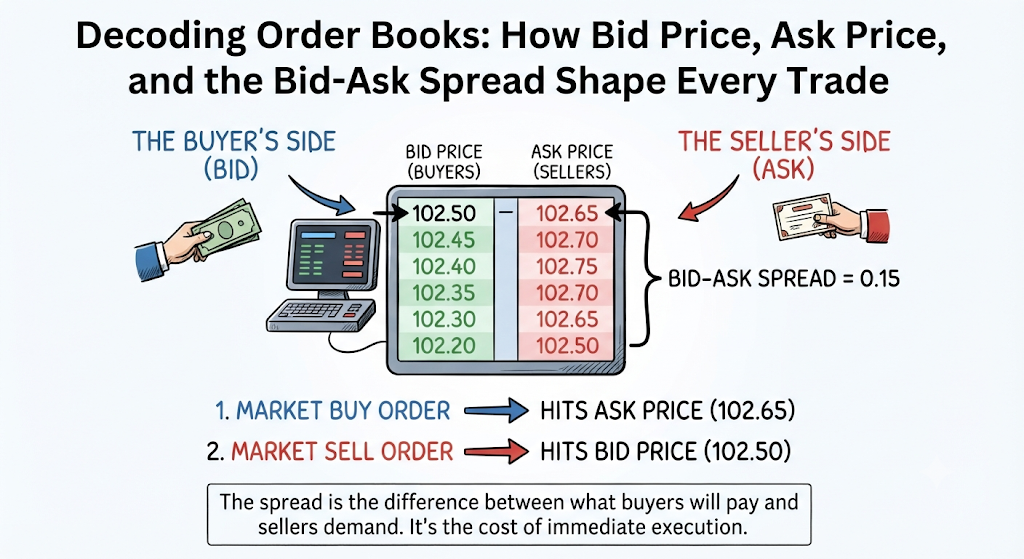
When you open your broker terminal to buy a share of an NSE-listed company, the headline Last Traded Price (LTP) rarely tells the whole story. Look one level deeper into the market depth window, and you will see two competing columns of numbers constantly flickering: the prices buyers are willing to pay and the prices sellers are demanding.
These two figures—the bid price and the ask price—form the live auction mechanism of the stock market. The gap between them, known as the bid-ask spread, acts as an invisible transaction cost on every trade you place. Understanding how these three elements interact helps you avoid unexpected slippage, read market liquidity accurately, and choose the right order type before hitting buy or sell.
The Two Sides of a Live Market Quote
Every stock exchange operates as a continuous double auction. Instead of a single fixed price tag, every tradable security carries two live quotes at any given second during market hours.
What Is the Bid Price?
The bid price represents the highest price a buyer is currently willing to pay for a share. When you place a sell order at the market price, your shares are matched against the highest available bid in the order book. Think of the bid column as the demand side of the market—buyers lining up with offers and waiting for a seller to accept.
What Is the Ask Price?
The ask price (also called the offer price) is the lowest price a seller is currently willing to accept to part with their shares. When you place a market buy order, you immediately purchase shares at the lowest available ask price. The ask column represents the supply side—sellers listing their minimum acceptable price.
How the Bid-Ask Spread Connects Them
The bid-ask spread is the numerical difference between the lowest ask price and the highest bid price:
$$\text{Bid-Ask Spread} = \text{Lowest Ask Price} – \text{Highest Bid Price}$$
To compare spreads fairly across low-priced and high-priced stocks, traders also express the spread as a percentage of the ask price:
$$\text{Spread Percentage} = \left( \frac{\text{Ask Price} – \text{Bid Price}}{\text{Ask Price}} \right) \times 100$$
| Component | Market Role | Who Interacts With It? | Price Priority in Order Book |
| Bid Price | Maximum price buyers offer | Market sellers sell into this price | Highest bid sits at the top |
| Ask Price | Minimum price sellers accept | Market buyers buy at this price | Lowest ask sits at the top |
| Bid-Ask Spread | Gap between supply and demand | Paid indirectly by market-order traders | Narrower gap means higher efficiency |
Walking Through a Real-World Order Book Example
Imagine you are looking at the market depth for a mid-cap stock on the NSE during regular trading hours:
- Last Traded Price (LTP): ₹500.00
- Best Bid Price: ₹499.80 (for 250 shares)
- Best Ask Price: ₹500.15 (for 180 shares)
Here, the bid-ask spread is ₹0.35 (or roughly 0.07%).
If you place a market buy order for 100 shares, your order executes immediately at ₹500.15—not the ₹500.00 LTP you saw on the main watchlist. Suppose you immediately change your mind and place a market sell order for those same 100 shares before the quotes move. Your sell order executes at ₹499.80. Even though the stock price itself did not move, you lose ₹0.35 per share (₹35 total, plus brokerage and statutory taxes) purely from crossing the bid-ask spread twice.
Now consider what happens if you want to buy 500 shares at market price when the best ask only offers 180 shares at ₹500.15:
- The first 180 shares fill at ₹500.15.
- The remaining 320 shares sweep into the next tier of the ask column—say, ₹500.40.
This upward price jump across multiple order-book levels is known as slippage, and it happens most often when large market orders meet thin order books.
Why Bid-Ask Spreads Widen or Narrow
Spreads are never static. They expand and contract throughout the trading session based on market conditions, stock characteristics, and news flow.
1. Trading Volume and Liquidity
Large-cap Nifty 50 stocks typically attract thousands of active buyers and sellers every second. Because orders constantly replenish both sides of the book, spreads often stay as tight as the minimum tick size (₹0.05 on Indian exchanges for most stocks). Conversely, thinly traded small-cap stocks or illiquid options contracts may have very few participants, resulting in wide spreads of several rupees.
2. Market Volatility and News Events
During earnings announcements, RBI monetary policy decisions, or sudden macroeconomic news, uncertainty spikes. Market makers and institutional traders widen their quotes—lowering their bids and raising their asks—to protect themselves against sudden price swings.
3. Time of Day
In the Indian equity market, spreads tend to be noticeably wider during the first 15 minutes after the 9:15 AM open as overnight orders settle and price discovery stabilizes. Spreads usually tighten during the mid-morning and afternoon sessions before occasionally widening again in the final minutes before the 3:30 PM close.
4. Share Price and Tick Size
A ₹0.10 spread on a ₹2,500 stock represents a negligible 0.004% cost. That exact same ₹0.10 spread on a ₹20 penny stock represents a 0.50% hurdle right from entry.
How Spreads Impact Different Market Participants
Not every market participant experiences the bid-ask spread in the same way:
- Long-Term Investors: If you are investing with a multi-year horizon in liquid blue-chip companies, a 0.02% or 0.05% spread has minimal impact on your overall return. However, if you accumulate shares in illiquid small-caps or sparsely traded ETFs, careless market orders can still erode 1% to 3% of your capital on day one.
- Intraday and Scalping Traders: Short-term traders rely on small price movements repeated over dozens of trades. A wide spread eats directly into profit margins because the stock must first move far enough to cover the spread—plus brokerage, STT, and exchange charges—before the trade breaks even.
- Options Traders: In index and stock options, particularly deep out-of-the-money (OTM) strikes or far-month expiries, bid-ask spreads can be disproportionately wide relative to the option premium. Entering or exiting such contracts with market orders frequently results in poor fills.
Practical Ways to Manage Bid-Ask Spread Costs
You cannot control market-wide liquidity, but you can control how your orders interact with the order book.
- Use Limit Orders Instead of Market Orders: A limit order lets you specify the maximum price you will pay to buy or the minimum price you will accept to sell. Instead of crossing the spread immediately, your order sits in the book waiting for the market to meet your price.
- Check Market Depth Before Placing Large Orders: Always inspect the top five bids and asks on your trading platform. Make sure the available quantity at the best quote can absorb your order size without pushing your fill into worse price tiers.
- Avoid Illiquid Counters for Short-Term Trades: Stick to stocks and derivatives with consistent daily turnover and tight percentage spreads when executing time-sensitive strategies.
- Let Opening Volatility Settle: Unless your strategy specifically targets opening breakouts, waiting 15 to 20 minutes after market open allows initial price discovery to finish and spreads to normalize.
Frequently Asked Questions
Why is the Last Traded Price (LTP) sometimes outside the current bid and ask?
LTP shows the price of the most recent completed transaction. If buyers or sellers cancel their orders or rapidly update their quotes right after a trade occurs, the new best bid and best ask can shift above or below the historical LTP until the next trade executes.
Can the bid price ever be higher than the ask price?
In an active, functioning order book, the bid price cannot remain higher than the ask price. Whenever a buyer places a bid equal to or higher than the lowest available ask, the exchange matching engine immediately executes a trade between them, removing those matched orders from the book.
Who earns the money from the bid-ask spread?
The stock exchange and your broker do not collect the bid-ask spread; they charge explicit transaction fees and brokerage. Instead, the spread is captured by liquidity providers and market makers who simultaneously post buy and sell limit orders, buying at the bid and selling at the ask.
What is considered a good bid-ask spread percentage?
For actively traded large-cap stocks, a spread under 0.05% is generally considered tight and highly liquid. Anything above 0.50% to 1.00% signals lower liquidity and requires extra caution with order sizing and limit pricing.
Do mutual funds have a bid-ask spread?
Open-ended mutual funds bought directly through an Asset Management Company (AMC) transact at the end-of-day Net Asset Value (NAV) and do not have a bid-ask spread. Exchange-Traded Funds (ETFs), however, trade live on stock exchanges and do carry bid-ask spreads just like individual shares.
Key Takeaway
The bid price, ask price, and bid-ask spread reveal the real-time balance between buyers and sellers behind every ticker symbol. While the Last Traded Price tells you where the market was, the bid and ask show you where you can actually transact right now. Making a habit of checking market depth and favoring limit orders over market orders ensures you stay in control of your execution price on every trade.