Introduction
Investing in mutual funds is one of the smartest ways to grow your wealth over time. You pool your money with other investors, and a professional manager invests it in stocks, bonds, or other assets.
However, many investors forget about one crucial detail until tax season arrives: taxes.
When you make a profit on your investments, the government takes a share. Ignoring tax rules can eat heavily into your returns. Understanding these rules does not require a degree in finance. Once you know how the system categorizes your investments and holding periods, managing your tax liability becomes simple. This guide breaks down mutual fund taxation using plain language, practical examples, and clear rules.
What Is Mutual Fund Taxation?
Mutual Fund Taxation refers to the taxes you pay on the earnings generated by your mutual fund investments.
These earnings generally come in two forms:
- Capital Gains: Profits made when you sell your mutual fund units at a higher price than your purchase price.
- Dividends:Payouts given by mutual funds out of their profits to investors.
Why It Matters
Taxes reduce your net returns. Two investments can give you the exact same percentage growth, but if one attracts a higher tax rate, your actual cash in hand will be much lower. Knowing the tax rules helps you choose the right holding period to keep more of your hard-earned money.
The Two Main Categories of Mutual Funds for Tax Purposes
To understand how your taxes are calculated, you must first know how tax laws divide mutual funds. For taxation, funds are broadly split into two categories:
- Equity-Oriented Funds: Mutual funds that invest at least 65 percent of their total assets in domestic company shares (stocks). This includes aggressive hybrid funds and certain arbitrage funds that maintain this equity threshold.
- Debt-Oriented and Other Funds (Non-Equity): Funds that invest primarily in fixed-income securities like corporate bonds, government securities, money market instruments, or gold, where equity exposure stays below 65 percent.
Understanding Holding Periods: Short-Term vs. Long-Term
Your tax rate depends heavily on your Holding Period. This is the exact duration between the day you buy your mutual fund units and the day you sell them.
- Short-Term Holding Period: Selling your investment relatively quickly.
- Long-Term Holding Period: Staying invested for a longer duration, which rewards you with lower tax rates.
The Turning Point
The exact timeline for what counts as “short-term” versus “long-term” differs between equity and debt funds.
Equity Mutual Fund Taxation Explained
Equity funds carry higher market risk because they invest in stocks, but the tax laws reward long-term investors with favorable rates.
1. Short-Term Capital Gains (STCG) on Equity Funds
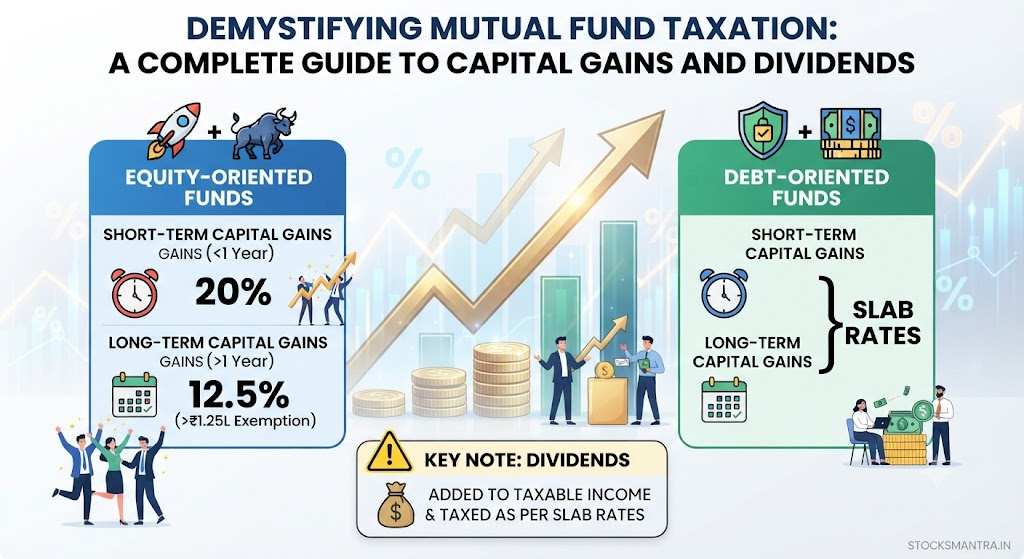
- Definition: Profits made when you sell your equity mutual fund units within one year (12 months) of purchase.
- Tax Rate: 20% (plus applicable surcharge and cess).
- Why it matters: Quick trading in equity funds attracts a steep tax penalty, reducing speculative gains.
2. Long-Term Capital Gains (LTCG) on Equity Funds
- Definition: Profits made when you sell your equity mutual fund units after holding them for more than one year (12 months).
- Tax Rate: 12.5% on gains exceeding ₹1.25 lakh in a financial year.
- Practical Example: If you invest ₹5 lakh in an equity fund and sell it after two years for ₹7 lakh, your total gain is ₹2 lakh. The first ₹1.25 lakh is exempt from tax. You only pay 12.5% tax on the remaining ₹75,000.
Debt Mutual Fund Taxation Explained
Debt funds invest in fixed-income bonds and money market tools. They are generally less volatile than equity funds, but tax rules for them have evolved over time to align closely with standard income tax slabs.
1. Short-Term and Long-Term Capital Gains on Debt Funds
- Rule: For most modern debt-oriented mutual funds (where equity exposure is below 65%), any capital gains—regardless of whether you hold them for days or years—are added directly to your taxable income and taxed according to your applicable income tax slab rate.
- Why it matters: If you fall in the highest tax bracket (e.g., 30%), your gains from debt funds will be taxed at 30%, just like salary or bank interest.
How Are Mutual Fund Dividends Taxed?
In the past, dividends were tax-free in the hands of the investor because companies paid a dividend distribution tax beforehand.
Today, the rules are direct:
- Tax Rule: Dividends declared by any mutual fund scheme are added directly to your total annual taxable income.
- Tax Rate: They are taxed according to your income tax slab rate.
- TDS (Tax Deducted at Source): If your total dividend income from a mutual fund distributor exceeds ₹5,000 in a financial year, the fund house will deduct 10% TDS before paying you.
Practical Example: Ramesh’s Mutual Fund Journey
To see how this works in real life, let us look at two investments made by Ramesh, a salaried professional:
- Investment A: Ramesh invested ₹1,000,000 in an Equity Fund. He sold it after 14 months, making a total profit of ₹200,000. Because his holding period exceeded 12 months, this is Long-Term Capital Gain. The first ₹1.25 lakh is tax-free. He pays 12.5% tax only on the remaining ₹75,000.
- Investment B: Ramesh invested ₹200,000 in a Debt Fund. He sold it after 6 months, making a profit of ₹20,000. Because it is a debt fund sold within a short window, the ₹20,000 is added to his annual salary income and taxed at his slab rate of 20%.
Common Mistakes Investors Make
Avoiding simple errors can save you significant money over your investing lifetime.
- Mistake 1: Ignoring the 12-month rule for equity.
- Why people do it: Needing emergency cash and selling units a few days before completing one year.
- The problem: You jump from a lower long-term tax rate to a higher short-term tax rate.
- What to do instead: If you can, wait until your units cross the 12-month mark to qualify for LTCG benefits.
- Mistake 2: Assuming all mutual funds have the same tax rate.
- Why people do it: Treating gold funds, hybrid funds, and equity funds identically.
- The problem: Asset allocation changes tax classification entirely. Always check the equity percentage of a fund before investing.
- Mistake 3: Forgetting to report capital gains during tax filing.
- Why people do it: Believing that if money stays inside the broker account, taxes do not apply.
- The problem: Tax authorities track financial transactions. Failing to report capital gains can lead to notices and penalties.
Risks and Limitations
- Regulatory Changes: Tax laws are not permanent. Governments frequently alter holding period definitions and tax percentages in annual budgets. Always stay updated on current financial year rules.
- Set-Off and Carry Forward of Losses: If you make a capital loss by selling mutual fund units at a loss, tax rules allow you to offset those losses against capital gains, but short-term and long-term loss rules have strict matching requirements.
Decision-Making Framework: How to Plan Your Investments for Tax Efficiency
Step 1: Define your financial goal and timeline. If your goal is short-term (under 1 year), expect higher tax friction on gains. If your goal is long-term (over 3–5 years), equity funds offer better tax efficiency.
Step 2: Check asset allocation. Confirm whether your chosen fund qualifies as an equity-oriented fund (65%+ in domestic equities) to benefit from the lower 12.5% LTCG rate.
Step 3: Track your holding periods. Before placing a sell order, check the exact purchase date of your units to ensure you clear the 12-month threshold for equity funds.
Step 4: Consult a certified tax professional. For complex portfolios spanning multiple asset classes, work with a chartered accountant or tax advisor to ensure accurate tax filing.
Checklist for Mutual Fund Tax Planning
- Verified whether your fund is classified as equity or non-equity.
- Checked the exact purchase date and calculated the holding duration before selling.
- Kept track of capital gains thresholds (such as the ₹1.25 lakh equity LTCG exemption limit).
- Downloaded the Consolidated Account Statement (CAS) or Capital Gains statement from your registrar (like CAMS or KFintech) before filing taxes.
- Accounted for dividend income in your annual income tax returns.
Key Terms
- Capital Gains: The profit you make when you sell an asset (like a mutual fund unit) for more than you bought it for.
- Holding Period: The length of time you hold an investment from the purchase date to the sale date.
- Equity Fund: A mutual fund scheme that invests the majority of its corpus in company stocks.
- Debt Fund: A mutual fund scheme that invests in fixed-income instruments like bonds and government securities.
- STCG (Short-Term Capital Gains): Profits taxed at higher rates due to a short holding duration.
- LTCG (Long-Term Capital Gains): Profits taxed at lower rates or granted exemptions due to a long holding duration.
- Dividend: A payout distributed by a company or mutual fund from its earnings to its investors.
- Slab Rate: The progressive income tax rate applicable to an individual based on their total taxable income bracket.
- Cess: An additional tax levied by the government for specific public purposes, added on top of base income or capital gains tax.
- Consolidated Account Statement (CAS): A single statement summarizing all your investments across different mutual fund houses.
Frequently Asked Questions
1. Do I have to pay tax when I switch my mutual funds from one scheme to another?
Yes. Switching from one mutual fund scheme to another is legally treated as selling your existing units and buying new ones. Any profit made during the switch is considered realized capital gain and is subject to taxation.
2. Are mutual fund dividends tax-free?
No. Dividends received from mutual funds are added to your total taxable income and taxed according to your individual income tax slab rate.
3. What happens if I sell my equity mutual funds at a loss?
If you sell equity mutual funds at a loss, it is called a capital loss. You can set off these losses against your capital gains to lower your overall tax liability. Unabsorbed losses can also be carried forward for up to eight financial years.
4. Is there any tax on investing in mutual funds?
No. You do not pay any tax when you buy or invest money into a mutual fund. Tax only applies when you redeem (sell) your units for a profit or receive dividend payouts.
5. How is tax calculated on SIP (Systematic Investment Plan) investments?
In an SIP, every installment you buy is treated as a separate, independent purchase. Therefore, when you sell units, each installment’s holding period is calculated individually from its specific purchase date using a First-In, First-Out (FIFO) method.
6. Do ELSS tax-saving funds have a lock-in period?
Yes. Equity Linked Savings Schemes (ELSS) come with a mandatory lock-in period of 3 years from the date of unit allotment. You cannot sell them before 3 years, which automatically qualifies any sale after the lock-in period as a long-term capital gain.
7. Can senior citizens get special tax exemptions on mutual funds? The tax rates on mutual fund capital gains (such as equity LTCG or STCG) remain the same regardless of age. However, senior citizens enjoy higher basic income tax exemption limits, which can help lower their overall tax burden when debt fund gains or dividends are added to their taxable income.
8. How do I get my tax statement for mutual fund investments? You can easily download a consolidated capital gains statement for free from official registrars like CAMS (camsonline.com) or KFintech (kfintech.com), or directly from your investment platform or broker portal.
Conclusion
Tax on mutual funds does not have to be confusing. By keeping track of whether your investments are in equity or debt funds, monitoring your holding periods carefully, and utilizing long-term horizons, you can legally minimize your tax burden. Smart investing is not just about picking the right funds; it is also about keeping as much of your profit as possible when you cash out. Plan your redemptions wisely, keep your records organized, and let your wealth grow steadily.