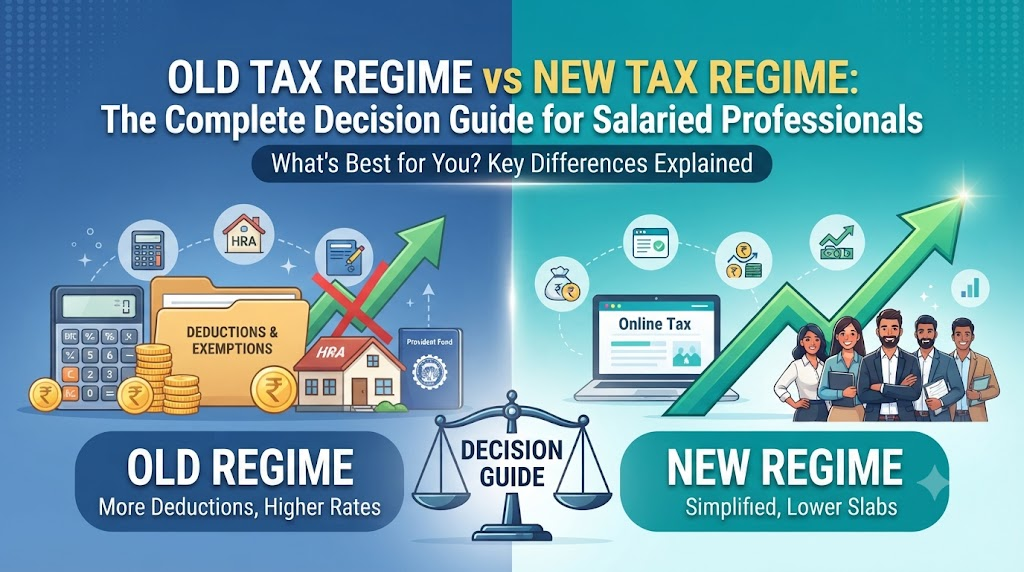
Introduction
Every financial year, millions of taxpayers face a familiar confusion: Should I stick to the old tax system, or should I move to the new one?
Choosing the wrong tax regime can cost you thousands of rupees in extra tax every single year. The confusion happens because both systems use different tax slabs and different rules for saving tax.
Many people choose a system simply because their colleagues or friends did, without checking their own numbers. This guide will break down both tax systems using simple language, clear examples, and a step-by-step decision framework to help you choose the right path for your income.
What Are Tax Regimes?
A tax regime is the set of rules, tax rates, and allowed deductions decided by the government for calculating how much income tax you must pay.
Think of it like two different billing plans at a phone service provider:
- The Old Tax Regime: A plan where your base bill is higher, but you get many discount coupons (deductions) for things you already buy or spend money on.
- The New Tax Regime: A plan with a lower base bill, but zero discount coupons allowed.
Why the Government Created Two Systems
For many years, India only had the old tax system. It encouraged people to save and invest money in specific financial products like life insurance, provident funds, and housing loans.
However, the government noticed that many people spent a lot of time and effort chasing paperwork just to lower their taxes, rather than focusing on simple investments. To fix this, the government introduced the new tax regime, which offers lower tax rates with fewer rules and lower paperwork.
How the Old Tax Regime Works
The old tax regime is built around the idea of rewarding savings and investments. Under this system, your tax is calculated after subtracting various deductions from your total income.
Key Features of the Old Regime
- Higher Slabs: The tax rates are generally higher compared to the new system.
- Deductions & Exemptions: You can reduce your taxable income using popular sections like:
- Section 80C: Up to ₹1.5 lakh for investments like Public Provident Fund (PPF), Employee Provident Fund (EPF), life insurance, and tuition fees.
- Section 80D: Deductions for health insurance premiums.
- Section 24: Interest paid on a home loan (up to ₹2 lakh).
- HRA (House Rent Allowance): Tax exemption on rent paid for housing.
- Standard Deduction: A flat deduction available to all salaried employees.
Example of Old Regime Calculation
If you earn ₹10,00,000 in a year and successfully claim ₹2,50,000 in total deductions (EPF, home loan interest, and health insurance), your taxable income drops to ₹7,50,000. Your tax is then calculated on ₹7,50,000 instead of ₹10,00,000.
How the New Tax Regime Works
The new tax regime was introduced to make tax filing simpler. It offers lower tax rates across broader income brackets, but it removes almost all deductions.
Key Features of the New Regime
- Lower Tax Slabs: The income ranges where taxes apply are wider, and the rates are reduced.
- No Deductions: You cannot claim Section 80C, 80D, HRA, or home loan interest for self-occupied property.
- Standard Deduction: A standard deduction is available under the new regime as well, making salaried individuals eligible for basic tax relief.
- Default Option: By default, tax systems now select the new regime unless you specifically choose the old one when filing your returns or submitting investment proofs to your employer.
Key Differences: Old vs. New Tax Regime
| Feature | Old Tax Regime | New Tax Regime |
| Tax Slabs | Higher rates | Lower rates |
| Deductions (80C, 80D, etc.) | Fully allowed | Mostly removed |
| HRA & LTA Exemptions | Allowed | Not allowed |
| Home Loan Interest (Self-Occupied) | Allowed (up to ₹2 lakh) | Not allowed |
| Paperwork & Proof Submission | High (requires bills and receipts) | Very low |
| Best Suited For | People with high home loans and investments | People with few deductions and simple investments |
Why Choosing the Right Regime Matters
Choosing the wrong tax regime means you pay more tax than necessary.
If you have a large home loan and invest heavily in insurance and retirement funds every year, switching to the new regime blindly will cause you to lose valuable tax savings. Conversely, if you live in your own house, rent nothing, and do not invest in tax-saving instruments, sticking to the old regime means you pay higher tax rates for no reason.
Common Mistakes Taxpayers Make
- Choosing Blindly Based on Colleagues: Every person has different financial commitments, loans, and rent expenses. What saves tax for your coworker might cost you money.
- Ignoring Home Loan Interest: Many homeowners automatically pick the new regime without realizing that losing the home loan interest deduction under Section 24 increases their overall tax outgo.
- Forgetting to Re-evaluate Yearly: Your financial life changes every year. A regime that saved you money last year might not be the best choice this year if your salary or expenses change.
- Last-Minute Panic Decisions: Deciding your tax regime at the very last moment without calculating the exact numbers often leads to financial losses.
Risks and Limitations
- Lock-in Periods: To save tax under the old regime, you often lock your money into long-term products like PPF or tax-saving mutual funds (ELSS) which cannot be easily withdrawn in emergencies.
- Regulatory Changes: Tax slabs and deduction rules change during annual government budgets. Relying on outdated tax slab numbers can lead to calculation errors.
- Employer Restrictions: Most companies allow you to change your tax regime choice only once a year at the beginning of the financial cycle. Changing it later during the year can sometimes create payroll complications.
Decision-Making Framework: Which One Should You Choose?
Follow this simple step-by-step process to find out which regime works best for you:
- Step 1: Calculate Your Total Eligible Deductions. Add up your expected Section 80C investments, health insurance (80D), home loan interest (Section 24), HRA, and standard deduction.
- Step 2: Compare the Threshold. If your total deductions exceed the tipping point (typically around ₹1.5 to ₹2.5 lakhs depending on your specific income bracket), the Old Tax Regime usually wins.
- Step 3: Check Your Rent and Loans. If you pay high rent in a metro city and pay off a home loan, calculate your tax under the old regime first.
- Step 4: Keep It Simple if Deductions Are Low. If you do not have a home loan and your Section 80C investments are minimal, choose the New Tax Regime to enjoy lower tax rates without paperwork hassles.
- Step 5: Test Both Using Online Calculators. Always plug your exact numbers into the official Income Tax calculator before submitting your choice to your employer or filing your return.
Checklist Before Submitting Your Tax Choice
- Calculated total annual salary and taxable income accurately.
- Listed all valid deductions (80C, 80D, HRA, home loan interest).
- Compared total tax payable under both old and new slabs.
- Checked company HR or payroll deadlines for submitting the regime choice.
- Saved all financial proofs and receipts if choosing the old regime.
Key Terms
- Tax Deduction: An amount you can subtract from your total income to lower the amount of tax you owe.
- Tax Slabs: Different income ranges that are taxed at different percentage rates.
- Exemption: Specific parts of your income (like HRA) that are completely free from tax.
- Standard Deduction: A flat, fixed deduction subtracted from your salary before tax is calculated, available to all salaried employees.
- Assessment Year (AY): The year in which your income from the previous year is evaluated and taxed.
FAQs
Can I switch between the old and new tax regimes every year?
If you are a salaried individual with business income, the rules differ, but general salaried taxpayers can usually choose their preferred regime every financial year when filing their Income Tax Return (ITR).
Is the Standard Deduction available in the new tax regime?
Yes. Recent tax updates allow salaried individuals to claim the standard deduction under both the old and the new tax regimes.
What happens if I forget to choose a tax regime?
If you do not make a choice, your employer or the tax department will automatically calculate your tax using the new tax regime as the default option.
Are children’s school tuition fees deductible under the new regime?
No. Tuition fee deductions fall under Section 80C, which is completely removed under the new tax regime.
Does the new regime eliminate all tax-saving investments?
The new regime does not stop you from making investments; it simply removes the tax benefits attached to them. You are still free to invest in PPF, mutual funds, or insurance for wealth creation, but they will not lower your tax bill under the new rules.
Conclusion
Choosing between the old and new tax regime does not require a degree in finance. It simply requires comparing your total annual deductions against the lower tax rates offered by the new system.
Take a few minutes to calculate your potential deductions, test both options, and choose the regime that leaves more money in your bank account. Review your choice at the start of every financial year to stay on top of your financial planning.