Introduction
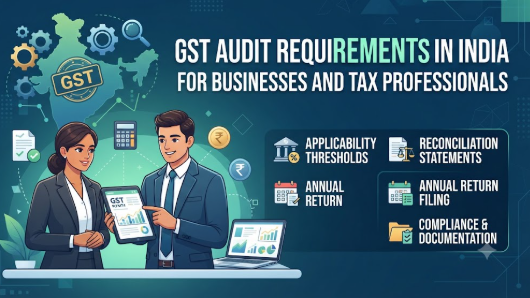
GST compliance does not end with filing monthly returns. Many businesses later find differences between their accounting records, GSTR-1, GSTR-3B, GSTR-2B and annual financial statements. These differences may relate to unreported invoices, incorrect input tax credit, credit notes, reverse charge or turnover recorded under multiple GST registrations. Understanding GST Audit Requirements in India helps business owners, accountants and tax professionals identify such issues before they lead to notices, interest or penalties. This guide explains GSTR-9, GSTR-9C, turnover limits, departmental audits, special audits, required documents and practical reconciliation steps in simple language.
What Are GST Audit Requirements in India?
GST audit requirements refer to the procedures used to examine a registered person’s:
- Accounting records
- GST returns
- Sales and purchase transactions
- Tax payments
- Input tax credit claims
- Refunds
- Exemptions
- Tax rates
- Supporting documents
- Overall compliance with GST law
In simple terms, GST audit and reconciliation help determine whether the information reported to the GST authorities is complete, accurate and supported by business records.
The phrase “GST audit” is commonly used for several different activities. These should not be confused with one another.
Annual GST reconciliation
A taxpayer may need to file:
- Form GSTR-9 as the annual return
- Form GSTR-9C as the self-certified reconciliation statement
Form GSTR-9C is generally applicable when aggregate turnover during the financial year exceeds ₹5 crore. Under the current framework, it is self-certified by the taxpayer rather than certified as a GST audit report by a Chartered Accountant or Cost Accountant.
Departmental GST audit
Tax officers may conduct an audit under Section 65 of the CGST Act. This can involve checking books, invoices, returns, input tax credit, tax rates, exemptions and refunds.
Special GST audit
A special audit under Section 66 may be directed when an officer considers that the value declared may not be correct or input tax credit may not be within normal limits. It is conducted by a Chartered Accountant or Cost Accountant nominated by the Commissioner.
Internal GST review
Many responsible businesses conduct an internal GST review even when GSTR-9C is not mandatory. This is not a separate statutory audit, but it can help identify errors before they result in notices, interest or penalties.
Simple illustration
Suppose a company reports annual taxable sales of ₹8.20 crore in its accounting records but only ₹7.95 crore in GST returns.
The ₹25 lakh difference may have arisen from unreported invoices, incorrect credit notes, timing differences or non-GST income included in the books. The reconciliation process must identify the reason and determine whether additional GST is payable.
Why GST Audit Compliance Is Important
GST compliance is not limited to filing monthly returns. Every return becomes part of a larger financial trail.
The department may compare information from:
- GSTR-1
- GSTR-3B
- GSTR-2B
- E-invoices
- E-way bills
- Annual financial statements
- Income-tax records
- TDS and TCS information
- Import and export records
- Bank transactions
- Customer and supplier declarations
A difference does not automatically mean tax evasion. It may be caused by timing, classification or accounting treatment. However, unexplained differences may lead to scrutiny.
It helps prevent tax shortfalls
Reconciliation can identify invoices that were recorded in the books but omitted from GST returns.
It protects eligible input tax credit
A business may have valid purchase invoices but may still face difficulty if the supplier has not reported them correctly or if the credit is restricted under GST law.
It supports accurate financial reporting
GST turnover, tax liabilities and input tax credit balances should agree with the financial statements and supporting ledgers.
It improves cash-flow planning
An unexpected tax shortfall discovered after year-end may create financial pressure. Regular reconciliation helps businesses identify liabilities earlier.
It strengthens lender and investor confidence
Clean tax records can support due diligence conducted by banks, investors, buyers and other stakeholders.
It reduces notice-related stress
Businesses with organised records can respond to departmental queries faster and more accurately.
Practical situation
A wholesaler notices a ₹6 lakh difference between input tax credit claimed in GSTR-3B and eligible credit appearing in GSTR-2B.
Instead of ignoring the difference, the business reviews invoice dates, supplier filings, import documents and blocked credits. It finds that ₹2 lakh relates to eligible import IGST, ₹1 lakh was reported late by suppliers and ₹3 lakh is unsupported.
The business can then take corrective action based on the nature of each difference.
Detailed Breakdown of GST Audit Requirements in India
Current Legal Framework for GST Audits
The current GST audit framework has three major parts:
- Annual return and self-certified reconciliation
- Departmental audit by tax authorities
- Special audit by a nominated professional
The earlier requirement under which specified taxpayers had to get their accounts audited under GST by a Chartered Accountant or Cost Accountant was removed.
From 1 August 2021, Rule 80 provides that taxpayers whose aggregate turnover exceeds ₹5 crore during a financial year must furnish a self-certified reconciliation statement in Form GSTR-9C with Form GSTR-9. The normal statutory due date is 31 December following the end of the relevant financial year, unless extended.
The change is important because:
- The responsibility for certification now lies with the taxpayer.
- Management must understand significant reconciliations.
- Professional assistance may still be advisable.
- Incorrect self-certification can create compliance exposure.
- Financial statements and GST records must still be reconciled carefully.
Types of GST Audits and Annual Compliance
Annual return in Form GSTR-9
Form GSTR-9 is an annual return containing consolidated information relating to:
- Outward supplies
- Inward supplies
- Input tax credit
- Tax paid
- Refunds
- Demands
- Previous-year transactions reported later
- HSN-wise details, where applicable
The GST portal requires taxpayers to file all applicable GSTR-1 or IFF statements and GSTR-3B returns for the relevant year before filing GSTR-9.
Reconciliation statement in Form GSTR-9C
Form GSTR-9C compares the figures reported in GST returns with the audited annual financial statements.
It primarily covers:
- Turnover reconciliation
- Taxable turnover reconciliation
- Rate-wise tax liability
- Tax paid reconciliation
- Input tax credit reconciliation
- Reasons for differences
- Additional liability, where applicable
Departmental audit under Section 65
A departmental audit is conducted by authorised tax officers.
It may cover:
- One financial year
- Part of a financial year
- Multiple financial years
- Records maintained at the business premises
- Records submitted to the department’s office
Special audit under Section 66
A special audit is conducted by a Chartered Accountant or Cost Accountant nominated by the Commissioner.
It may be ordered even when the taxpayer’s accounts have already been audited under another law.
Internal GST health check
An internal GST health check may be conducted monthly, quarterly or annually.
It can cover:
- Sales reconciliation
- Purchase reconciliation
- Vendor compliance
- E-invoice matching
- E-way bill matching
- Reverse charge review
- Tax-rate verification
- Place-of-supply verification
- Credit note review
- Input tax credit eligibility
GST Audit Turnover Limits and Applicability
Table 1: General GST Annual Compliance Position
| Aggregate turnover position | General annual compliance position | Important consideration |
|---|---|---|
| Up to ₹2 crore | GSTR-9 may be exempted for a financial year through a specific government notification | Verify the notification applicable to the exact financial year |
| Above ₹2 crore and up to ₹5 crore | GSTR-9 is generally required, while GSTR-9C is generally not required | Complete all periodic returns and reconcile turnover and ITC |
| Above ₹5 crore | GSTR-9 and self-certified GSTR-9C are generally required | Reconcile GST returns with audited annual financial statements |
| Taxpayer selected under Section 65 | Departmental audit may apply regardless of turnover | Respond to Form GST ADT-01 and maintain complete records |
| Taxpayer directed under Section 66 | Special audit may apply regardless of turnover | Audit is conducted by a CA or CMA nominated by the Commissioner |
Understanding Aggregate Turnover
Aggregate turnover is not limited to the turnover of one GST registration.
It is generally calculated on an all-India PAN basis and includes:
- Taxable supplies
- Exempt supplies
- Zero-rated supplies
- Exports
- Inter-state supplies
- Supplies made by different branches under the same PAN
- Outward supplies on which tax is payable by the recipient under reverse charge
It generally excludes:
- CGST
- SGST
- UTGST
- IGST
- Compensation cess
- Inward supplies on which tax is payable under reverse charge
CBIC guidance confirms that aggregate turnover is computed on an all-India basis and that inward supplies liable to reverse charge are not included.
Multiple GST registrations under one PAN
Suppose a company has:
- Delhi GSTIN turnover: ₹2.40 crore
- Haryana GSTIN turnover: ₹1.80 crore
- Maharashtra GSTIN turnover: ₹1.50 crore
The all-India aggregate turnover is ₹5.70 crore.
The threshold analysis should therefore not be performed by looking at each GSTIN in isolation.
At the same time, GSTR-9 is filed at the GSTIN level. A person with multiple registrations must prepare the annual return separately for each applicable registration.
This means that businesses may need:
- State-wise trial balances
- GSTIN-wise revenue allocation
- Branch-level input tax credit records
- Cross-charge or ISD documentation
- State-wise reconciliation workings
GSTR-9 Annual Return Requirements
Form GSTR-9 provides an annual summary of GST transactions.
Main categories covered
The form generally includes:
- Taxable outward supplies
- Exempt supplies
- Nil-rated supplies
- Non-GST supplies
- Export supplies
- Supplies to SEZ units or developers
- Advances
- Reverse charge transactions
- Input tax credit claimed
- Input tax credit reversed
- Ineligible input tax credit
- Tax paid
- Refunds
- Demands
- HSN-wise details
- Previous-year transactions reported during the permitted period
The GST portal auto-populates several fields using information already filed in GSTR-1 and GSTR-3B. Table 8A is populated using GSTR-2A or GSTR-2B data, depending on the relevant financial year.
General exclusions
The GST portal identifies certain categories that are not required to file GSTR-9, including:
- Casual taxable persons
- Non-resident taxable persons
- Input Service Distributors
- Certain OIDAR service providers
- Persons covered by specific statutory exclusions or notifications
Taxpayers should verify their exact category instead of relying only on turnover.
Important filing conditions
Before filing GSTR-9:
- All applicable GSTR-1 or IFF statements must be filed.
- All applicable GSTR-3B returns must be filed.
- Annual figures should be reconciled with books.
- Additional liability should be calculated.
- Late fee, where applicable, should be paid.
- The final draft should be reviewed before submission.
GSTR-9 cannot be revised after filing. The GST portal allows taxpayers to preview the draft before submission, making the review stage especially important.
Additional tax liability
A taxpayer can disclose additional liability in GSTR-9 if it was not reported earlier.
The additional liability is generally paid through Form GST DRC-03 using the electronic cash ledger. Unclaimed input tax credit cannot be newly claimed through GSTR-9.
GSTR-9C Reconciliation Statement Requirements
GSTR-9C is not simply a duplicate of the annual return. It reconciles the annual GST information with the financial statements.
GSTR-9C applicability
Under the current Rule 80 framework, GSTR-9C is generally required when aggregate turnover during the financial year exceeds ₹5 crore.
The form is self-certified by the taxpayer.
The removal of compulsory CA or CMA certification does not prevent a business from seeking professional assistance. For complex businesses, independent review can reduce the risk of inaccurate self-certification.
Main reconciliations in GSTR-9C
Gross turnover
The business compares turnover from:
- Audited financial statements
- GST returns
- Branch records
- State-wise financial data
- GSTR-9
Adjusted annual turnover
Adjustments may be needed for:
- Unbilled revenue
- Advances
- Credit notes
- Debit notes
- Deemed supplies
- Schedule I supplies
- Turnover reported in another financial year
- Non-GST income
- Foreign exchange differences
- Sales returns
- Branch transfers
Taxable turnover
The business must separate:
- Taxable supplies
- Exempt supplies
- Nil-rated supplies
- Non-GST supplies
- Zero-rated supplies without payment of tax
- Supplies on which the recipient pays tax under reverse charge
Tax liability
Tax payable should be reviewed rate-wise and compared with:
- GSTR-1
- GSTR-3B
- GSTR-9
- Output GST ledgers
- E-invoice data
Input tax credit
Input tax credit should be reconciled among:
- Purchase register
- General ledger
- GSTR-3B
- GSTR-2B
- Import documents
- Input Service Distributor credits
- Reverse charge payments
- Capital goods register
- Expense ledgers
Additional liability
Unreconciled differences may result in:
- Additional tax
- Interest
- Input tax credit reversal
- Explanatory disclosure
- Further professional review
Departmental Audit Under Section 65
A departmental audit can be initiated for any registered person selected by the tax authorities. There is no general turnover-based protection from such an audit.
Audit notice
The proper officer issues a notice in Form GST ADT-01.
The registered person must generally receive at least 15 working days’ notice before the audit begins.
Audit location
The audit may be conducted:
- At the taxpayer’s place of business
- At the tax department’s office
- Through electronic submission of records
- Through a combination of physical and electronic verification
Audit period
The audit may cover:
- A financial year
- Part of a financial year
- Multiple financial years
Areas examined
Tax officers may verify:
- Books of account
- GST returns
- Turnover
- Exemptions
- Deductions
- Tax rates
- Input tax credit
- Refund claims
- Reverse charge liability
- Place of supply
- E-invoices
- E-way bills
- Related-party transactions
- Supporting records
The official audit rules specifically permit verification of the correctness of turnover, exemptions, deductions, tax rates, input tax credit, refunds and other relevant matters.
Time allowed for completion
A departmental audit is ordinarily required to be completed within three months from its commencement.
The Commissioner may extend this period by a further period not exceeding six months where the prescribed conditions are satisfied.
Audit findings
After considering the taxpayer’s explanation, findings are communicated through Form GST ADT-02.
Where an audit detects short payment, wrongful input tax credit, erroneous refund or another non-compliance, further proceedings may be initiated under the applicable provisions.
Special Audit Under Section 66
A special audit is different from a routine departmental audit.
It may be ordered during scrutiny, inquiry, investigation or another proceeding when the officer considers that:
- The value declared may not be correct.
- Input tax credit claimed may not be within normal limits.
- The case is complex.
- A detailed professional examination is necessary.
Who orders the audit?
An Assistant Commissioner or an officer above that rank may direct a special audit with prior approval of the Commissioner.
Who conducts it?
The audit is conducted by a Chartered Accountant or Cost Accountant nominated by the Commissioner.
The taxpayer does not independently select the auditor.
Applicable form
The direction is issued in Form GST ADT-03.
The findings are communicated in Form GST ADT-04.
Time limit
The nominated professional generally submits the report within 90 days.
The period may be extended by a further 90 days for sufficient reasons.
Audit cost
The cost of the special audit, including the professional’s remuneration, is determined and paid by the Commissioner.
Opportunity of being heard
Where material from the special audit is proposed to be used against the taxpayer, the registered person must be given an opportunity of being heard.
Records and Documents Required
A well-prepared business should maintain records throughout the year rather than collecting documents only after receiving a notice.
Registration records
- GST registration certificate
- Amendments to registration
- Details of additional places of business
- Authorised signatory details
- Branch and GSTIN list
Financial records
- Audited financial statements
- Balance sheet
- Profit and loss account
- Trial balance
- General ledger
- Cash book
- Bank book
- Journal register
- Fixed asset register
- Stock records
Sales records
- Tax invoices
- Bills of supply
- Export invoices
- E-invoices
- Credit notes
- Debit notes
- Delivery challans
- Advance receipts
- Customer ledgers
- Sales register
- E-way bill data
Purchase and expense records
- Purchase invoices
- Expense vouchers
- Vendor ledgers
- Import bills of entry
- Reverse charge invoices
- Payment records
- Capital asset invoices
- Input Service Distributor documents
GST records
- GSTR-1
- GSTR-3B
- GSTR-2A
- GSTR-2B
- GSTR-9
- GSTR-9C
- GSTR-7 or GSTR-8 data, where relevant
- Electronic cash ledger
- Electronic credit ledger
- Electronic liability register
- DRC-03 payment records
- Refund applications
- Departmental notices and replies
Special supporting documents
- Agreements
- Purchase orders
- Work orders
- Job-work challans
- Export documentation
- Letter of undertaking
- SEZ endorsements
- Related-party valuation workings
- Place-of-supply analysis
- Exemption notifications
- Tax-rate opinions
GST rules require relevant accounts, invoices, bills of supply, credit and debit notes, delivery challans and records relating to stock, inward supplies and outward supplies to be preserved for the statutory period.
Step-by-Step Practical Guide to GST Audit Preparation
Step 1: Determine the applicable turnover
What it means
Calculate aggregate turnover across all GST registrations held under the same PAN.
Why it matters
The turnover determines whether GSTR-9C may be applicable and whether an annual-return exemption may be available.
How to apply it
Combine:
- Taxable turnover
- Exempt turnover
- Export turnover
- Inter-state turnover
- Turnover of every branch under the PAN
Exclude GST and inward reverse charge supplies.
Practical application
A company with three GSTINs showing ₹2 crore, ₹1.75 crore and ₹1.50 crore has aggregate turnover of ₹5.25 crore, subject to final reconciliation.
Step 2: Confirm the taxpayer category
What it means
Check whether the registration is regular, composition, ISD, casual, non-resident, TDS, TCS or another category.
Why it matters
Different categories have different annual filing requirements.
How to apply it
Review:
- Registration certificate
- Return filing history
- Composition status
- Cancellation or suspension periods
- Conversion between schemes
Practical application
A taxpayer that moved from composition to the regular scheme during the year may have different reporting obligations for each period.
Step 3: Download complete GST data
What it means
Collect all filed returns, auto-populated statements and electronic ledgers.
Why it matters
Reconciliation cannot be completed reliably using accounting data alone.
How to apply it
Download:
- GSTR-1 summaries
- GSTR-3B returns
- GSTR-2B statements
- Electronic ledgers
- E-invoice records
- E-way bill records
- Annual-return system summaries
Practical application
A business creates month-wise folders containing returns, challans, invoice data and reconciliation files.
Step 4: Reconcile outward supplies
What it means
Compare sales reported in the books with GSTR-1, GSTR-3B and e-invoice data.
Why it matters
Differences may lead to short payment, excess payment or incorrect reporting.
How to apply it
Check:
- Invoice number
- Invoice date
- GSTIN
- Taxable value
- Tax rate
- Place of supply
- Credit notes
- Debit notes
- Export status
- Reverse charge classification
Practical application
An invoice recorded in March but uploaded in April should be identified as a timing difference rather than left unexplained.
Step 5: Reconcile input tax credit
What it means
Compare input tax credit claimed with purchase records and GSTR-2B.
Why it matters
Unsupported or ineligible credit may result in reversal, interest and further proceedings.
How to apply it
Classify differences into:
- Supplier filed late
- Invoice missing from GSTR-2B
- Import IGST
- Reverse charge credit
- Blocked credit
- Duplicate claim
- Credit claimed under the wrong GSTIN
- Credit not claimed
- Credit requiring reversal
Practical application
Motor vehicle expenses, employee-related expenses and personal expenditure should be reviewed separately for blocked-credit restrictions.
Step 6: Review tax payments and reverse charge
What it means
Verify whether all output tax and reverse charge liabilities were paid correctly.
Why it matters
Reverse charge entries are commonly missed because the supplier may not charge GST on the invoice.
How to apply it
Review:
- Legal fees
- Director-related services, where applicable
- Goods transport agency services
- Import of services
- Sponsorship
- Security services in covered cases
- Other notified supplies
Practical application
A foreign software subscription used by an Indian business may require review under import-of-service and reverse-charge provisions.
Step 7: Prepare annual reconciliation workings
What it means
Create clear schedules supporting every major difference.
Why it matters
A single unexplained figure in GSTR-9C can create future difficulties.
How to apply it
Prepare:
- Turnover reconciliation
- Taxable turnover reconciliation
- Tax-rate reconciliation
- Tax-paid reconciliation
- Input tax credit reconciliation
- Expense-wise ITC schedule
- Additional liability schedule
- GSTIN-wise trial balance
Practical application
Non-GST income such as interest is separately identified instead of being mixed with taxable operating revenue.
Step 8: Conduct management review before filing
What it means
The authorised signatory and responsible finance personnel review the final return and reconciliation.
Why it matters
GSTR-9 cannot be revised after filing, and GSTR-9C is self-certified.
How to apply it
Management should review:
- Major differences
- Tax shortfalls
- ITC reversals
- Legal positions
- Supporting evidence
- Additional payments
- Final declarations
Practical application
The finance head signs a documented review note confirming that major reconciliations and payments have been examined.
Five Practical Real-Life Examples
Example 1: Sales invoice omitted from GSTR-1
Situation: A service invoice of ₹5 lakh was recorded in the books but omitted from GSTR-1 and GSTR-3B.
Challenge: The annual books show higher revenue than GST returns.
Better action: Calculate the applicable tax and interest, consider payment through the prescribed process, and disclose the difference correctly.
Learning: Monthly sales reconciliation can prevent year-end tax shortfalls.
Example 2: Supplier invoice missing from GSTR-2B
Situation: A business claimed input tax credit on an invoice that never appeared in GSTR-2B.
Challenge: The supplier did not report the invoice under the correct GSTIN.
Better action: Contact the supplier, verify the invoice and determine whether the credit must be reversed or otherwise treated under the applicable law.
Learning: Possessing an invoice alone may not resolve every ITC eligibility issue.
Example 3: Credit note entered only in books
Situation: A customer returned goods and the business entered a credit note in its accounting software but did not report it in GST returns.
Challenge: Book turnover became lower than GST turnover.
Better action: Check the permitted reporting period and determine the correct GST treatment before preparing the annual return.
Learning: Financial credit notes and GST credit notes must be reviewed separately.
Example 4: Multiple GSTIN turnover ignored
Situation: A company checked each state registration separately and concluded that none crossed ₹5 crore.
Challenge: The combined PAN-based aggregate turnover exceeded ₹5 crore.
Better action: Calculate all-India aggregate turnover first and then prepare GSTIN-wise annual compliance.
Learning: Threshold analysis should not be limited to one state registration.
Example 5: Personal expense included in input tax credit
Situation: GST on personal travel and non-business expenditure was claimed through the company’s GSTR-3B.
Challenge: The expenditure did not satisfy business-use and eligibility conditions.
Better action: Identify the ineligible credit, reverse it where required and strengthen expense-approval controls.
Learning: Every invoice bearing the company’s GSTIN does not automatically create eligible input tax credit.
Common Problems Readers Face
Lack of clarity about the meaning of GST audit
Many businesses continue to use outdated information and assume that GSTR-9C must still be certified by a Chartered Accountant.
The present system requires self-certification for eligible taxpayers, although professional review may remain useful.
Incorrect turnover calculation
Businesses may:
- Exclude exempt supplies
- Ignore branch turnover
- Ignore export turnover
- Calculate turnover GSTIN-wise instead of PAN-wise
- Include GST in turnover
- Include inward reverse charge supplies incorrectly
Weak monthly reconciliation
When reconciliation is postponed until year-end, the finance team may need to review thousands of invoices within a short period.
Overdependence on auto-populated data
Auto-populated figures are useful, but they do not replace accounting verification.
Incorrect source returns can produce incorrect annual figures.
Unexplained GSTR-1 and GSTR-3B differences
A business may report invoices in GSTR-1 but fail to pay the corresponding liability in GSTR-3B.
Poor input tax credit controls
Common problems include:
- Duplicate credit
- Credit claimed under the wrong GSTIN
- Blocked credit
- Missing supplier invoices
- Credit claimed before receiving goods or services
- Failure to reverse credit where required
- Incorrect treatment of capital goods
Ignoring reverse charge
Reverse charge liabilities may be missed because the supplier’s invoice does not contain normal GST.
Incomplete branch accounting
Businesses with multiple GSTINs may not maintain state-wise trial balances, making GSTR-9C preparation difficult.
Unsupported exemptions
A supply may be treated as exempt without preserving the relevant notification, agreement or supporting evidence.
Filing without final review
Because GSTR-9 cannot be revised, premature filing can create permanent reporting inconsistencies.
Mistakes to Avoid
Using an outdated GST audit threshold
The earlier GST audit framework should not be confused with the current self-certified GSTR-9C requirement.
Assuming professional review is unnecessary
Self-certification does not mean that complex tax positions should be handled without qualified advice.
Matching only total turnover
A total turnover match can hide errors in:
- Tax rate
- Place of supply
- Taxable classification
- Exempt classification
- Export reporting
- Reverse charge
- Credit notes
Ignoring GSTR-2B differences
Differences should be classified and explained rather than carried forward without review.
Treating GSTR-9 as a revision return
GSTR-9 is not a general replacement for correcting every historical return.
It can report specified annual information and additional liability, but it cannot be used to claim previously unclaimed ITC.
Using balancing figures without evidence
Do not insert arbitrary adjustments merely to make the books and returns agree.
Filing GSTR-9 before completing GSTR-9C
Where GSTR-9C is applicable, the annual-return obligation is not treated as complete until both forms are furnished. CBIC has clarified that late fee may continue until the complete annual return, including GSTR-9C where applicable, is filed.
Ignoring notices
A notice should be reviewed immediately and assigned to a responsible person.
Sharing portal credentials carelessly
GST login credentials, digital signatures, OTPs and sensitive financial data should be protected.
Don’t Do This Checklist
- Do not calculate turnover using only one GSTIN.
- Do not claim every purchase invoice as eligible ITC.
- Do not ignore reverse charge transactions.
- Do not file GSTR-9 without previewing the final return.
- Do not use unsupported turnover adjustments.
- Do not submit false explanations for reconciliation differences.
- Do not depend entirely on accounting software classification.
- Do not ignore cancelled invoices and credit notes.
- Do not delay responding to Form GST ADT-01.
- Do not alter records after receiving an audit notice without maintaining a transparent correction trail.
- Do not share digital signature access with unauthorised persons.
- Do not treat self-certification as a routine formality.
Table 2: Common Reconciliation Differences and Correct Response
| Reconciliation difference | Possible reason | Better compliance response |
|---|---|---|
| Books turnover higher than GSTR-1 | Unreported invoice, timing difference or non-GST income | Identify invoice-level difference and determine tax liability |
| GSTR-1 turnover higher than books | Duplicate invoice, advance reporting or accounting omission | Trace the transaction and correct the accounting or GST treatment |
| GSTR-3B liability lower than GSTR-1 | Tax not paid on reported invoices | Calculate shortfall and applicable interest |
| ITC in GSTR-3B higher than GSTR-2B | Missing supplier filing, blocked credit, import or reverse charge difference | Classify each item and retain supporting documents |
| ITC in books higher than GSTR-3B | Credit not claimed, timing issue or ineligible credit | Determine whether credit was legally available within the prescribed period |
| Financial revenue higher than GST turnover | Non-GST income, branch allocation or unbilled revenue | Prepare a documented turnover reconciliation |
| E-way bill value higher than sales register | Cancelled movement, delivery challan, stock transfer or duplicate e-way bill | Match document-wise and retain cancellation evidence |
| Export turnover mismatch | Foreign exchange difference, shipping bill timing or invoice amendment | Reconcile invoice, shipping and receipt records |
| Credit note mismatch | Note not reported or treated as a financial adjustment only | Review GST eligibility and reporting timeline |
| Tax rate difference | Wrong HSN, SAC or classification | Obtain a reasoned classification review |
Tools, Methods and Compliance Frameworks
GST compliance calendar
Maintain a calendar containing:
- GSTR-1 due dates
- GSTR-3B due dates
- Annual return timeline
- Vendor follow-up dates
- Reconciliation dates
- Notice-response deadlines
- LUT renewal
- Refund deadlines
- E-invoice and e-way bill reviews
Monthly turnover reconciliation
Use a standard worksheet containing:
- Book turnover
- GSTR-1 turnover
- GSTR-3B turnover
- E-invoice turnover
- E-way bill value
- Difference
- Explanation
- Corrective action
- Person responsible
- Closure date
Input tax credit reconciliation tool
Maintain invoice-level fields such as:
- Supplier GSTIN
- Invoice number
- Invoice date
- Taxable value
- GST amount
- GSTR-2B status
- ITC eligibility
- Payment status
- Goods or service receipt status
- Reversal requirement
- Follow-up status
GST risk register
Assign every issue:
- Risk description
- Relevant GSTIN
- Tax period
- Potential tax amount
- Interest exposure
- Supporting document
- Responsible employee
- Target closure date
- Final treatment
Vendor compliance scorecard
Classify suppliers based on:
- Invoice accuracy
- Timely GSTR-1 filing
- Correct GSTIN reporting
- Credit note cooperation
- Response time
- Frequency of GSTR-2B mismatches
Four-way matching framework
For outward supplies, match:
- Accounting records
- GSTR-1
- GSTR-3B
- E-invoice or e-way bill information
For inward supplies, match:
- Purchase register
- Supplier invoice
- GSTR-2B
- Evidence of receipt and payment
Document indexing method
Use consistent file names containing:
- Financial year
- GSTIN
- Return type
- Tax period
- Document category
- Version number
This makes records easier to retrieve during an audit.
Expert Tips
- Reconcile monthly instead of annually. Small monthly differences are easier to investigate than a large year-end mismatch.
- Calculate aggregate turnover at PAN level. Include every registration and all relevant categories of outward supply.
- Maintain GSTIN-wise financial records. Multi-state businesses should avoid relying only on one consolidated trial balance.
- Review GSTR-1 and GSTR-3B differences every month. A reported invoice without corresponding tax payment can create immediate exposure.
- Create an ITC eligibility matrix. Classify expenses as eligible, blocked, proportionately reversible or requiring legal review.
- Track supplier compliance. Regular follow-up reduces long-pending GSTR-2B differences.
- Review reverse charge separately. Do not rely only on supplier invoices to identify the liability.
- Document every material adjustment. A reconciliation entry should have a clear working paper and supporting evidence.
- Preview GSTR-9 carefully. The form cannot be revised after filing.
- Involve management in GSTR-9C review. Self-certification creates direct responsibility for the taxpayer and authorised signatory.
- Keep legal positions in writing. Maintain notes for exemptions, tax rates, place of supply and related-party valuation.
- Protect GST data. Limit access to portal credentials, OTPs, digital signatures and confidential financial files.
- Prepare for audit before receiving notice. A year-wise electronic document repository reduces response time.
- Do not use artificial balancing figures. Unexplained adjustments can be more damaging than a properly disclosed difference.
- Seek qualified advice for material issues. Complex classification, valuation, ITC and cross-border matters should be professionally reviewed.
Three Detailed Case Studies
Case Study 1: Multi-State Trading Company Crossing the Threshold
Profile
A trading company operates in Delhi, Uttar Pradesh and Rajasthan under three GST registrations.
Situation
Each individual GSTIN had turnover below ₹5 crore. The finance team therefore assumed that GSTR-9C was not applicable.
Problem
The team calculated turnover separately for each state instead of calculating aggregate turnover across all registrations under the PAN.
Wrong approach
The company planned to file only GSTR-9 for the registrations with turnover above the annually notified small-taxpayer limit.
It did not prepare state-wise reconciliations with audited financial statements.
Better approach
The company combined taxable, exempt and inter-state supplies across all GSTINs.
The all-India aggregate turnover exceeded ₹5 crore. It then:
- Prepared GSTIN-wise trial balances
- Allocated head-office income and expenses
- Reconciled branch transfers
- Reviewed input tax credit distribution
- Prepared separate annual-return workings for each registration
- Obtained a professional review before self-certification
Result or learning
The company identified the correct compliance position before the filing deadline and avoided incomplete annual-return filing.
Key takeaway
GST audit turnover limits should be evaluated on the basis of aggregate turnover under the PAN, while annual filings are prepared at the applicable GSTIN level.
Case Study 2: Service Company With Excess Input Tax Credit
Profile
A technology consulting company purchases software, cloud services, professional services and office equipment.
Situation
The purchase register showed input tax credit of ₹48 lakh, while GSTR-2B reflected ₹42 lakh.
Problem
The finance team initially treated the entire ₹6 lakh difference as supplier non-compliance.
Wrong approach
It continued carrying the difference in a reconciliation account without investigating invoice-level reasons.
Better approach
The company divided the difference into:
- ₹1.50 lakh relating to import IGST
- ₹80,000 relating to reverse charge credit
- ₹1.20 lakh reported late by suppliers
- ₹1 lakh claimed twice
- ₹90,000 relating to blocked employee expenses
- ₹60,000 reported under the wrong GSTIN
The company then took corrective steps for each category rather than treating all differences alike.
Result or learning
Duplicate and blocked credits were identified, supplier corrections were requested, and valid non-GSTR-2B items were supported with proper records.
Key takeaway
An ITC mismatch is not one single problem. Every difference must be classified according to its legal and documentary nature.
Case Study 3: Manufacturer Receiving a Departmental Audit Notice
Profile
A medium-sized manufacturer maintains inventory, job-work, e-way bill and production records.
Situation
The company received Form GST ADT-01 for a departmental audit covering multiple tax periods.
Problem
Records were stored across different systems, and the finance team had never reconciled production, stock movement and outward supply data.
Wrong approach
Management initially planned to submit only GST returns and audited financial statements.
Better approach
The company created an audit-response team and assembled:
- Registration documents
- Trial balances
- Sales and purchase registers
- Stock registers
- Production records
- Job-work challans
- E-way bill data
- Input tax credit schedules
- Reverse charge workings
- Exemption documents
- Tax-rate notes
- Reconciliation explanations
Each departmental query was tracked through a response register.
Result or learning
The company responded in an organised manner, explained genuine timing differences and identified a limited tax shortfall before the audit was finalised.
Key takeaway
A departmental GST audit examines much more than the annual return. Operational, inventory and documentary controls are equally important.
Risk Awareness Section
Tax liability risk
Unreported sales, incorrect tax rates or missed reverse charge transactions can result in additional tax liability.
Interest risk
Interest may arise where tax has been paid after the applicable due date.
Input tax credit risk
Credit may be questioned because of:
- Missing invoices
- Supplier non-reporting
- Blocked-credit restrictions
- Non-business use
- Duplicate claims
- Wrong GSTIN
- Failure to satisfy prescribed conditions
Departmental audit risk
Any registered person may be selected for departmental audit based on the applicable administrative and risk-selection process.
Special audit risk
Complex valuation or unusual input tax credit patterns can result in a special audit direction.
Documentation risk
A correct transaction may still become difficult to defend if agreements, invoices, transport documents or payment evidence are unavailable.
Classification risk
Incorrect HSN, SAC, exemption or tax rate can affect tax liability across multiple periods.
Cash-flow risk
A large year-end tax adjustment can affect working capital, loan repayments and operating expenses.
Technology risk
Incorrect accounting-system mapping may repeatedly send transactions to the wrong GST return field.
Fraud risk
Fake invoices, circular trading, identity misuse and unauthorised input tax credit can create severe exposure.
Data privacy risk
GST audit records may contain bank information, customer details, pricing data, employee information and commercial agreements.
Access should be restricted and monitored.
Legal and compliance risk
GST law, rules, notifications, circulars and portal functions can change. Businesses should verify current requirements and consult a qualified GST professional for material matters.
Checklist Before Taking Action
- Confirm the taxpayer’s GST registration category.
- Calculate all-India aggregate turnover under the PAN.
- Include taxable, exempt, zero-rated and inter-state outward supplies.
- Exclude GST and inward reverse charge supplies from aggregate turnover.
- Review the annual notification applicable to the financial year.
- Confirm whether GSTR-9 is required.
- Confirm whether GSTR-9C is required.
- Identify every GSTIN requiring annual compliance.
- Complete all applicable GSTR-1, IFF and GSTR-3B filings.
- Download GSTR-1, GSTR-3B and GSTR-2B data.
- Download electronic cash, credit and liability ledgers.
- Reconcile book turnover with GSTR-1.
- Reconcile GSTR-1 liability with GSTR-3B.
- Reconcile purchase register credit with GSTR-2B.
- Review import IGST and reverse charge credit separately.
- Check blocked and ineligible input tax credit.
- Review exempt, nil-rated and non-GST supplies.
- Verify exports, LUT records and SEZ documentation.
- Match e-invoice data with the sales register.
- Match e-way bills with invoices, stock transfers and delivery challans.
- Review credit notes, debit notes and sales returns.
- Review advances and unbilled revenue.
- Prepare GSTIN-wise trial balances.
- Reconcile tax rates and classification.
- Calculate additional tax and interest exposure.
- Keep emergency working capital available for valid tax shortfalls.
- Avoid unsupported adjustments or balancing figures.
- Document the reason for every material difference.
- Protect GST login credentials and digital signatures.
- Review the draft GSTR-9 before filing.
- Obtain management approval for material adjustments.
- Arrange professional review for complex issues.
- Preserve final workings and supporting documents.
- Maintain a written compliance plan for the next financial year.
Advanced Insights for Serious Readers
Materiality should not replace legal compliance
Financial-statement auditors commonly use materiality thresholds. GST reporting, however, is transaction-based.
A difference that appears financially small may still be important where it:
- Repeats across several months
- Involves an incorrect tax rate
- Affects input tax credit eligibility
- Relates to an exemption
- Indicates a system error
- Concerns a related-party supply
Build reconciliation at transaction level
Summary-level matching can hide:
- Duplicate invoices
- Wrong GSTINs
- Incorrect place of supply
- Tax-rate errors
- Invoice timing problems
- Customer-type classification errors
Transaction-level reconciliation creates a stronger audit trail.
Use a bridge between financial statements and GSTIN records
Multi-GSTIN businesses should prepare a structured bridge:
- Consolidated financial-statement revenue
- Less non-GST and non-operating income
- Add or subtract timing adjustments
- Allocate revenue to each GSTIN
- Reconcile each GSTIN to GSTR-9
- Document cross-charges and branch transactions
Review internal controls, not only figures
A strong GST review should assess:
- Who creates customer masters
- Who selects GST rates
- Who approves ITC
- Who files returns
- Who reviews amendments
- Who controls digital signatures
- Who monitors vendor compliance
- Who responds to notices
Establish position-based tax limits
Management may define internal review levels, such as:
- Routine differences handled by the GST executive
- Medium-value differences reviewed by the finance manager
- Material legal issues reviewed by the tax head
- High-risk matters referred to an external professional
These are internal governance limits and do not replace statutory obligations.
Monitor recurring causes
A repeated mismatch often indicates a process failure rather than an isolated error.
Examples include:
- Wrong accounting mapping
- Incorrect GSTIN master
- Delayed credit notes
- Manual invoice upload
- Weak vendor onboarding
- Incorrect branch allocation
Correcting the root cause is more valuable than repeatedly passing year-end adjustments.
Prepare an audit defence file
For major tax positions, maintain a file containing:
- Transaction summary
- Legal provision
- Relevant notification or circular
- Agreement
- Invoice sample
- Accounting treatment
- GST return treatment
- Management approval
- Professional opinion, where obtained
Key Terms Explained
- Aggregate turnover: The combined all-India value of specified outward supplies made by persons under the same PAN, excluding GST and inward reverse charge supplies.
- GSTR-9: The annual return filed by applicable regular GST taxpayers.
- GSTR-9C: A self-certified statement reconciling GST annual-return figures with audited annual financial statements.
- GSTR-1: A statement containing details of outward supplies.
- GSTR-3B: A summary return through which taxpayers report and pay GST liability and claim eligible input tax credit.
- GSTR-2B: A static input tax credit statement generated from supplier and other prescribed information.
- Input tax credit: Eligible GST paid on business purchases that may be used against output tax liability, subject to conditions.
- Output tax: GST payable on taxable outward supplies, excluding tax payable under reverse charge in the hands of the recipient.
- Reverse charge: A mechanism under which the recipient, rather than the supplier, is liable to pay GST on specified supplies.
- Taxable turnover: The portion of turnover on which GST is payable after considering permitted exclusions and exemptions.
- Exempt supply: A supply attracting a nil rate or wholly exempt from GST and other supplies included in the statutory definition.
- Zero-rated supply: Certain export and SEZ supplies receiving specified GST treatment.
- Departmental audit: An audit conducted by authorised GST officers under Section 65.
- Special audit: An audit conducted by a CA or CMA nominated by the Commissioner under Section 66.
- GST ADT-01: The notice issued for a departmental audit.
- GST ADT-02: The form used to communicate departmental audit findings.
- GST ADT-03: The direction issued for a special audit.
- GST ADT-04: The form used to communicate special audit findings.
- DRC-03: A form commonly used for voluntary payment of tax, interest or other applicable amounts.
- Reconciliation: The process of comparing two or more sets of financial or tax information and explaining the differences.
Who Should Read This Blog
This guide is particularly useful for:
- Beginners learning GST compliance
- Accountants preparing annual GST returns
- Business owners supervising finance teams
- Startups crossing higher turnover levels
- Companies operating in multiple states
- Small and medium enterprises
- Freelancers and consultants with GST registration
- Manufacturers maintaining stock and job-work records
- Traders managing large invoice volumes
- Exporters and SEZ suppliers
- Finance managers responsible for GSTR-9C
- Tax professionals assisting with reconciliations
- Students studying indirect taxation
- Directors signing self-certified GST statements
- Businesses that have received GST notices
- Organisations preparing for departmental audit
Frequently Asked Questions
1. Is GST audit mandatory for every registered business?
No. The earlier compulsory annual GST audit by a Chartered Accountant or Cost Accountant has been removed. However, annual-return filing, self-certified GSTR-9C, departmental audit or special audit may apply depending on turnover, taxpayer category and departmental action.
2. What is the current GST audit turnover limit?
Form GSTR-9C is generally applicable when aggregate turnover during a financial year exceeds ₹5 crore. GSTR-9 applicability must be checked separately, including any exemption notification issued for the relevant year.
3. Who certifies GSTR-9C under the current rules?
GSTR-9C is self-certified by the taxpayer or authorised signatory. Businesses may still obtain professional assistance to prepare and review the reconciliation, especially where transactions are complex or material.
4. Are GSTR-9 and GSTR-9C the same?
No. GSTR-9 is the annual GST return containing consolidated transaction information. GSTR-9C reconciles the figures reported in the annual return with the audited annual financial statements.
5. How is turnover calculated for GST Audit Requirements in India?
Aggregate turnover is generally calculated across all GST registrations under the same PAN on an all-India basis. It includes taxable, exempt, export and inter-state outward supplies but excludes GST and inward reverse charge supplies.
6. Is the ₹5 crore limit checked GSTIN-wise?
The threshold is based on aggregate turnover, which is a PAN-based all-India concept. However, annual returns and reconciliation statements are prepared at the applicable GSTIN level, making state-wise financial records important.
7. Can a business below the GSTR-9C limit face a GST audit?
Yes. Departmental audit under Section 65 and special audit under Section 66 are not restricted only to taxpayers crossing the GSTR-9C turnover limit. A smaller taxpayer may also be selected or directed for audit.
8. What is the normal due date for GSTR-9 and GSTR-9C?
The normal statutory due date is 31 December following the end of the relevant financial year, unless the government extends the date. Taxpayers should verify the due date applicable to their specific year.
9. Can GSTR-9 be revised after filing?
No. The GST portal states that GSTR-9 cannot be revised after it has been filed. Taxpayers should therefore preview the form, review all reconciliations and obtain appropriate approval before submission.
10. Can unclaimed input tax credit be claimed through GSTR-9?
No. GSTR-9 cannot be used to claim input tax credit that was not claimed earlier. ITC availability must be examined under the applicable statutory time limits and return provisions.
11. What happens when GSTR-9C is filed late?
Where GSTR-9C is applicable, CBIC has clarified that the annual return is not complete until both GSTR-9 and GSTR-9C are filed. Late fee exposure may therefore continue until the complete annual return is furnished.
12. How should a beginner prepare for GST Audit Requirements in India?
Start by calculating aggregate turnover, confirming applicable forms and downloading all GST data. Reconcile sales, tax payments and input tax credit, document every difference, review additional liability and seek professional assistance for material issues.
Conclusion
GST Audit Requirements in India are important for maintaining accurate tax records and avoiding unnecessary compliance problems. Although compulsory CA or CMA certification of GSTR-9C has been removed, eligible taxpayers must still file the annual return and self-certified reconciliation statement based on the applicable turnover limit. Businesses should regularly reconcile sales, tax liability, input tax credit, reverse charge and financial statements instead of waiting until year-end. Proper records, clear explanations and timely professional advice can help reduce risks and make annual GST compliance easier and more reliable.