Introduction
Choosing between Regular GST vs Composition GST Scheme can feel confusing for beginners and small business owners. Both options come under GST, but they work differently in tax payment, invoice rules, input tax credit, filing requirements, and business flexibility. Regular GST is suitable for businesses that need input tax credit, sell to registered buyers, or plan to grow across markets. On the other hand, the Composition GST Scheme is designed to reduce compliance pressure for eligible small businesses. Therefore, understanding both schemes clearly helps business owners avoid wrong decisions, manage tax responsibilities better, and choose the option that fits their business model.
Understanding Regular GST vs Composition GST Scheme in Simple Words
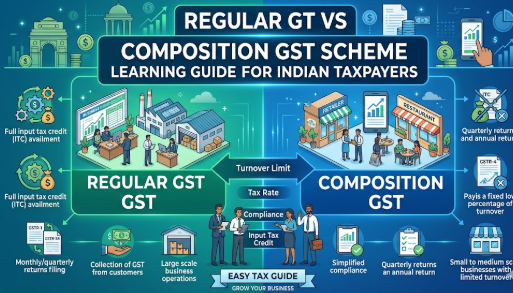
Regular GST is the normal GST system where a registered taxpayer charges GST on taxable sales, issues tax invoices, files applicable GST returns, and claims eligible input tax credit on business purchases.
Composition GST Scheme is a simplified GST option for eligible small taxpayers. Under this scheme, the taxpayer generally pays tax at a lower prescribed rate on turnover, follows simpler compliance, and files fewer returns. However, the taxpayer cannot collect GST separately from customers and cannot claim input tax credit.
In simple words, regular GST gives more flexibility, but it also brings more filing and documentation work. Composition GST reduces compliance pressure, but it also limits business flexibility.
People search for Regular GST vs Composition GST Scheme because they want to know which option is better for their shop, trading business, restaurant, small service business, manufacturing unit, or local business. This topic connects directly with tax planning, pricing, customer management, compliance, working capital, and business growth.
For example, a local grocery shop selling mostly to end customers may find composition easier if it meets all conditions. However, a wholesaler selling to registered businesses may prefer regular GST because customers may demand tax invoices and input tax credit.
A common misunderstanding is that composition GST is always cheaper. In reality, it may reduce compliance, but it may not always reduce total cost because input tax credit is not available.
Practical takeaway: Do not choose a GST scheme only by looking at the tax rate. Compare customer type, purchase GST, business growth, invoice needs, and compliance capacity.
Why Regular GST vs Composition GST Scheme Is Important
Understanding Regular GST vs Composition GST Scheme affects real-life business decisions because GST is not only a tax filing matter. It affects pricing, profit margin, customer trust, vendor relationships, cash flow, and future expansion.
For savings, a business must know whether input tax credit can reduce tax burden. Under regular GST, eligible GST paid on purchases may reduce output tax liability. Under composition GST, input tax credit is not available, so purchase GST becomes part of business cost.
For borrowing, lenders and financial institutions may review business turnover, invoices, GST filings, and tax discipline. Better GST records can support business credibility when applying for business loans.
For investing, a business owner who plans to expand must consider whether the current GST option supports growth. Composition GST may suit a small local setup, but regular GST may become necessary when turnover increases or interstate sales begin.
For trading, GST invoice rules affect buyer behavior. Many registered buyers prefer suppliers who issue tax invoices because they can claim input tax credit.
For tax planning, scheme selection affects filing frequency, record keeping, tax payment, ITC, and compliance risk.
For crypto, casino, or digital income creators, GST treatment depends on the nature of supply, platform model, location, and legal classification. Therefore, such readers should take qualified tax advice before applying general GST logic.
Practical scenario: A small furniture seller chooses composition because the rate looks low. Later, most of his customers become offices and registered businesses. They ask for tax invoices and input credit. He loses orders because his GST structure does not match customer expectations. A better approach would have been to compare customer type before choosing the scheme.
The Real Problem Readers Face With Regular GST vs Composition GST Scheme
The real problem is not only lack of information. The bigger issue is mixed advice.
One person says composition is best because it is simple. Another says regular GST is better because input tax credit is available. A third person says small businesses should avoid GST complexity. As a result, beginners feel stuck.
Many business owners also depend on social media posts, short videos, or casual advice from friends. However, GST decisions should not be based on half-information because one wrong choice can affect invoices, tax payment, customer relations, and penalties.
Another common problem is weak comparison. Beginners often compare only tax rate but ignore the following points:
- Whether buyers need input tax credit
- Whether the business sells outside the state
- Whether sales happen through e-commerce platforms
- Whether purchases have high GST input
- Whether the business plans to scale
- Whether proper invoices and records are maintained
- Whether the taxpayer is actually eligible for composition
Emotional decision-making also creates mistakes. Some owners choose composition because they fear filing work. Others choose regular GST because they want to look bigger. Both approaches can be wrong if not matched with business reality.
The better approach is to review business type, turnover, customer profile, supplier invoices, purchase GST, filing ability, and growth plans before selecting the scheme.
How Regular GST vs Composition GST Scheme Works Step by Step
Step 1: Identify Your Business Type
What it means: First, check whether you are a trader, manufacturer, restaurant owner, service provider, freelancer, consultant, online seller, or mixed supplier.
Why it matters: GST scheme eligibility and practical suitability depend heavily on business type.
How to apply it: Write down your main income source and classify your supplies properly.
Practical example: A small restaurant may have different GST treatment from a mobile accessories trader.
Common mistake: Many beginners assume all small businesses can choose composition.
Better approach: Confirm the exact nature of supply before choosing any GST scheme.
Step 2: Check Turnover and Eligibility
What it means: Turnover limits and eligibility conditions decide whether the composition option is available.
Why it matters: If you choose composition without eligibility, tax authorities may deny the option and demand tax with consequences.
How to apply it: Review previous financial year turnover and current year expected turnover.
Practical example: A local trader with turnover within the prescribed limit may evaluate composition, but a rapidly growing seller should also consider future turnover.
Common mistake: Checking only one branch turnover instead of PAN-based aggregate turnover.
Better approach: Calculate turnover across all registrations under the same PAN.
Step 3: Understand Your Customer Type
What it means: Identify whether most buyers are end consumers or GST-registered businesses.
Why it matters: GST-registered business buyers usually prefer tax invoices because they may claim input tax credit.
How to apply it: Review your invoices and customer list.
Practical example: A retail shop selling to households may not face ITC demand. A wholesaler selling to retailers may face strong ITC demand.
Common mistake: Choosing composition without checking buyer expectations.
Better approach: Match GST scheme with customer needs.
Step 4: Review Purchase GST and Input Tax Credit
What it means: Input tax credit means eligible GST paid on purchases can be adjusted against GST collected on sales under regular GST.
Why it matters: If your purchases include heavy GST, losing ITC under composition may increase actual cost.
How to apply it: Review vendor invoices and GST paid on purchases.
Practical example: A small manufacturer buying taxable raw material may benefit from ITC under regular GST.
Common mistake: Looking only at output tax rate and ignoring purchase-side GST.
Better approach: Compare net tax effect, not only visible tax rate.
Step 5: Compare Filing and Record-Keeping Capacity
What it means: Regular GST generally requires more detailed invoicing, return filing, reconciliation, and record keeping.
Why it matters: Poor compliance can lead to notices, interest, late fees, mismatches, and stress.
How to apply it: Decide whether you can manage monthly or quarterly records with professional support.
Practical example: A small family-run shop may prefer simpler compliance if business is local and eligible.
Common mistake: Selecting regular GST but not maintaining purchase and sales records.
Better approach: Choose a scheme that your business can follow properly.
Step 6: Check Interstate and E-Commerce Plans
What it means: Composition GST has restrictions on interstate outward supplies and certain e-commerce supplies.
Why it matters: A business planning to sell outside its state may need regular GST.
How to apply it: Check whether you sell locally, across states, or through online platforms.
Practical example: A home decor seller planning to sell across India through an online marketplace may need regular GST.
Common mistake: Starting online sales after opting for composition without checking restrictions.
Better approach: Plan GST structure before expanding sales channels.
Step 7: Evaluate Pricing and Profit Margin
What it means: GST scheme affects how you price goods or services.
Why it matters: Under composition, tax cannot generally be collected separately from customers, so it affects margin if not priced carefully.
How to apply it: Build tax cost into pricing legally and transparently.
Practical example: A trader under composition must consider tax payment from business revenue.
Common mistake: Assuming lower tax rate automatically means higher profit.
Better approach: Calculate selling price, purchase cost, tax cost, and customer expectation together.
Step 8: Take Professional Review Before Final Choice
What it means: GST law contains conditions, exceptions, forms, and compliance rules.
Why it matters: A qualified tax professional can help avoid wrong classification, incorrect filing, or ineligible scheme selection.
How to apply it: Share turnover, invoices, purchase records, customer type, and business plans with a GST practitioner or chartered accountant.
Practical example: A service business with mixed income should not choose a scheme without reviewing eligibility.
Common mistake: Taking advice from random online comments.
Better approach: Use educational content for awareness and professional advice for final action.
Key Factors That Influence Regular GST vs Composition GST Scheme
Documentation
Documentation is the base of GST compliance. Regular GST needs proper tax invoices, purchase bills, return data, ITC records, and reconciliation. Composition GST also needs records, but the structure is simpler.
The mistake is thinking composition means no records are required. The better approach is to maintain sales, purchases, expenses, tax payment challans, and filing proofs under both schemes.
Filing Accuracy
Regular GST requires accurate reporting of outward supplies, eligible ITC, tax payable, and return data. Composition GST also requires accurate turnover reporting and payment.
The mistake is filing approximate numbers. The better approach is to update accounts regularly and verify details before submission.
Record Keeping
Record keeping helps during audits, notices, loan applications, business reviews, and vendor disputes.
The mistake is keeping only handwritten rough notes. The better approach is to use accounting software, spreadsheets, or a proper bookkeeping system.
Compliance Deadlines
GST compliance works on due dates. Missing due dates may create late fees, interest, and compliance pressure.
The mistake is remembering GST only at the end of the month or quarter. The better approach is to maintain a compliance calendar.
Professional Review
GST rules can change, and each business has different facts. Professional review reduces the chance of wrong decisions.
The mistake is treating general blogs as final legal advice. The better approach is to use blogs for learning and professionals for business-specific decisions.
Penalty Risk
Wrong scheme selection, incorrect invoices, ineligible ITC, late filing, or false claims can create tax risk.
The mistake is assuming small businesses are never checked. The better approach is to follow rules from the beginning.
Invoice Discipline
Regular GST taxpayers issue tax invoices. Composition taxpayers issue bill of supply and must follow required declarations.
The mistake is issuing the wrong invoice type. The better approach is to use correct invoice format based on registration type.
Tax Planning Awareness
GST planning is not about avoiding tax. It is about choosing the right structure, maintaining records, and reducing avoidable mistakes.
The mistake is choosing the lowest-looking tax option. The better approach is to compare total business impact.
Detailed Breakdown of Regular GST vs Composition GST Scheme
Basic Meaning of Regular GST
Regular GST is the standard GST registration system. A taxpayer under regular GST charges GST on taxable outward supplies, issues tax invoices, claims eligible input tax credit, and files applicable GST returns.
Regular GST is generally suitable for businesses that sell to GST-registered buyers, make interstate supplies, sell through certain e-commerce channels, have significant input tax credit, or plan to scale.
The main benefit is flexibility. The business can collect GST, issue tax invoices, and pass input credit to eligible buyers. However, it also requires more compliance discipline.
The common mistake is choosing regular GST without understanding filing responsibility. The better approach is to maintain proper accounts from day one.
Basic Meaning of Composition GST Scheme
Composition GST Scheme is a simplified option for eligible small taxpayers. It is designed to reduce compliance burden for smaller businesses that meet prescribed conditions.
The main benefit is simpler compliance and lower prescribed tax rate. However, the taxpayer cannot collect GST separately from customers and cannot claim input tax credit.
Composition GST can suit local businesses that sell mainly to final consumers and do not need complex GST credit flow. However, it may not suit businesses selling to registered buyers who need ITC.
The common mistake is assuming composition is best for every small business. The better approach is to check eligibility, customer type, and growth plans.
Compliance Matters in Both Schemes
Many beginners think regular GST means compliance and composition GST means freedom from compliance. This is wrong.
Composition taxpayers also need to file prescribed forms, pay tax, maintain records, issue correct bills, and follow restrictions. Regular taxpayers need more detailed compliance, but both schemes require discipline.
The better approach is to build a simple monthly GST habit:
- Record sales daily
- Save purchase invoices
- Review GST payable
- Check filing due dates
- Keep payment proofs
- Reconcile data before filing
Common Filing or Documentation Mistakes
Beginners commonly make these mistakes:
- Not saving purchase invoices
- Mixing personal and business expenses
- Issuing tax invoice under composition
- Claiming ITC without eligibility
- Not checking GSTIN details of vendors
- Missing return due dates
- Ignoring turnover limits
- Not updating registration details
- Forgetting to withdraw from composition after becoming ineligible
The better approach is to keep a GST file, digital records, and professional review at least periodically.
Important Records to Maintain
Every GST-registered business should maintain practical records such as:
- Sales register
- Purchase register
- Tax invoices or bills of supply
- Expense bills
- Payment receipts
- GST return acknowledgements
- Tax challans
- Credit notes and debit notes
- Vendor GST details
- Customer GST details, if applicable
- Stock records, where relevant
Good records reduce confusion and support business credibility.
Late Filing or Incorrect Filing Risks
Late filing can create fees, interest, and business stress. Incorrect filing can create mismatches, notices, or tax demands.
Regular GST taxpayers may face ITC mismatch issues if data is not reconciled. Composition taxpayers may face problems if turnover is wrongly reported or restrictions are violated.
The better approach is to review data before filing instead of correcting errors later.
Practical Preparation Steps
Before choosing any GST scheme, prepare these details:
- Business category
- Previous year turnover
- Expected current year turnover
- Customer type
- Purchase GST amount
- Vendor type
- State-wise business activity
- E-commerce sales plan
- Interstate sales plan
- Record-keeping capacity
- Professional support availability
This preparation helps avoid emotional or incomplete decisions.
Awareness vs Professional Advice
Educational awareness helps you ask better questions. Professional advice helps you take correct action for your specific facts.
A blog can explain the difference between regular GST and composition GST. However, a qualified tax expert can review your documents, eligibility, turnover, invoices, and business model.
The better approach is to learn first, then consult before making final decisions.
Common Mistakes Beginners Make With Regular GST vs Composition GST Scheme
Following Random Advice
This happens because GST feels technical and beginners want quick answers. It is risky because GST scheme choice depends on your business facts. What works for one shop may not work for another.
Instead, compare your turnover, customer type, purchases, sales channel, and growth plan.
Ignoring Input Tax Credit
Many taxpayers choose composition because the tax rate looks lower. However, if purchases include high GST, losing ITC may increase cost.
Instead, calculate total tax impact before choosing.
Not Comparing Options
Some business owners select the first option suggested by a friend or accountant without understanding alternatives.
Instead, prepare a simple comparison of regular GST and composition GST for your exact business.
Trusting Fake Saving Claims
Some people promote composition as a guaranteed money-saving option. That is misleading because savings depend on business model.
Instead, avoid guaranteed claims and use actual numbers.
Ignoring Invoice Rules
Composition taxpayers cannot issue regular tax invoices. Regular taxpayers must issue proper tax invoices for taxable supplies.
Instead, use the correct invoice format based on registration type.
Making Emotional Decisions
Fear of compliance may push a business into composition. Desire to look bigger may push a business into regular GST.
Instead, choose based on practical suitability.
Not Reading Conditions
Composition scheme has restrictions. Ignoring them can create future problems.
Instead, read eligibility conditions and review them whenever the business changes.
Sharing Sensitive Information Carelessly
GST login credentials, OTPs, bank details, and financial records should be protected.
Instead, share documents only with trusted professionals and use secure systems.
Depending Only on Social Media Advice
Short posts and videos may explain one part but miss important conditions.
Instead, use official sources, professional advice, and proper documentation.
Ignoring Legal or Compliance Responsibility
GST is a legal compliance matter. Poor handling can affect business credibility.
Instead, treat GST as a regular business process, not a last-minute task.
“Don’t Do This” Checklist
- Do not choose composition only because the rate looks low.
- Do not choose regular GST without maintaining records.
- Do not issue tax invoices if you are under composition.
- Do not claim ITC without eligibility.
- Do not ignore turnover limits.
- Do not sell interstate under composition without checking rules.
- Do not depend only on social media advice.
- Do not share GST login details casually.
- Do not mix personal and business expenses.
- Do not delay filing until notices arrive.
- Do not ignore professional advice for complex cases.
Practical Real-Life Examples of Regular GST vs Composition GST Scheme
Example 1: Local Kirana Store
Situation: A small kirana store sells mostly to nearby households.
Mistake or challenge: The owner fears GST filing and assumes regular GST is mandatory.
Better action: The owner checks turnover, customer type, eligibility, and local sales pattern.
Learning: Composition may be practical for some local consumer-focused businesses, but eligibility must be verified.
Example 2: Wholesale Garment Seller
Situation: A garment wholesaler sells mainly to registered retailers.
Mistake or challenge: The owner considers composition because it appears simpler.
Better action: The owner checks that business customers want tax invoices and ITC.
Learning: Regular GST may be more suitable when buyers need input tax credit.
Example 3: Small Restaurant
Situation: A small restaurant serves local customers and wants simpler compliance.
Mistake or challenge: The owner does not understand rate, invoice, and ITC restrictions.
Better action: The owner reviews restaurant-specific GST treatment with a tax expert.
Learning: Business category matters because GST rules are not identical for every business.
Example 4: Online Seller
Situation: A handmade product seller wants to sell across India through an online marketplace.
Mistake or challenge: The seller chooses composition without checking e-commerce and interstate restrictions.
Better action: The seller reviews GST rules before listing products online.
Learning: Growth channel matters while choosing between regular GST and composition GST.
Example 5: Service Consultant
Situation: A freelance consultant has small turnover and wants easy compliance.
Mistake or challenge: The consultant assumes composition for goods automatically applies to services.
Better action: The consultant checks service-provider eligibility and applicable scheme conditions.
Learning: Service businesses should not copy GST decisions from traders or shops.
Two Useful Tables for Better Understanding
Table 1: Regular GST vs Composition GST Scheme Comparison
| Point | Regular GST | Composition GST Scheme |
|---|---|---|
| Basic nature | Standard GST system | Simplified GST option for eligible small taxpayers |
| GST collection | GST is collected from customers on taxable supplies | GST is generally not collected separately from customers |
| Invoice type | Tax invoice | Bill of supply |
| Input tax credit | Eligible ITC can be claimed | ITC cannot be claimed |
| Buyer benefit | Registered buyers may claim ITC if conditions are met | Buyers generally do not get ITC |
| Compliance level | Higher | Lower, but still required |
| Interstate outward supply | Generally allowed, subject to GST law | Restricted under composition conditions |
| E-commerce suitability | More flexible | Restricted in specified cases |
| Best suited for | Growing businesses, B2B sellers, interstate sellers | Eligible local small businesses selling mainly to consumers |
| Main risk | Poor filing and ITC mismatch | Loss of ITC, growth restrictions, wrong eligibility |
Table 2: Beginner Mistake vs Correct GST Approach
| Beginner Mistake | Why It Is Risky | Better Approach |
|---|---|---|
| Choosing only by tax rate | Real cost may change due to ITC loss | Compare net tax impact |
| Ignoring customer type | Business buyers may demand ITC | Review B2B vs B2C sales |
| Not checking turnover | Ineligible choice can create compliance issues | Calculate PAN-based aggregate turnover |
| Issuing wrong invoice | Invoice errors can create disputes | Use tax invoice or bill of supply correctly |
| Ignoring interstate sales | Composition restrictions may apply | Review sales geography |
| Not maintaining records | Filing errors become common | Keep sales, purchase, and tax records |
| Copying another business | GST suitability differs by model | Take business-specific advice |
| Missing due dates | Late fees and interest may apply | Maintain a compliance calendar |
Tools, Methods, and Frameworks Readers Can Use
GST Eligibility Checklist
This checklist helps you confirm whether your business can consider composition or should stay under regular GST.
Beginners can use it by writing down business type, turnover, customer type, interstate sales, e-commerce activity, and purchase pattern.
It helps avoid the mistake of choosing a scheme without checking conditions.
GST Invoice Review Method
This method means reviewing whether you issue the correct invoice type.
Regular GST taxpayers should generally issue tax invoices. Composition taxpayers issue bill of supply with required declarations.
It helps avoid invoice mistakes that can affect customers and compliance.
Input Tax Credit Review Sheet
This sheet lists GST paid on purchases and checks whether ITC is important for your business.
Beginners can use it monthly to understand whether regular GST gives a practical tax advantage.
It helps avoid the mistake of ignoring purchase-side GST.
Turnover Tracking Sheet
This sheet tracks monthly turnover and cumulative turnover.
It helps business owners know when turnover approaches GST limits or composition eligibility limits.
It avoids the mistake of discovering ineligibility too late.
Compliance Calendar
A compliance calendar records filing dates, payment dates, document review dates, and professional review dates.
It helps beginners avoid late filing, missed returns, and last-minute stress.
Customer Profile Framework
This framework divides customers into B2B, B2C, local, interstate, online, and offline categories.
It helps decide whether buyers need tax invoices and ITC.
It avoids choosing composition when regular GST may be commercially better.
Professional Review File
This file includes turnover records, GST returns, invoices, purchase bills, bank statements, and business plans.
It helps tax professionals review your GST position quickly and accurately.
It avoids incomplete advice based on missing information.
Expert Tips to Make Better Decisions
1. Compare Total Business Impact, Not Only Tax Rate
A lower visible rate may not mean lower business cost. ITC loss, pricing pressure, and buyer expectations matter.
Apply this by comparing purchase GST, customer type, and expected turnover before choosing.
2. Know Whether Your Customers Need ITC
If most customers are registered businesses, they may prefer suppliers under regular GST.
Apply this by checking past invoices and asking major buyers about invoice requirements.
3. Keep GST Records From Day One
Good records reduce filing errors and support business credibility.
Apply this by saving every sales bill, purchase invoice, tax payment proof, and return acknowledgement.
4. Do Not Mix Personal and Business Expenses
Mixed expenses make GST records confusing and may create incorrect claims.
Apply this by using separate bank records and expense categories.
5. Review Turnover Monthly
Composition eligibility and GST planning depend on turnover.
Apply this by maintaining a monthly turnover tracker with cumulative totals.
6. Avoid Random Social Media Advice
GST decisions depend on business facts, not general opinions.
Apply this by using social media only for awareness and consulting a qualified expert for final action.
7. Understand Invoice Rules Clearly
Wrong invoices can create customer disputes and compliance risk.
Apply this by using accounting software or professional invoice templates.
8. Consider Future Growth
A scheme that works today may not work after expansion.
Apply this by reviewing whether you plan interstate sales, e-commerce sales, wholesale supply, or new branches.
9. Keep Emergency Money Separate
Tax payments should not disturb basic business working capital.
Apply this by setting aside a GST and compliance reserve from business receipts.
10. Review Purchase GST Before Choosing Composition
If your business purchases taxable goods regularly, ITC may be valuable.
Apply this by checking monthly purchase invoices and GST amounts.
11. Take Professional Advice Before Switching
Switching schemes can involve forms, ITC reversal, eligibility checks, and timing rules.
Apply this by consulting a GST expert before opting in or withdrawing.
12. Build a Monthly GST Review Habit
GST becomes easier when reviewed regularly.
Apply this by reviewing sales, purchases, invoices, and filing status once every month.
Case Studies: How Better Understanding Changes Decisions
Case Study 1: Retail Shop Owner
Profile: Raj owns a small retail shop in a local market.
Situation: Most customers are households and do not ask for GST input credit.
Problem: Raj finds regular GST filing stressful and does not understand whether composition is possible.
Wrong approach: He wants to switch only because another shop owner suggested it.
Better approach: Raj reviews turnover, product type, customer type, purchase GST, and eligibility with a tax professional.
Result or learning: He understands that composition may reduce compliance pressure only if all conditions are satisfied.
Key takeaway: Small local businesses should compare eligibility and customer needs before choosing.
Case Study 2: B2B Supplier
Profile: Neha runs a small packaging supply business.
Situation: Her main customers are GST-registered manufacturers and traders.
Problem: She considers composition because tax payment seems easier.
Wrong approach: She ignores that her customers want tax invoices and ITC.
Better approach: She calculates business impact and realizes regular GST supports her B2B sales better.
Result or learning: She focuses on better bookkeeping instead of choosing a scheme that may reduce customer interest.
Key takeaway: Regular GST can be more practical for B2B businesses even when compliance is higher.
Case Study 3: Growing Online Seller
Profile: Arjun sells handmade home decor items locally and wants to expand online.
Situation: His current turnover is small, but he plans interstate and marketplace sales.
Problem: He wants composition because it looks simple.
Wrong approach: He does not consider interstate and e-commerce restrictions.
Better approach: He reviews expansion plans before finalizing GST structure.
Result or learning: He understands that future sales channels may require regular GST compliance.
Key takeaway: GST scheme selection should consider growth plans, not only current turnover.
Risk Awareness: What Readers Must Check First
Compliance Risk
Compliance risk means the chance of facing issues due to wrong filing, wrong scheme selection, or missed deadlines.
It matters because GST mistakes can create notices, interest, penalties, and business disruption.
Reduce this risk by maintaining records, using correct forms, and taking professional advice.
Input Tax Credit Risk
ITC risk means losing credit, claiming wrong credit, or not understanding ITC rules.
It matters because ITC affects cost, pricing, and tax payment.
Reduce this risk by checking purchase invoices, vendor compliance, and scheme eligibility.
Invoice Risk
Invoice risk means issuing the wrong invoice or missing required details.
It matters because invoices affect customers, ITC, and tax records.
Reduce this risk by using correct invoice format and reviewing invoice rules regularly.
Turnover Risk
Turnover risk means crossing eligibility limits without timely action.
It matters because composition option may lapse when limits or conditions are breached.
Reduce this risk by tracking turnover monthly.
Customer Risk
Customer risk means losing customers because your GST structure does not support their needs.
It matters especially for B2B suppliers where buyers may need ITC.
Reduce this risk by understanding your customer profile before choosing a scheme.
Growth Restriction Risk
Growth restriction risk means choosing a scheme that limits future interstate, e-commerce, or business expansion.
It matters because changing schemes later may require planning.
Reduce this risk by reviewing future business plans.
Misinformation Risk
Misinformation risk means acting on incomplete or wrong GST advice.
It matters because GST rules are technical and business-specific.
Reduce this risk by verifying details and consulting qualified professionals.
Data Privacy Risk
Data privacy risk means exposing GST login details, OTPs, financial records, or bank information.
It matters because misuse can create financial and compliance problems.
Reduce this risk by sharing data only with trusted professionals through secure methods.
Checklist Before Taking Action
Before choosing between regular GST and composition GST, check the following:
- I understand the basic difference between regular GST and composition GST.
- I have checked my business category.
- I have calculated PAN-based aggregate turnover.
- I have reviewed customer type: B2B, B2C, local, interstate, or online.
- I have checked whether customers need input tax credit.
- I have reviewed GST paid on purchases.
- I have checked invoice requirements.
- I have reviewed interstate supply plans.
- I have reviewed e-commerce sales plans.
- I have checked filing responsibilities.
- I have reviewed cash flow impact.
- I have avoided fake saving claims.
- I have kept business and personal expenses separate.
- I have prepared a written GST decision note.
- I have reviewed tax, legal, and compliance impact.
- I have considered professional advice.
- I have avoided emotional decisions based on fear, greed, or pressure.
Use this checklist before registration, scheme switch, business expansion, online selling, or major pricing changes. It helps convert GST confusion into a structured decision.
Strategic Insights for Better Decision-Making
Documentation Discipline
Documentation is not only for filing. It also protects the business during reviews, audits, disputes, and loan applications.
For example, a shop with clean purchase and sales records can explain tax payments better than a shop with only rough estimates.
Filing Accuracy
Accuracy matters more than speed. A return filed quickly with wrong data can create future problems.
A better approach is to reconcile sales, purchases, invoices, and tax payment before filing.
Record Maintenance
Record maintenance helps business owners understand profit, tax cost, outstanding payments, and vendor reliability.
Beginners should use a simple digital system even if the business is small.
Professional Review
GST professionals help interpret rules based on actual facts.
For example, a mixed supplier selling goods and services may need careful review before selecting any scheme.
Compliance Calendar Planning
A compliance calendar prevents last-minute filing stress.
Beginners can mark GST payment dates, return dates, invoice review dates, and professional review dates.
Customer-Based GST Planning
GST should match customer expectations.
If your buyers are businesses, regular GST may support smoother transactions. If your buyers are final consumers and you are eligible, composition may be practical.
Growth-Based GST Planning
A business planning interstate sales, online marketplace sales, or B2B expansion should think beyond current turnover.
The better approach is to choose a scheme that supports near-future growth.
Cost-Based GST Planning
Tax cost includes more than payable tax. It includes ITC loss, accounting cost, professional fee, pricing impact, and customer behavior.
Beginners should compare total impact before deciding.
Key Terms Explained for Beginners
- GST: GST means Goods and Services Tax. It applies to the supply of goods and services and affects invoicing, pricing, tax payment, and compliance.
- Regular GST: Regular GST is the standard GST system where taxpayers charge GST, issue tax invoices, claim eligible ITC, and file applicable returns.
- Composition GST Scheme: Composition GST Scheme is a simplified GST option for eligible small taxpayers with reduced compliance but important restrictions.
- Input Tax Credit: Input tax credit means eligible GST paid on purchases can be adjusted against GST payable on sales under regular GST.
- Tax Invoice: A tax invoice is issued by a regular GST taxpayer for taxable supplies and helps eligible buyers claim ITC.
- Bill of Supply: A bill of supply is issued by a composition taxpayer instead of a tax invoice because GST is not collected separately.
- Aggregate Turnover: Aggregate turnover means total turnover calculated on an all-India PAN basis as per GST rules.
- Interstate Supply: Interstate supply means supply from one state to another. It can affect GST eligibility and scheme selection.
- E-Commerce Operator: An e-commerce operator is a platform that enables online supply of goods or services. GST rules may differ for such supplies.
- Reverse Charge: Reverse charge means the buyer pays GST instead of the supplier in specified cases.
- GST Return: GST return is a filing submitted to report sales, purchases, tax liability, and related details.
- CMP-08: CMP-08 is a statement used by composition taxpayers for quarterly payment of self-assessed tax.
- GSTR-4: GSTR-4 is an annual return associated with composition taxpayers.
- ITC Reversal: ITC reversal means paying back or reversing input tax credit when rules require it.
- Compliance Risk: Compliance risk means the possibility of tax issues due to wrong filing, late filing, wrong invoices, or ineligible scheme selection.
Who Should Read This Blog
- Beginners: This blog helps beginners understand GST options without technical confusion.
- Students: Commerce, finance, and taxation students can use this guide to understand practical GST decision-making.
- Salaried Employees: Salaried people planning a side business can understand GST responsibilities before starting.
- Small Business Owners: Shopkeepers, traders, restaurants, and local businesses can compare regular GST and composition GST practically.
- New Investors: Investors reviewing small businesses can understand how GST affects compliance and cash flow.
- Traders: Business traders can learn why buyer ITC expectations matter.
- Loan Seekers: Business loan applicants can understand why proper GST records support financial credibility.
- Crypto Learners: Crypto learners running taxable business activities should understand that digital income may need professional tax review.
- Casino Content Creators: Content creators earning through online platforms should understand that GST treatment depends on activity, location, and legal classification.
- Finance Bloggers: Finance writers can use this topic to explain GST planning responsibly.
- People Improving Money Awareness: Anyone learning business finance can understand how tax choices affect real decisions.
- People Trying to Avoid Financial Mistakes: This blog helps readers avoid random advice, wrong invoices, poor records, and tax confusion.
Frequently Asked Questions
1. What is Regular GST vs Composition GST Scheme?
Regular GST vs Composition GST Scheme means comparing the normal GST system with the simplified composition option. Regular GST allows tax invoices and eligible ITC. Composition GST reduces compliance for eligible small taxpayers but restricts ITC and GST collection.
2. Which is better for small business owners?
There is no single best option for every small business. Composition may suit eligible local businesses selling mainly to final consumers. Regular GST may suit B2B sellers, interstate sellers, online sellers, or businesses needing ITC.
3. Can a composition taxpayer claim input tax credit?
No, a composition taxpayer cannot claim input tax credit on purchases. This is why businesses with high GST-paid purchases should compare total tax impact before choosing composition.
4. Can a composition taxpayer issue a tax invoice?
No, a composition taxpayer generally issues a bill of supply instead of a tax invoice. This matters because buyers usually cannot claim ITC from purchases made from a composition taxpayer.
5. Why is Regular GST vs Composition GST Scheme important for beginners?
Regular GST vs Composition GST Scheme is important because it affects pricing, invoices, ITC, filing, customer type, and business growth. Beginners who choose without understanding may face avoidable compliance and commercial problems.
6. Is composition GST always cheaper?
No, composition GST is not always cheaper. The rate may look lower, but the business cannot claim ITC and cannot collect GST separately from customers. The real impact depends on purchases, margins, and customers.
7. Who should prefer regular GST?
Businesses selling to registered buyers, making interstate sales, selling through certain online platforms, or needing ITC may prefer regular GST. However, the final decision should be based on eligibility and professional review.
8. Who should consider composition GST?
Eligible small businesses selling mainly within the state to final consumers may consider composition GST. It may reduce compliance burden, but restrictions and ITC loss must be understood clearly.
9. What is the biggest mistake in GST scheme selection?
The biggest mistake is choosing only by tax rate. A business should also consider ITC, customer needs, sales geography, e-commerce plans, turnover, invoices, and compliance capacity.
10. Can a business switch from composition to regular GST?
A business may need to withdraw from composition if it becomes ineligible or chooses to shift. However, switching involves forms, timing, and ITC-related implications, so professional advice is important.
11. How often should GST scheme suitability be reviewed?
A business should review GST suitability whenever turnover grows, customer type changes, online sales begin, interstate sales start, or purchase GST becomes significant. A periodic review helps avoid mistakes.
12. What is the best next step after reading about Regular GST vs Composition GST Scheme?
The best next step is to prepare your business details, turnover, sales pattern, purchase invoices, and growth plan. Then compare both options and consult a qualified GST professional before taking action.
Conclusion
Understanding Regular GST vs Composition GST Scheme helps small business owners choose the right GST option with more confidence. Regular GST gives more flexibility, input tax credit, and better suitability for B2B or growing businesses, while the Composition GST Scheme offers simpler compliance for eligible small businesses. However, the best choice depends on turnover, customer type, purchase GST, invoice needs, and future business plans. Therefore, beginners should compare both options carefully, maintain proper records, avoid random advice, and consult a qualified GST professional before making a final decision.
Leave a Reply