Introduction
For many small business owners, GST becomes confusing because it is connected with sales, billing, tax payment, filing, and record keeping. A shopkeeper, restaurant owner, trader, or small manufacturer may run the business confidently every day, but GST rules can still feel difficult when returns, invoices, and tax rates come into the picture. The GST Composition Scheme Explained Simply is important because it helps eligible small taxpayers understand a simpler way to manage GST compliance. However, this scheme is not suitable for every business. It has benefits, limits, and important conditions. This blog explains the scheme in simple words so beginners can understand eligibility, tax payment, records, filing, mistakes, and practical decisions before choosing it.
Understanding GST Composition Scheme Explained Simply in Simple Words
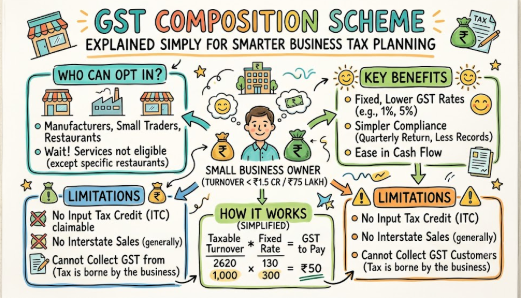
The GST Composition Scheme is a simplified tax payment option under GST for eligible small taxpayers. Instead of following the regular GST process with detailed tax collection and input tax credit claims, a composition taxpayer pays tax at a prescribed percentage of turnover and follows simpler compliance rules.
In simple words, it is like a small-business-friendly GST option. It reduces paperwork, but it also comes with restrictions.
How It Works
A normal GST taxpayer usually collects GST from customers, claims input tax credit on purchases, and files detailed returns. A composition taxpayer generally pays tax on turnover at a fixed rate and follows simplified filing requirements.
This may help small businesses that mostly sell directly to end customers and do not need complex input tax credit calculations.
Why People Search for It
People search for GST Composition Scheme Explained Simply because they want to know:
- Whether their small business is eligible
- Whether it reduces GST compliance burden
- Whether it saves time
- Whether it is cheaper than regular GST
- Whether they can issue tax invoices
- Whether customers can claim input tax credit
- Which returns must be filed
- What mistakes can create penalties
Where It Is Used in Real Life
The scheme is commonly considered by small traders, local shops, small manufacturers, restaurants, and certain small service providers. It is useful for businesses that have limited turnover, simple sales patterns, and customers who usually do not demand input tax credit.
Beginner-Friendly Example
Suppose a small grocery shop sells mostly to local customers. The customers do not ask for GST input credit because they are end consumers. The shop owner may find regular GST filing complex. If eligible, the composition scheme may reduce compliance pressure.
Common Misunderstanding
A common misunderstanding is that composition scheme means “no GST.” That is incorrect. The taxpayer still has GST responsibilities. The difference is that the tax payment and filing structure is simplified.
Practical Takeaway
The composition scheme is not automatically best for every small business. It should be selected only after checking eligibility, customer type, input tax credit impact, turnover, and compliance responsibilities.
Why GST Composition Scheme Explained Simply Is Important
The GST Composition Scheme affects real-life business decisions because tax is not just a legal matter. It influences pricing, cash flow, customer relationships, record keeping, and profit planning.
For small businesses, even a small compliance mistake can create stress. Many owners focus only on daily sales and ignore GST planning until filing time. That approach can lead to confusion, wrong tax payment, and weak documentation.
How It Affects Savings
A simplified scheme may reduce compliance effort and professional filing costs for some small businesses. However, it may not always reduce total tax cost because input tax credit is not available.
How It Affects Borrowing
Banks and lenders may review business records, sales, tax filings, and financial discipline. Clean GST records can support better business credibility.
How It Affects Investing and Planning
A small business owner may invest in stock, equipment, or expansion. Before doing that, they should understand whether GST paid on purchases can be claimed or becomes part of business cost.
How It Affects Tax Planning
Composition taxpayers need invoice discipline, sales tracking, and timely filing. Tax planning is not only about paying less tax; it is about paying correctly and avoiding future disputes.
How It Affects Risk Awareness
The wrong GST choice can create risk. For example, if most customers are GST-registered businesses that want input tax credit, composition scheme may make the seller less attractive.
Practical Scenario
A small restaurant serving mostly walk-in customers may find the composition scheme practical if eligible. But a supplier selling to large registered companies may lose customers if buyers cannot claim input tax credit. The same scheme can be useful for one business and unsuitable for another.
The Real Problem Readers Face With GST Composition Scheme Explained Simply
The real problem is not only the GST law. The real problem is confusion.
Many beginners hear about the composition scheme from friends, social media, accountants, or business groups. But they do not always understand the conditions and restrictions. Some focus only on the lower-looking tax rate. Others ignore the fact that input tax credit is not available. Some do not understand the difference between a tax invoice and a bill of supply.
Common Reader Problems
- Lack of awareness about eligibility
- Confusing advice from different online sources
- Not knowing whether customers need input tax credit
- Poor invoice understanding
- Weak sales and purchase records
- Missing return filing deadlines
- Not understanding turnover limits
- Assuming the scheme is always cheaper
- Depending only on social media advice
- Not consulting a qualified tax professional when needed
Why This Creates Risk
A business can make pricing mistakes if it does not understand GST treatment. It can also create customer disputes if buyers expect input tax credit but cannot claim it. Filing mistakes may also lead to notices, interest, or penalties.
Better Approach
Beginners should first understand the structure, then check eligibility, then compare regular GST and composition GST, and finally take professional advice before choosing or switching.
How GST Composition Scheme Works Step by Step
Step 1: Check Your Business Type
What it means:
You must first identify whether your business category is allowed under the scheme.
Why it matters:
Not every business can opt for composition. Eligibility depends on turnover, type of supply, and GST rules.
How to apply it:
List your business activity clearly: trader, manufacturer, restaurant, service provider, or mixed business.
Practical example:
A local kirana shop may be eligible if it meets conditions, but a business making inter-state taxable supplies may not fit the basic composition structure.
Common mistake:
Choosing the scheme only because another shopkeeper is using it.
Better approach:
Check your own business model, not someone else’s.
Step 2: Check Turnover Limit
What it means:
The composition scheme is available only within prescribed turnover limits.
Why it matters:
Crossing the limit can affect eligibility and may require a shift to regular GST.
How to apply it:
Track aggregate turnover carefully, including taxable supplies and other relevant turnover components as applicable.
Practical example:
A small trader with steady local sales should review turnover monthly instead of waiting until year-end.
Common mistake:
Looking only at profit instead of turnover.
Better approach:
GST eligibility usually depends on turnover, not profit.
Step 3: Understand Customer Type
What it means:
Check whether your customers are end consumers or registered businesses.
Why it matters:
Composition taxpayers generally cannot pass input tax credit to buyers.
How to apply it:
Review your customer base. If most customers are retail consumers, composition may be simpler. If most buyers are GST-registered businesses, regular GST may be more practical.
Practical example:
A small sweet shop selling to walk-in customers may find composition easier. A wholesaler selling to registered retailers may face buyer objections.
Common mistake:
Ignoring customer expectations.
Better approach:
Choose GST structure based on customer needs, not only tax rate.
Step 4: Understand Invoice Rules
What it means:
Composition taxpayers generally issue a bill of supply instead of a regular tax invoice.
Why it matters:
Wrong invoice format can create compliance problems.
How to apply it:
Use proper invoice wording and mention composition taxpayer status as required.
Practical example:
A composition dealer should not issue a tax invoice showing GST separately like a regular taxpayer.
Common mistake:
Using old tax invoice templates without checking GST category.
Better approach:
Prepare a correct bill format before starting billing.
Step 5: Plan Tax Payment
What it means:
Composition tax is paid based on turnover at applicable rates.
Why it matters:
Even if the rate looks simple, tax must be planned from business cash flow.
How to apply it:
Set aside money regularly from sales to avoid pressure near filing time.
Practical example:
A small shop can keep a monthly GST reserve instead of arranging money at the last moment.
Common mistake:
Using all sales money for purchases and expenses.
Better approach:
Treat GST payment as a planned business obligation.
Step 6: Maintain Records
What it means:
Simpler compliance does not mean no record keeping.
Why it matters:
Sales, purchases, bills, payments, and returns must be traceable.
How to apply it:
Maintain daily sales summaries, purchase bills, expense records, and filing proof.
Practical example:
A restaurant can maintain daily sales reports and vendor purchase files.
Common mistake:
Keeping only rough notebook entries.
Better approach:
Use a simple spreadsheet or accounting software.
Step 7: File Required Returns
What it means:
Composition taxpayers still have filing responsibilities.
Why it matters:
Late or incorrect filing can create interest, late fees, or compliance issues.
How to apply it:
Track return due dates and keep data ready before filing.
Practical example:
Keep quarterly turnover details ready for CMP-08 and annual details ready for GSTR-4.
Common mistake:
Assuming no return is required because business is small.
Better approach:
Use a compliance calendar.
Step 8: Review Suitability Regularly
What it means:
Your business may change over time.
Why it matters:
A scheme suitable today may not remain suitable if turnover grows or customer type changes.
How to apply it:
Review turnover, customer profile, and purchase structure every few months.
Practical example:
A small supplier who starts selling to registered businesses may need to rethink composition.
Common mistake:
Never reviewing the GST option after registration.
Better approach:
Review before expansion, new product lines, or B2B sales growth.
Key Factors That Influence GST Composition Scheme
Documentation
Documentation means keeping proper bills, sales records, purchase invoices, payment proof, and return copies. It matters because GST compliance depends on evidence. A common mistake is believing that small businesses do not need organized records. The better approach is to keep simple but consistent documentation.
Filing Accuracy
Filing accuracy means reporting correct turnover, tax liability, and other required details. Mistakes can create mismatch, notices, or correction work. Beginners should not file in a hurry. They should review data before submission.
Record Keeping
Record keeping helps a business understand sales, purchases, margins, and tax obligations. Composition taxpayers may have simpler filing, but they still need strong internal records. Weak records create confusion during audits or professional reviews.
Compliance Deadlines
Deadlines matter because GST filings are time-sensitive. Missing deadlines can lead to interest, late fees, or compliance pressure. A better approach is to maintain a GST calendar and prepare data early.
Professional Review
A qualified tax expert can help check eligibility, tax rate, filing, and scheme suitability. The common mistake is asking only informal sources. The better approach is to take professional advice before opting in or switching.
Penalty Risk
Penalty risk arises when taxpayers ignore conditions, issue wrong invoices, or file incorrectly. Beginners should understand that simplified does not mean careless.
Invoice Discipline
Invoice discipline means using the correct invoice format, mentioning required details, and avoiding wrong GST collection. This helps protect both the seller and customer.
Tax Planning Awareness
Tax planning awareness means understanding the cost impact of composition scheme. Since input tax credit is not available, GST paid on purchases may become part of business cost. A business should compare before deciding.
Detailed Breakdown of GST Composition Scheme
Basic Meaning of the Scheme
The GST Composition Scheme is a simplified GST option for eligible small taxpayers. It reduces compliance complexity but limits some benefits available under regular GST.
The purpose is to help smaller businesses manage GST without heavy paperwork. However, it is not a shortcut to avoid tax. It is a structured scheme with rules.
Why Compliance Matters
Compliance matters because GST is connected with billing, tax payment, returns, business records, and legal responsibility. Even small errors can create future problems.
A business that maintains clean GST compliance can understand its financial position better. It can also build trust with vendors, customers, lenders, and advisors.
Common Filing or Documentation Mistakes
Beginners often make mistakes such as:
- Reporting wrong turnover
- Forgetting exempt or other turnover details where relevant
- Not maintaining purchase records
- Using incorrect invoice format
- Filing late
- Ignoring reverse charge situations
- Not tracking turnover limit
These mistakes usually happen because the owner treats GST as a last-minute task. The better approach is monthly record discipline.
Important Records to Maintain
A composition taxpayer should maintain:
- Daily sales records
- Purchase bills
- Expense bills
- Payment receipts
- Bank statements
- Bill of supply copies
- Return filing acknowledgments
- Stock records where useful
- Vendor details
- Professional advice notes if applicable
Records are not only for filing. They help the owner understand whether the business is actually profitable.
Late Filing or Incorrect Filing Risks
Late filing may create additional cost and stress. Incorrect filing may require correction and professional help. Repeated mistakes can also affect business credibility.
A better approach is to prepare data before the deadline and review it carefully.
Practical Preparation Steps
Before choosing or continuing with composition scheme, a business should:
- Confirm eligibility
- Review customer type
- Estimate yearly turnover
- Check purchase GST impact
- Prepare proper bill format
- Set a filing calendar
- Maintain sales records
- Consult a GST professional
Awareness vs Professional Advice
Awareness helps you ask better questions. Professional advice helps you apply the law correctly to your specific business. Both are important.
A blog can explain the concept, but a tax consultant can check your business facts, state rules, turnover, invoices, and filing position.
When to Consult a Qualified Tax Expert
Consult a tax expert when:
- Your turnover is near the limit
- You sell to registered businesses
- You supply across states
- You provide services and goods together
- You are unsure about eligibility
- You received a GST notice
- You want to switch from regular to composition or composition to regular
- You are changing business model
Common Mistakes Beginners Make With GST Composition Scheme
Mistake 1: Following Random Advice
This happens when business owners copy what another shopkeeper or friend is doing. It is risky because GST suitability depends on your own turnover, customers, purchases, and business type. Instead, verify your own eligibility.
Mistake 2: Ignoring Input Tax Credit Impact
Composition taxpayers generally cannot claim input tax credit. This can increase cost if purchases include significant GST. Instead, compare tax cost under regular GST and composition GST before deciding.
Mistake 3: Not Comparing Options
Some businesses select composition because it looks simple. But simple does not always mean suitable. Compare customer expectations, tax cost, filing requirements, and growth plans.
Mistake 4: Wrong Invoice Format
Composition taxpayers should not issue regular tax invoices like normal GST taxpayers. Wrong invoicing can create compliance risk. Use the correct bill of supply format.
Mistake 5: Ignoring Turnover Limit
Many owners track profit but not turnover. GST composition eligibility depends on turnover limits. Track monthly sales and review growth.
Mistake 6: Depending Only on Social Media Advice
Social media may explain basics, but it may not apply to your business. Always verify with reliable sources or a qualified professional.
Mistake 7: Not Reading Terms and Conditions
GST rules include restrictions. Ignoring them may create future problems. Understand what you can and cannot do under the scheme.
Mistake 8: Making Emotional Decisions
Some owners choose a scheme quickly to reduce paperwork. But tax decisions should be based on numbers, not fear or convenience alone.
Mistake 9: Sharing Sensitive Data Carelessly
GST login credentials, OTPs, PAN details, and financial records should be protected. Share them only with trusted professionals.
Mistake 10: Ignoring Professional Review
A small consultation can prevent bigger compliance problems. Do not wait for a notice to seek help.
Don’t Do This Checklist
- Do not choose composition only because the tax rate looks lower.
- Do not issue a regular tax invoice if you are under composition.
- Do not ignore customer input tax credit needs.
- Do not miss return filing deadlines.
- Do not mix personal and business records carelessly.
- Do not rely only on WhatsApp forwards or social media clips.
- Do not share GST login details with untrusted people.
- Do not ignore turnover growth.
- Do not assume small business means no compliance.
- Do not delay professional advice when confused.
Practical Real-Life Examples of GST Composition Scheme
Example 1: Local Grocery Shop
A small grocery shop sells mostly to household customers. The owner wants simpler GST compliance. The challenge is maintaining daily sales records. The better action is to check eligibility, use the correct bill format, and maintain monthly sales summaries. The learning is that composition may help when customers do not need input tax credit.
Example 2: Small Manufacturer
A small manufacturer buys raw materials with GST and sells finished goods locally. The owner chooses composition without checking input tax credit impact. Later, purchase GST becomes a cost. The better action is to compare regular GST and composition GST before opting. The learning is that lower compliance does not always mean lower total cost.
Example 3: Restaurant Owner
A small restaurant serves walk-in customers and wants less paperwork. The challenge is daily cash sales and purchase bills. The better action is to maintain a daily sales register, vendor bills, and filing calendar. The learning is that even simplified GST needs disciplined records.
Example 4: B2B Supplier
A supplier sells mainly to GST-registered businesses. The buyers want input tax credit, but the supplier is under composition. This creates customer dissatisfaction. The better action is to review customer type before choosing the scheme. The learning is that customer profile matters as much as tax rate.
Example 5: New Entrepreneur
A salaried person starts a small side business and hears that composition is easy. The challenge is not knowing GST rules. The better action is to speak with a tax professional before registration and maintain clean records from day one. The learning is that early compliance planning prevents future confusion.
Two Useful Tables for Better Understanding
Table 1: Regular GST vs Composition Scheme
| Point | Regular GST | Composition Scheme |
|---|---|---|
| Best suited for | Businesses needing input tax credit flow | Eligible small businesses with simpler operations |
| Input tax credit | Generally available if conditions are met | Generally not available |
| Invoice type | Tax invoice | Bill of supply |
| Customer type | Suitable for B2B and B2C | Often suitable for B2C-heavy businesses |
| Compliance level | More detailed | Comparatively simpler |
| Tax payment basis | Output tax minus eligible input credit | Prescribed rate on turnover |
| Key caution | Needs detailed records and return discipline | Has restrictions and credit limitations |
Table 2: Beginner Mistake vs Better Approach
| Beginner Mistake | Better Approach |
|---|---|
| Choosing composition without checking eligibility | Verify turnover, business type, and supply conditions |
| Ignoring input tax credit impact | Compare total tax cost before deciding |
| Using tax invoice format wrongly | Use proper bill of supply format |
| Not tracking turnover | Review sales monthly |
| Filing at the last moment | Maintain a compliance calendar |
| Depending on social media advice | Consult a qualified GST professional |
| Ignoring customer needs | Check whether buyers need input tax credit |
| Poor record keeping | Maintain sales, purchase, and filing records |
Tools, Methods, and Frameworks Readers Can Use
GST Compliance Calendar
A GST compliance calendar is a simple monthly and quarterly reminder system. It helps beginners remember filing dates, tax payment dates, and record review days. It avoids last-minute panic and missed filing.
Sales Tracking Sheet
A sales tracking sheet records daily sales, monthly turnover, and customer type. It helps business owners monitor turnover limits and understand whether composition remains suitable.
Purchase Record File
A purchase record file stores supplier bills, expense bills, and payment details. Even when input tax credit is not claimed, purchase records are important for business clarity.
Invoice Format Checklist
This checklist helps confirm that the bill format is correct for a composition taxpayer. It avoids the mistake of issuing a wrong tax invoice.
Customer Type Review Method
This method separates customers into retail consumers and GST-registered business buyers. It helps decide whether composition scheme supports the business model.
Tax Cost Comparison Sheet
This sheet compares estimated cost under regular GST and composition GST. It helps avoid choosing a scheme only because it looks simple.
Professional Review Note
A professional review note is a written summary from a tax expert about eligibility, filing, and risks. It helps the business owner remember why a decision was taken.
Monthly Record Review System
This system checks sales, purchases, invoices, bank entries, and tax obligations every month. It prevents small mistakes from becoming major issues.
Expert Tips to Make Better Decisions
1. Check Eligibility Before Choosing
Eligibility is the foundation. If your business does not qualify, the scheme should not be selected. Apply this by reviewing turnover, business type, and supply conditions with a GST expert.
2. Understand Customer Needs
If customers need input tax credit, composition may create problems. Apply this by checking whether your major buyers are end consumers or registered businesses.
3. Compare Total Cost, Not Only Tax Rate
A lower-looking rate may not always reduce cost because input tax credit is not available. Apply this by comparing purchase GST impact and final pricing.
4. Keep Written Records
Written records protect you during filing, review, or notice situations. Apply this by maintaining sales, purchase, and return files.
5. Use Correct Invoice Format
Wrong invoices can create confusion and compliance risk. Apply this by preparing a proper bill of supply template.
6. Review Turnover Monthly
Turnover changes can affect eligibility. Apply this by checking cumulative turnover every month.
7. Keep GST Money Separate
Tax payment becomes stressful when all sales money is spent. Apply this by setting aside a portion for GST obligations.
8. Avoid Blindly Copying Others
Another business may have different customers, margins, and purchases. Apply this by making decisions based on your own business facts.
9. Consult Before Switching
Switching GST category can affect billing and compliance. Apply this by taking professional advice before changing schemes.
10. Do Not Ignore Notices
A GST notice should be handled carefully and on time. Apply this by contacting a qualified tax professional immediately.
11. Protect Login Details
GST credentials are sensitive. Apply this by sharing access only with trusted professionals and using secure communication.
12. Review Business Growth Plans
If you plan to expand, composition may not remain suitable. Apply this by reviewing GST structure before adding B2B customers or new locations.
13. Maintain Bank Discipline
Clean banking records support better accounting. Apply this by separating business and personal transactions where possible.
14. Learn Basic GST Terms
You do not need to become a tax expert, but you should understand key terms. Apply this by learning turnover, input tax credit, bill of supply, and return filing basics.
15. Treat Compliance as Business Hygiene
GST compliance is not only a legal task. It supports better business discipline. Apply this by reviewing records every month.
Case Studies: How Better Understanding Changes Decisions
Case Study 1: Retail Shop Owner
Profile:
Ramesh runs a small retail shop selling household items.
Situation:
Most customers are local families and end consumers.
Problem:
He finds regular GST filing difficult and expensive.
Wrong approach:
He almost chooses composition only because a friend suggested it.
Better approach:
He checks eligibility, customer type, turnover, and purchase tax impact with a GST professional.
Result or learning:
He understands whether the scheme fits his business and prepares proper billing records.
Key takeaway:
Composition decisions should be based on business facts, not casual advice.
Case Study 2: Small B2B Supplier
Profile:
Neha supplies packaging material to registered businesses.
Situation:
Her buyers want GST invoices so they can claim input tax credit.
Problem:
She considers composition because it looks simpler.
Wrong approach:
Choosing composition without asking customers about input tax credit needs.
Better approach:
She reviews her customer base and realizes regular GST may support her B2B relationships better.
Result or learning:
She avoids a decision that could reduce customer satisfaction.
Key takeaway:
Customer type is a major factor in GST scheme selection.
Case Study 3: New Restaurant Owner
Profile:
Amit opens a small local restaurant.
Situation:
Most sales are to walk-in customers.
Problem:
He is confused about filing, daily sales records, and bill format.
Wrong approach:
Maintaining rough cash notes and delaying GST planning.
Better approach:
He creates a daily sales sheet, keeps vendor bills, prepares correct bills, and sets filing reminders.
Result or learning:
His compliance becomes more organized and less stressful.
Key takeaway:
Simplified GST still requires disciplined record keeping.
Risk Awareness: What Readers Must Check First
Compliance Risk
Compliance risk means the risk of not following GST rules correctly. It matters because wrong filing, wrong invoices, or ineligible scheme selection can create notices or penalties. Reduce this risk by checking eligibility and filing accurately.
Tax Cost Risk
Tax cost risk means paying more than expected because input tax credit is not available. It matters for businesses with high GST-paid purchases. Reduce it by comparing regular GST and composition before opting.
Customer Risk
Customer risk arises when buyers are unhappy because they cannot claim input tax credit. It matters especially for B2B sellers. Reduce it by understanding your customer profile.
Turnover Risk
Turnover risk means crossing the permitted limit and failing to act on time. It matters because eligibility can change as business grows. Reduce it by tracking monthly turnover.
Invoice Risk
Invoice risk means issuing incorrect invoices or collecting GST wrongly. It matters because billing errors can create disputes. Reduce it by using the correct bill format.
Data Privacy Risk
GST credentials and business records are sensitive. Sharing them carelessly can create misuse risk. Reduce it by working only with trusted professionals.
Misinformation Risk
Online advice may be incomplete or outdated. Reduce this risk by verifying details and consulting qualified experts.
Professional Advice Reminder
Readers should always verify GST details and consult a qualified tax professional where required, especially before registration, switching schemes, filing corrections, or responding to notices.
Checklist Before Taking Action
- Confirm that you understand the GST Composition Scheme basic meaning.
- Check whether your business type is eligible.
- Review annual and monthly turnover.
- Understand whether your customers need input tax credit.
- Compare regular GST and composition GST impact.
- Check whether your purchase GST cost will increase.
- Prepare the correct bill of supply format.
- Maintain sales and purchase records.
- Keep GST filing dates in a calendar.
- Avoid fake claims or shortcuts.
- Protect GST login and financial data.
- Keep business records separate and organized.
- Review tax, legal, and compliance impact.
- Prepare a written plan before opting.
- Avoid emotional or rushed decisions.
- Consult a qualified GST professional when needed.
Use this checklist before choosing the scheme, switching GST type, expanding business, or changing customer category. A checklist cannot replace professional advice, but it helps beginners avoid careless decisions.
Strategic Insights for Better Decision-Making
Documentation Discipline
Documentation discipline means maintaining records regularly instead of preparing them only during filing. For example, a shop owner should update sales and purchase records weekly or monthly.
Filing Accuracy
Accurate filing reduces future correction work. Beginners should avoid guessing turnover or filing without reviewing records.
Record Maintenance
Good records help understand profit, tax cost, and business growth. Even if filing is simple, records should not be weak.
Professional Review
Professional review is useful when rules feel confusing. A small consultation can prevent costly mistakes.
Compliance Calendar Planning
A compliance calendar helps track CMP-08, annual returns, payments, and review dates. It is one of the simplest ways to reduce filing stress.
Customer Profile Analysis
Composition scheme often works better when customers are end consumers. If your customer base shifts to registered businesses, review your GST structure.
Purchase Cost Review
If your business purchases goods with significant GST, not getting input tax credit may affect margins. Review purchase cost before deciding.
Growth Planning
A business that expects fast growth should think ahead. If turnover may cross limits or B2B sales may increase, composition may not remain suitable.
Key Terms Explained for Beginners
- GST: GST means Goods and Services Tax. It is an indirect tax applied to the supply of goods and services.
- Composition Scheme: This is a simplified GST option for eligible small taxpayers who pay tax at a prescribed rate on turnover.
- Turnover: Turnover means the value of sales or supplies made by a business. GST eligibility often depends on turnover.
- Aggregate Turnover: Aggregate turnover generally means PAN-based turnover calculated as per GST rules. It is important for checking eligibility.
- Input Tax Credit: Input tax credit means credit of GST paid on purchases. Composition taxpayers generally cannot claim it.
- Tax Invoice: A tax invoice is issued by regular GST taxpayers and shows GST charged separately.
- Bill of Supply: A bill of supply is generally issued when GST is not charged separately, including by composition taxpayers.
- CMP-08: CMP-08 is a statement used by composition taxpayers for declaring self-assessed tax liability.
- GSTR-4: GSTR-4 is an annual return for composition taxpayers.
- Registered Taxpayer: A registered taxpayer is a person or business registered under GST.
- B2B Sales: B2B sales mean selling to another business. Input tax credit needs are often important in B2B sales.
- B2C Sales: B2C sales mean selling directly to consumers. Composition may be more practical in many B2C cases.
- Reverse Charge: Reverse charge means the receiver may need to pay tax instead of the supplier in certain cases.
- Compliance: Compliance means following tax rules, filing returns, paying tax, and maintaining records properly.
- Penalty: Penalty means a financial consequence for not following rules correctly.
Who Should Read This Blog
Beginners
Beginners can use this guide to understand GST composition basics without complex legal language.
Students
Commerce, finance, and business students can understand how GST affects small businesses in real life.
Salaried Employees
Salaried people planning a side business can learn why GST planning matters before starting.
Small Business Owners
Shopkeepers, traders, restaurant owners, and small manufacturers can understand whether composition may suit their business.
New Investors
Investors studying small businesses can understand how tax structure affects margins and compliance.
Traders
Business traders can learn why customer type and input tax credit matter.
Loan Seekers
Business loan seekers can understand why clean tax records may support better financial discipline.
Crypto Learners
Crypto learners exploring taxation can understand the importance of compliance mindset, even though GST composition is a business GST topic.
Casino Content Creators
Casino content creators can learn how financial topics should be explained responsibly, clearly, and without misleading claims.
Finance Bloggers
Finance bloggers can use this structure to explain GST topics in simple, trustworthy language.
People Improving Money Awareness
Anyone trying to improve financial awareness can learn how tax decisions affect real business planning.
Frequently Asked Questions
1. What is GST Composition Scheme Explained Simply?
GST Composition Scheme Explained Simply means understanding the scheme in easy language. It is a simplified GST option for eligible small taxpayers. It reduces compliance complexity but includes important restrictions.
2. Who can use the GST Composition Scheme?
Eligible small taxpayers within prescribed turnover limits may use the scheme, depending on business type and GST rules. Eligibility should be checked carefully before opting. A qualified tax professional can confirm suitability.
3. Is GST Composition Scheme always better for small businesses?
No, it is not always better. It may help some small B2C businesses, but it may not suit businesses whose customers need input tax credit. Suitability depends on turnover, customers, purchases, and growth plans.
4. Can composition taxpayers claim input tax credit?
Generally, composition taxpayers cannot claim input tax credit. This means GST paid on purchases may become part of business cost. This should be checked before choosing the scheme.
5. Can a composition taxpayer issue a tax invoice?
A composition taxpayer generally issues a bill of supply, not a regular tax invoice. Using the wrong invoice format can create compliance problems. Proper billing format is important.
6. Why is GST Composition Scheme Explained Simply important for beginners?
GST Composition Scheme Explained Simply helps beginners avoid confusion. It explains eligibility, tax payment, filing, records, mistakes, and risks in practical language. This makes tax decisions more informed.
7. What is the biggest mistake beginners make?
The biggest mistake is choosing the scheme only because it appears simple. Beginners should first check input tax credit impact, customer needs, turnover, and eligibility. Professional review is helpful.
8. Is the composition scheme useful for restaurants?
It may be useful for eligible small restaurants serving mostly end consumers. However, the business should still check rules, rates, records, and filing requirements. Suitability depends on facts.
9. What records should a composition taxpayer maintain?
A composition taxpayer should maintain sales records, purchase bills, expense records, bill copies, payment proof, and return filing acknowledgments. Simple compliance still needs proper documentation.
10. Should I consult a tax professional before opting?
Yes, professional advice is strongly recommended. GST rules can vary based on business activity, turnover, supply type, and customer profile. A professional can help avoid wrong selection.
11. How often should I review GST composition suitability?
Review it at least periodically, especially when turnover increases, customer type changes, or business expands. A scheme suitable today may not remain suitable later.
12. What is the best next step after reading this blog?
The best next step is to review your business turnover, customers, purchase GST, and invoice process. Then speak with a qualified GST professional before making a final decision.
Conclusion
The GST Composition Scheme can make compliance easier for eligible small businesses, but it should not be selected without proper understanding. Business owners must check turnover, customer type, input tax credit impact, invoice rules, filing duties, and future growth plans before taking a decision. The main purpose of GST Composition Scheme Explained Simply is to help beginners see the scheme clearly, not as a shortcut, but as a structured GST option with rules and responsibilities. A small business can benefit from this scheme when it fits the business model, but the wrong choice may create pricing, customer, or compliance problems. Therefore, keep proper records, review your GST position regularly, avoid random advice, and consult a qualified tax professional when needed.
Leave a Reply