Introduction
Receiving an official communication from the tax department can be daunting for any business owner. Imagine finishing a busy quarter, feeling confident about your sales, only to find a notification on your dashboard or in your inbox labeled as a “GST Notice.” For many, the immediate reaction is panic. However, in the world of tax compliance, these notices are often procedural requests rather than accusations of fraud.
Whether you are a freelancer, a small business owner, or an emerging entrepreneur, understanding GST Notices: Reasons, Types, and Reply Process is essential to maintaining a healthy business. This guide aims to demystify these communications, helping you navigate the complexities of tax compliance with confidence and clarity. By staying proactive, you can turn a potentially stressful situation into a routine administrative task.
What Are GST Notices?
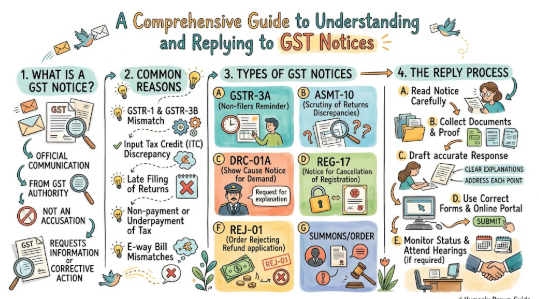
A GST notice is a formal, legal communication sent by tax authorities to a registered taxpayer. It acts as a request for information, a notification of discrepancies, or a demand for action. In a digital-first tax system, these notices are often generated by automated algorithms that identify mismatches between the data filed in your returns and the data available in the GST network’s centralized database.
Think of it as a quality check. Just as a bank might contact you to verify a large transaction, the GST portal contacts you when the numbers don’t add up. It is not always a penalty notice; many times, it is simply a request for clarification.
Why This Topic Matters
Ignoring a notice is the single biggest mistake a taxpayer can make. Compliance is the backbone of your business operations. A simple, unresolved notice can escalate into interest payments, heavy penalties, or even the cancellation of your GST registration, which would effectively halt your ability to issue valid tax invoices.
Common Reasons for Receiving GST Notices
- Mismatched Returns: Discrepancies between your GSTR-1 (outward supplies) and GSTR-3B (tax payment summary).
- ITC Discrepancies: Claiming credit that does not appear in your GSTR-2B.
- Late Filing: Frequent delays in filing monthly or quarterly returns.
- Non-payment of Tax: Shortfalls or complete non-payment of GST liability.
- E-way Bill Mismatches: Differences between data in e-way bills and actual tax returns.
- Classification Errors: Using the wrong HSN or SAC codes for your products or services.
Types of GST Notices
| Notice Form | Purpose |
| GSTR-3A | Sent to non-filers as a reminder to file pending returns. |
| ASMT-10 | Issued during scrutiny of returns to point out discrepancies. |
| REG-17 | A show-cause notice regarding the potential cancellation of GST registration. |
| DRC-01 | A formal demand notice for unpaid tax, interest, or penalties. |
| RFD-08 | A notice questioning or rejecting a GST refund application. |
Step-by-Step Practical Guide to Replying
- Identify the Notice: Log in to the GST portal, go to ‘Services’ > ‘User Services’ > ‘View Additional Notices/Orders’ to download the document.
- Read Carefully: Identify the specific section of the CGST Act under which the notice is issued.
- Gather Records: Collect invoices, bank statements, and relevant GSTR filings that support your case.
- Draft a Professional Response: Create a clear, factual, and polite reply. Address each point mentioned in the notice sequentially.
- Use Official Forms: Ensure you are using the correct response form (e.g., ASMT-11 for scrutiny, REG-18 for registration issues).
- Upload to Portal: Submit your response through the portal. Keep a copy of the acknowledgment for your records.
- Track Status: Check the portal regularly for any further updates or orders issued against your reply.
Practical Real-Life Examples
- Example 1: A trader received a notice for an ITC mismatch. They discovered a vendor hadn’t filed their return. The trader contacted the vendor, got the filing done, and replied to the notice with the updated GSTR-2B data.
- Example 2: An e-commerce seller was flagged for GSTR-1 vs. 3B differences. They reconciled their books, identified a typing error in an invoice, and filed an amendment.
- Example 3: A service provider failed to register a change in address. They received a REG-03 notice, promptly uploaded the new rent agreement, and resolved the issue.
- Example 4: A business was issued a demand notice for interest on late tax payments. They calculated the exact number of delayed days, paid the interest via DRC-03, and uploaded the challan.
- Example 5: A taxpayer received a notice for non-filing. They filed all pending returns within 15 days, paid the late fees, and informed the officer via the portal.
Mistakes to Avoid
- Ignoring the Notice: This is the most common cause of legal escalation.
- Generic Replies: Avoid “copy-pasted” explanations. Every notice is unique.
- Missing Deadlines: The GST portal enforces strict timelines. Always diarize your due dates.
- Lack of Evidence: Never make a claim without attaching the relevant invoice or proof of payment.
- Not Consulting a Professional: If the notice involves complex legal sections, always consult a Chartered Accountant (CA).
Comparison of Compliance Approaches
| Feature | Proactive Approach | Reactive Approach |
| Data Handling | Monthly reconciliation of GSTR-2B | Ad-hoc checks when a notice arrives |
| Penalty Risk | Minimal (errors caught early) | High (interest + late fees) |
| Stress Level | Low; operations continue smoothly | High; potential business interruption |
Expert Tips for Compliance
- Reconcile Monthly: Don’t wait for the year-end to check your ITC.
- Maintain an Audit Trail: Store digital copies of all invoices and e-way bills for at least 6 years.
- Verify Vendors: Check the GST compliance status of your suppliers periodically.
- Use Automation: Leverage accounting software that auto-syncs with the GST portal.
- Stay Updated: GST rules change frequently; subscribe to official government notifications.
Case Studies
- Case 1: The Mismatch Muddle. A small manufacturer received a scrutiny notice. They initially panicked, but upon review, realized they had claimed ITC on an invoice that was later cancelled by the vendor. They reversed the credit and paid the interest voluntarily. Takeaway: Proactive reversals can save you from penalty proceedings.
- Case 2: The Registration Scare. An entrepreneur received a REG-17 notice for not having a sign-board at their shop. They took a photo of the shop with the board and updated their address details within 48 hours. Takeaway: Timely action prevents registration cancellation.
- Case 3: The Refund Delay. A company’s export refund was held up by an RFD-08 notice. They provided a detailed reconciliation of their export invoices. Takeaway: Documentation is the key to proving your claims.
Risk Awareness
Operating a business involves inherent risks, including regulatory and compliance risk. The GST system is designed to be self-policing, meaning the burden of accuracy lies with the taxpayer. Data privacy is also a concern; ensure only authorized personnel have access to your GST login credentials. Always verify the authenticity of a notice through the official gst.gov.in portal before sharing any sensitive business data.
Checklist Before Taking Action
- Have I downloaded the original notice?
- Is the deadline clear?
- Have I cross-referenced the claims made in the notice with my books?
- Is my response factual and supported by documents?
- Have I paid any admitted tax liability + interest?
- Is my digital signature or EVC ready for submission?
Advanced Insights for Serious Taxpayers
For growing businesses, focus on position sizing and internal control. As your turnover increases, implement a ‘Maker-Checker’ system where one person prepares the return and a senior partner reviews it against the GSTR-2B statement. Automating the reconciliation process between your ERP and the GST portal is no longer a luxury but a necessity for scaling safely.
Key Terms Explained
- Input Tax Credit (ITC): The tax you paid on purchases that you can deduct from the tax you owe on sales.
- GSTR-2B: An auto-drafted statement showing the ITC available to you based on your suppliers’ filings.
- Scrutiny: A process where tax officers check your return for mathematical errors or anomalies.
- Show Cause Notice (SCN): A legal notice asking you to explain why a specific action (like a penalty) should not be taken against you.
- Best Judgment Assessment: When an officer calculates your tax liability based on their own assessment because you failed to provide the requested information.
- HSN Code: The Harmonized System of Nomenclature used to classify goods for GST.
- RCM (Reverse Charge Mechanism): A scenario where the buyer, rather than the seller, is responsible for paying the GST.
- Digital Signature (DSC): A secure electronic method for signing digital documents on the portal.
- ARN: The Application Reference Number generated when you submit a document.
- Composition Scheme: A simplified tax scheme for small taxpayers with limited turnover.
Who Should Read This Blog
- Small business owners and traders.
- Freelancers and consultants registered under GST.
- New entrepreneurs navigating their first year of tax compliance.
- Finance and accounting staff in MSMEs.
Frequently Asked Questions
- What should I do first if I receive a GST notice?
Remain calm and log in to the official GST portal to view the specific notice and its reference number. - Can I ignore a minor GST notice?
No, ignoring any notice can lead to automatic escalation and potential penalties. - How do I use the primary keyword GST Notices: Reasons, Types, and Reply Process?
Understanding the reasons and types of GST Notices allows you to follow the correct reply process efficiently. - Are GST Notices always about tax evasion? Not at all; many are simply system-generated requests for clarification on data mismatches.
- What is the time limit to respond to a GST notice?
The deadline is usually mentioned in the notice itself, typically ranging from 7 to 30 days. - Can I reply to a GST notice offline? No, the process is entirely digital and must be conducted via the official GST portal.
- Do I need a lawyer for every GST notice?
Not for minor discrepancies, but consult a professional for show-cause notices involving large sums. - What happens if I don’t reply in time?
The officer may pass an order based on the “best judgment” assessment, which can be unfavorable. - How to handle GST Notices: Reasons, Types, and Reply Process effectively?
Stay organized with your records and ensure your filings are reconciled monthly. - Is it possible to appeal against a GST order?
Yes, if you are unsatisfied with an officer’s order, you can file an appeal with the Appellate Authority. - Why do I keep getting the same GST notice?
This often happens if the underlying error in your books hasn’t been corrected; resolve the root cause, not just the symptom. - Should I use AI to draft my reply?
While AI can help structure your response, you must verify all legal references and data before submission.
Conclusion
Managing GST notices is an inevitable part of modern business life in India. While they might seem intimidating, they are essentially the tax department’s way of ensuring transparency and accuracy in the economy. By understanding the common reasons for these notices—such as mismatched data or minor administrative slips—and following a structured reply process, you can maintain a clean compliance record.
The most important takeaway is to be proactive. Reconcile your books of accounts with your GSTR filings every month. Keep your documentation orderly and up-to-date. If you ever feel overwhelmed by a complex notice, do not hesitate to reach out to a qualified tax professional. Your business’s long-term health depends on your ability to handle these administrative challenges with care and diligence. Start by auditing your last three months of filings today to ensure everything is in order.
Leave a Reply