Introduction
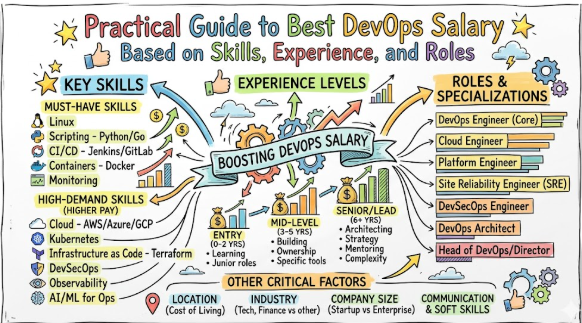
Discover DevOps salary trends, pay ranges by experience and region, top skills that increase income, and data-backed negotiation tips to maximize earnings.
The modern technology ecosystem relies entirely on rapid deployment, reliable infrastructure, and scalable operations. Because businesses must launch software faster than ever without disrupting existing workflows, engineering teams have shifted away from traditional, siloed software development and operations. This architectural shift has positioned system reliability and continuous delivery at the center of corporate strategy. As organizations continue to scale their cloud presence, professionals who bridge the gap between development and engineering operations remain in exceptionally high demand.
Understanding your earning potential is crucial whether you are a university graduate entering the job market, a software engineer looking to switch fields, or a senior engineer evaluating competitive offers. A comprehensive breakdown of compensation structures allows you to assess the value of your existing technical competencies and avoid the common pitfall of accepting under-market compensation. Knowing your market value equips you with the leverage necessary to navigate recruitment cycles confidently and align your skill acquisition with high-paying engineering domains.
The financial landscape of technical operations spans multiple interconnected disciplines, including Cloud Infrastructure, Site Reliability Engineering (SRE), Platform Engineering, and DevSecOps. Earning potential within this space is highly dynamic, fluctuating based on localized demand, technological complexity, and structural industry variations. For example, a professional skilled in automated compliance pipelines often commands a fundamentally different market premium than an engineer managing single-cloud environments.
This analytical guide delivers a granular breakdown of global compensation trends, analyzing regional benchmarks, experience tiers, and tool-specific premium skills. By examining real-world progression trajectories, system design expectations, and practical negotiation frameworks, this guide serves as a strategic roadmap for engineering professionals aiming to maximize their financial and professional growth.
What Does “DevOps Salary” Mean?
When evaluating a technical role, focusing exclusively on the monthly or annual base pay provides an incomplete view of your actual financial compensation. In engineering and infrastructure operations, “total compensation” represents the cumulative economic value an employer provides. This structure is designed to reward system uptime, support long-term engineering stability, and align individual performance with broader company growth.
Total compensation consists of multiple distinct variables that combine to form your overall package. These layers insulate your earnings against inflation and reward deep operational ownership. The fundamental components of a standard enterprise package include:
- Base Salary: The guaranteed, predictable cash distribution paid out on a regular bi-weekly or monthly schedule. It reflects your core technical responsibilities, experience tier, and baseline market value.
- Sign-on and Performance Bonuses: Single-payment cash awards. Sign-on bonuses offset unvested equity abandoned when leaving a previous employer, while performance bonuses tie directly to team uptime metrics, system stability, and company revenue targets.
- Equity and Stock Incentives: Long-term wealth generation mechanisms delivered through Restricted Stock Units (RSUs) or stock options. These typically vest over a multi-year period, aligning an engineer’s financial rewards with the company’s valuation growth.
- On-Call Stipends: Structured, extra payments designed to compensate engineers for maintaining production system reliability during nights, weekends, and holidays.
- Health and Lifestyle Perks: Comprehensive medical coverage, dedicated learning budgets, home-office stipends for remote engineers, and retirement matching schemes that reduce your out-of-pocket expenses.
DevOps Salary Overview
Global market data indicates that infrastructure automation, cloud operations, and platform reliability roles remain among the highest-compensated segments within the broader technology sector. The global median salary reflects a strong corporate willingness to pay a premium for professionals who can actively lower infrastructure costs, prevent costly production downtime, and accelerate software deployment cycles.
Compensation fluctuates across a wide spectrum, driven primarily by localized economic maturity, cost-of-living index variables, and the structural scale of deployment pipelines. For instance, teams handling hyperscale architectures with millions of concurrent users naturally allocate larger compensation budgets to prevent systemic outages. Key structural trends shaping the global market include:
- High infrastructure complexity and rapid multi-cloud migration strategies keep consumer demand outstripping the qualified talent supply, driving upward pressure on total compensation packages.
- Specialized practitioners who possess a deep blend of software development and automated operations consistently command higher premiums than infrastructure administrators focused solely on maintenance.
- Total compensation packages are increasingly weighted toward equity, performance incentives, and on-call premiums within mature tech ecosystems.
- Remote work options have created a unified global talent pool, forcing local companies to increase their domestic pay structures to compete with international organizations.
Table 1 – DevOps Salary by Experience Level
| Experience Level | Average Base Salary | Range | Typical Responsibilities |
| Entry-Level / Junior | $75,000 | $55,000 – $95,000 | Maintaining CI/CD script workflows, basic log monitoring, assisting with cloud resource provisioning under guidance. |
| Mid-Level Engineer | $115,000 | $95,000 – $140,000 | Building infrastructure as code pipelines, managing container deployments, building dashboard configurations, and sharing on-call rotations. |
| Senior Engineer | $165,000 | $140,000 – $210,000 | Architecting multi-region systems, designing robust disaster recovery frameworks, optimizing infrastructure costs, and mentoring juniors. |
| Lead / Principal | $210,000 | $185,000 – $270,000+ | Defining enterprise cloud strategy, engineering structural internal developer platforms, and aligning multi-team operations with security. |
| SRE / Platform Lead | $230,000 | $190,000 – $300,000+ | Governing enterprise-wide reliability metrics, defining SLO/SLA criteria, reducing operational toil, and leading root-cause postmortems. |
Factors That Influence DevOps Salary
Geographic Region and Cost of Living
The physical location of an engineering team or the remote residency of an employee remains a primary factor in determining base compensation. Regions characterized by high cost-of-living indexes and concentrated tech clusters feature elevated baseline compensation packages designed to offset local housing and tax obligations. Conversely, emerging offshore delivery hubs offer lower nominal compensation figures that often provide high local purchasing power.
Company Size and Industry
Tier-one technology enterprises, high-frequency financial trading firms, and heavily backed hyperscale startups allocate much larger compensation budgets than legacy non-tech corporations or early-stage boot-strapped businesses. A company’s operational scale dictates the financial impact of system downtime, which directly influences how much they are willing to invest in top-tier engineering talent.
Cloud and Platform Expertise (AWS, Azure, GCP)
Earning potential varies depending on your mastery of public and hybrid cloud ecosystems. Engineers capable of designing multi-cloud architectures, orchestrating complex cloud migrations, and managing enterprise networking across Amazon Web Services, Microsoft Azure, or Google Cloud Platform command a distinct premium over engineers limited to simple single-provider setups.
Container Orchestration (Kubernetes, Docker)
As applications shift toward distributed microservices, the ability to manage complex container environments is a core differentiator. True market value lies beyond basic container creation; it requires the expertise to scale, secure, and troubleshoot enterprise-grade Kubernetes clusters running under heavy production workloads.
Infrastructure Automation (Terraform, Ansible)
Modern engineering organizations completely reject manual server configuration. High-value engineers treat infrastructure exactly like application software—versioned, tested, and automated. Demonstrating deep proficiency in declarative configuration languages allows you to eliminate human error and secure top-tier compensation packages.
                  +-----------------------------------+
                  |   Declaring Desired State (IaC)   |
                  |     (Terraform / OpenTofu HCL)     |
                  +-----------------+-----------------+
                                    |
                                    v
                  +-----------------+-----------------+
                  |   Automated Execution Pipeline   |
                  |       (GitHub Actions / GitLab)   |
                  +-----------------+-----------------+
                                    |
                                    v
+-----------------------------------+-----------------------------------+
|                     Target Cloud Infrastructure                       |
|   +-----------------------+   +-----------------------+   +-------+   |
|   |  VPC Networks & IAM   |   | Kubernetes Clusters   |   | DBs   |   |
|   +-----------------------+   +-----------------------+   +-------+   |
+-----------------------------------------------------------------------+
Security and DevSecOps Skills
Integrating automated compliance and security protocols directly into software delivery pipelines is a highly sought-after specialization. Security-first practitioners who embed vulnerability scanning, static code analysis, and secret-management workflows into production lifecycles naturally protect companies from catastrophic breaches, commanding premium pay scales for their expertise.
Monitoring and Observability
Collecting basic system metrics is no longer sufficient for complex modern environments. Top-earning engineers understand how to establish holistic observability strategies. They piece together distributed tracing, log aggregation, and metric visualization systems to diagnose subtle performance bottlenecks before they impact end-users.
Team Leadership and Project Scope
As your career advances, your financial growth decouples from pure coding output and shifts toward your systemic blast radius. Engineers who steer cross-functional initiatives, define technical standards across multiple business units, and elevate their peers through structured mentorship unlock senior compensation bands.
Certifications and Practical Experience
While foundational industry certifications validate your conceptual baseline, verified practical experience remains the ultimate currency during salary evaluations. A portfolio demonstrating real-world problem-solving, architectural design trade-offs, and successful production incident resolutions will always carry more weight than certificates alone.
Regional Salary Comparisons
United States
The US tech ecosystem continues to lead global compensation trends, driven by heavy venture capital deployment, intense competition for talent, and a high concentration of primary cloud providers. Major metropolitan hubs like San Francisco, Seattle, New York, and Austin feature elevated compensation packages. These packages are frequently weighted heavily toward equity and variable bonuses, alongside base salaries ranging from $110,000 for mid-level professionals to well over $220,000 for advanced principal leads.
Canada
Canada’s major technology hubs, including Toronto, Vancouver, and Montreal, function as highly mature engineering ecosystems. Compensation scales effectively across these tech centers, with mid-level engineers commanding baseline averages around $115,000 CAD. The market benefits from a blend of strong domestic enterprises and a high concentration of US technology satellites offering highly competitive, talent-retaining compensation packages.
United Kingdom and Europe
The European market presents a diversified compensation landscape shaped by distinct national regulations and economic landscapes. Technical hubs like London, Berlin, Amsterdam, and Zurich lead the region in total compensation. While baseline figures in continental Europe might appear lower than US equivalents, they are supported by comprehensive social benefit models, statutory retirement contributions, and structured health provisions that reduce out-of-pocket costs.
India
India has rapidly transitioned from a traditional back-office outsourcing model into a major global hub for core platform engineering and cloud architecture. Highly competitive tech centers like Bengaluru, Hyderabad, and Pune feature steep salary escalation curves. Engineers who display deep proficiency in advanced system design, distributed systems, and container infrastructure easily outpace traditional developer wage scales.
Australia
The Australian tech sector, concentrated across Sydney and Melbourne, features consistent demand for cloud transformation specialists. Mid-level base packages average roughly $130,000 AUD, with senior leadership positions frequently climbing past $190,000 AUD. This market is heavily focused on public cloud expertise, enterprise security, and migration strategies across finance and enterprise software sectors.
Middle East
Tech hubs like Dubai and Riyadh represent rapidly growing tech ecosystems backed by large-scale sovereign development initiatives and corporate digital transformations. The market offers highly attractive tax-free baseline compensation structures alongside comprehensive relocation, housing, and education stipends. These premiums are designed to attract senior international architects capable of building foundational digital infrastructure from the ground up.
Table 2 – DevOps Salary Comparison by Region
| Region | Average Salary (Mid-Level) | Cost of Living Adjustment | Key Demand Skills |
| United States | $135,000 USD | High | Multi-Cloud Architecture, Advanced Kubernetes, Platform Engineering |
| Canada | $115,000 CAD | Moderate to High | Terraform, AWS Systems, CI/CD Pipeline Architecture |
| United Kingdom | £70,000 GBP | High (London localized) | DevSecOps, Azure Cloud, Automated Compliance Infrastructure |
| Europe (Germany/NL) | €78,000 EUR | Moderate | Prometheus/Grafana Observability, GitOps, Hybrid-Cloud |
| India | ₹1,600,000 INR | Low | Systems Automation, Scripting, Docker/Kubernetes Administration |
| Australia | $130,000 AUD | High | Cloud Migrations, Enterprise Security, Service Mesh Networking |
| Middle East (UAE) | $95,000 USD (Tax-Free) | High | Large-Scale Architecture, Site Reliability Engineering, Governance |
Step-by-Step Guide to Increase Your DevOps Salary
1. Master Core Infrastructure Tools
Begin by building a rock-solid operational foundation. True engineering capability requires a deep, fundamental understanding of Linux systems internals, file management, and networking configurations. Combine this with master-level command of Git version control workflows and the ability to build, maintain, and optimize automated CI/CD deployment pipelines using tools like GitHub Actions, GitLab CI, or Jenkins.
2. Deepen Your Public Cloud Platform Domain Knowledge
Move past superficial dashboard interactions and study the underlying mechanics of at least one primary public cloud provider—AWS, Azure, or Google Cloud Platform. You need to confidently navigate core programmatic concepts, including complex Identity and Access Management (IAM) permission models, virtual private networking architectures, serverless computing blocks, and managed database solutions.
3. Specialize in Microservices Containers and Declarative Infrastructure
Transition away from manual setup scripts by adopting declarative Infrastructure as Code (IaC) principles. Master Terraform or OpenTofu to safely provision, version, and manage infrastructure state across different providers. Once comfortable with basic systems automation, focus on microservices architectures by learning to build Docker configurations and orchestrate production-grade workloads inside managed Kubernetes platforms.
4. Implement Comprehensive Observability and Security Pipelines
Elevate your value from a standard tools administrator to a strategic operations engineer by mastering real-time monitoring and telemetry systems. Learn to configure Prometheus metrics collection, design actionable Grafana dashboards, and parse logs to quickly isolate failures. Integrate automated vulnerability scanning, dependency checks, and compliance auditing tools directly into your active deployment pipelines.
+------------------------+      +-------------------------+      +-------------------------+
|     1. CORE BASIS      | ---> |     2. CLOUD INFRA      | ---> |     3. ORCHESTRATION    |
| Linux, Git, Basic CI/CD|      |  AWS / Azure / GCP IAM  |      |   Terraform, Kubernetes |
+------------------------+      +-------------------------+      +-------------------------+
                                                                              |
                                                                              v
+------------------------+      +-------------------------+      +-------------------------+
|     6. HIGHER PAY      | <--- |   5. PORTFOLIO & CODE   | <--- |     4. OBSERVABILITY    |
| Systems Design Mastery |      | GitHub Real-World Cases |      | Prometheus, DevSecOps   |
+------------------------+      +-------------------------+      +-------------------------+
5. Construct a Verified Real-World Portfolio
Certificates look good on paper, but a functional, production-ready GitHub repository is what lands high-paying offers. Build public projects that demonstrate clean, modular Terraform configurations, automated multi-stage application builds, and self-healing container setups. Document your architecture choices with thorough README files that explain the design trade-offs you made.
6. Prepare Thoroughly for System Design and Behavioral Evaluations
Senior engineering interviews evaluate your systemic problem-solving skills, not just your tool knowledge. Practice designing highly available, fault-tolerant architectures that can handle sudden traffic spikes and isolate service dependencies. Pair this technical preparation with behavioral examples that show how you use data to resolve production outages and coordinate with development teams during critical incidents.
7. Negotiate Compensation Packages Using Market Data
Never enter an offer conversation without objective market data. Research verified, crowdsourced compensation platforms like levels.fyi to understand the exact equity, bonus, and base salary structures for your target tier and location. Frame your salary expectations around the measurable business outcomes you deliver—such as reducing monthly cloud spend or speeding up deployment cycles—rather than your personal financial needs.
Skills That Maximize DevOps Salary
- Multi-Cloud Architecture Strategy: The ability to architect resilient infrastructures that span multiple cloud vendors. This approach eliminates vendor lock-in, optimizes multi-region traffic routing, and protects the business from single-provider outages.
- Production-Grade Kubernetes Management: Moving beyond basic setups to handle live production workloads. High-value skills include tuning cluster autoscalers, configuring secure ingress controllers, managing persistent storage volumes, and implementing advanced service mesh networking.
- Declarative Infrastructure as Code (IaC): Writing clean, reusable, and modular Terraform configurations. This requires a deep understanding of state file locking, remote backends, and building automated drift detection pipelines to prevent environment inconsistencies.
- Automated DevSecOps Compliance: Shifting security to the very beginning of the development lifecycle. This involves embedding static application security testing (SAST), dynamic testing (DAST), and automated secrets detection directly into continuous integration workflows.
- Site Reliability Engineering (SRE) Principles: Approaching operational problems through a software engineering lens. Engineers maximize value by defining clear Service Level Objectives (SLOs), managing error budgets, and writing automated software to permanently eliminate repetitive manual tasks (toil).
- Advanced Monitoring and Observability: Setting up end-to-end telemetry systems. This means designing distributed tracing across microservices, building proactive alerting rules, and configuring metric collectors to expose hidden system bottlenecks.
- Programmatic Scripting and Automation: Writing clean, maintainable code in languages like Python or Go. High-earning practitioners use these languages to extend open-source tools, build custom internal integrations, and automate complex infrastructure workflows.
- Cross-Functional Communication and Soft Skills: The ability to simplify complex technical concepts for non-technical stakeholders. High-level engineers excel at leading post-incident reviews without placing blame, mentoring junior team members, and aligning engineering goals with broader business priorities.
Real-World Salary Growth Scenarios
Case Study 1: The Accelerated Graduate Trajectory
An entry-level computer science graduate accepted a junior infrastructure operations role at a regional logistics enterprise with a starting base salary of $72,000. Their primary tasks involved maintaining existing bash scripts and reviewing system logs.
By dedicating nights to learning Git workflows, public cloud foundations, and modern CI/CD patterns, they took ownership of upgrading the company’s legacy build pipelines. Within twenty-four months, their demonstrated technical independence and successful pipeline modernizations earned them an internal promotion to Mid-Level Engineer, adjusting their base salary upward to $102,000.
Case Study 2: The Infrastructure Specialist Pivot
A mid-level systems administrator earning a flat $90,000 felt limited by manual server configuration workflows and slow enterprise progression cycles. They decided to pivot their career by focusing deeply on declarative infrastructure management and container ecosystems.
Over a year, they built a public portfolio showcasing modular Terraform code and automated microservices deployments. Using this portfolio to prove their hands-on skills, they transitioned to a dedicated cloud technology company. This strategic move shifted them into a senior engineering band with a base salary of $145,000, supplemented by a 10% performance bonus.
Case Study 3: The Enterprise Platform Architect Transformation
An experienced senior engineer with a $155,000 base salary realized that their single-cloud skill set was capping their market value. They proactively expanded their domain expertise into complex cloud-agnostic architectures, service mesh networking, and internal developer platform design.
When a multi-national financial institution initiated a major migration to hybrid-cloud architecture, they stepped into the Principal Platform Lead role. Their ability to design scalable, compliant deployment foundations across different business units secured them a total compensation package featuring a $215,000 base salary, significant corporate equity options, and a sign-on bonus.
Common Mistakes to Avoid
- Expecting Premium Compensation Without Verifiable Practical Skills: Relying purely on conceptual definitions during interview rounds will not land top-tier offers. Teams evaluate your hands-on ability to troubleshoot live infrastructure failures and design resilient, real-world systems.
- Relying Solely on Certifications While Ignoring Real Projects: Collecting a long list of certifications without building an accompanying portfolio of working code signals a lack of practical engineering depth to technical recruiters.
- Ignoring the Critical Software Development Aspect of the Discipline: Treating the role as merely an updated title for traditional systems administration is a major career bottleneck. You must understand software engineering principles, version control, and API integrations to command premium salaries.
- Failing to Learn Modern Observability and Automated Security Platforms: Stopping your education journey once you master basic container creation leaves you exposed to market changes. High-paying roles require expertise in system visibility and automated compliance.
- Neglecting Targeted Negotiation Preparation: Accepting the initial baseline numbers presented during an interview loop without conducting data-backed market research can leave significant money and equity on the table.
Frequently Asked Questions (FAQs)
1. What is the average DevOps salary worldwide?
The global average for a mid-level professional hovers between $95,000 and $135,000 annually. However, total compensation varies drastically based on your geographical region, corporate scale, and specific multi-cloud competencies.
2. How much do entry-level DevOps engineers earn?
Entry-level and junior engineers typically secure base salaries ranging from $55,000 to $95,000. Your exact starting offer depends on your familiarity with Linux systems internals, basic source control, and automated scripting frameworks.
3. Does DevOps salary vary by country?
Yes, compensation ranges are highly dependent on regional economic conditions and local tech market maturity. The United States features the highest nominal salaries and equity packages, while regions like Europe offer extensive statutory social benefits alongside lower nominal base numbers.
4. Which skills increase DevOps pay the most?
Mastering production-grade Kubernetes orchestration, declarative multi-cloud architecture design using Terraform, and building automated compliance checks (DevSecOps) yield the highest market premiums.
5. Do certifications improve salary?
Certifications validate your foundational knowledge and help get your resume past initial HR screening filters. However, actual salary scaling is driven by your practical experience, system design competence, and portfolio execution.
6. What is the difference in salary between DevOps and SRE?
Site Reliability Engineers (SREs) typically command a 10% to 20% premium over standard operations engineers. This variance exists because SRE roles demand deeper software engineering capabilities to programmatically solve complex reliability and infrastructure problems.
7. Is cloud expertise necessary to earn more?
Yes, public or hybrid cloud fluency is a fundamental requirement for high compensation bands. Modern enterprises expect engineers to confidently design, secure, and optimize resources across providers like AWS, Azure, or Google Cloud.
8. Can I earn more as a DevOps engineer without a degree?
Absolutely. The infrastructure engineering market values verifiable technical competence, system design skills, and a proven track record of solving production issues far above formal academic credentials.
9. What is the salary trend for DevOps in 2026?
Compensation trends show steady upward growth, particularly for engineers specializing in automated security compliance and platform engineering. Companies are consistently willing to pay a premium for talent that reduces infrastructure sprawl and optimizes cloud spending.
10. Do DevSecOps skills increase pay?
Yes, embedding automated security controls, vulnerability scanning, and secret management directly into active delivery pipelines is a highly valued skill set that protects companies from costly data breaches.
Conclusion
The financial and professional rewards within the technical operations domain remain highly attractive, reflecting how critical infrastructure reliability is to modern business stability. As organizations continue to migrate to complex multi-cloud architectures and microservices, the demand for engineers who can confidently automate and secure these systems will continue to scale. Earning potential is not tied to a specific job title, but rather scales alongside your technical autonomy, system design capabilities, and the overall business impact of your work.
To maximize your market value and secure top-tier total compensation packages, you must move beyond basic tool configuration. Focus your career development on mastering core cloud architecture principles, implementing deep observability strategies, and contributing to open-source or production-grade automation projects. By continuously aligning your technical skill set with emerging enterprise needs—and backing those skills up with a verifiable public portfolio—you position yourself to successfully navigate recruitment cycles and command premium compensation anywhere in the global market.