Introduction
Stepping into the world of business compliance in India can feel like entering a maze, especially when it comes to taxation. For many small business owners, freelancers, and startups, the Goods and Services Tax (GST) system seems like a mountain of paperwork and confusing technical terms. If you have recently registered for GST, you might be wondering what comes next. How do you keep your business compliant without getting overwhelmed?
The truth is that understanding the GST return filing process is completely manageable once you break it down into simple, logical steps. Filing your returns is not just about avoiding penalties from the tax department; it is a vital practice that helps you track your business growth, maintain transparent accounting records, and build trust with your clients and vendors. This comprehensive guide is designed specifically to simplify the GST Return Filing Process Explained for Beginners, helping you confidently navigate your tax obligations.
we believe that financial literacy and tax compliance should be accessible to everyone. Whether you are running a small local shop, managing freelance clients online, or scaling a new startup, this guide will walk you through everything you need to know about GST return filing in India without the confusing jargon.
What is GST Return Filing?
In simple words, a GST return is a official document that a taxpayer must file with the tax administrative authorities. This document contains details of all your sales, purchases, tax collected on sales (output tax), and tax paid on purchases (input tax).
When you complete the GST return filing process, you are essentially declaring your business activity to the government for a specific period, which could be monthly or quarterly depending on your registration category.
It is important to distinguish between GST registration and GST return filing:
- GST Registration is the initial, one-time process where your business obtains a unique 15-digit Goods and Services Tax Identification Number (GSTIN) from the government.
- GST Return Filing is an ongoing, periodic obligation that begins immediately after you receive your GSTIN. Even if your business had zero transactions during a specific month or quarter, you are usually required to file what is known as a “Nil Return” to maintain active compliance.
Every standard GST return includes specific categories of financial data. It tracks your outward supplies (the goods or services you sold to customers), inward supplies (the goods or services you bought from suppliers), and the exact amount of tax liability calculated after adjusting the taxes you have already paid.
Why GST Return Filing Matters for Beginners
When you are focused on building a new business or finding freelance clients, tax compliance might feel like a distraction. However, setting up a smooth GST filing routine early on offers massive advantages for your long-term success.
- Legal Compliance and Peace of Mind: Staying regular with your tax filings keeps your business out of legal trouble. It ensures you do not receive unexpected notices or warning letters from the tax department, allowing you to focus completely on growing your operations.
- Claiming Input Tax Credit (ITC): This is perhaps the biggest financial benefit of the GST ecosystem. When you buy raw materials, office equipment, or professional services for your business, you pay GST on them. By filing your returns properly, you can deduct this tax from the GST you collect on your sales, saving your business significant amounts of money.
- Avoiding Accumulating Penalties: The GST portal applies automated late fees for every single day a return is delayed. For a beginner, these daily fees can quickly add up to a substantial amount, draining your business capital unnecessarily.
- Creating Better Business Records: Regular filing forces you to organize your invoices, track your expenses, and reconcile your bank accounts every month. This disciplined approach leaves you with clean, professional accounting records that are highly useful for business analysis.
- Smooth Tax and Loan Management: If your business ever needs a commercial loan or a business credit card in the future, banks and financial institutions will invariably ask for your past GST returns to verify your actual business turnover and financial stability.
- Building Trust with Customers and Vendors: Large corporate clients and reputable vendors prefer working with GST-compliant businesses. If you fail to file your returns on time, your buyers cannot claim their Input Tax Credit, which can permanently damage your professional reputation and business relationships.
Who Needs to File GST Returns?
The requirement to file GST returns applies widely across the Indian business ecosystem. It depends entirely on whether your business is registered under the GST Act, regardless of whether you have crossed the official turnover thresholds voluntarily or mandatory.
- GST-Registered Businesses: Any individual or company that has been granted a 15-digit GSTIN must file regular returns. Your sales volume for a particular month does not exempt you from this requirement.
- Small Businesses and Traders: Local retail shops, wholesalers, and distribution businesses that fall under regular registration must declare their trading activities periodically.
- Freelancers and Service Providers: Graphic designers, software developers, consultants, and writers who hold a GST registration are usually required to report their income and file returns.
- E-commerce Sellers: Individuals selling products through online marketplaces like Amazon, Flipkart, or their own Shopify stores must comply with specific GST filing rules, as e-commerce transactions face distinct tax collection guidelines.
- Composition Scheme Taxpayers: Small businesses with an annual turnover up to a specific limit can opt for the Composition Scheme to reduce paperwork. However, they are still required to file simplified, quarterly statements and an annual return.
- Exporters of Goods and Services: Businesses providing services or shipping goods outside India must file their returns carefully to claim tax exemptions or refunds on their inputs.
Please keep in mind that filing requirements, specific forms, and deadlines may vary significantly based on your specific registration type, your business category, and your annual turnover.
Types of GST Returns
The GST framework includes multiple types of return forms, each designed for a specific purpose and category of taxpayer. As a beginner, you do not need to learn all of them, but you must become familiar with the primary forms that apply to regular businesses.
The following table provides an overview of the most common GST return types used in India:
| GST Return Type | Purpose | Who Usually Files It | Filing Frequency |
| GSTR-1 | Outward supplies/sales details | Regular taxpayers | Monthly/Quarterly |
| GSTR-3B | Summary return and tax payment | Regular taxpayers | Monthly/Quarterly |
| GSTR-4 | Composition taxpayer return | Composition taxpayers | Usually annually |
| GSTR-9 | Annual return | Eligible registered taxpayers | Annually |
Documents Required for GST Return Filing
Before you sit down to start the online filing process, it is highly recommended to gather all your financial documents for the reporting period. Having these organized beforehand prevents errors and speeds up the entire workflow.
- Your GSTIN Details: Your business username, password, and active registration details to log into the government portal.
- Sales Invoices (Outward Supplies): All invoices issued to your customers during the month or quarter. These must show the customer’s GSTIN (if it is a B2B sale), the value of the transaction, and the split between CGST, SGST, and IGST.
- Purchase Invoices (Inward Supplies): All bills and invoices received from your suppliers for goods or services purchased for your business operations.
- Debit and Credit Notes: Documents issued to record adjustments in transaction values, product returns, or corrections in original invoices.
- E-way Bills: If your business moves goods worth more than specific regulatory limits across state lines or within a state, corresponding e-way bill numbers must be kept handy.
- HSN/SAC Details: Harmonized System of Nomenclature (HSN) codes for physical goods and Services Accounting Codes (SAC) for services must be mentioned accurately based on your business turnover tier.
- Input Tax Credit (ITC) Verification Data: Access to your GSTR-2B or GSTR-2A statements on the portal to check which of your suppliers have uploaded their invoices.
- Tax Payment Challans: If you have paid any tax liability during the month using online banking or NEFT, save the payment challans and transaction receipts.
- Bank Statements and Accounting Records: Your business bank statements and ledger entries to cross-verify that the invoice amounts match the actual money received or paid out.
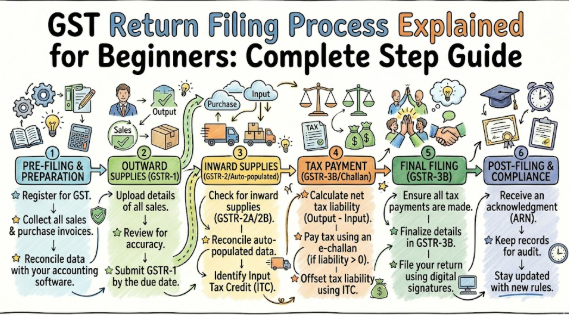
GST Return Filing Process Explained for Beginners
To make the GST return filing process explained for beginners as practical as possible, let us break the entire exercise down into 13 logical, sequential steps. This is the structural workflow that every tax professional and business owner follows during each tax cycle.
1. Collect Sales and Purchase Invoices
Gather every single bill, invoice, debit note, and credit note generated during the tax period. Ensure they are organized by date and categorized clearly into sales (outward) and purchases (inward).
2. Verify GSTIN and Invoice Details
Double-check that your clients’ GSTIN numbers are correct on your B2B sales invoices. A single wrong digit can cause your client’s tax credit to get blocked, leading to complaints and payment disputes.
3. Calculate Output GST
Sum up the total GST you collected from your customers. You will need to know the total amount divided into Central GST (CGST) and State GST (SGST) for sales within your home state, or Integrated GST (IGST) for sales made outside your state.
4. Check Eligible Input Tax Credit
Review your purchase bills to determine how much GST you paid to your vendors. Only count expenses that are directly related to running your business. Personal expenses cannot be used to claim tax credits.
5. Reconcile Data with Books
Compare your physical invoices and accounting ledger with the data reflecting on the GST portal (specifically GSTR-2B). If a supplier forgot to upload your invoice, you may need to follow up with them to secure your tax credit.
6. Log In to the GST Portal
Visit the official government tax portal and enter your secure username, password, and the displayed captcha code to access your customized business dashboard.
7. Select the Correct Return Form
Navigate to the returns filing section, pick the appropriate financial year, and select the specific tax return form (such as GSTR-1 or GSTR-3B) required for your current filing cycle.
8. Enter or Verify Return Details
Carefully enter your transaction details into the designated tiles on the screen. If you use compliant accounting software, you might be able to generate an offline JSON file to auto-populate these sections instantly.
9. Review Tax Liability
The portal will automatically compute your final tax liability based on the data you provided. It will deduct your eligible Input Tax Credit from your Output Tax to show whether you owe any money to the government.
10. Pay GST if Applicable
If your output liability exceeds your input credit, you must pay the remaining balance. You can generate an online electronic challan directly on the portal and pay using internet banking, debit cards, or NEFT/RTGS.
11. Submit the Return
Once the data is entered and any tax dues are cleared, click the preview button to double-check every figure. If everything looks correct, proceed to click the official submit button.
12. File Using DSC or EVC
To finalize the filing, you must authenticate the return digitally. Proprietary companies, individuals, and freelancers can use an Electronic Verification Code (EVC), which sends an OTP to their registered mobile number. Private limited companies usually require a Digital Signature Certificate (DSC).
13. Download Acknowledgement
Once the authentication is successful, the system will generate an Application Reference Number (ARN). Download and save the official filing acknowledgement recipe for your permanent business records.
How to File GST Return Online
The physical execution of filing happens entirely through the official government portal. While it might look confusing initially, navigating the user interface becomes straightforward once you understand where to click.
First, log into your profile on the secure GST portal. Once your main dashboard loads, click on the Services tab, select Returns, and then click on Returns Dashboard. The portal will prompt you to choose the exact Financial Year and the specific Return Filing Period (the month or quarter) you want to work on.
After selecting the period, the screen will display the available return forms. For instance, if you are uploading your sales details, select GSTR-1 and choose whether to prepare it online directly in your browser or upload an offline file generated by your accounting system. Inside the form, you will see separate boxes or tiles for different categories:
- Table 4A, 4B, 4C: Used for entering business-to-business (B2B) invoices where your client has a GSTIN.
- Table 7: Used for entering business-to-consumer (B2C) sales where you sold to everyday end-users.
After entering your data in the relevant boxes, click Save, scroll down, and select Generate Summary. This updates the system calculation tables. Review the preview document thoroughly to ensure no typos occurred. If you are filing a GSTR-3B return to settle taxes, click Proceed to Payment, check your cash and credit ledger balances, offset your liabilities, and authorize the submission with your registered mobile OTP or digital signature.
GST Return Filing Example for Beginners
Let us look at a simple, real-world example to see how these numbers actually work out in daily practice.
Imagine a small business owner named Rahul who runs an office stationery supplies startup in Mumbai. During a specific month, Rahul’s business operations look like this:
- Outward Supplies (Sales): Rahul sells bulk office files to a corporate company and collects a total GST of ₹18,000 from them. This ₹18,000 is his Output Tax Liability—money he has collected on behalf of the government.
- Inward Supplies (Purchases): To make those files, Rahul bought raw paper and plastic sheets from a local manufacturer. When buying these materials, he paid a GST of ₹10,000 to his supplier. This ₹10,000 is his Input Tax Credit (ITC).
When Rahul undergoes the online GST return filing process, the calculation engine applies a simple formula:
$$\text{Net GST Payable} = \text{Output Tax Liability} – \text{Eligible Input Tax Credit}$$
$$\text{Net GST Payable} = ₹18,000 – ₹10,000 = ₹8,000$$
Therefore, instead of paying the full ₹18,000, Rahul safely utilizes his Input Tax Credit and pays only ₹8,000 to the government via an online challan. He completes his filings by uploading these details, ensuring his corporate client can easily claim their corresponding credit of ₹18,000.
GST Return Filing Due Dates
Missing deadlines is one of the most common issues beginners encounter. GST return timelines follow a strict calendar structure, and remembering them is critical to avoiding automated system fines.
Due dates are entirely dependent on the specific type of return form your business uses and your annual turnover category. For example, regular taxpayers filing monthly data are usually required to submit their GSTR-1 sales details by the 11th day of the succeeding month. On the other hand, the summary return and actual tax payment form, GSTR-3B, is typically due between the 20th and 24th day of the following month, varying slightly across different Indian states.
Small businesses registered under the QRMP (Quarterly Return Monthly Payment) scheme or the Composition Scheme enjoy longer, quarterly reporting windows. However, the government frequently issues updates, and due dates can be extended during public holidays, technical portal upgrades, or emergency administrative announcements. It is a vital business habit to verify the exact calendar dates on the official GST portal home screen at the start of every month.
GST Late Fees, Penalties, and Interest
The tax portal enforces compliance automatically through pre-programmed financial penalties. Understanding how these accumulate can help you appreciate why timely submission is so critical.
- Daily Late Fees: If you file a return after its official due date, a fixed late fee is charged for every single day of delay until the return is submitted. This late fee applies even to “Nil Returns”, though the daily rate for a zero-transaction return is lower than that for an active business return.
- Interest on Delayed Tax Payments: If you owe tax money to the government and pay it late, you will have to pay an additional interest charge on the net tax liability amount. This interest rate is calculated annually but applied on a daily basis for the exact number of days the payment was delayed.
- Blocked Input Tax Credit: If you repeatedly fail to file your GSTR-1 returns, your buyers and clients will notice that your invoices are not showing up on their dashboards. Consequently, their ITC gets blocked, which can lead them to stop doing business with you or hold back your pending payments.
- Suspension of GSTIN Registration: Continuous non-filing over consecutive tax periods gives the authorities the legal right to cancel or suspend your GST registration completely, making it illegal for your business to make further taxable sales.
Benefits of Filing GST Returns on Time
Maintaining a clean track record with the tax department offers massive direct benefits that make the operational effort completely worthwhile.
- Elimination of Ghost Expenses: Filing on time ensures your business capital is spent on growth, marketing, or inventory rather than being wasted on preventable government late fees and interest penalties.
- Seamless Business Cash Flow: When your filings are accurate and timely, your corporate clients receive their Input Tax Credits seamlessly. This speeds up your invoice processing times and improves your overall working capital.
- High Trust Rankings on the Portal: The GST portal internally monitors compliance histories. A clean record ensures your business profile remains highly rated, reducing the chances of facing detailed tax audits or physical premises verifications.
- Stress-Free Financial Year-Ends: When you file your data correctly every single month, compiling your comprehensive annual return (GSTR-9) becomes an easy task instead of a stressful bookkeeping nightmare at the end of the fiscal year.
Common GST Return Filing Mistakes Beginners Make
When you are learning how to file GST return options on your own, it is easy to slip up on technical data fields. Being aware of these 10 classic beginner mistakes can help you avoid them completely:
- Typing Wrong Customer GSTINs: Inputting a typo in a customer’s registration number shifts the tax credit to a complete stranger’s account, leaving your actual buyer empty-handed.
- Treating Sales and Purchase Data Separately Without Reconciliation: Uploading information without cross-checking it against your actual bank statements or internal ledger accounts leads to significant accounting mismatches.
- Claiming Blocked or Ineligible ITC: Attempting to claim tax credits on personal lifestyle expenses, luxury items, or food and beverages that are legally restricted under the GST rules.
- Completely Forgetting to File Nil Returns: Assuming that if you made zero sales in a particular month, you can simply ignore the portal. This results in accumulated late fees when you log back in next time.
- Filing Under the Wrong Return Form Category: Accidentally entering regular transaction figures into forms meant exclusively for specialized composition or non-resident taxpayers.
- Ignoring Invoices Left Out by Suppliers: Failing to check your GSTR-2B dashboard and losing out on valuable input tax credits because your vendor forgot to file their reports.
- Procrastinating Until the Absolute Last Evening: Waiting until the final hours of the due date when the government servers often face heavy traffic, leading to upload failures and forced late fees.
- Mixing Up Tax Rate Components: Accidentally entering an $18\%$ tax item under the $12\%$ or $28\%$ column, resulting in wrong collection declarations.
- Failing to Respond to System Notices: Ignoring small automated mismatch alerts sent by the portal, which can escalate into formal tax disputes over time.
- Submitting Without Running a Final Manual Review: Clicking the definitive submit button before downloading the draft preview to cross-verify the entered numbers.
Expert Tips for Beginners
To maintain excellent business compliance without losing your mind, try implementing these practical compliance strategies into your weekly work routine:
- Adopt Regular Weekly Bookkeeping: Do not leave invoice collection for the end of the month. Spend 30 minutes every Friday evening sorting your sales bills and purchase vouchers into separate folders.
- Utilize Reliable Accounting Software: Transition away from simple spreadsheet templates. Use modern cloud accounting applications that generate automated, error-free GST compliance reports and JSON files instantly.
- Implement a Vendor Verification Protocol: Before signing a contract with a new material supplier, run their GSTIN through the public “Search Taxpayer” link on the portal to verify that their registration status is active and compliant.
- Keep Separate Reserves for Tax Liabilities: The GST you collect from customers is not your business revenue; it belongs to the government. Keep this tax money in a separate bank sub-account so you never face cash crunches on payment day.
- Do Not Hesitate to Ask for Expert Help: If your business transactions begin to involve complex scenarios like import-export rules, high transaction volumes, or legal tax notices, hiring a professional accountant can save you money and protect your peace of mind.
GST Return Filing Checklist
Before you officially authorize and click the final button to submit your periodic tax returns, use this quick operational checklist to ensure your data is accurate.
The following table summarizes the vital check-points you should verify during every filing session:
| Checklist Point | Status |
| Sales invoices checked | Yes/No |
| Purchase invoices checked | Yes/No |
| ITC matched | Yes/No |
| Tax liability reviewed | Yes/No |
| Payment completed | Yes/No |
| Return filed and acknowledgement saved | Yes/No |
Who Should Take Professional Help?
While filing a basic, straightforward return can be handled independently by tech-savvy individuals, certain business growth milestones require expert supervision. You should seriously consider onboarding a chartered accountant or a certified GST practitioner if your business expands to include multiple warehouse locations across different states.
Furthermore, handling international import-export compliance, managing high volumes of daily e-commerce consumer sales, or sorting through complex internal ledger mismatches requires specialized knowledge. Investing in professional support can safeguard your business from costly errors and keep your financial foundation strong.
Frequently Asked Questions
1. What is GST return filing for beginners?
Answer. It is the structured process where a registered business uploads its periodic sales, purchases, and collected tax details to the government portal. This process helps calculate net tax payments and ensures legal business compliance.
2. How can I file GST return online?
Answer. You can file by securely logging into the official government GST portal dashboard using your business credentials. From there, enter your transaction numbers into the appropriate form fields, verify the summaries, and authorize using an OTP or digital signature.
3. Is it mandatory to file a GST return if there are zero sales?
Answer. Yes, filing remains mandatory even during zero-activity periods. You must submit what is known as a “Nil Return” to keep your account active and avoid automated daily late fees.
4. What is the difference between GSTR-1 and GSTR-3B?
Answer. GSTR-1 is used strictly to report the detailed breakdown of your outward sales transactions. GSTR-3B is a separate, self-declaration summary form used to calculate final tax liabilities, claim input credit, and pay taxes.
5. What happens if I make a mistake in my GST filing?
Answer. If an error occurs, you generally cannot edit that specific return once it is submitted. Instead, you must enter rectifications or adjustments in the relevant amendment tables during the subsequent month’s filing cycle.
6. How is Input Tax Credit helpful for small business owners?
Answer. Input Tax Credit prevents double taxation by allowing you to subtract the GST you already paid on business purchases from the GST you collect from customers. This significantly lowers your final out-of-pocket tax bills.
7. Can I file my GST returns without a tax accountant?
Answer. Yes, if your startup has simple, straightforward transactions, you can easily file your returns independently using online tutorials. However, consulting an expert is highly recommended for complex or high-volume business operations.
8. What are the common penalties for late GST filing?
Answer. Late filings attract a fixed daily late fee for every day the return is delayed past the deadline. Additionally, an interest penalty is applied to any unpaid tax amounts due to the government.
9. How can I check if my supplier has uploaded my invoice?
Answer. You can check this by logging into your portal profile and opening your automated GSTR-2B or GSTR-2A statements. These view-only dashboards show all invoices uploaded by registered vendors during that month.
10. What is the QRMP scheme in GST return filing?
Answer. The Quarterly Return Monthly Payment (QRMP) scheme allows eligible small business taxpayers with a turnover below specified limits to submit their detailed returns quarterly while paying taxes monthly through simplified challans.
Conclusion
Mastering the GST return filing process explained for beginners is a powerful milestone for any new business owner, freelancer, or startup founder in India. While the initial setup and terms might seem challenging, breaking the system down into consistent routines turns tax compliance into a straightforward, predictable business habit. Staying regular with your filings protects your capital from late fees, secures your Input Tax Credits, and builds invaluable market credibility with your corporate clients and financial partners.
Always remember that accurate bookkeeping is the secret ingredient behind smooth tax management. Keep your sales and purchase invoices well-sorted, monitor your portal dashboard regularly, and adapt quickly as the government updates its compliance frameworks.