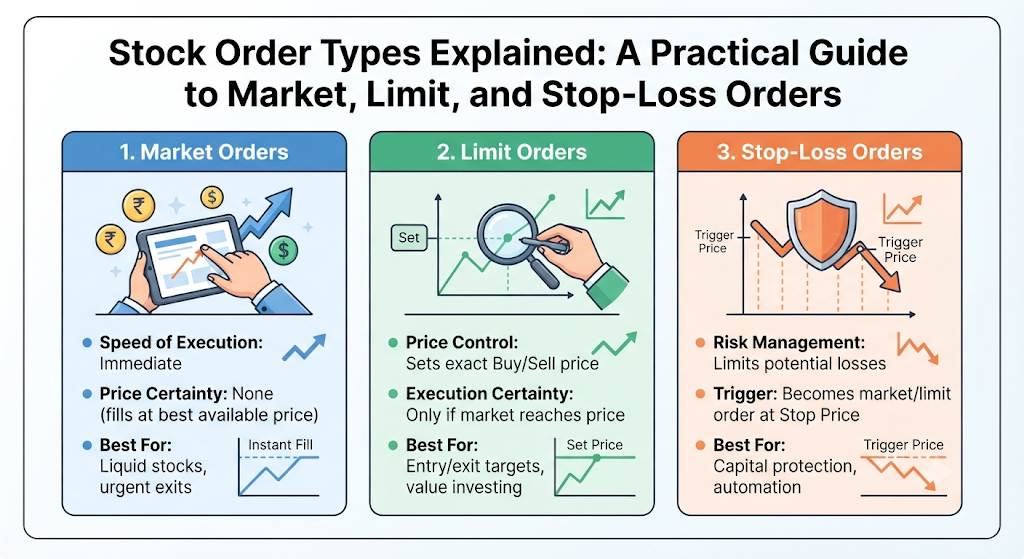
Picking the right stock is only half the work. The instruction you send to your broker when placing a trade decides the exact price you pay, how quickly your trade goes through, and how much money you stand to lose if the market moves against you.
On Indian exchanges like the National Stock Exchange (NSE) and the Bombay Stock Exchange (BSE), every buy or sell request passes through an automated order-matching engine. Whether you are buying shares of an IT company for a five-year hold or managing a short-term swing position, choosing between a market order, a limit order, and a stop-loss order changes your actual outcome.
How Exchange Order Matching Shapes Your Trade
Before looking at individual order types, it helps to see what happens behind your broker’s trading terminal.
At any given second during market hours (9:15 AM to 3:30 PM IST), the exchange maintains an order book for every listed stock. One side lists buyers and the highest prices they are willing to pay (the bid). The other side lists sellers and the lowest prices they are willing to accept (the ask or offer).
The gap between the highest bid and the lowest ask is called the bid-ask spread. The order type you choose tells the exchange’s matching engine whether you care more about speed of execution or price certainty.
1. Market Orders: Prioritizing Speed Over Price
A market order instructs your broker to buy or sell a stock immediately at the best price currently available in the order book. You do not specify a price; you accept whatever the market is offering at that exact moment.
How Execution Works in Practice
Suppose a banking stock shows a best ask price of ₹1,200.00 for 50 shares, and the next seller in line is offering shares at ₹1,200.50. If you place a market buy order for 80 shares:
- The first 50 shares fill immediately at ₹1,200.00.
- The remaining 30 shares fill at ₹1,200.50.
Your order completes in milliseconds, though your average purchase price ends up slightly higher than the quote you saw on screen.
The Hidden Risk of Slippage
The difference between the price you expected when clicking “Buy” or “Sell” and the actual execution price is known as slippage.
In heavily traded Nifty 50 stocks, the bid-ask spread is often just ₹0.05 or ₹0.10, keeping slippage minimal. In thinly traded small-cap stocks, during the first few minutes after market open, or right after a major corporate announcement, spreads widen sharply. A market order in a low-liquidity stock can fill several percentage points away from the last traded price.
Note: Under SEBI and exchange risk-management frameworks, pure market orders are restricted or converted into market-with-protection orders in certain segments—such as illiquid scrips, pre-open sessions, and stock options—to prevent freak trades.
2. Limit Orders: Controlling Your Exact Entry and Exit Price
A limit order lets you set the exact price threshold at which you are willing to trade.
- A buy limit order executes only at your specified limit price or lower.
- A sell limit order executes only at your specified limit price or higher.
Why Investors Use Limit Orders
If a stock is trading at ₹512, and your valuation tells you ₹500 is a fair entry point, you place a buy limit order at ₹500. The order sits quietly in the exchange’s order book. If sellers bring the price down to ₹500 or lower, the matching engine fills your order. If the stock rallies to ₹540 without touching ₹500, your order remains unfilled and expires at the end of the trading day (unless placed as a Good Till Triggered or GTC instruction through your broker).
The Trade-Off: Non-Execution and Partial Fills
Price control comes at the expense of certainty:
- Missed opportunities: If a stock drops to ₹500.10 and bounces back, a ₹500.00 limit order will not execute.
- Partial fills: If only 40 shares are available at ₹500 when you want 100, you will receive 40 shares while the remaining 60 stay pending in the order book until more sellers match your price.
3. Stop-Loss Orders: Automating Downside Protection
A stop-loss (SL) order is a conditional instruction designed to cap losses on an open position or lock in existing gains. Unlike a standard limit order, a stop-loss order stays inactive in your broker’s or exchange’s system until the stock hits a predefined trigger price.
Once the trigger price is crossed, the stop-loss converts into an active order and enters the regular order book.
SL vs. SL-M on Indian Exchanges
Indian brokers and exchanges divide stop-loss orders into two distinct variants:
- Stop-Loss Limit (SL): Requires two prices—a trigger price and a limit price. When the stock touches the trigger price, a limit order is released into the market. For a sell stop-loss on a long position, your limit price must be equal to or lower than the trigger price.
- Example: You buy a stock at ₹800 and set a trigger at ₹770 with a limit price of ₹768. If the stock falls to ₹770, your sell order becomes active and will execute at any price down to ₹768. If the stock gaps down straight to ₹760 on bad news, your order will not execute, leaving you exposed to further drops.
- Stop-Loss Market (SL-M): Requires only a trigger price. Once triggered, it converts into a market order and sells at whatever bid is available. While this guarantees an exit in fast-falling markets, it exposes you to slippage if liquidity dries up. (Note: Exchanges restrict SL-M orders in segments like stock and index options to curb extreme price spikes.)
Using Stop-Loss Orders for Breakout Entries
Stop-loss orders are not strictly for exits. Traders also use buy stop-loss orders above the current market price. For instance, if a stock faces strong resistance at ₹450 and trades at ₹442, a trader might place a buy SL order with a trigger at ₹451 so they enter only after the stock proves upward momentum.
Side-by-Side Comparison of Order Types
| Feature | Market Order | Limit Order | Stop-Loss Order (SL / SL-M) |
| Primary Goal | Immediate execution | Exact price control | Automated risk cap or breakout entry |
| Execution Guarantee | High (if liquidity exists) | Not guaranteed | Triggers only if trigger price is reached |
| Price Certainty | None (subject to slippage) | Guaranteed at limit or better | Guaranteed only with SL (limit), not SL-M |
| Visibility in Order Book | Immediate match | Visible immediately on book | Hidden until trigger price is hit |
| Best Market Condition | Liquid large-cap stocks | Normal or range-bound markets | Volatile swings or unattended positions |
Choosing the Right Order for Different Situations
Rather than sticking to a single order type for every trade, match the instruction to your goal and the stock’s liquidity:
- Building a long-term portfolio: Use limit orders slightly below or right around the current market price. Over dozens of purchases, avoiding ₹1 to ₹3 of bid-ask spread slippage compounds into meaningful savings.
- Exiting an urgent position in a liquid stock: Use a market order when getting out immediately matters more than saving a fraction of a percent, such as ahead of unexpected news.
- Protecting capital while away from your screen: Always attach a stop-loss order after entering a short-term trade. Give the trigger price enough breathing room below normal daily price swings so routine volatility does not knock you out prematurely.
- Trading low-volume or mid/small-cap stocks: Avoid market and SL-M orders. Always rely on limit or SL (limit) orders with a reasonable buffer between your trigger and limit prices so thin order books do not trap you in an unfavorable fill.
Frequently Asked Questions
Can a buy limit order be placed above the current market price?
If you place a buy limit order above the current market price, the exchange’s matching engine treats it as an immediate match against the best available ask prices. It will execute right away at the current lower market price rather than waiting for the price to rise. To buy only after a price rises to a certain level, you must use a buy stop-loss order.
What happens to unexecuted limit and stop-loss orders at 3:30 PM?
Standard intraday or day-validity limit and stop-loss orders automatically cancel at the close of the regular trading session at 3:30 PM IST. If you want an order to remain active across multiple days until triggered, you must use a multi-day validity feature like GTT (Good Till Triggered) if your broker offers it.
Why did my stop-loss order trigger, yet my shares were not sold?
This happens when you use an SL (Stop-Loss Limit) order during a sharp price drop. Once the stock crosses your trigger price, the price may fall below your specified limit price before the exchange can match your order. Because the market price is now worse than your minimum acceptable limit, the order remains pending until the price recovers to your limit level.
Are there extra brokerage charges for placing limit or stop-loss orders?
No. Brokers in India do not charge extra fees for choosing a limit or stop-loss order over a market order. Standard brokerage, Securities Transaction Tax (STT), exchange transaction charges, and GST apply only when an order actually executes. Unexecuted or cancelled orders incur zero brokerage.
Key Takeaway
Every order type forces a choice between certainty of execution and certainty of price. Market orders get you in or out immediately, limit orders protect your entry and exit valuation, and stop-loss orders enforce discipline when a trade goes wrong. Before clicking confirm on your next trade, check the stock’s bid-ask spread and liquidity first—that single habit will tell you immediately which order belongs on your ticket.