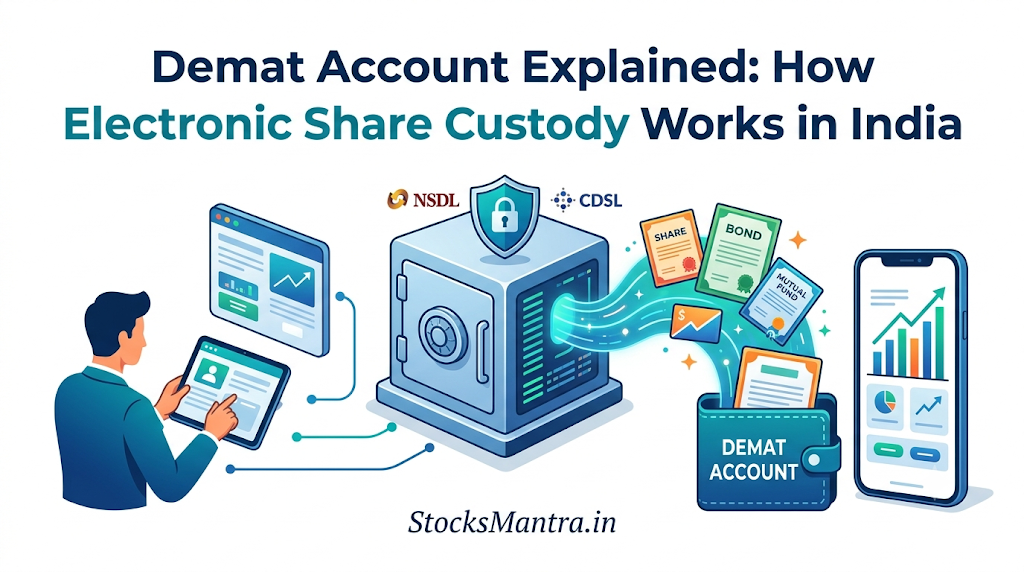
When you buy shares of an Indian company on the stock exchange, you never receive a paper certificate in the mail. Instead, your ownership is recorded electronically inside a specialized digital vault known as a Demat (Dematerialized) account.
Before 1996, investing in the Indian stock market meant handling physical share certificates. Transfers required mailing signed paper deeds, waiting weeks for company registrars to verify signatures, and risking theft, forgery, or damage. The introduction of the Depositories Act in 1996 replaced paper certificates with electronic book-entry records—a process called dematerialization.
For anyone entering the Indian equity or debt markets, understanding how a Demat account works behind the scenes clarifies where your money actually sits, who safeguards your assets, and why your holdings remain safe even if your stockbroker shuts down.
The Three-Tier System Behind Demat Holdings
A common misconception among new investors is that their stockbroker holds their shares. In reality, a broker only acts as an intermediary. Your securities are held within a regulated three-tier infrastructure overseen by the Securities and Exchange Board of India (SEBI).
1. The Depositories (NSDL and CDSL)
At the top of the system are the two SEBI-registered central depositories in India:
- National Securities Depository Limited (NSDL)
- Central Depository Services (India) Limited (CDSL)
Think of a depository as a central bank for securities. Just as a bank holds your cash in electronic ledger balances, NSDL and CDSL hold all dematerialized shares, bonds, and mutual fund units in digital form.
2. The Depository Participant (DP)
Investors cannot open an account directly with NSDL or CDSL. Instead, you interact with them through an authorized agent called a Depository Participant (DP). Banks, registered stockbrokers, and financial institutions act as DPs. When you open a Demat account with a broker, that broker is functioning as your DP—giving you an interface to view your holdings and submit transfer instructions.
3. The Beneficial Owner (BO)
In depository terminology, you—the investor—are the Beneficial Owner. While the depository holds the legal records of the securities on behalf of the company, you retain full economic ownership, voting rights, and entitlement to dividends or bonus shares.
Step-by-Step: How Securities Move Into and Out of Your Demat Account
Understanding how a Demat account holds securities becomes much clearer when you trace what happens during a standard stock market trade.
- Placing an Order: Suppose you place an order to buy 50 shares of a company through your trading app. Your Trading Account executes this order on the National Stock Exchange (NSE) or Bombay Stock Exchange (BSE).
- Clearing and Settlement: Once the trade is matched, the exchange’s clearing corporation verifies the funds from your bank account and the shares from the seller’s side. India follows a T+1 settlement cycle (Trade Day plus one working day) for equities.
- Electronic Credit: On the settlement day, the seller’s Demat account is debited by 50 shares, and the depository (NSDL or CDSL) credits 50 electronic units directly to your 16-digit Demat account ID.
- Holding and Corporate Actions: While the shares remain in your Demat account, the company’s Registrar and Transfer Agent (RTA) accesses the depository’s ownership records on specific “record dates.” When the company declares a dividend, stock split, or bonus issue, the cash is sent directly to your linked bank account, and new shares are credited straight to your Demat balance.
- Selling Securities: When you sell those shares, you authorize your DP (typically via a CDSL TPIN/OTP or a Power of Attorney/DDPI mandate) to debit the shares from your Demat account and transfer them to the clearing corporation.
Demat Account vs. Trading Account vs. Bank Account
New investors often confuse the roles of the three accounts required to participate in the Indian stock market. Each serves a distinct purpose:
| Feature | Bank Account | Trading Account | Demat Account |
| Primary Function | Holds liquid cash | Executes buy and sell orders on exchanges | Stores financial securities electronically |
| What It Holds | Indian Rupees (INR) | Holds nothing; acts purely as a transaction bridge | Shares, ETFs, mutual funds, bonds, Sovereign Gold Bonds |
| Role in Buying | Debits money to pay for your purchase | Places the bid on NSE/BSE | Receives the purchased securities upon settlement |
| Role in Selling | Receives cash proceeds from the sale | Places the ask order on NSE/BSE | Releases the sold securities to the buyer |
Types of Securities You Can Hold in a Demat Account
While equities are the most common asset stored in a Demat account, the infrastructure supports a wide range of financial instruments:
- Equity Shares: Stocks of publicly listed companies on the NSE and BSE.
- Exchange-Traded Funds (ETFs): Index ETFs, gold ETFs, and liquid ETFs.
- Mutual Fund Units: Both active and passive mutual funds held in dematerialized form (though mutual funds can also be held in Statement of Account format without a Demat account).
- Government Securities (G-Secs) and Bonds: Treasury bills, state development loans, and corporate bonds.
- Sovereign Gold Bonds (SGBs): Digital units issued by the Reserve Bank of India (RBI) on behalf of the Government of India.
- Debentures and Commercial Papers: Corporate debt instruments.
What Happens to Your Securities If Your Broker Shuts Down?
One of the strongest safeguards of the Indian depository system is asset segregation. Your shares are stored on the servers of NSDL or CDSL, not on your broker’s internal balance sheet.
If your broker faces financial trouble, loses its license, or shuts down operations:
- Your shares remain untouched in your depository account.
- Creditors of the broker cannot claim your Demat holdings to settle the broker’s debts.
- You can open a new Demat account with another SEBI-registered DP and transfer your entire portfolio using a Delivery Instruction Slip (DIS) or online transfer facility without selling a single share.
Important Costs and Limitations to Keep in Mind
While a Demat account simplifies investing, investors should be aware of standard operational rules and charges:
- Annual Maintenance Charges (AMC): Most DPs charge an annual fee to maintain your Demat account, typically ranging from ₹0 (for Basic Services Demat Accounts with low holding values) to ₹300–₹750 per year.
- Depository Participant (DP) Charges: Whenever you sell shares from your Demat account, the depository and DP levy a flat transaction fee (usually around ₹13 to ₹20 plus GST per scrip per day, regardless of quantity sold). Buying shares generally incurs zero DP charges.
- Nomination and KYC Compliance: SEBI mandates updated Know Your Customer (KYC) details and nominee registration (or an explicit opt-out) to keep a Demat account active and prevent freezing.
- No Interest on Holdings: Unlike a savings bank account that pays interest on idle cash, a Demat account simply stores securities; returns come solely from capital appreciation, dividends, or interest paid by the underlying instruments themselves.
Frequently Asked Questions (FAQs)
1. Can I open a Demat account without a trading account?
Yes. If you only want to apply for IPOs, hold gifted shares, or convert existing physical share certificates into electronic form without actively buying or selling on the stock exchange, you can open a standalone Demat account.
2. Is it possible to have more than one Demat account in India?
Yes, an individual can open multiple Demat accounts across different Depository Participants using the same PAN card. However, you can only open one Demat account per broker/DP, and maintaining multiple accounts means paying separate Annual Maintenance Charges for each.
3. How do I know whether my Demat account is with NSDL or CDSL?
You can identify your depository by looking at your 16-character Demat Account ID (Beneficial Owner ID). NSDL account numbers start with “IN” followed by 14 digits (e.g., IN300XXX12345678), whereas CDSL account numbers consist entirely of 16 numeric digits (e.g., 1208160012345678).
4. What is a Basic Services Demat Account (BSDA)?
A BSDA is a SEBI-mandated facility designed for small retail investors. If you hold only one Demat account across India and the total value of your debt and equity holdings stays within SEBI’s prescribed threshold, you pay zero or reduced Annual Maintenance Charges.
5. Can I transfer shares from one Demat account to another?
Yes. You can transfer shares between your own Demat accounts or gift them to someone else using off-market transfer facilities—either physically via a Delivery Instruction Slip (DIS) or online through CDSL’s Easiest and NSDL’s SPEED-e portals.
Key Takeaway
A Demat account is the foundational record-keeping layer of modern Indian investing. By separating trade execution (handled by your trading account) from asset custody (secured at NSDL or CDSL), the system ensures that your stocks, bonds, and funds remain verifiable, liquid, and protected under your name—making it essential to monitor your Consolidated Account Statement (CAS) periodically and keep your KYC and nominee details up to date.