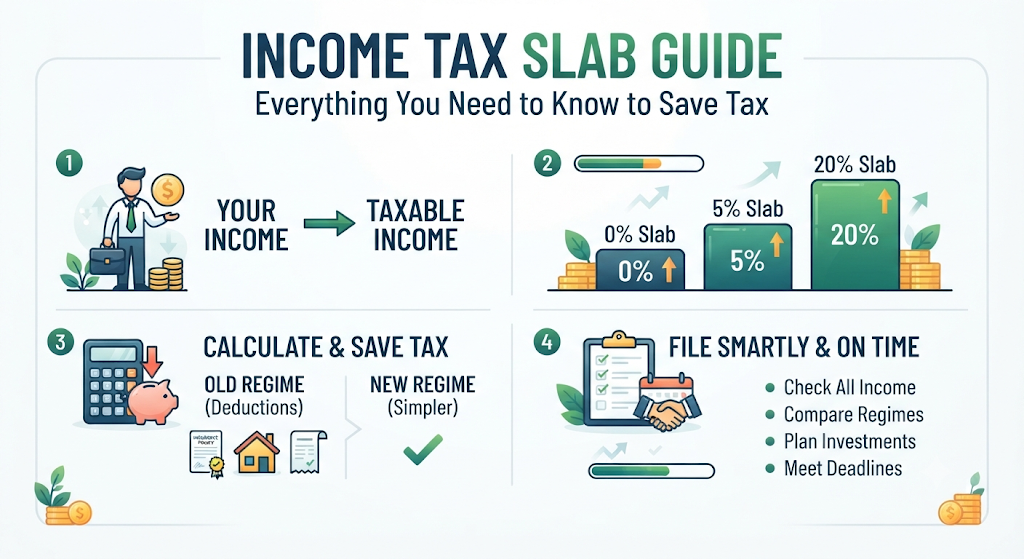
Introduction
Tax season often causes confusion for many earners. Words like “tax slabs,” “deductions,” and “tax regimes” can sound complicated. When people do not understand how tax brackets work, they often pay more tax than necessary or choose the wrong tax system for their savings.
This guide breaks down income tax slabs into simple terms. You will learn how tax slabs work, the difference between the Old and New tax regimes, how to calculate your tax, and common mistakes to avoid.
What Are Income Tax Slabs?
Professional term -> Simple meaning -> Why it matters -> Example
- Income Tax Slab: A tiered system where different income ranges (slabs) are taxed at increasing percentage rates.
- Simple Meaning: Your income is split into income brackets. Lower brackets are taxed less (or not at all), while higher brackets are taxed at higher percentages.
- Why It Matters: It ensures a fair system where people who earn more pay a higher percentage of tax, while lower-income earners are protected.
- Example: If the first slab of ₹3,00,000 has a 0% tax rate, you pay zero tax on your first ₹3,00,000 of earnings, regardless of how much total money you make.
How Income Tax Slabs Work
Tax slabs do not mean your entire income gets taxed at your highest bracket rate. This is a common myth.
Instead, tax calculation uses a progressive tax system. Your income is broken down into slices. Each slice is taxed according to that specific slab’s rate.
Practical Example of Progressive Taxation
Imagine the tax rules are:
- Up to ₹3,00,000: 0% tax
- ₹3,00,001 to ₹7,00,000: 5% tax
If you earn ₹6,00,000 in a year:
- Your first ₹3,00,000 is taxed at 0% = ₹0
- Your remaining ₹3,00,000 (from ₹3,00,001 to ₹6,00,000) is taxed at 5% = ₹15,000
- Total tax before rebates = ₹15,000
You do not pay 5% on the whole ₹6,00,000. You only pay 5% on the amount that falls inside the 5% bracket.
New Tax Regime vs. Old Tax Regime
Tax systems generally offer two choices: the Old Tax Regime and the New Tax Regime. Choosing the right one depends on your investments and expenses.
1. The Old Tax Regime
- What it is: A traditional tax structure with lower tax rates for certain brackets, but it allows you to claim numerous deductions and exemptions (such as investments in Public Provident Fund, life insurance, home loan interest, and medical insurance).
- Best for: People who have high tax-saving investments, home loans, and eligible expenses.
2. The New Tax Regime
- What it is: A simplified tax structure with lower tax slab rates across broader income ranges, but it removes almost all major deductions and exemptions.
- Best for: People who prefer lower tax rates without keeping track of tax-saving investments and receipts.
Important Factors to Understand
When evaluating your income tax obligations, keep these core concepts in mind:
- Tax Rebate: A government rule that reduces your tax liability to zero if your total income is below a certain limit (such as under specific rebate thresholds in the tax laws).
- Standard Deduction: A fixed flat amount subtracted from your salary income before tax is calculated, lowering your taxable income automatically.
- Surcharge: An extra tax charged on top of your normal tax if your income is extremely high.
- Cess: A small additional percentage charged on your calculated tax amount to fund specific public programs (like education and health).
Common Mistakes to Avoid
People often make avoidable errors when dealing with income tax slabs and filings:
- Mistake: Assuming the highest slab applies to all earnings.
- Why it happens: Misunderstanding progressive tax brackets.
- What to do instead: Remember that tax is calculated in slices, so only your income above a threshold enters a higher slab.
- Mistake: Choosing a tax regime without calculating both options.
- Why it happens: Blindly following what colleagues or friends chose.
- What to do instead: Add up your total deductions (rent, investments, insurance) under the old regime and compare your final tax liability against the simplified new regime rates.
- Mistake: Forgetting to include secondary income sources.
- Why it happens: Only counting primary salary and ignoring bank interest, freelance work, or capital gains.
- What to do instead: Combine all sources of income to find your correct total taxable income bracket.
Risks and Limitations
- Changing Rules: Tax slabs, tax rebates, and deduction limits can change with government budgets. Always verify the current financial year’s active rules before filing.
- Lock-in Periods: Under the old regime, certain tax-saving investments (like tax-saving fixed deposits or equity-linked savings schemes) lock your money away for several years. Ensure you need the investment, not just the tax break.
Decision-Making Framework: Which Regime Should You Choose?
Use this simple step-by-step framework to decide between the Old and New tax regimes:
- Calculate your Gross Income: Add up your salary, business earnings, rental income, and interest.
- List your Eligible Deductions: Calculate how much you can claim under popular old-regime sections (like standard deduction, provident fund, life/health insurance, home loan interest, and house rent allowance).
- Calculate Tax Under the Old Regime: Subtract your deductions from your gross income, then apply the old tax slab rates.
- Calculate Tax Under the New Regime: Take your gross income, subtract the standard deduction (if permitted), and apply the new tax slab rates.
- Compare and Choose: Pick the regime that results in the lower final tax amount.
Checklist Before Filing Your Taxes
- Gather all income documents (salary slips, bank interest statements, investment proofs).
- Check your tax credit statements (like Form 26AS or Annual Information Statement) to verify taxes already paid or deducted.
- Compare tax liabilities under both the Old and New tax regimes.
- Confirm eligible deductions if choosing the Old regime.
- File your tax return before the official deadline to avoid penalties.
Key Terms
- Tax Bracket: Another name for a tax slab; the income range subject to a specific tax rate.
- Taxable Income: The portion of your income that is actually subject to tax after subtracting legal deductions and exemptions.
- Exemption: Specific types of income or expenses that are legally freed from being taxed.
- Deduction: An amount you can subtract from your gross total income to lower your overall tax burden.
- Assessment Year: The year in which the income earned in the previous year is evaluated and taxed.
- Financial Year: The 12-month period during which you earn your income.
FAQs
What happens if my income crosses into a higher tax slab by just a small amount?
Only the amount that falls above the threshold is taxed at the higher rate. Your income below that threshold is still taxed at the lower rate.
Can I switch between the Old and New tax regimes every year?
Salaried individuals generally have the option to choose between the two regimes each financial year when filing their returns. Business owners may have stricter rules regarding switching back and forth.
Is the standard deduction available in the New Tax Regime?
Yes, salaried individuals can claim the standard deduction from their salary income under both the Old and New tax regimes.
Does tax get deducted automatically from my salary?
Yes, if you are a salaried employee, your employer estimates your annual tax based on your declared tax regime and investments, deducting a portion each month (Tax Deducted at Source).
What is a tax rebate?
A tax rebate is a government provision that gives you a complete discount on your tax if your total taxable income stays below a specified limit.
Are capital gains from stocks taxed using regular income tax slabs?
No, capital gains from selling shares or mutual funds are often taxed at special separate rates (such as short-term or long-term capital gains tax rates) rather than standard income tax slabs.
Do senior citizens have different tax slabs?
Tax laws often provide higher basic exemption limits and tax relief for senior citizens (individuals aged 60 and above) or super senior citizens compared to regular working-age individuals.
What is an Annual Information Statement (AIS)?
An AIS is a comprehensive statement provided by tax authorities that shows all financial transactions linked to your permanent account number, including salary, interest, dividends, and property transactions.
Conclusion
Understanding income tax slabs gives you control over your personal finances. Instead of viewing taxes as a confusing chore, look at them as a predictable part of earning money. By knowing your brackets, comparing tax regimes carefully, and keeping accurate records, you can keep your tax stress low and your savings high.