Introduction
Managing a business or a professional practice involves keeping track of money coming in and going out. While keeping clean records is a good habit, the law sometimes demands that an expert double-check those records. This process is called a tax audit.
For many growing business owners and independent professionals, tax audits sound intimidating. Terms like “turnover limits,” “books of accounts,” and “compliance” can feel overwhelming. Many people only find out about these rules when it is almost too late to hire an accountant or organize their invoices, leading to stress, missed deadlines, and penalties.
This guide breaks down tax audit applicability in very simple English. You will learn what a tax audit is, who needs one, what the exact limits are, what mistakes to avoid, and how to handle the process smoothly.
What Is a Tax Audit?
To understand a tax audit, let us separate it from a regular business audit.
Professional term: Tax Audit (specifically under Section 44AB of the Income Tax Act).
Simple meaning: An official examination of your financial books by a certified independent accountant (like a Chartered Accountant) to confirm that your income, expenses, deductions, and tax calculations are reported accurately.
Why it matters: It ensures that taxpayers are not hiding income or claiming false expenses. It gives the tax department confidence that the financial statements match the actual business reality.
Example: Imagine running a busy retail store. You record thousands of cash and digital transactions. A tax audit means an expert verifies if your reported profit matches your actual sales bills and expense receipts.
Why Tax Audits Matter for Your Business
A tax audit is not just an annoying government formality. It serves several practical purposes for you, your business, and the tax authorities.
When an expert reviews your books, they spot hidden accounting errors, missing bills, or incorrect tax deductions before the tax department does. Fixing these mistakes early protects you from sudden tax notices and legal trouble. Furthermore, having a certified tax audit report builds trust. If you ever need a business loan, banks look very favorably on audited financial statements because they know the numbers are verified.
Who Needs a Tax Audit? (The Core Rules and Limits)
The biggest question every business owner asks is: “Do I cross the line where a tax audit becomes mandatory?”
The applicability depends on whether you run a business or provide professional services, and how much money you make (your turnover or gross receipts).
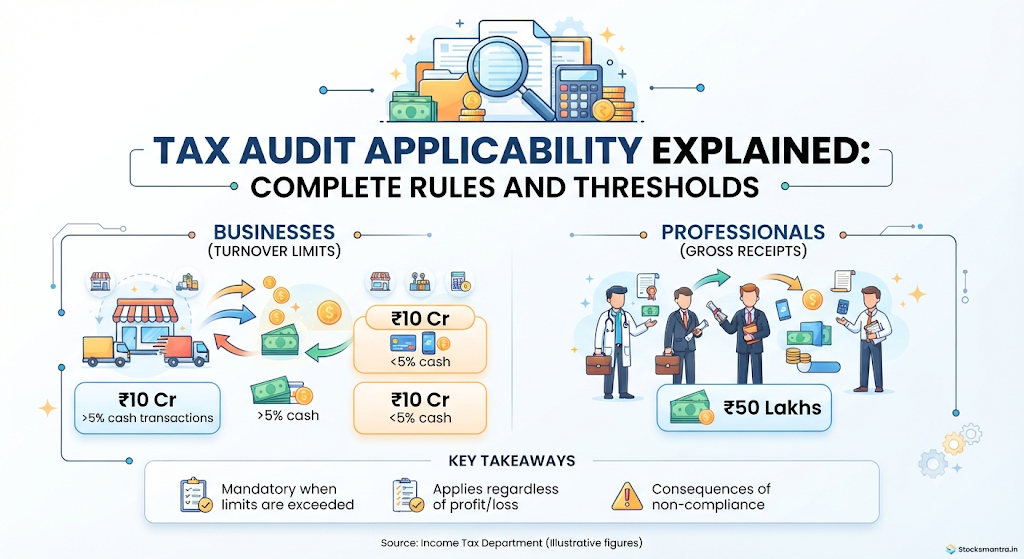
1. For Businesses (Trading, Manufacturing, Retail, etc.)
If your primary activity is selling goods, products, or running a standard commercial business, the general turnover threshold is a crucial milestone.
- General Rule: If your total sales or turnover from the business cross the standard monetary limit in a financial year, a tax audit is compulsory.
- The Digital Transactions Relaxation: To encourage digital payments and reduce cash dependency, governments often provide a higher turnover limit if your cash transactions (both receipts and payments) stay below a very small percentage (usually 5%) of your total business transactions. This means if you collect almost all your money through banks, digital wallets, or UPI, you enjoy a much higher threshold before a tax audit becomes mandatory.
2. For Professionals (Doctors, Lawyers, Consultants, Engineers, etc.)
If you earn money by applying your intellectual or professional skill rather than selling physical goods, the rules look at your gross receipts (total fees collected).
- Professional Limit: If your gross receipts from your profession cross the specified professional threshold in a financial year, you must undergo a tax audit.
Understanding Key Thresholds and Scenarios
To make these rules crystal clear, let us look at practical scenarios involving different kinds of earners.
| Category | Nature of Activity | When Tax Audit Becomes Applicable |
|---|---|---|
| Retail Trader | Selling clothes or electronics mostly in cash | When total annual sales cross the standard business turnover limit. |
| E-commerce Seller | Selling products online via digital payments | Higher threshold applies as long as cash transactions are minimal (under 5%). |
| Consultant / Freelancer | Providing IT, design, or legal advisory services | When total annual professional fees (gross receipts) cross the professional limit. |
| Presumptive Taxation | Declaring lower profits than the minimum percentage | When you declare profits lower than the prescribed presumptive rate and your total income crosses the basic exemption limit. |
The Presumptive Taxation Exception
Many small business owners and professionals choose a simplified tax scheme often called Presumptive Taxation. Under this scheme, the government assumes you made a certain minimum profit percentage based on your turnover, saving you from maintaining detailed day-to-day account books.
However, a special trap exists here:
- If you opt for presumptive taxation, your business income is calculated at a flat rate (e.g., 6% or 8%).
- If you claim that your actual profit was lower than this assumed rate, and your total taxable income crosses the basic tax-free limit, a tax audit becomes mandatory, even if your turnover is well below the normal audit limit.
How the Tax Audit Process Works
If you cross the applicability limits, here is the step-by-step workflow you and your accountant will follow:
- Appointment of Auditor: You formally appoint a qualified independent accountant to conduct the audit.
- Book Keeping and Closing: You ensure that all ledger accounts, cash books, bank statements, and invoice files are organized and closed for the financial year.
- Verification and Testing: The auditor checks sample transactions, matches bills with bank entries, verifies inventory valuation, and checks statutory payments (like employee taxes or provident fund contributions).
- Drafting the Report: The auditor prepares a detailed audit report using standardized forms (such as Form 3CA/3CB and Form 3CD). This report highlights key financial ratios, tax disallowances, and compliance notes.
- Filing and Submission: The auditor submits the report electronically to the tax portal, and you review and approve it before filing your final income tax return.
Common Mistakes to Avoid
Many taxpayers make avoidable errors regarding tax audits. Here are the most frequent pitfalls:
- Waiting Until the Last Minute: Giving your books to an accountant a week before the deadline leads to rushed audits, missed invoices, and errors. Start organizing your financial data right after the financial year ends.
- Confusing Turnover with Profit: Turnover means your total sales revenue, not your net profit. Business owners often mistakenly think, “My profit is low, so I don’t need an audit,” forgetting that the audit trigger is based on total sales, not profit.
- Ignoring Cash Receipt Limits: Failing to monitor the share of cash transactions can accidentally pull your business into a lower audit threshold than you expected.
- Mixing Personal and Business Expenses: Running personal grocery bills or family travel expenses through business bank accounts creates audit complications and invites tax penalties.
Risks and Limitations of Failing to Comply
Ignoring tax audit applicability carries serious consequences.
If you are legally required to get a tax audit done but fail to do so, the tax department can levy heavy penalties. This penalty is usually calculated as a percentage of your total turnover or gross receipts, or capped at a substantial maximum amount. Furthermore, missing the tax audit deadline usually means your income tax return cannot be filed on time, leading to late fees, loss of certain business loss carry-forward benefits, and high interest charges.
Checklist for Tax Audit Preparation
Use this practical checklist to ensure you are ready before your accountant begins the audit:
- Reconcile all active bank statements with your accounting software or cash books.
- Keep physical or digital copies of all major purchase invoices and sales bills organized by date.
- Verify that all statutory dues (such as GST, TDS, or employee welfare contributions) paid during the year have matching challans.
- Prepare a clear closing inventory valuation statement if you deal in physical goods.
- Gather loan sanction letters and repayment schedules for any business loans taken or repaid during the year.
- Keep a summary of fixed asset purchases and bills for new machinery, computers, or office furniture.
Key Terms
- Turnover: The total amount of money a business brings in from selling goods or services over a specific period.
- Gross Receipts: The total amount of fees or cash collected by a professional before deducting any expenses.
- Presumptive Taxation: A simplified tax scheme where small businesses can declare a standard fixed profit percentage instead of maintaining complex account books.
- Form 3CD: The detailed statement format that an auditor fills out, covering tax-specific disclosures, ratios, and compliance checks.
- Financial Year: The 12-month period for which accounts and taxes are calculated (typically running from April 1 to March 31).
Frequently Asked Questions
What is the difference between a statutory company audit and a tax audit?
A company audit (statutory audit) is required under corporate law to check the general financial health and fairness of a company’s financial statements for shareholders. A tax audit is specifically required under income tax laws to verify tax-related compliance, deductions, and correct income calculation.
Does a loss-making business still need a tax audit?
Yes. Tax audit applicability depends strictly on your turnover or gross receipts, not on whether your business made a profit or a loss. If your sales cross the threshold, an audit is mandatory even if you suffered a net loss.
Can I change my auditor after the financial year ends?
Yes, you can appoint a new auditor, but it is best to do so early to ensure a smooth handover of your financial records and previous year’s working papers.
What happens if my turnover crosses the limit just before the year ends?
The moment your total turnover crosses the specified legal threshold during the financial year, the tax audit requirement becomes applicable for that entire year. You must immediately start preparing your books for the audit.
Is GST turnover the same as Income Tax turnover?
Not always. While both measure business sales, calculation differences can occur due to branch transfers, export adjustments, or specific exemptions. You must calculate your income tax turnover strictly according to income tax rules.
How far back should I keep my bills for a tax audit?
It is standard professional practice to maintain books of accounts, bills, invoices, and tax challans for at least the legally mandated number of years specified by tax laws (often 6 to 7 years) in case the tax authorities reopen past cases.
Conclusion
Tax audit applicability may sound like dry legal jargon, but understanding it is a core part of running a responsible business or professional practice. By knowing your sales thresholds, keeping your invoices organized, and working closely with a qualified accountant well before the deadline, you turn a stressful compliance chore into a smooth annual routine. Stay proactive, keep your accounts clean, and protect your enterprise from avoidable tax penalties.