Introduction
Investing in the stock market can feel exciting. You pick a good company, buy its shares, and watch your investment grow. But when you finally sell those shares and see a profit in your account, a sudden question pops up: How much of this money actually belongs to me, and how much goes to the tax department?
For many beginners, tax rules sound like a foreign language filled with confusing numbers and scary legal terms. People often make costly mistakes because they do not understand when their tax clock starts ticking, or they forget to set aside money for taxes.
This guide breaks down capital gains tax on shares into plain, everyday English. You will learn what these taxes mean, why they matter, how the system calculates them, and what smart steps you can take to keep more of your hard-earned profits.
What Is Capital Gains Tax on Shares?
A capital gain is the profit you make when you sell an asset—like a stock or share—for a higher price than what you paid for it.
Imagine you buy a share of a tech company for $100. A few months later, the share price rises, and you sell it for $150. Your profit is $50. That $50 profit is your capital gain.
Why Does It Matter?
Governments collect taxes on income. While a salary is income earned from your job, capital gains are income earned from your investments. If you do not track and pay your capital gains tax, you can face penalties, legal trouble, and unexpected bills from tax authorities. Understanding these rules helps you plan your investments better and avoid nasty surprises at tax time.
How Capital Gains Work: The Holding Period
The tax department looks closely at time. The duration between the day you bought a share and the day you sold it is called your holding period.
The tax world splits this period into two categories:
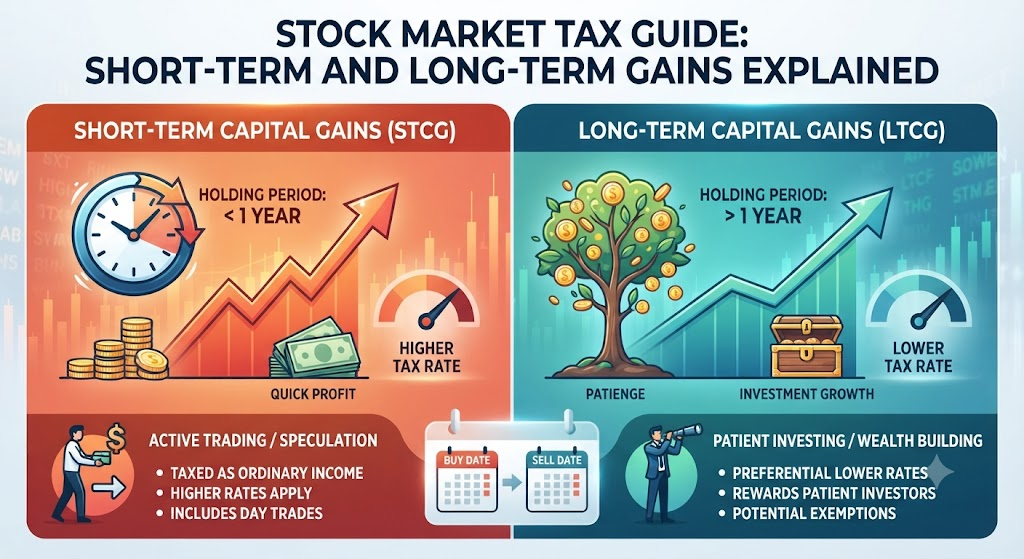
- Short-Term Capital Gains (STCG): Profits made from selling shares that you held for a short duration.
- Long-Term Capital Gains (LTCG): Profits made from selling shares that you kept for a longer duration.
The exact number of months that separates “short-term” from “long-term” can vary depending on local tax laws, but the general rule is simple: holding shares longer usually rewards you with lower tax rates.
Short-Term Capital Gains (STCG) Explained
What Is It?
Short-Term Capital Gains happen when you buy a share and sell it quickly—usually within a year (or whatever the legal threshold is in your country). Day traders and swing traders mostly deal with STCG.
Why Does It Matter?
Governments generally want to encourage people to invest for the long term to keep the stock market stable. To discourage rapid, speculative day trading, short-term profits usually face higher tax rates.
Example
Suppose you buy shares of a retail company for $1,000 in January and sell them for $1,200 in October of the same year. Your holding period is nine months. Because you sold the shares in less than a year, your $200 profit falls under STCG and gets taxed at your short-term rate.
Long-Term Capital Gains (LTCG) Explained
What Is It?
Long-Term Capital Gains happen when you buy a share, hold onto it patiently for more than a year, and then sell it for a profit.
Why Does It Matter?
Long-term investing helps build stable businesses and a strong economy. Because the government wants to reward patient investors, LTCG is taxed at a much lower rate than STCG. In many tax systems, there is even a yearly tax-free exemption limit on long-term stock profits.
Example
You buy shares of an energy company for $5,000 and keep them in your portfolio for three years. When you finally sell them for $8,000, your $3,000 profit is classified as LTCG. You will pay a much lower tax percentage on this amount compared to a short-term trade.
Important Factors to Understand
Navigating share taxes requires looking beyond just buying and selling. Keep these core factors in mind:
- Purchase Price (Cost Basis): The original price you paid for the share, plus any broker fees or commissions. This number is vital because your profit is calculated as the selling price minus your purchase price.
- Grandfathering Rules: When tax laws change, governments sometimes introduce “grandfathering” clauses. These rules protect profits made up to a specific past date from new, higher tax rates.
- Tax Loss Harvesting: A smart strategy where you sell losing stocks on purpose to offset your capital gains, thereby lowering your overall tax bill.
Comparison: Short-Term vs. Long-Term Capital Gains
| Feature | Short-Term Capital Gains (STCG) | Long-Term Capital Gains (LTCG) |
|---|---|---|
| Holding Period | Usually less than 1 year | Usually more than 1 year |
| Tax Rate | Generally higher (aligns with regular income or higher flat rate) | Generally lower (reduced flat rate) |
| Intent | Quick trading, capturing fast price swings | Wealth building, retirement, patience |
| Exemptions | Rare or none | Often includes yearly tax-free limits |
Common Mistakes Beginners Should Make
- Forgetting to Track Transaction Costs: People often calculate profit as just (Sell Price – Buy Price). Remember to subtract brokerage fees, exchange charges, and taxes paid when buying, as these reduce your overall net profit.
- Confusing Trading with Investing: Day trading generates frequent short-term gains that require meticulous record-keeping. Treating high-frequency trades like casual long-term investments leads to severe tax audits.
- Ignoring Tax Loss Harvesting: Investors often hold onto losing stocks forever, hoping they will bounce back, instead of using those losses to offset taxable gains on winning stocks.
- Waiting Until the Last Minute: Scrambling to calculate capital gains right before the tax filing deadline leads to missing documents, calculation errors, and missed savings opportunities.
Decision-Making Framework: Should You Sell Now or Hold?
Before selling your shares, run through this simple decision checklist:
- Step 1: Check your holding period. Have you held the shares past the long-term threshold? Waiting just a few more weeks could drop your tax rate significantly.
- Step 2: Calculate your net profit. Subtract all purchase fees and selling expenses from your gross profit.
- Step 3: Review your annual income bracket. Understand how your short-term gains will stack on top of your regular salary or business income.
- Step 4: Consider tax-loss opportunities. Do you have other underperforming stocks you can sell to balance out your profits?
- Step 5: Make the final move. Execute the trade only when the financial return outweighs the tax impact.
Checklist for Capital Gains Tax Filing
- Gather all contract notes and transaction statements from your broker.
- Separate your trades into short-term and long-term buckets based on exact purchase and sale dates.
- Calculate your total buy cost, including commissions and fees.
- Calculate your net selling price after deducting broker fees.
- Check if your country offers any basic exemption limits or tax-free allowances for capital gains.
- File your returns accurately using the correct tax forms before the deadline.
Key Terms
- Capital Gain: The financial profit you make when you sell an investment for more than its purchase price.
- Holding Period: The exact length of time you own an asset between buying and selling it.
- STCG (Short-Term Capital Gains): Profits earned from selling shares held for a short period (typically under a year).
- LTCG (Long-Term Capital Gains): Profits earned from selling shares held for a prolonged period (typically over a year).
- Cost Basis: The original total cost of acquiring an asset, used to measure capital gains.
- Tax Loss Harvesting: Selling investments at a loss to reduce the capital gains tax liability of your profitable investments.
- Grandfathering: A provision in tax law that exempts old investments from new, stricter tax rules.
- Brokerage: The fee charged by a broker to execute buy and sell orders on your behalf.
FAQs
Q: Do I have to pay tax if I sell my shares at a loss?
A: No. Capital gains tax only applies to profits. If you sell a share at a loss, you do not pay capital gains tax. In fact, many tax systems let you use those losses to reduce taxes on your other investment profits.
Q: What if I receive dividends from my shares? Are they capital gains?
A: No. Dividends are a share of company profits paid out to you while you own the stock. Dividends are usually taxed separately as dividend income, whereas capital gains only happen when you actually sell the shares.
Q: Does the tax clock reset if I buy more shares of the same company?
A: Most tax systems use the First-In, First-Out (FIFO) method. This means when you sell shares, the system assumes you are selling the oldest shares you bought first. Therefore, buying new shares does not reset the holding period of your older shares.
Q: Do I owe tax if I sell my shares but keep the cash inside my brokerage account?
A: Yes. The tax event happens the moment you sell the share, not when you withdraw the cash into your personal bank account. Once the sale order executes, the profit is locked in for that tax year.
Q: Are free shares or bonus shares subject to capital gains tax?
A: When a company gives you bonus shares, you do not pay tax immediately. However, when you eventually sell those bonus shares, their purchase price is considered zero for tax calculation purposes, meaning the entire sale value is treated as your gain.
Q: Can I avoid capital gains tax entirely?
A: You cannot avoid taxes illegally, but you can plan around them. Holding shares for the long term, utilizing tax-free allowance limits, and practicing tax loss harvesting are legal, smart ways to minimize your tax burden.
Q: What documents do I need to file my capital gains tax?
A: You will need your profit and loss (P&L) statement, capital gains statements provided by your broker, contract notes, and bank statements showing transaction dates.
Q: Do I pay capital gains tax if my total income is very low?
A: In many tax jurisdictions, if your total taxable income (including capital gains) falls below the minimum tax exemption limit, you may not owe any tax. Always check your local tax laws for specific income thresholds.
Conclusion
Capital gains tax on shares does not have to be intimidating. By understanding the simple difference between short-term and long-term holding periods, keeping track of your purchase costs, and planning your sales strategically, you can manage your taxes like a seasoned professional. Always maintain clear records of your trades throughout the year, and consult a qualified tax advisor if you deal with complex portfolios.