Introduction
Running a business takes immense energy, time, and financial risk. After managing employees, inventory, customer service, and daily operations, seeing a massive chunk of your hard-earned revenue vanish in taxes can be painful. Many business owners assume high taxes are just an unavoidable cost of success.
However, tax laws around the world are designed to encourage business growth, hiring, and investment. Governments offer legal ways to lower your taxable income if you know how to use them correctly.
The problem is that tax rules are often filled with confusing jargon. Many beginners either miss out on valuable deductions out of fear or make risky choices that lead to penalties. This guide breaks down the core concepts of tax planning into clear, simple language. You will learn how to organize your finances, spot legitimate deductions, and build a safe strategy to keep more money in your business.
What Is Business Tax Planning?
Tax planning is the process of looking at your business finances to arrange your income and expenses in a way that minimizes your legal tax burden.
- Simple meaning: It is the art of organizing your business money so you pay the exact minimum amount of tax required by law.
- Why it matters: Every dollar or rupee you save on taxes is money you can reinvest into your business, use as an emergency cushion, or take home as profit.
- Example: If your business makes fifty thousand dollars in profit and your tax rate is twenty percent, you owe ten thousand dollars. Through proper tax planning—such as buying necessary software and equipment before the year ends—you lower your taxable profit to forty thousand dollars, reducing your tax bill to eight thousand dollars.
Tax planning is completely legal and different from tax evasion, which involves hiding income or lying on official forms to illegally avoid paying taxes.
How Business Taxes Work
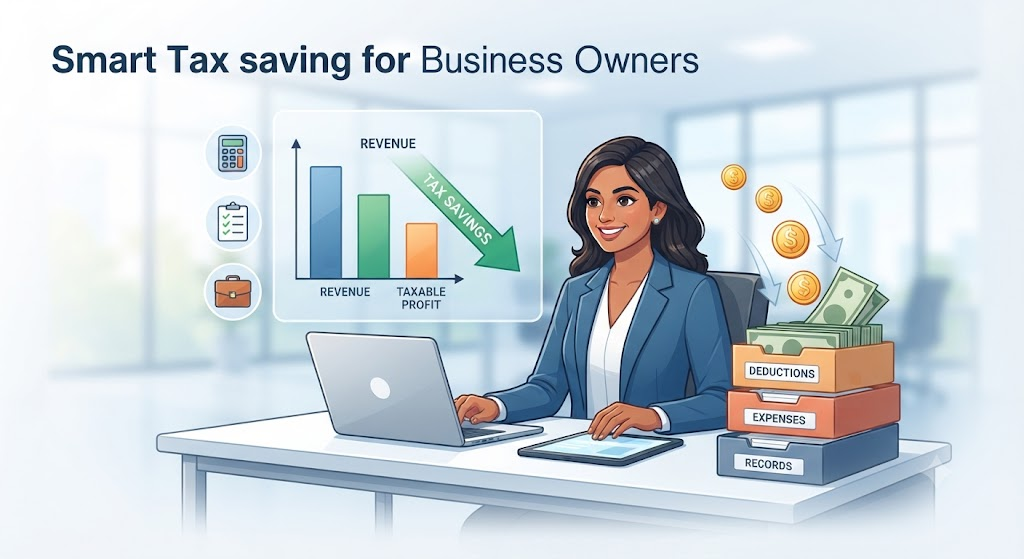
To save money on taxes, you first need to understand how the system calculates what you owe. Governments rarely tax your total revenue. Instead, they tax your net profit.
Net profit is your total income minus your allowable business expenses.
$$\text{Net Profit} = \text{Total Revenue} – \text{Business Expenses}$$
If your revenue is high, but your documented business expenses are also high, your net profit shrinks. A smaller net profit means a smaller tax bill. The entire secret to business tax saving lies in two things:
- Maximizing legitimate business deductions.
- Keeping accurate records to prove every expense.
Why Tax Planning Matters for Every Business Owner
Ignoring tax planning until the filing deadline is one of the most expensive mistakes an entrepreneur can make. Without a strategy, you lose control over your cash flow.
When you plan your taxes throughout the year, you achieve three major benefits:
- Better Cash Flow: You avoid sudden, massive tax bills that can drain your bank accounts.
- Smart Growth: You know exactly how much capital you have available to hire staff, buy inventory, or expand your workspace.
- Peace of Mind: Organized records protect you during tax audits and keep your business compliant with government regulations.
Important Factors to Understand Before You Start
Before diving into specific tax-saving strategies, you must grasp a few foundational rules of business finance.
- Business vs. Personal Separation: Never mix personal spending with business spending. Using a dedicated business bank account and credit card makes it easy to track expenses and prove deductions to tax authorities.
- The Receipt Rule: In the eyes of the tax department, if an expense is not documented with a receipt, invoice, or digital trail, it essentially did not happen.
- Timing of Income and Expenses: Depending on your accounting method, timing when you send invoices or pay for supplies can help shift income or deductions into the most tax-friendly financial year.
Smart Tax Saving Tips for Business Owners
Implementing practical tax strategies does not require a degree in accounting. Here are the most effective ways to lower your business tax burden legally.
1. Claim All Legitimate Business Expenses
Every ordinary and necessary cost required to run your business can usually be written off to lower your taxable income. Common deductible expenses include:
- Office Rent and Utilities: Payments for workspace, electricity, internet, and phone lines used for business.
- Software and Subscriptions: Monthly or annual fees for accounting software, project management tools, and digital marketing platforms.
- Marketing and Advertising: Costs spent on social media ads, website hosting, design work, and promotional materials.
- Professional Fees: Payments made to accountants, lawyers, and consultants who help run your business.
2. Take Advantage of Equipment and Asset Write-Offs
When you buy heavy machinery, computers, or office furniture, you usually cannot deduct the entire cost in a single year if the asset lasts a long time. Instead, governments allow depreciation, which means you write off a portion of the asset’s cost each year as it loses value. However, many tax codes feature special immediate expensing rules that let small businesses deduct the full cost of qualifying equipment in the year they buy it.
- Why it matters: It encourages you to upgrade your tools now while immediately lowering your current tax bill.
- Example: Buying a new delivery van for your business this December instead of waiting until next January can lower your current year’s taxable profit.
3. Deduct Home Office Expenses If Applicable
If you run your business from a dedicated space inside your home, you may be eligible to deduct a portion of your household expenses.
- What qualifies: A specific room or area used regularly and exclusively for business work.
- What you can deduct: A calculated percentage of your rent, mortgage interest, property taxes, home insurance, and utilities based on the square footage of your office compared to the entire home.
4. Provide Tax-Deductible Employee Benefits
If you have a team, offering certain benefits is a powerful way to attract talent while lowering your tax bill. Many health insurance plans, retirement contributions, and educational assistance programs funded by the business qualify as deductible operational expenses.
Common Mistakes to Avoid
Even well-meaning business owners often fall into common tax traps.
| Common Mistake | Why It Happens | The Problem | What You Should Do Instead |
| Mixing Personal and Business Funds | Using one credit card for groceries and business software. | Makes auditing impossible and flags your account for review. | Open a separate business bank account immediately. |
| Waiting Until Tax Season | Ignoring records all year and scrambling in April. | Misses out on strategic year-end purchases and deductions. | Review your financials and talk to an accountant quarterly. |
| Claiming Personal Expenses | Trying to write off family vacations or personal clothing. | Results in heavy fines, back taxes, and potential audits. | Only deduct expenses that are strictly necessary for business operations. |
| Throwing Away Receipts | Relying on memory or bank statements alone. | Tax authorities may disallow deductions without itemized proof. | Use digital receipt-scanning apps to save every invoice instantly. |
Risks and Limitations
While saving on taxes is smart, pushing boundaries too far introduces serious risks.
- The Audit Risk: Claiming excessive deductions without proof increases the likelihood of a government tax audit. An audit is time-consuming, stressful, and can result in expensive penalties.
- Cash Flow Traps: Do not spend money on an unnecessary business asset just to get a tax write-off. Spending a thousand dollars on equipment you do not need just to save two hundred dollars in taxes still leaves you eight hundred dollars poorer.
- Changing Laws: Tax regulations change frequently. A strategy that worked legally last year might be altered or eliminated in the current fiscal year. Always verify rules with a certified tax professional.
Decision-Making Framework: Should You Make a Year-End Business Purchase?
Use this simple step-by-step checklist before buying equipment or software just to lower your taxes:
- Do I actually need this item to run or grow my business? If no, stop here. Do not buy it.
- Do I have the cash flow to make this purchase without harming my emergency savings? If no, wait.
- What is the net cost after tax savings? Calculate how much tax you will actually save versus the cash leaving your account.
- Does this investment increase productivity or generate future revenue? If yes, proceed with the purchase and document the receipt.
Key Terms
- Deduction: An expense that you are legally allowed to subtract from your total revenue to lower your taxable income.
- Depreciation: The gradual reduction in the recorded value of a business asset over time due to wear and tear.
- Net Profit: The actual money left over after subtracting all business expenses from total revenue.
- Tax Bracket: The range of income levels that are taxed at a specific percentage rate.
- Tax Audit: An official examination of your business financial records by tax authorities to verify accuracy.
- Tax Evasion: The illegal practice of deliberately misrepresenting or hiding income to avoid paying taxes.
- Tax Avoidance: The legal use of tax laws and deductions to minimize the amount of tax you owe.
- Fiscal Year: A one-year period that companies use for calculating financial statements and annual tax reporting.
FAQs
Can I deduct my meals with clients?
In many jurisdictions, you can deduct a percentage (often fifty percent) of business meal costs if the meal is directly related to discussing business with clients, partners, or prospective customers. You must keep a receipt and write down who attended and the business purpose on the back or in your accounting software.
What happens if I forget to claim an expense during the current tax year?
Depending on local tax laws, you can often file an amended tax return for previous years to claim missed deductions. However, doing so is tedious and can trigger scrutiny, so it is always best to catch everything during the initial filing.
Should I hire a professional accountant or use tax software?
If your business is very simple with few transactions, good tax software can handle it. However, as soon as you have employees, inventory, multiple revenue streams, or complex assets, hiring a certified public accountant or licensed tax practitioner usually saves you more money than they charge in fees.
Are personal vehicle expenses deductible?
Yes, if you use your car for business purposes—such as driving to client meetings, visiting suppliers, or delivering products. You can either track actual vehicle expenses (gas, insurance, maintenance) or use the standard mileage rate set by your tax authority. Always keep a detailed mileage logbook.
How long should I keep my business tax records?
Most tax authorities require you to keep business records, receipts, and tax returns for at least three to seven years. In cases of suspected fraud or failure to file, there is often no time limit, so keeping digital backups indefinitely is safest.
Conclusion
Tax planning is not about dodging responsibilities; it is about managing your enterprise with financial intelligence. By tracking expenses diligently, claiming every legal deduction, avoiding personal and business mixing, and timing your major purchases wisely, you keep more capital where it belongs—inside your business. Build good financial habits early, keep your paperwork organized year-round, and consult a qualified professional to ensure your strategy keeps your business safe and profitable.