Introduction
Medical emergencies never knock on your door before arriving. When they strike, they bring emotional stress and a heavy financial burden. Hospital bills, medicines, and doctor fees can easily drain your savings in a few days.
To help people protect themselves, the government encourages buying health insurance through tax savings. Under Section 80D, you get a reward from the tax department simply for keeping your family medically insured.
Yet, many taxpayers miss out on the maximum benefit because they do not understand how the rules work. They confuse limits for parents and children, or they forget to claim expenses on preventive checkups. This guide will walk you through everything you need to know about Section 80D in simple, easy-to-understand language.
What Is Section 80D?
Section 80D is a specific rule in the Indian Income Tax Act. It lets you claim a deduction from your total taxable income if you pay for health insurance.
When you buy a health policy, the money you pay toward the premium reduces the income on which you have to pay tax. For example, if your annual income is 8,00,000 INR and you qualify for an 80D deduction of 25,000 INR, the government calculates your tax as if your income was 7,75,000 INR.
Why Does It Matter?
Healthcare costs are rising every year. Section 80D encourages people to buy health cover so they do not face financial ruin during a medical crisis. It lowers the real cost of buying insurance by giving you tax relief.
How Section 80D Limits Work
The deduction amount you can claim depends on two main things:
- Who is covered under the policy (yourself, your family, or your parents).
- The age of the people insured (regular adults versus senior citizens aged 60 or above).
1. Deduction for Self, Spouse, and Dependent Children
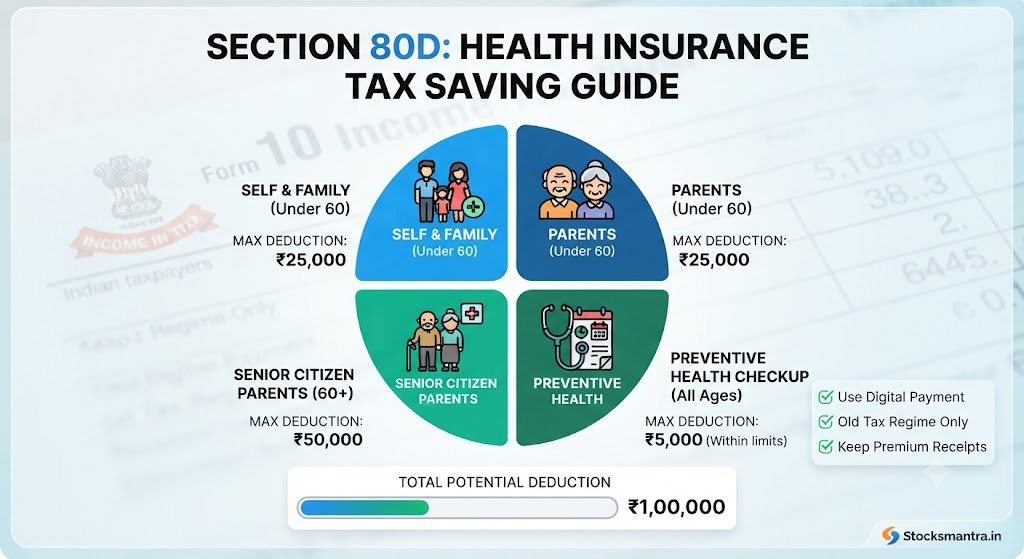
For you, your spouse, and your dependent children, the maximum deduction limit is 25,000 INR per financial year.
- If you pay 20,000 INR as a premium, you can claim 20,000 INR.
- If you pay 30,000 INR, you can only claim up to the maximum limit of 25,000 INR.
If you or your spouse are senior citizens (60 years or older), this limit increases to 50,000 INR.
2. Deduction for Parents
You can claim an extra deduction if you pay health insurance premiums for your parents.
- If your parents are below 60 years old, the limit is 25,000 INR.
- If your parents are senior citizens (60 years or older), the limit increases to 50,000 INR.
This means if you pay insurance for yourself and your senior citizen parents, your total deduction can go up to 75,000 INR (25,000 INR + 50,000 INR). If you are also a senior citizen and pay for senior citizen parents, the total can reach 1,00,000 INR.
Preventive Health Checkup Allowance
Section 80D does not just reward insurance policies; it also rewards taking care of your health before you fall sick.
You can claim up to 5,000 INR every year for preventive health checkups. This amount is not extra; it is included within the overall limits mentioned above (25,000 INR or 50,000 INR).
Change block type or style
Move Heading block from position 24 up to position 23
Move Heading block from position 24 down to position 25
Change alignment
Change text alignment
Displays more block tools
Practical Example
Suppose you spend 4,000 INR on a full-body health checkup for your family, and your total insurance premium is 22,000 INR.
- Total expense = 26,000 INR.
- Because the overall limit for your category is 25,000 INR, your maximum allowed deduction is capped at 25,000 INR.
Medical Expenditure for Senior Citizens
Many senior citizens find it hard to buy health insurance because insurance companies reject them or charge very high rates due to pre-existing illnesses.
To help them, the government added a special provision under Section 80D. If a senior citizen (aged 60 or above) does not have a health insurance policy, any money spent on their medical treatment can be claimed as a deduction up to the 50,000 INR limit.
Why This Matters
If your elderly parents do not have insurance and you spend 40,000 INR on their medicines, doctor visits, or hospital care, you can claim that amount under Section 80D, provided the total does not cross the 50,000 INR parent cap.
Summary of Section 80D Deduction Limits
| Category | Who is Covered | Max Age Group | Maximum Deduction Limit |
| Self & Family | Self, Spouse, Children | Below 60 Years | 25,000 INR |
| Self & Family (Senior) | Self, Spouse, Children | 60 Years and Above | 50,000 INR |
| Parents | Mother, Father | Below 60 Years | 25,000 INR |
| Parents (Senior) | Mother, Father | 60 Years and Above | 50,000 INR |
| Preventive Checkup | Self, Family, Parents | All Ages | 5,000 INR (Inside total limit) |
Important Rules and Conditions to Remember
To claim your Section 80D deduction smoothly, keep these operational rules in mind:
- Mode of Payment: You must pay insurance premiums through digital methods like net banking, credit cards, debit cards, UPI, or cheques. Cash payments are not allowed, except for preventive health checkups.
- Single Premium Policies: If you buy a multi-year health insurance policy (for example, paying for 2 or 3 years upfront), you can claim the deduction proportionately across the years the policy covers, as per income tax guidelines.
- Tax Regime: Section 80D deductions are only available if you choose the Old Tax Regime. If you opt for the New Tax Regime, most deductions under Chapter VI-A (including 80D) are not available.
Common Mistakes Taxpayers Make
- Paying Premiums in Cash: Paying your annual insurance premium in cash means you lose the tax deduction, even if you have the receipt. Always use digital payment modes.
- Forgetting Parent Limits: Many people think the 25,000 INR limit is for the entire family including parents. In reality, you get a separate pool for your parents.
- Double Claiming: If you and your sibling both contribute to your parents’ insurance, only one of you can claim the tax benefit for that payment, or you can split it as long as the total does not exceed the legal limit.
- Ignoring Preventive Checkup Receipts: People often pay cash for small lab tests and forget to collect bills. Keep your diagnostic bills safe to claim up to 5,000 INR within your limit.
Checklist Before Claiming Section 80D
- Are you using the Old Tax Regime for filing your income tax return?
- Did you pay all insurance premiums through digital channels or cheques?
- Do you have valid premium payment receipts or certificates from your insurance provider?
- Did you separate the payments made for yourself and your parents?
- Are your preventive health checkup bills properly documented?
Key Terms
- Deduction: An amount you can subtract from your total gross income to lower your taxable income.
- Premium: The regular amount of money you pay to an insurance company to keep your health policy active.
- Senior Citizen: An individual who has completed 60 years of age.
- Preventive Health Checkup: Medical tests done to detect health problems early before symptoms appear.
- Old Tax Regime: The traditional tax system that allows various deductions and exemptions.
FAQs
1. Can I claim Section 80D if my employer pays my health insurance?
No. If your employer provides health insurance and pays the full premium, you cannot claim a tax deduction for it because you did not spend your own money.
2. Can I claim deductions for my in-laws under Section 80D?
No. Section 80D allows deductions for yourself, your spouse, your children, and your parents. It does not include your parents-in-law.
3. Is GST included in the health insurance premium for tax calculation?
Yes. The total amount you pay, which includes the base premium plus Goods and Services Tax (GST), qualifies for the Section 80D deduction.
4. What happens if my parents have insurance and also incur heavy medical expenses?
You can claim deductions for both the insurance premium and actual medical expenses for senior citizen parents, but the combined total deduction for parents cannot exceed 50,000 INR.
5. Can a freelancer or business owner claim Section 80D?
Yes. Any individual or Hindu Undivided Family (HUF) paying health insurance premiums can claim deductions under Section 80D, regardless of whether they are salaried or self-employed.
Conclusion
Section 80D is one of the most useful provisions in the tax code because it protects your financial health while reducing your tax liability. By keeping digital payment records, understanding parent limits, and utilizing preventive checkup allowances, you can maximize your savings legally and safely. Always evaluate your family’s insurance needs first, and let the tax benefits work as a helpful bonus.