Introduction
Good rental decisions follow the same pattern as most good decisions. You set clear criteria, compare a few options against them, and choose the one that fits. Vehicle rentals suit daily travel, tourism, business trips and weekend journeys, but the wrong choice can waste money and time.
Searches for bike rental in India usually come from people with a specific plan, such as a weekend ride, a work trip or a few weeks in a new city. MotoShare is a platform built around that kind of search. Its description presents a marketplace for motorcycles, scooters, cars and bicycles, with city-based search and a range of rental periods. This guide shows how to turn a vague idea into a clear shortlist and a confident booking.
Getting to Know MotoShare
MotoShare is described as a vehicle-rental marketplace. It brings together travellers and local rental providers on one platform. According to its description, people can search by city, look at different vehicle types, choose how long they need a vehicle and use the booking options provided. The description also refers to verified local providers and to opportunities in India and other Asian destinations.
These points describe what the platform aims to offer. Vehicle lists, prices and policies change, and not every feature may be present in every city. Always check the current details with the platform and the provider before you rely on them.
The Practical Value of Renting on Your Own Terms
Renting gives you a vehicle for the period you need it and releases you from the cost of owning one. It helps when:
- You are visiting a city and do not want to depend on cabs for every trip.
- You want to test a scooter or motorcycle before buying.
- Your travel needs change from week to week.
- You need a bigger vehicle for a family trip, or a smaller one for a crowded area.
- You prefer not to cover the wear and servicing of your own vehicle on a long trip.
There are limits. Frequent daily use over a long time can make ownership cheaper. A short trip over a small distance may be easier by public transport. Renting is a good tool when the need is temporary, clear and worth the cost.
A Decision Framework for Choosing Rentals, From Search to Selection
Define the Trip Before Opening Any Listing
Write down four facts: the city, the dates, the type of vehicle you think you need and the duration. People who rent a bike online usually find the process faster when they start with these four facts. The listings then act as a filter, not a source of confusion.
Add two more points if you can: the total distance you expect to travel and the number of people and bags. These two numbers often decide between a scooter, a motorcycle and a car.
Weighing Convenience: Distance to the Pickup Point
A search for bike rental near me is a search for convenience. A pickup point close to your stay saves time and avoids extra travel cost on the first and last day. Ask where to collect the vehicle, where to return it and whether delivery is possible. If you leave the city on the return day, check that the drop-off time suits your travel schedule.
Comparing Vehicle Classes by Use Case
- Scooters: Easy to ride and park, and suited to short city distances. Scooter rental in India is a common choice for daily errands and local exploring.
- Commuter motorcycles: A better fit for longer rides and varied road surfaces.
- Premium bikes: More power and comfort, but often a larger deposit and stricter conditions.
- Adventure bikes: Built for long routes and rough terrain. Suitable for experienced riders.
- Cars: Best for groups, families, luggage and wet weather.
- Bicycles: Good for short, slow rides where distances are small.
Self drive bike rental places the responsibility on the rider, so your licence and experience matter as much as the vehicle. A larger engine is not automatically a better choice. Match the vehicle to your skill, load and road.
Rental Length Changes the Decision
For a few hours, convenience leads the decision. For a week or longer, comfort, reliability and total cost matter more.
Short rentals are often priced by the hour or day. Some providers may give a lower daily rate for longer periods, but this is not certain, so ask. For longer rentals, also ask about servicing, breakdown support and distance limits.
The Eight Terms That Decide Value
Compare these terms side by side for every vehicle on your shortlist:
- Total cost: the rate plus taxes and any extra charges.
- Deposit: the amount and the refund timeline.
- Insurance: what is covered, what is excluded and what you pay in case of damage.
- Licence requirements: the class of licence needed and any rules for foreign visitors.
- Mileage rules: the distance allowed and the charge beyond it.
- Fuel policy: how the fuel level must be handled at return.
- Cancellation terms: the free-cancellation window and later fees.
- Vehicle condition: tyres, brakes, lights and any marks.
Scoring Your Shortlist
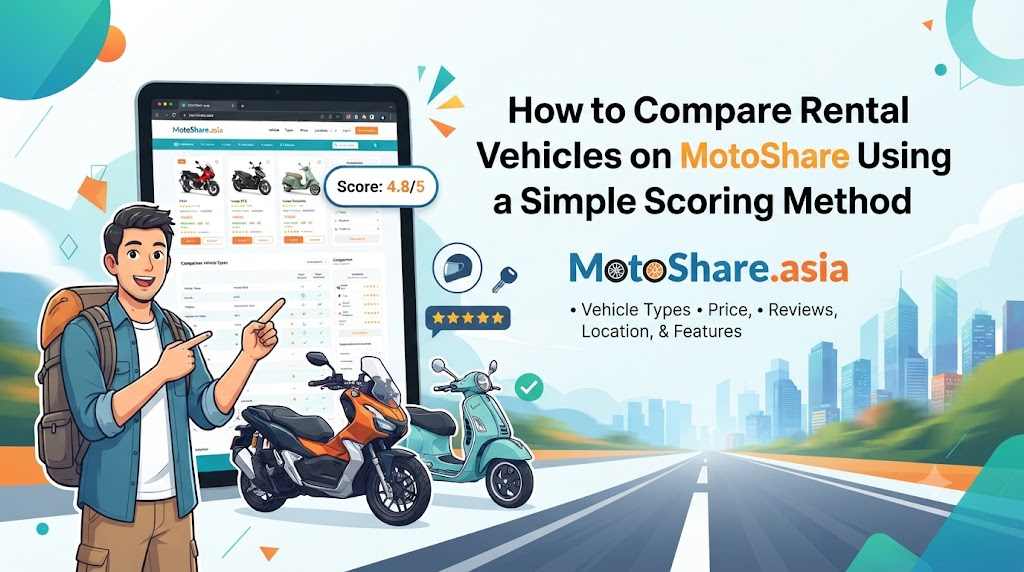
A simple scoring method can make the final choice easier. Pick the criteria that matter to your trip, for example price, pickup convenience, comfort, terms clarity and suitability for your route. Give each vehicle a score from 1 to 5 on each criterion, then add the numbers.
Do not treat the total as a final answer. Use it to see which option leads and why. If two options are close, the clearer terms and the easier pickup usually deserve the tie-break.
What Online Discovery Can and Cannot Do
Online search helps you view several vehicles, cities and durations in one place. It saves time and lets you compare before you travel.
It does not replace your own checks. Listings can differ in the amount of detail they give, and information can go out of date. Use the payment methods supported by the platform or provider, keep your receipts and never share an OTP or PIN.
Matching Rentals to Different Travellers
- Tourists should focus on pickup location, fuel rules and safety gear.
- Commuters should compare the monthly total with other travel options and ask about servicing.
- Students often have limited budgets, so deposit size and simple vehicles matter.
- Professionals may need reliability, clear paperwork and receipts for expense claims.
Reading City Searches: Goa and Bangalore
Goa draws visitors who want to travel between beaches, cafés and small towns. That is why bike rental in Goa is a familiar search for short trips. A scooter often works for coastal roads. Check weather, parking and helmet rules, and plan early for busy periods.
People who search for bike rental in Bangalore, also written as Bengaluru, often need transport for office visits, meetings or weekend trips outside the city. Traffic can be heavy, so smaller two-wheelers are often easier for city use, while cars or comfortable motorcycles suit longer drives.
The method is the same in both places. The best vehicle changes because the purpose changes.
Four Wheels on Your Own Schedule: Car Options
A car is a sound choice for family outings, groups, luggage and wet weather. Readers looking at self drive car rental India options usually want privacy and control. Since you drive, read the insurance terms and understand the amount you would pay if there is damage.
Car rental in India can also help business visitors who need to reach several places in a day. Ask about tolls, parking, late-return fees and whether you may drive into another state.
The Asian Context: Regional Marketplaces
Many Asian cities are dense, and many travellers prefer two-wheelers for short distances. This is part of the reason why motorcycle rental Asia draws steady interest. A regional marketplace gives travellers one familiar way to search in several places, and it can make local providers easier to find.
The routine stays the same across borders: define the trip, shortlist, compare terms and confirm. The rules for licences, insurance and routes change between countries, so local checks are necessary.
A Five-Step Selection Routine
This is general guidance and not a description of any specific MotoShare process.
- Set the destination and dates. Fix where you will collect and return the vehicle.
- Check availability. Shortlist two to four options.
- Compare terms and prices. Use the eight terms and your scoring method.
- Review required documents. Confirm the licence, ID and payment method accepted.
- Confirm the booking. Save the details, receipt, pickup address and contact number.
Errors That Reduce the Value of a Rental
- Comparing only the rate. The cheapest rate may carry the strictest terms.
- Ignoring the deposit. Know the amount and when it returns.
- Misreading insurance. Ask what is excluded.
- Skipping the pickup inspection. Photograph the vehicle before leaving.
- Overlooking return rules. Late returns and different drop-off points may cost extra.
- Picking power over fit. The strongest vehicle is not always the most useful one.
A Hypothetical Weekend Comparison
Four colleagues in Hyderabad plan a weekend trip. They assume listings are available and compare two options: two scooters, or one self-drive car.
They score each option from 1 to 5 on price, comfort, luggage space, pickup convenience and clarity of terms. The scooters score well on price and pickup, but poorly on luggage and rain. The car scores better on comfort and luggage, but lower on price. They also notice that the car’s fuel policy requires a full tank at return, and that the scooters have a distance cap that may be tight for the route.
They choose the car and confirm the fuel and return rules in writing. The decision came from the criteria, not from a first impression.
Common Questions
How many options should I compare?
Two to four is usually enough. Fewer may miss a better fit, and more can slow the decision.
How do I rank rental options fairly?
List the criteria that matter to your trip, score each option from 1 to 5, and look at both the total and the weak points.
Should I check feedback about a provider?
Where feedback is available, it can help. Treat it as one input along with clear terms and a verified pickup address.
What if the booking details change?
Contact the provider and ask for the update in writing. Keep the original confirmation as well.
How do weather and season affect the choice?
Rain, heat and crowds can change what is practical. A scooter that suits a dry weekday may be poor in heavy rain. Also, popular periods can reduce availability.
Can I plan a trip across more than one city with rentals?
It depends on the provider and the return rules. Ask whether the vehicle can be returned in another city and whether extra charges apply.
Does a bigger engine mean a better rental?
No. A bigger engine adds power, but it can also add weight, cost and risk. Choose what suits your skill and your route.
Conclusion
Choosing a rental vehicle comes down to a few simple rules:
- If your trip is short and within one city, a scooter is often enough.
- If you carry luggage or travel with family, a car is usually more practical.
- If the daily rate looks unusually low, read the terms twice.
- If the terms are unclear, ask for them in writing before you pay.
- If two options score close, choose the one with the easier pickup and clearer rules.
MotoShare is one platform where travellers can look at motorcycles, scooters, cars and bicycles across Indian cities and other Asian destinations, and the same decision habits help on any platform.